Defending the Grid: Analyzing Threat Vectors and Security Controls in Critical Infrastructure Systems
Executive Summary
The electricity sector's operational resilience faces a compound challenge rooted not in isolated technical vulnerabilities, but in fragmented implementation of five foundational cybersecurity controls across generation, transmission, and distribution assets. State-sponsored reconnaissance campaigns, supply chain infiltration vectors, and legacy system integration gaps persist partly because of coordination deficits between federal oversight bodies, regional transmission operators, and generation facilities—and partly because workforce expertise in industrial control system (ICS) defense remains concentrated and specialized.
This article surveys the threat landscape evolution from 2023–2026, assesses control maturity variance across the sector, and maps operational and institutional implications for security practitioners, grid operators, federal policy makers, and organizational leadership responsible for critical infrastructure resilience. The central recommendation: prioritize five specific control domains (network segmentation, credential management, anomaly detection, patch management, and threat intelligence integration) through coordinated federal-sector governance, staffing alignment, and measurable capability benchmarks.
Key Finding: The electricity sector's vulnerability to both advanced persistent threats and systemic operational failures stems not from isolated technical gaps, but from the fragmented implementation of five core ICS cybersecurity controls—network segmentation, credential management, anomaly detection, patch management timeliness, and cross-sector threat intelligence integration—each measurably undermined by coordination deficits between federal oversight bodies, regional transmission operators, and generation assets.
What Happened
Between 2023 and mid-2026, the electricity sector confronted an accelerating convergence of state-sponsored reconnaissance, supply chain infiltration, and credential compromise cascades that redefined both immediate operational risk and strategic threat assessment. Federal sources including CISA Advisory AA24-038A documented sustained targeting of grid operators by state-sponsored threat actors deploying network reconnaissance techniques, credential harvesting protocols, and supply chain infiltration vectors designed to establish persistent access within operational technology (OT) environments.
These campaigns exploited coordination and implementation gaps across the five-control framework systematically: threat actors harvested credentials from weakly-segmented networks; they established footholds in zones where anomaly detection capabilities remained immature or uncalibrated; they persisted across patch management windows where zero-day or unpatched systems remained exposed due to operational continuity constraints; and they exploited information-sharing barriers that delayed awareness of known threat indicators across regional operators.
Supply chain compromise emerged as a particularly consequential attack vector. Managed service providers (MSPs) supporting multiple utilities, industrial control system vendors deploying remote access capabilities, and third-party software providers became persistent pressure points. A single compromised vendor relationship could cascade across multiple utility networks, multiplying exposure and extending reconnaissance dwell times before detection.
Credential compromise illustrated systemic control failures. In legacy OT environments, shared administrative accounts persisted due to historical system design constraints and operational continuity concerns. Multi-factor authentication (MFA) adoption lagged across the sector due to OT protocol limitations and compatibility concerns with aging control systems. Privileged access management (PAM) implementations remained inconsistent, creating lateral movement pathways that threat actors systematically exploited once initial access was established.
The White House National Cybersecurity Strategy (March 2023) formally designated the electricity sector as a priority critical infrastructure domain, establishing a federal mandate structure requiring coordinated action across the Department of Homeland Security (DHS), Cybersecurity and Infrastructure Security Agency (CISA), Department of Energy (DOE), Federal Energy Regulatory Commission (FERC), and regional transmission organizations (RTOs).
CISA's February 2024 advisory (AA24-038A) operationalized this mandate by articulating specific threat vectors, operational tactics, techniques, and procedures (TTPs), and threat actor attribution indicators. The guidance established baseline control priorities but lacked enforcement mechanisms and measurable implementation timelines.
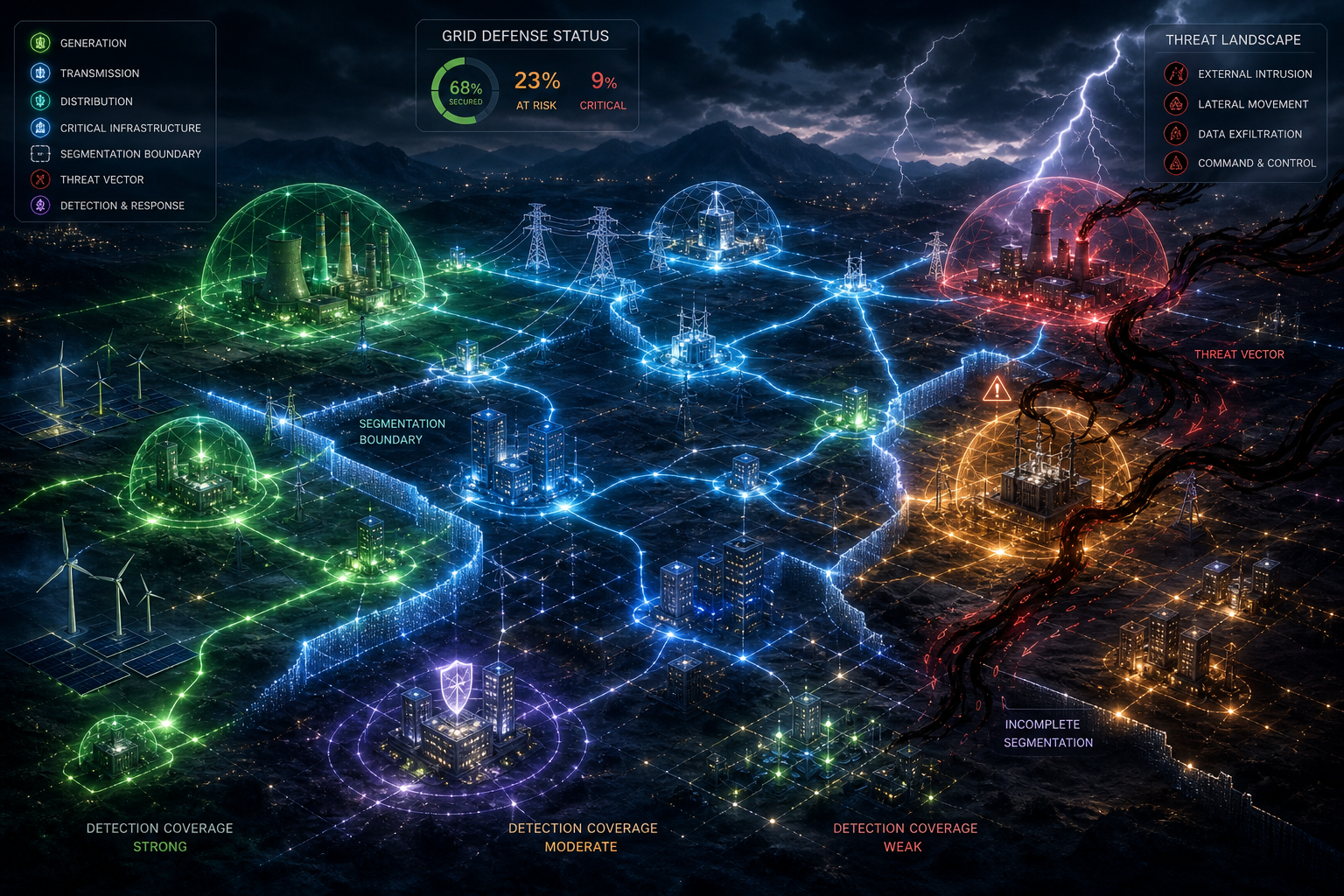
Across the sector's generation, transmission, and distribution infrastructure, five critical control domains exhibited measurable implementation variance, creating identifiable vulnerability windows: network segmentation deficiencies in OT-IT boundary separation; credential management weaknesses including shared accounts and legacy system limitations; anomaly detection maturity variance across utilities; patch and vulnerability management timing constraints unique to operational systems; and threat intelligence integration failures from classification barriers and organizational compartmentalization.
Why It Matters
Transmission Operators and Regional Transmission Organizations
RTOs orchestrate real-time electricity flow across multiple generation sources and regional networks. These entities operate the control systems most attractive to state-sponsored threat actors: compromise of a major RTO control center creates leverage over entire regional grids. RTOs face the greatest attribution and response coordination burden because their incidents cascade across member utilities. Network segmentation and anomaly detection maturity directly determine dwell time and lateral movement capability.
Generation Assets
Individual power plants (coal, natural gas, hydroelectric, wind, solar) generate electricity flowing into regional grids. Compromise of generation control systems could force emergency shutdown, degrade efficiency, or falsify output data. Generation facilities operate distributed across geographies with heterogeneous security postures; large utilities may implement sophisticated controls, while smaller independent generators often operate with minimal cybersecurity infrastructure.
Distribution Utilities
These entities deliver electricity to end consumers through geographically distributed networks including SCADA systems, automated metering infrastructure (AMI), and customer service systems. Compromise of distribution control systems could cause outages affecting millions of consumers. Distribution utilities range from large municipal providers to small cooperative entities with highly variable cybersecurity maturity.
Federal Oversight Bodies
The Department of Homeland Security, CISA, DOE, FERC, and NSA establish policy frameworks, disseminate threat intelligence, coordinate incident response, and develop standards. Their effectiveness depends on sector-wide coordination, information sharing, and implementation alignment. Federal agencies struggle with classification barriers limiting intelligence dissemination, organizational silos preventing unified strategy, and resource constraints limiting hands-on technical support to utilities.
Workforce and Public Safety
OT engineers, security analysts, and incident response personnel operate the systems and respond to threats. The electricity grid's deep interdependence with water treatment, telecommunications, emergency services, healthcare, and transportation infrastructure means that extended grid disruption triggers secondary cascades. Detection deficits mean adversaries operate undetected for weeks or months, maximizing lateral movement capability, data exfiltration opportunity, and implant placement depth.
Operational Implications
Immediate (0-90 days): Network segmentation audit and air-gap validation must identify connectivity between operational technology and corporate IT networks. Shared account elimination begins with comprehensive credential inventory. Anomaly detection baseline establishment requires initial 30-60 days of behavior collection on critical assets. Threat intelligence integration initiation establishes participation in sector information-sharing organizations.
Near-term (90-180 days): Patch management policy alignment establishes vendor vulnerability notification procedures and patch deployment policies compatible with operational windows. Privileged access management deployment for critical systems implements approval workflows and session recording. Anomaly detection maturation expands ICS-specific detection rules to additional asset classes. Incident response procedure documentation and drills validate organizational response capability.
Mid-term (180-365 days): Comprehensive control framework alignment assessment maps current-state capability to recognized standards and develops target-state architecture. Cross-functional risk governance establishes executive steering committee oversight with quarterly capability assessments. Workforce specialization development establishes ICS cybersecurity career pathways and training investments. Intelligence analysis capability matures from operational input to proactive threat hunting programs.
Strategic (365+ days): Sustained control framework maturity requires continuous improvement cycles leveraging operational incident data. Federal-to-operator coordination cascades must synchronize across 3,000+ utilities operating in heterogeneous regulatory jurisdictions. Inter-regional synchronization ensures RTO/ISO coordination functions across organizational boundaries. Incident response protocols and mutual aid agreements enable resource-sharing across organizations.
Recommended Actions
Actions are organized by organizational security maturity. Baseline controls apply across all tiers and should be treated as immediate priorities regardless of organizational size.
* Organizations with standard security tooling and general-purpose endpoint protection.
- 1 - Network Segmentation Audit and Air-Gap Validation (0–90 days): Conduct documented network topology assessment identifying all connectivity between OT and IT networks. Execute penetration testing validating segmentation controls prevent lateral movement. Document gaps and establish remediation timelines.
- 2 - Shared Account Elimination and Credential Inventory (30–180 days): Conduct comprehensive inventory of administrative and service accounts across OT systems. Identify shared accounts, default credentials, and overly-broad access permissions. Establish policy prohibiting new shared accounts.
- 3 - Anomaly Detection Baseline Establishment (90–180 days): Deploy ICS-specific intrusion detection and SIEM monitoring on critical assets. Configure sector-standard detection rules. Establish 30–60 days baseline data collection and iteratively calibrate detection thresholds.
- 4 - Threat Intelligence Integration Initiation (ongoing): Establish participation in sector information-sharing organizations. Subscribe to unclassified threat feeds from CISA and relevant ISACs. Designate personnel for indicator receipt and operationalization.
* Organizations with dedicated security functions and established security policies.
- 1 - Patch Management Policy Alignment (90–180 days): Establish vendor vulnerability notification procedures and CVSS tracking. Develop patch deployment policies compatible with operational windows. Establish patch prioritization frameworks by criticality and asset sensitivity.
- 2 - Privileged Access Management Deployment for Critical Systems (180 days): Deploy PAM solution governing privileged account access to critical OT systems. Implement approval workflows, session recording, and comprehensive audit logging. Provide staff training on PAM procedures.
- 3 - Anomaly Detection Maturation and Threat Hunting (180 days): Expand ICS-specific detection rules to additional asset classes. Conduct monthly threat hunting reviews leveraging available indicators. Develop baseline performance metrics and establish secondary analyst training program.
- 4 - Incident Response Procedure Documentation and Drills (180 days): Document incident response procedures specific to OT environments. Identify internal and external response resources. Conduct tabletop drill covering grid-wide compromise scenario and assess response capability gaps.
* Organizations with sophisticated detection systems, intelligence analysis capability, and cross-functional risk governance.
- 1 - Comprehensive Control Framework Alignment Assessment (180–365 days): Conduct comprehensive assessment of control maturity across all five domains. Map current-state to recognized standards (NIST Framework, NERC CIP, DOE guidance). Develop target-state architecture and multi-year remediation roadmap with investment requirements.
- 2 - Cross-Functional Risk Governance and Continuous Improvement (365 days): Establish executive steering committee oversight of critical infrastructure cybersecurity maturity. Implement quarterly capability assessment reviews. Establish scorecard metrics visible to executive and board leadership.
- 3 - Workforce Specialization Development and Talent Pipeline Investment (365 days): Establish ICS cybersecurity career pathways with commensurate compensation. Establish training budget supporting vendor certifications and specialized coursework. Develop partnerships with academic institutions and mentorship programs.
- 4 - Intelligence Analysis Capability and Active Threat Hunting (365 days): Establish dedicated threat intelligence function analyzing sector threat landscape. Implement proactive threat hunting program leveraging open-source and peer indicators. Establish quarterly intelligence briefing cycles and disseminate threat context through sector channels.
Closing Statement
The electricity sector's institutional resilience depends fundamentally on sustained integration of five core cybersecurity control domains across thousands of heterogeneous generation, transmission, and distribution assets operated by public utilities, private generators, and regional coordinators. The threat landscape has evolved substantially between 2023 and 2026, shifting from primarily nation-state reconnaissance to active supply chain infiltration and sustained persistence attempts.
This evolution demands not incremental refinement of existing security infrastructure, but rather coordinated commitment across federal policy makers, utility executives, operations personnel, and security specialists to close identified control implementation gaps. Federal agencies must balance intelligence sharing with operational utility of disseminated information, simplifying classification barriers where possible while maintaining necessary operational security.
Regulatory bodies (NERC, FERC) must establish measurable control benchmarks and implementation timelines that acknowledge operational constraints while advancing sector capability. Utilities must prioritize the five control domains through disciplined capital allocation, workforce development, and cross-functional governance. Workforce development at scale requires coordinated investment by government, academic institutions, and employers to address the persistent shortage of ICS cybersecurity specialists.
This is not a crisis awaiting catastrophic failure to catalyze response. Rather, it is a measured institutional challenge requiring sustained strategic commitment, resource allocation, and operational discipline. Utilities and federal agencies that advance control maturity systematically will measurably reduce dwell times, limit lateral movement capability, and accelerate detection and response.
The pathway forward is institutional: aligning policy, resource allocation, expertise development, and cross-sector coordination to consolidate electricity sector resilience and, by extension, the continuity of the broader infrastructure ecosystem on which institutional and public safety depend. Organizations that begin now will establish measurable capability advantages; those that delay will face accelerating institutional and operational risk as threat sophistication and adversary persistence increase.