
Extracting Data in Silence: Analyzing Time-Based Blind SQL Injection in Cacti's ORDER BY Clause (CVE-2026-71287)
Executive Summary
CVE-2026-71287 represents a critical vulnerability in Cacti network monitoring platforms that enables unauthenticated attackers to extract sensitive database contents through time-based blind SQL injection. The vulnerability exploits improper input validation in the ORDER BY clause, allowing threat actors to systematically enumerate databases by analyzing temporal response variations—a technique that evades conventional web application firewall signatures and enables extended reconnaissance periods.
Immediate actionable guidance: For organizations deploying Cacti across enterprise networks, operational technology environments, and service provider infrastructures, this vulnerability presents immediate exposure risk to administrative credentials, monitoring configuration data, and infrastructure visibility insights. Immediate action includes comprehensive inventory validation, network exposure assessment, and accelerated patching timelines. Organizations unable to patch immediately should implement ORDER BY parameter whitelisting and enhanced SQL query logging to detect exploitation attempts.
Key Finding: Time-based blind SQL injection in Cacti's ORDER BY clause enables unauthenticated attackers to systematically extract sensitive database contents through temporal response analysis, bypassing standard WAF detection signatures and creating a 72-hour minimum exposure window before patch availability reaches organizational deployment.
What Happened
Cacti, a widely deployed open-source network monitoring and graphing platform used across enterprise infrastructure, service provider networks, and operational technology environments, contains a critical input validation vulnerability in its ORDER BY clause processing logic. CVE-2026-71287, disclosed in August 2026, exposes a database query construction flaw that permits unauthenticated attackers to inject arbitrary SQL commands through improperly sanitized ORDER BY parameters.
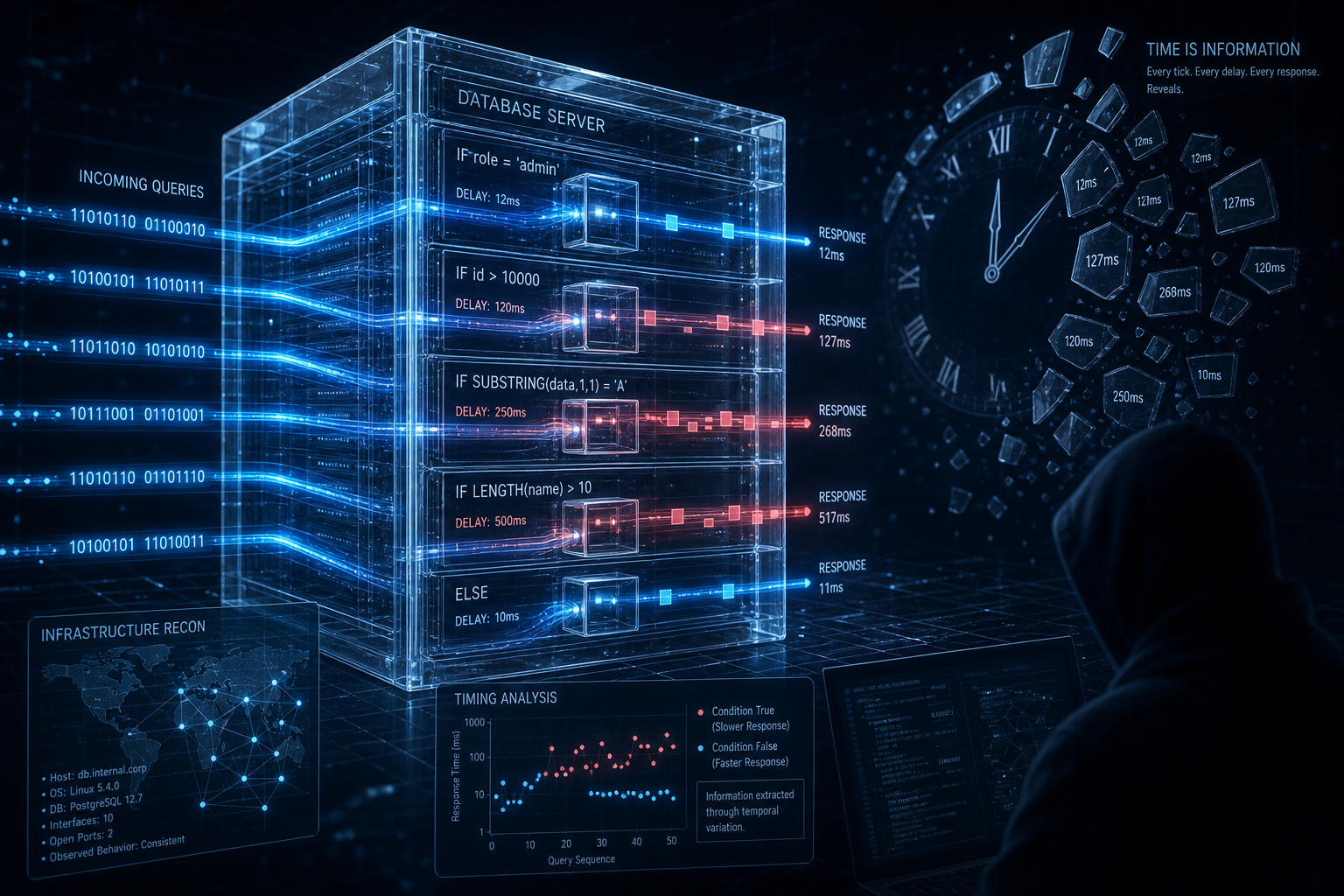
The vulnerability operates through time-based blind injection mechanics. When a threat actor submits a specially crafted ORDER BY parameter containing conditional SQL logic, the application executes the injected code without proper parameterization. Unlike error-based SQL injection that relies on database error messages, time-based blind injection forces the database to delay query responses when certain conditions are met. By measuring response timing—comparing requests that trigger conditional delays against baseline response times—attackers infer true or false conditions about database contents, effectively reading sensitive data bit-by-bit through purely temporal analysis.
The affected versions span a range of Cacti installations still in active production deployment. The vulnerability requires no authentication to exploit, meaning an attacker with network access to a Cacti instance can immediately begin reconnaissance without compromising user credentials. The attack vector is straightforward: an attacker manipulates the ORDER BY parameter in a web request, injecting conditional SQL statements that cause observable delays when specific database content matches the attacker's test conditions.
Discovery followed established vulnerability coordination protocols. Security researchers identified the flaw and reported it to Cacti maintainers through approved disclosure channels. The vendor published an official advisory and released patched versions during the August 2026 window. However, the timeline between disclosure and widespread patch deployment created significant exposure: organizations typically require 48–72 hours minimum to test patches in non-production environments before deploying to production systems.
Exploitation requires minimal sophistication. Proof-of-concept demonstrations circulated through technical security communities within hours of disclosure, detailing exact payload structures for common database platforms (MySQL, PostgreSQL, MariaDB). The low barrier to entry means threat actors ranging from sophisticated nation-state operators to financially motivated cybercriminal groups can weaponize the vulnerability immediately.
The technical foundation of the vulnerability lies in Cacti's database query construction. Rather than using parameterized query frameworks that separate SQL logic from user input, the application concatenates user input directly into query strings. Input validation routines fail to properly restrict character sets and syntax patterns permitted in ORDER BY clauses. This combination allows attackers to inject conditional SQL statements that remain syntactically valid within the ORDER BY context while executing arbitrary logic.
Why It Matters
Infrastructure and Network Operations Teams
Cacti deployments are endemic across enterprise network monitoring, service provider management platforms, and operational technology infrastructure. The platform provides critical visibility into network performance, device health, and traffic patterns—making it a high-value reconnaissance target for threat actors planning broader attacks. Time-based blind SQL injection in Cacti enables attackers to extract administrative credentials, API tokens, SNMP community strings, and monitoring configuration data without triggering conventional alerting mechanisms. This information directly enables lateral movement into monitored infrastructure segments. An attacker exfiltrating SNMP credentials from Cacti's database gains direct access to all network devices Cacti monitors—potentially including routers, switches, firewalls, and industrial control systems. The reconnaissance value extends beyond immediate credential theft: Cacti stores detailed topology maps, performance baselines, and historical configuration data that reveal network architecture, capacity constraints, and critical infrastructure dependencies.
Security Operations and Incident Response Professionals
Time-based blind SQL injection represents a detection challenge exceeding conventional monitoring approaches. Standard intrusion detection systems flag obvious SQL injection patterns—such as UNION-based injections or error-based techniques—by matching known malicious syntax against network traffic signatures. Time-based blind injection appears as a series of innocuous database queries with slightly delayed responses. The attack leaves minimal traces in application logs because injected SQL executes within legitimate query constructs. Detecting exploitation requires establishing baseline response time profiles for legitimate ORDER BY queries, then identifying statistically anomalous latency patterns. In high-latency environments (geographically distributed networks, remote branch offices), distinguishing between legitimate slow queries and exploitation attempts becomes analytically challenging. This detection gap means organizations relying exclusively on signature-based WAF rules and standard web application monitoring will experience extended dwell time before breach discovery—potentially weeks or months for silent reconnaissance campaigns.
Database Administrators and Application Security Teams
This vulnerability exposes risks inherent in legacy code predating parameterized query frameworks and input validation best practices. Many network monitoring platforms, developed over 15+ years of evolution, contain inherited code patterns that concatenate user input into SQL strings. The vulnerability also demonstrates limitations of application-layer input filtering undertaken without database-layer enforcement. Competent attackers can often bypass application-layer validation through encoding techniques, character set manipulation, or exploitation of database-specific syntax variations. Remediation requires not only patching the immediate vulnerability but also architectural evaluation of query construction patterns across the entire application.
Organizational Leadership and Risk Assessment
The broader significance lies in recognizing that monitoring and visibility platforms themselves have become attack targets. Historically, threat actors focused on compromising end-user systems and network devices. Contemporary threat modeling increasingly targets the infrastructure providing visibility into those systems—a strategic shift compounding organizational risk. Cacti instances are often deployed at network ingress points, service provider facilities, and critical infrastructure network operations centers. Successful compromise of Cacti provides threat actors with unparalleled visibility into target network architecture without triggering defensive mechanisms designed to protect end-user systems. For organizations operating in regulated environments (financial services, energy sector, healthcare), unauthorized access to network monitoring databases may constitute direct regulatory violations independent of whether actual network compromise occurs.
Third-Party Risk and Supply Chain Considerations
Service providers managing customer networks deploy Cacti instances that monitor customer infrastructure. A single compromised Cacti instance in a service provider environment potentially exposes multiple customer networks. The vulnerability creates cascading risk across supply chains where managed service providers, system integrators, and network operations centers rely on Cacti for centralized monitoring. Organizations must evaluate not only their own Cacti deployments but also the patch status of monitoring systems operated by third parties on their behalf.
Operational Implications
Immediate Exposure Assessment: Organizations must establish within 24 hours whether they operate Cacti instances and, if so, identify the specific versions deployed and the network exposure level of each instance. This requires comprehensive network and application inventory processes. Network teams should query asset management systems, examine configuration management databases, and conduct active network scanning for Cacti-specific ports and service banners. Organizations should document whether Cacti instances are internet-facing (directly exposed to untrusted networks), internally accessible (accessible from corporate networks), or air-gapped (isolated networks). The threat model differs significantly across these categories: an internet-facing Cacti instance is immediately exploitable by any threat actor with basic network access, while internal-only instances require network compromise or insider threat vectors. However, service provider environments where Cacti monitors customer networks blur these boundaries—internal-only from the service provider's perspective may represent internet-exposed risk from customer network standpoints.
Detection and Monitoring: Detecting active exploitation requires establishing baseline response time profiles for legitimate Cacti ORDER BY queries before exploitation attempts occur. Organizations should examine existing database query logs and web server access logs to establish normal latency distributions for ORDER BY parameter requests. SQL database audit logs should capture timestamps for all query execution, enabling forensic analysts to correlate unusually slow queries with specific request parameters. Many organizations do not enable comprehensive SQL query logging by default due to performance overhead and storage costs. Enabling logging retroactively does not capture historical exploitation attempts. Prospective monitoring requires configuring database systems to log all queries involving ORDER BY clauses and establishing automated alerting when response times exceed statistical baselines. Web application firewalls equipped with time-based injection detection rules can supplement database-layer monitoring, though such rules are less common than traditional SQL injection signature matching and may generate false positives in legitimate high-latency environments. Organizations should recognize that time-based blind injection requires repeated requests—dozens or hundreds of conditional queries to extract database contents. Bulk request analysis (identifying IP addresses sending unusually high volumes of ORDER BY parameter variations within short time windows) may reveal exploitation activity even when individual query timing analysis proves inconclusive.
Database Audit Trail Analysis: Organizations investigating whether their Cacti instances have been compromised should examine database transaction logs and query audit trails for the 30-day period preceding vulnerability disclosure. Indicators of exploitation include: elevated execution counts for queries containing ORDER BY clauses with conditional logic (CASE WHEN statements, IF() functions); queries containing database information schema queries (SELECT ... FROM information_schema.tables); queries attempting to extract data from user or credentials tables; and unusual clustering of queries from single source IP addresses within brief time windows. Distinguishing legitimate slow queries from exploitation attempts requires understanding typical ORDER BY usage patterns in Cacti's normal operations. Database administrators familiar with Cacti's query patterns are essential for forensic accuracy.
Patch Management and Deployment Logistics: Vendor patches for CVE-2026-71287 became available within the August 2026 disclosure window. However, patch deployment timelines involve testing, change management approvals, and production scheduling. For non-critical systems in isolated environments, patches can often be deployed within 24–48 hours. For critical infrastructure, financial systems, or operational technology environments where Cacti monitoring is essential to system availability, patches require thorough testing in non-production replicas before production deployment. Organizations typically allocate 7–14 days for testing and 7–30 days for phased production deployment across multiple business units or geographic regions. This timeline means the majority of Cacti deployments remain unpatched for weeks following disclosure. Workarounds implemented during this window—such as input validation hardening at the application level or network segmentation restricting ORDER BY parameter access—can reduce exploitation likelihood without requiring full patch deployment.
Incident Response Protocol Adjustments: Organizations should update incident response procedures to include specific handling for time-based SQL injection detection. Standard security operations procedures often assume SQL injection attempts will be detected through error messages or WAF signatures. For blind injection, detection relies on behavioral analysis (response timing anomalies and bulk request pattern analysis) rather than signature matching. Incident responders should recognize indicators such as: sustained requests with minor parameter variations (an attacker testing different conditional clauses); requests originating from external IPs outside normal business partner connectivity; Cacti administrative interface access from unusual geographic locations; and temporal correlation between unusual database query activity and external network requests. Forensic preservation requires immediate capture of database transaction logs, web server access logs, and network flow records for 30+ day analysis windows.
Vulnerability Scanning and Continuous Monitoring: Application vulnerability scanning tools (WAST platforms) should be configured with detection rules for SQL injection vulnerability patterns. However, detecting time-based blind injection through dynamic scanning is inherently difficult because the vulnerability manifests as behavioral timing anomalies rather than syntactic SQL errors. Organizations should prioritize static application security testing (SAST) tools that analyze Cacti source code for unsafe query construction patterns. Web application firewalls should be updated with rules designed to detect ORDER BY parameter manipulation attempts, including rules that flag conditional logic within ORDER BY clauses and requests with unusual parameter encoding patterns.
Recommended Actions
Actions are organized by organizational security maturity. Baseline controls apply across all tiers and should be treated as immediate priorities regardless of organizational size.
* Critical remediation steps required within the first 24 hours to establish visibility and control.
- 1 - Asset Inventory and Exposure Assessment: Conduct comprehensive discovery of all Cacti deployments across the organization, including production environments, test systems, development instances, and service provider-managed deployments. For each instance, document: version number, deployment date, network exposure level (internet-facing vs. internal), and criticality ranking.
- 2 - Baseline Response Time Profiling: Establish baseline response time profiles for legitimate Cacti ORDER BY queries. Query your web server and database logs for historical ORDER BY query patterns and calculate the normal latency distribution. Configure alerting thresholds for outlier queries exceeding the 95th percentile of baseline latencies.
- 3 - Access Log Analysis Initiation: Begin review of the past 30 days of web server access logs and database query logs for exploitation indicators. Assign dedicated personnel to identify ORDER BY requests from unusual source IP addresses, requests containing conditional SQL logic, or bulk request patterns from single sources.
- 4 - Security Operations Alert: Notify your security operations center, infrastructure teams, and incident response leadership of the vulnerability. Establish a dedicated escalation channel for exploitation detection alerts and assign on-call staff to prioritize CVE-2026-71287 related incidents.
- 5 - Vendor Patch Status Verification: Contact your Cacti vendor and software supply chain partners to confirm patch availability, testing requirements, and deployment timelines for your specific deployed versions.
* Interim protective measures and initial patch validation for rapid deployment.
- 1 - Input Validation Hardening (Workaround): Implement application-level controls that restrict ORDER BY parameter values to a predefined whitelist of legitimate column names and sorting directions. This requires code modification but can be deployed without full system patching. Consult Cacti documentation and security advisories for specific implementation guidance.
- 2 - Network Segmentation Enforcement: Restrict network access to Cacti administrative interfaces to trusted networks and jump hosts. Implement firewall rules that deny direct access from untrusted networks to Cacti web interfaces. For service provider environments, segment customer networks to prevent lateral movement from compromised Cacti instances.
- 3 - Non-Production Patch Validation: Deploy vendor patches to test environments that replicate production configurations. Validate that patches do not introduce application compatibility issues, performance degradation, or conflicts with existing configurations. Document any compatibility concerns for escalation to vendor support.
- 4 - Enhanced SQL Query Logging Deployment: Enable comprehensive SQL query logging on backend databases supporting Cacti instances. Configure logging to capture all query text, execution times, source connections, and query timestamps. Implement log retention policies ensuring 90-day minimum historical access.
- 5 - Multi-Factor Authentication (MFA) Enforcement: Ensure Cacti administrative accounts require multi-factor authentication. This reduces the impact of credential exfiltration through the vulnerability—attackers who obtain usernames and passwords cannot access administrative functions without second-factor credentials.
* Phased production patching, forensic analysis, and credential remediation.
- 1 - Phased Production Patching: Deploy vendor patches to production Cacti instances in a phased approach, grouping instances by business unit, geographic region, or infrastructure criticality. Maintain a 48-hour monitoring window following each production deployment phase to identify any patch-related regressions or availability issues.
- 2 - Forensic Database Analysis: Conduct detailed forensic examination of database transaction logs and query audit trails captured during the past 30 days. Work with database security specialists to identify all queries indicating potential exploitation attempts. For identified suspicious activity, determine the source IP addresses, access times, and specific data elements queried.
- 3 - Credential Rotation and Access Control Review: For any instances where exploitation is suspected, initiate immediate rotation of all administrative passwords, API tokens, SNMP credentials, and service account credentials. Review access control lists for Cacti administrative functions and remove unnecessary privileged accounts.
- 4 - Post-Patch Validation: Following production patch deployment completion, rerun application vulnerability scans and penetration testing against updated Cacti instances to confirm that the vulnerability is fully remediated and no residual injection points remain.
- 5 - Third-Party Risk Assessment: Contact service providers, managed service providers, and software vendors who operate Cacti instances on your behalf or who depend on your Cacti deployments. Verify their patch status and request confirmation that they have completed exploitation detection procedures.
* Long-term capability development and organizational security maturity advancement.
- 1 - Application Security Maturity Assessment: Evaluate your current application security testing program, including the breadth of SAST and DAST tool coverage, the frequency of security code reviews, and the effectiveness of input validation frameworks. This vulnerability indicates gaps in existing security assessments that permitted a straightforward SQL injection flaw to persist through multiple Cacti release cycles.
- 2 - Secure Coding Standards Development: Develop and enforce organizational secure coding standards that mandate parameterized query frameworks, input validation whitelisting, and output encoding for all custom applications. Conduct training for development teams on SQL injection risks and secure query construction.
- 3 - Continuous Database Security Monitoring: Implement continuous database activity monitoring (DAM) solutions that provide real-time analysis of database query patterns, user access behaviors, and anomalous query execution. DAM platforms can detect time-based injection attempts through statistical behavioral analysis exceeding manual log review capabilities.
- 4 - Vendor Security Assessment Integration: Update your vendor risk management process to include security advisory responsiveness and patch deployment timelines as evaluation criteria. Prioritize software vendors who maintain active security programs and provide timely vulnerability disclosures and patches.
- 5 - Supply Chain Monitoring Architecture: Develop processes for continuous monitoring of security advisories affecting critical infrastructure components used by third parties on your behalf. Establish contractual obligations requiring service providers to meet specific patch deployment SLAs for critical vulnerabilities.
Closing Statement
CVE-2026-71287 exemplifies a recurring vulnerability pattern in network monitoring platforms: the convergence of technical debt, input validation gaps, and the strategic value of visibility infrastructure to threat actors. Time-based blind SQL injection attacks are increasingly weaponized against monitoring platforms precisely because these systems operate at network chokepoints where they command exceptional visibility into infrastructure architecture, credentials, and operational dependencies.
For security practitioners and infrastructure leaders, the vulnerability underscores the necessity of treating monitoring platforms as critical infrastructure worthy of equivalent security rigor applied to production systems. The extended exposure window between disclosure and widespread patching—itself a consequence of legitimate testing requirements in mature organizations—creates an unavoidable reconnaissance opportunity for threat actors.
The path forward balances immediate tactical remediation (inventory, patching, monitoring) with strategic architectural evolution toward parameterized query frameworks and continuous database security monitoring. Institutional resilience depends on securing not only end-user systems and production networks but also the visibility layer that defends them.