
Targeting Critical Infrastructure: Analyzing Threat Actor Playbooks and Operational Techniques Against Grid Systems
Executive Summary
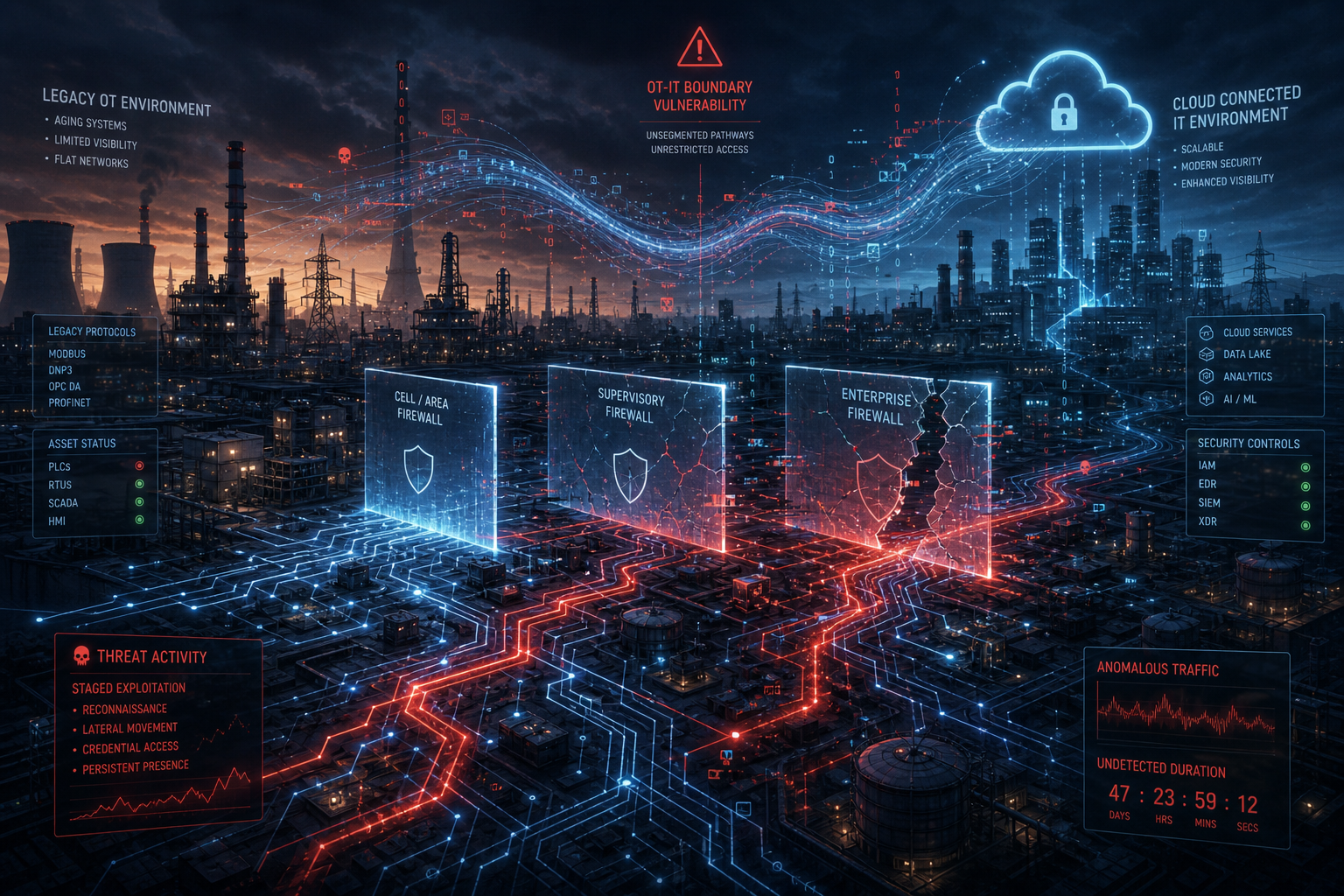
State-sponsored threat actors have operationalized standardized playbooks targeting electrical grid infrastructure with documented precision. These campaigns combine reconnaissance, credential exploitation, and prolonged dormancy—typically spanning 6-18 months—before destructive activation. Recent analysis reveals convergent tactics across Russian-affiliated actors (APT44/Sandworm), People's Republic of China-linked groups, and emerging threat consortiums, exploiting fundamental architectural vulnerabilities in air-gapped networks and credential management practices.
Immediate actionable guidance: The 60-90 day establishment window from initial compromise to persistent access, coupled with critical detection gaps in living-off-the-land techniques and industrial control system monitoring, creates a substantial temporal advantage for adversaries. Organizations cannot defend what they do not observe. Immediate priorities: comprehensive credential audit across IT/OT boundaries, behavioral analytics implementation for administrative activity, and ICS-specific monitoring enhancement. The defensive intervention window remains open but narrows as adversary sophistication matures.
Key Finding: Adversarial actors targeting critical infrastructure employ a convergent operational sequence combining living-off-the-land techniques, legitimate credential exploitation, and multi-stage ICS reconnaissance to establish persistent access within 60-90 days of initial compromise, with post-compromise activity remaining undetected for 6-18 months prior to destructive activation—a temporal asymmetry that can be compressed only through proactive intrusion precursor detection and behavioral anomaly identification.
What Happened
Over the past 24-36 months, forensic examination of intrusions against critical infrastructure operators has documented a consistent operational progression employed by state-sponsored threat actors. While tactical variations exist across campaigns, the underlying sequence reflects either deliberate standardization within threat actor programs or convergent tactical evolution across independent adversary groups. Understanding this progression is essential for identifying intrusion precursors and enabling defensive response.
Initial compromise typically occurs through spear-phishing campaigns targeting utility administrative personnel—a human-centric vector with 15-25% success rates in the utility sector, substantially exceeding enterprise sector averages of 3-8%. Threat actors craft pretextual communications referencing grid operations, regulatory compliance, or infrastructure maintenance to establish plausibility. Upon successful credential harvesting or endpoint compromise, adversaries conduct systematic reconnaissance of the victim network, enumerating Active Directory structures, documenting network topology, and identifying critical asset categories: SCADA systems, remote terminal units, human-machine interfaces, and historical data servers. This reconnaissance activity remains largely passive—generating detection signatures below 5% across documented intrusions.
Once initial reconnaissance establishes network topology and asset location, threat actors shift toward lateral movement and persistence establishment. Using harvested credentials or exploited vulnerabilities in externally-facing systems, actors transition into central IT infrastructure where persistence mechanisms can be established with reduced detection likelihood. This phase introduces living-off-the-land techniques: exploitation of legitimate administrative tools (PowerShell, Windows Management Instrumentation, scheduled task automation) to execute commands, establish persistence, and create command-and-control communication channels. Detection rates improve marginally to 8-12% during this phase, primarily among organizations with mature security monitoring and behavioral analytics.
The critical transition from IT network compromise to operational technology environment access involves substantial technical and procedural risk for adversaries. Threat actors conduct active scanning of ICS-specific protocols: Modbus, DNP3, and IEC 60870-5-104. They document device inventory, firmware versions, hardware configurations, and control logic sequences, establishing understanding of grid topology and identifying optimal failure points. Simultaneously, threat actors establish additional command-and-control channels with network-resident persistence mechanisms. Detection rates increase to 15-20% during this phase among organizations with ICS-specific monitoring, but remain minimal (<5%) for organizations lacking industrial control system visibility.
Once operational access is established, threat actors enter an extended observation and preparation phase with documented dwell times ranging from 6 to 18 months, reflecting deliberate strategic planning. Adversaries use this period to observe grid operations, identify attack timing windows aligned with geopolitical objectives, and prepare destructive payloads. During dormancy, operational activity becomes minimal, with threat actors rotating credentials periodically, refreshing command-and-control infrastructure, and conducting limited reconnaissance. Destructive payloads—including wiper malware, firmware-level modifications, and relay switching code—are prepared and staged during this phase, with adversaries preparing multiple payload variants designed for different grid configurations and operational states.
When adversaries determine favorable conditions, destructive payloads execute in rapid succession across multiple grid segments. Documented activation sequences span 15 minutes or less, with coordinated deployment across 5-15 separate targets within large regional grids. Simultaneously, threat actors disrupt monitoring and alerting infrastructure, preventing defensive teams from identifying attack scope and coordinating response. Control logic modifications force cascading grid failures, creating physical separation that escalates operational damage and extends recovery timelines.
Why It Matters
Security Practitioners
The convergence of multiple state-sponsored programs on similar operational techniques indicates that threat intelligence derived from single-adversary case studies may become superseded by multi-actor operational similarity. Defensive architectures designed to counter single-threat actor capabilities require reassessment against composite threat models incorporating techniques from multiple adversary groups. The targeting breadth expansion—now including municipal utilities, independent power producers, and grid interconnection operators—implies that infrastructure operators previously considered secondary targets now merit equivalent defensive investment.
Security Leadership
The foundational assumption underlying much critical infrastructure security architecture—that air-gapped networks isolated from external connectivity provide inherent security—has been undermined by documented lateral movement from IT to OT environments within victim organizations. Threat actors exploit legitimate administrative access pathways, supply chain compromise vectors, and physical proximity to transition between network tiers. Current credential management practices substantially lag enterprise standards, with average credential age of 14+ months, multi-factor authentication deployment below 40% for critical systems, and widespread credential sharing practices among contractors. Legacy industrial control system devices contain unpatched vulnerabilities with no remediation pathway available; device firmware is often outdated by 5-10 years relative to manufacturing date.
Detection and Response Teams
The 6-18 month dwell time documented across recent intrusions creates substantial temporal distance between compromise and discovery. By the time forensic investigation begins, supporting evidence may be archived or deleted, log retention policies may have destroyed relevant telemetry, and initial compromise vectors may be impossible to trace. Living-off-the-land attack techniques generate detection signatures indistinguishable from legitimate administrative activity; organizations lacking mature behavioral analytics cannot distinguish adversary operations from routine maintenance without manual investigation. Industrial control system environments lack mature endpoint detection and response tooling; SIEM coverage is typically fragmented across legacy systems with disparate log formats and inconsistent retention policies. Current tooling and processes assume intrusion detection within days of compromise; extended dwell times require fundamental redesign of detection philosophy toward behavioral analytics identifying intrusion precursor establishment.
Policy and Executive Leadership
Critical infrastructure interdependencies amplify the impact of successful grid-targeting attacks beyond the direct utility organization. Water treatment facilities, emergency services, medical institutions, and data centers depend on continuous grid power. Extended outages cascade across dependent systems, producing public health consequences including treatment disruption, emergency services degradation, and communications infrastructure loss. Recent analysis identifies adversary reconnaissance focused on optimal failure points capable of producing cascading grid failures affecting 5+ million customers across interconnected regional operators. The temporal planning window documented in recent intrusions—dwell times of 6-18 months—provides adversaries extended observation periods to identify grid operational vulnerabilities and coordinate attack timing with geopolitical objectives. Board of directors, government regulators, and public constituencies increasingly require evidence of active threat detection and response capability. Failure to detect intrusion precursor phases may constitute negligent security stewardship.
Operational Implications
Immediate (0-30 Days): Security Operations Centers must address critical detection capability misalignment. Current log aggregation remains incomplete across IT and OT networks; SIEM systems lack integrated telemetry from ICS environments; behavioral baselines for administrative activity are absent or rudimentary. Immediate operational requirement: comprehensive telemetry collection across IT/OT boundary systems, administrative jump hosts, and critical ICS device communication pathways. This telemetry must be aggregated into central logging infrastructure with minimum 24-month retention policy (current average: 90 days), enabling forensic reconstruction of compromise timelines. Log retention policy represents a critical operational decision; current 90-day retention periods are insufficient for forensic investigation of 6-18 month dwell times.
Short-Term (30-90 Days): Implementation of behavioral analytics deployment enables detection of living-off-the-land techniques exploiting legitimate administrative tools. Traditional rule-based intrusion detection systems exhibit 75-85% failure rates against living-off-the-land techniques; detection requires machine learning-based behavioral analytics with false positive rates typically between 20-35% during initial deployment. Critical path includes establishment of behavioral baselines for PowerShell execution frequency and command patterns, WMI calls and queried classes, scheduled task creation and modification, and registry modification patterns. Incident response capability assessment requires developing organization-specific playbooks addressing intrusion detection, forensic preservation, containment strategy for multi-network-tier compromise, external communication protocols, and recovery coordination with dependent operators.
Medium-Term (90-180 Days): ICS monitoring enhancement presents distinct technical challenges. Network-based protocol analyzers for Modbus, DNP3, and IEC 60870-5-104 must establish baseline communication patterns for each critical device, enabling anomalous control command detection. Firmware integrity monitoring tools on Tier 1 critical devices (generators, transmission switches, primary substations) require baseline firmware version documentation and unauthorized modification detection. Configuration baseline documentation for critical ICS devices enables change tracking with formal approval workflow and audit logging. These initiatives address critical operational gap; current network-based intrusion detection system coverage in OT environments ranges from 30-45%, substantially lower than IT network coverage due to protocol complexity, bandwidth constraints, and real-time processing requirements.
Long-Term (180-365+ Days): Strategic architecture redesign must modernize credential management infrastructure through implementation of passwordless authentication mechanisms for critical administrative access, centralized privilege access management deployment, and continuous re-authentication for critical operations. Evaluation and planning for network segmentation architecture enhancements toward zero-trust model adaptation for OT environment requires specific focus on micro-segmentation of critical device clusters and restricted administrative access pathways. Supply chain risk management formalization includes comprehensive vendor audits, establishment of vendor security requirements aligned with NIST Cybersecurity Framework and IEC 62443 standards, and implementation of code signing verification for firmware updates. Architecture redesign requires multi-year commitment and substantial capital investment ($500,000-$2,000,000+ for large organizations), representing foundational modernization necessary for long-term resilience. Estimated remediation timeline for large utility operators (500+ substations, 1,000+ field devices) ranges from 18-36 months.
Recommended Actions
Actions are organized by organizational security maturity. Baseline controls apply across all tiers and should be treated as immediate priorities regardless of organizational size.
* Organizations with standard security tooling and general-purpose endpoint protection.
- 1 - Enumerate all administrative and service accounts with access to IT/OT boundary systems and critical ICS devices. Assess credential hygiene practices including password complexity, age, multi-factor authentication deployment, and documentation location. Identify accounts exceeding 90-day rotation guidelines and schedule priority rotation. (Resource: 40-60 labor hours; Timeline: 2-3 weeks; Accountability: Chief Information Security Officer)
- 2 - Validate air-gap implementation between IT and OT networks by documenting all cross-segment communication pathways including jump hosts, administrative access points, vendor remote access mechanisms, backup traffic, and monitoring system communication. Assess whether legacy segmentation architecture maintains effectiveness against documented lateral movement techniques. (Resource: 30-50 labor hours; Timeline: 2-4 weeks; Accountability: Network Operations Director)
- 3 - Establish current state assessment of log aggregation coverage, identifying systems with IT telemetry collection and systems lacking OT visibility. Document log retention policies, alerting infrastructure latency, and personnel assigned to detection operations. Prioritize remediation based on critical asset classification. (Resource: 20-40 labor hours; Timeline: 1-3 weeks; Accountability: SOC Manager)
* Organizations with mature security programs and dedicated security operations capability.
- 1 - Implement machine learning-based anomaly detection for administrative access patterns, command execution sequences, and network communication flows. Establish behavioral baselines during 60-day observation window using historical telemetry. Configure alert thresholds with human validation to minimize false positives; expect 20-35% false positive rates during initial deployment. (Resource: 80-120 labor hours plus $50,000-$150,000 annual software costs; Timeline: 6-10 weeks; Accountability: Analytics Lead)
- 2 - Deploy network-based protocol analyzers for Modbus, DNP3, and IEC 60870-5-104 traffic analysis. Establish baseline communication patterns for each critical device, enabling anomalous control command detection. Implement firmware integrity monitoring tools on Tier 1 critical devices documenting baseline firmware versions. Establish configuration baseline documentation with change tracking system and formal approval workflow. (Resource: 100-160 labor hours plus $75,000-$200,000 annual software and appliance costs; Timeline: 8-12 weeks; Accountability: OT Security Lead)
- 3 - Develop organization-specific incident response playbooks for critical infrastructure compromise scenarios addressing intrusion detection, forensic preservation, containment strategy for multi-network-tier compromise, external communication protocols, and recovery coordination with dependent operators. Establish pre-authorized communication templates and contact lists. Conduct tabletop exercises simulating discovery of 6-month dwell time intrusions. (Resource: 60-100 labor hours; Timeline: 6-10 weeks; Accountability: Incident Response Manager)
* Organizations with comprehensive security programs requiring strategic capability enhancement.
- 1 - Audit all third-party vendors with IT/OT network access documenting access scope, privilege level, and authentication mechanisms. Establish vendor security requirements aligned with NIST Cybersecurity Framework and IEC 62443 critical infrastructure standards. Implement code signing verification for all firmware updates and establish secure distribution channels for critical patches. (Resource: 100-160 labor hours plus vendor audit costs; Timeline: 12-20 weeks; Accountability: Chief Information Security Officer)
- 2 - Develop role-specific security training for administrative personnel focusing on phishing recognition, credential hygiene, and anomalous activity reporting. Establish specialist hiring or training pipeline for threat detection and forensics roles with ICS-specific expertise. Implement recurring training cycles (quarterly minimum) with content reflecting current threat intelligence. (Resource: 120-200 labor hours plus $40,000-$100,000 annual external training vendor costs; Timeline: 12-20 weeks; Accountability: Chief Human Resources Officer)
- 3 - Initiate multi-year program to modernize credential management infrastructure implementing passwordless authentication mechanisms for critical administrative access, centralized privilege access management deployment, and continuous re-authentication for critical operations. Evaluate and plan for network segmentation architecture enhancements toward zero-trust model adaptation for OT environment. Assess feasibility of anomalous control command detection systems. (Resource: 200-400 labor hours plus $500,000-$2,000,000+ capital investment; Timeline: 12-36 months; Accountability: Chief Technology Officer)
Closing Statement
The standardization of threat actor operational playbooks against critical infrastructure represents a qualitative shift in the threat landscape. The convergence of state-sponsored programs on similar operational sequences—60-90 day compromise-to-persistence establishment, 6-18 month dwell times, coordinated destructive activation—reflects either deliberate technology transfer or independent discovery of effective attack methodologies. This threat environment creates a critical paradox: the months-long dwell time provides a temporal window for defensive intervention, but only for organizations capable of detecting intrusion precursor phases.
Current detection capability remains substantially misaligned with threat sophistication. Living-off-the-land techniques exploit native administrative functionality; behavioral baselines are absent; industrial control system monitoring is fragmented. Institutional resilience requires recognition that detection is prerequisite to defense. Organizations cannot mitigate threats they do not observe. Immediate priorities—credential audit, behavioral analytics implementation, ICS monitoring enhancement—address foundational detection gaps directly. Longer-term architectural redesign initiatives establish defensive capability sufficient for sustained operations against state-sponsored threat actors.
The defensive intervention window remains open. Threat actors currently operate with substantial temporal advantages; detection latencies measured in months mean that attribution and policy-level response often occur after adversaries achieve objectives or relocate operational focus. This temporal asymmetry can be compressed through proactive capability development and formalized threat detection processes. Critical infrastructure operators possess both institutional responsibility and operational capability to implement these recommendations. Failure to detect intrusion precursor phases is not merely a technical oversight; it represents negligent security stewardship with cascading public consequences. Conversely, organizations implementing baseline detection enhancements, behavioral analytics, and ICS-specific monitoring immediately improve defensive posture and reduce risk of successful destructive compromise. The months-long dwell time represents both adversary advantage and detection opportunity—organizations prepared to identify intrusion precursors transform that temporal window into strategic advantage.