
Bypassing Query Validation: Analyzing SQL Injection via the @having Operator in Tencent APIJSON (CVE-2026-72565)
Executive Summary
Tencent APIJSON, a widely adopted rapid API development framework, contains a critical SQL injection vulnerability (CVE-2026-72565, CVSS 9.8) enabling attackers to bypass input validation through the @having operator and execute arbitrary SQL without authentication. The vulnerability affects microservices architectures and data-driven platforms globally, with active exploitation confirmed in production environments.
Immediate actionable guidance: Organizations utilizing APIJSON must immediately inventory deployments, restrict external API access if unpatched, and apply security patches within 72 hours of availability. The framework's prevalence in financial services, e-commerce, and healthcare sectors elevates this to institutional priority requiring CISO-level incident response activation and coordinated remediation across microservices ecosystems.
Key Finding: The @having operator in APIJSON query construction was excluded from input sanitization rulesets, allowing attackers to inject arbitrary SQL code and execute unauthorized database operations including data exfiltration, modification, and deletion.
What Happened
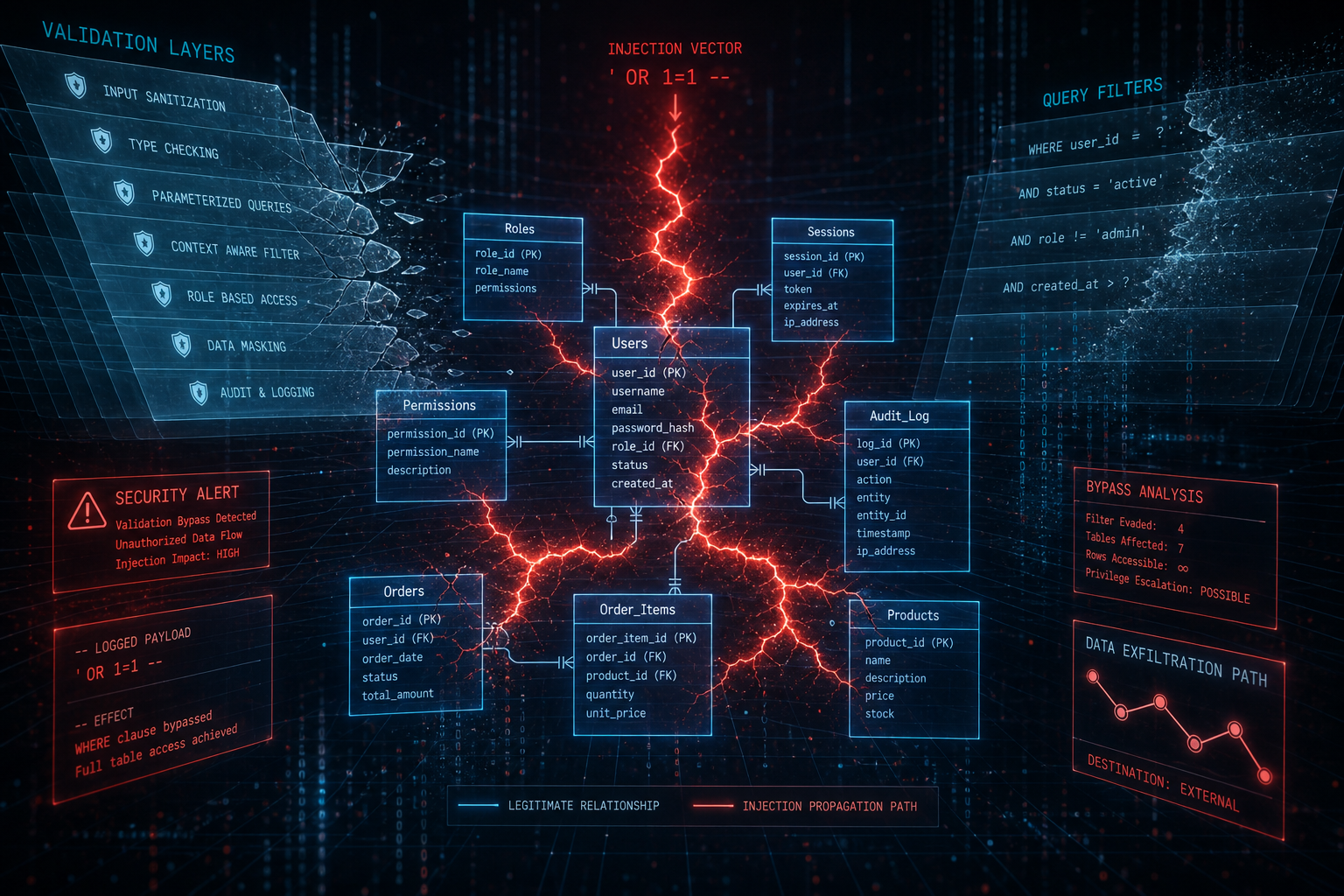
Tencent APIJSON abstracts SQL query construction into operator-driven syntax, enabling rapid API development by translating client-supplied query structures into backend SQL statements. The vulnerability stems from a validation gap: the @having operator—intended for legitimate aggregation filtering—was excluded from the input sanitization ruleset applied to other query operators. This oversight permits attackers to inject arbitrary SQL directly into @having parameters without triggering existing input filters.
When a client application submits a query containing the @having operator, APIJSON's query processor recognizes it as valid and bypasses standard input validation. The resulting SQL code is passed to the database engine unfiltered, allowing attackers to inject commands that perform unauthorized operations: data exfiltration, privilege escalation, record modification, or service disruption.
The attack execution is straightforward. An attacker crafts a malicious query payload embedding SQL commands within a @having operator, then transmits it to an external-facing API endpoint. The framework processes @having without validation, concatenates the malicious content into the final SQL query, and the database executes both the legitimate filtering logic and the injected SQL code.
A simplified example illustrates the mechanism: a legitimate query using @having might be {"@having":"{count}>10"}. An attacker modifies this to {"@having":"{count}>10 OR 1=1; DROP TABLE users;--"}. APIJSON passes this through without filtering, resulting in unintended SQL execution against the database.
Exploitation requires only network access to an API endpoint—no authentication, no special privileges, and no user interaction. Proof-of-concept demonstrations confirm successful exploitation against unpatched APIJSON instances. Threat actors have already weaponized this vulnerability; active exploitation in production environments has been documented since August 2026.
Why It Matters
Financial Services and E-Commerce Organizations
APIJSON adoption spans financial services, e-commerce platforms, healthcare systems, and SaaS data APIs. The framework's rapid API generation capability appeals to organizations prioritizing deployment speed; microservices architectures—increasingly common in enterprise infrastructure—frequently depend on APIJSON for inter-service communication. Cloud-native and containerized environments make APIJSON particularly prevalent due to its seamless integration with distributed systems requiring flexible, data-driven APIs. The geographic and sectoral distribution of vulnerable deployments indicates exposure across regulated industries with strict compliance obligations.
Security and Infrastructure Teams
External accessibility of API endpoints creates an unauthenticated attack surface requiring minimal attacker sophistication for initial compromise. Unlike vulnerabilities requiring authenticated access or existing infrastructure compromise, this flaw enables exploitation directly from the internet. Once database access is achieved through SQL injection, secondary exploitation pathways emerge: credential extraction from accessible tables, sensitive business data retrieval, database privilege escalation, and lateral movement to systems accessible from the compromised database. Microservices deployments amplify risk. Compromise of a single APIJSON-dependent service provides attackers with database credentials, internal API tokens, and system architecture intelligence enabling further infiltration across the broader infrastructure.
Compliance and Legal
Organizations subject to GDPR face notification requirements if personal data is accessed through unauthorized SQL injection. PCI-DSS compliance mandates remediation of SQL injection vulnerabilities in systems handling cardholder data; unpatched APIJSON instances represent non-compliance and potential payment processing suspension. HIPAA-regulated organizations face notification requirements and civil penalties if protected health information is exposed; the vulnerability's lack of authentication requirements increases the likelihood of undetected unauthorized access. SOC 2 Type II audits evaluate system controls including input validation; unpatched APIJSON instances represent control deficiencies requiring auditor notification and remediation documentation.
Executive Leadership
Data breach disclosure from APIJSON exploitation creates significant reputational damage, particularly acute for financial institutions and healthcare organizations where trust is foundational. Regulatory fines under GDPR, HIPAA, and PCI-DSS can reach millions of dollars. Litigation risk emerges from breach notification failures, inadequate security controls, and regulatory non-compliance. Remediation costs including forensic investigation, customer notification, credit monitoring, and system rebuilding multiply across large deployments. Operational disruption from database compromise creates revenue loss and service unavailability.
Operational Implications
Immediate (24–72 hours): Security operations teams must deploy network-level and database-level detection mechanisms. Web Application Firewalls should detect @having operator injection patterns, including SQL keywords (SELECT, DROP, INSERT, UPDATE, DELETE) within @having parameter values and statement termination attempts (semicolons). API query log analysis requires attention to @having operators paired with SQL syntax anomalies. Organizations should establish baselines of normal @having usage; anomalies include logic operators (OR, AND) unexpected in aggregation filtering, comparison operators targeting non-numeric fields, and script-like syntax (semicolons, comment delimiters). Database query log analysis is critical. Unauthorized aggregation queries, unexpected SELECT statements targeting sensitive tables, and DDL operations (DROP, ALTER) traced to API sources should trigger incident response. Database transaction logs enable forensic reconstruction of attacker activity, identifying which tables were accessed, what data was extracted, and when unauthorized modifications occurred. Network detection should monitor for unusual API traffic patterns: spikes in failed queries (indicating reconnaissance), unusually large result sets (suggesting data extraction), and lateral database connections from web application servers to database infrastructure (suggesting credential theft).
Short-term (1–4 weeks): Upon suspected or confirmed exploitation, immediately isolate affected API endpoints while preserving forensic evidence. Implement temporary database access restrictions limiting accessible data to essential operations only, reducing attacker opportunity even if compromised credentials remain active. Query logs, application logs, WAF logs, and database transaction logs must be securely copied to isolated forensic repositories before containment actions. Timeline reconstruction requires cross-referencing these sources to establish exploitation timing and attacker actions. Affected data must be identified through log analysis: which tables were queried, which records potentially exposed, which customers or systems impacted. Activate notification chains beginning with legal and compliance teams, followed by customer notification processes if personal or sensitive data exposure is confirmed. Prioritize containment based on exposure: external API endpoints require immediate restriction, while internal-only systems face lower initial risk though may enable lateral movement if compromised.
Medium-term (1–3 months): Remediation depends on patched APIJSON version availability. Temporary mitigation measures provide risk reduction while patches are validated or released. WAF rule deployment can immediately block @having operator injection patterns, constraining attacker capability even if the underlying vulnerability remains. Database access restrictions limiting API service accounts to essential tables reduce lateral movement risk if compromise occurs. APIJSON configuration hardening can exclude @having from allowed operators if organizational requirements do not depend on this functionality. Code review should identify actual @having usage; if unused, operator restriction provides safety without operational impact. Patch application to staging and development systems enables compatibility validation before production deployment. Testing must confirm that patched versions maintain API contracts and do not alter query parameter structures or introduce performance regressions. Production patching carries operational risk requiring careful validation. Staged patching—addressing non-critical systems first, then staging, then production—allows rollback if issues emerge. Compatibility verification across dependent microservices must confirm that patched framework versions maintain API contracts. Rollback procedures and validation checkpoints must be established before patching begins. Post-deployment monitoring must verify that query processing remains within acceptable performance parameters and that database load characteristics match pre-patch baselines.
Recommended Actions
Actions are organized by organizational security maturity. Baseline controls apply across all tiers and should be treated as immediate priorities regardless of organizational size.
* Organizations with standard security tooling and general-purpose endpoint protection.
- 1 - Inventory all systems utilizing APIJSON through collaboration between application development, DevOps, and infrastructure teams. Document version information and deployment locations in asset management systems.
- 2 - Deploy 24/7 monitoring on all database systems with query logging capturing complete SQL statements, source connections, and execution timestamps.
- 3 - Update Web Application Firewalls with detection rules specific to @having operator injection patterns, including SQL keywords and statement termination attempts.
- 4 - Document baseline API traffic and database query patterns to enable anomaly detection and establish thresholds for incident response activation.
- 5 - For externally exposed APIJSON-based APIs, immediately restrict access through API gateway restrictions or WAF blocking rules if emergency patches are unavailable.
- 6 - Apply APIJSON security patches to development and staging environments immediately upon availability and conduct regression testing confirming dependent applications function correctly.
* Organizations with mature security operations and sophisticated monitoring capabilities.
- 1 - Refine WAF rules beyond emergency blocking to implement content-inspection rules permitting @having operators in expected contexts while blocking SQL injection signatures.
- 2 - Execute automated test suites validating API contracts against patched framework versions before production deployment is considered.
- 3 - Conduct penetration testing of patched systems with targeted SQL injection testing of @having operators, confirming that both patches and compensating controls effectively prevent exploitation.
- 4 - Forensically review accumulated database access logs for signs of exploitation, including unusual aggregation queries, unexpected data access patterns, or queries from API endpoints.
- 5 - Implement framework-level query validation enhancements during code review with explicit documentation of which operators are in use and intentional restriction of excluded operators.
- 6 - Establish security review processes requiring framework operator audits as a mandatory gate before production deployment with specific test cases targeting operator-based injection.
* Organizations with comprehensive security architectures and governance frameworks.
- 1 - Conduct root cause analysis examining why @having was excluded from validation rulesets in the original framework design to address institutional learning around framework vulnerability patterns.
- 2 - Evaluate alternative frameworks offering equivalent functionality with superior security architecture and initiate migration planning if strategic decision supports APIJSON deprecation.
- 3 - Deploy automated dependency scanning tools to flag APIJSON instances and alert when known vulnerabilities are published, integrating with vulnerability management systems.
- 4 - Update incident response playbooks with framework-level injection vulnerability response procedures, including rapid isolation protocols, forensic data preservation, and coordination procedures.
- 5 - Establish vendor security assessment criteria for rapid-development and low-code frameworks at the enterprise architecture level, defining minimum security requirements for framework adoption decisions.
- 6 - Mandate security testing of query construction pathways during code review as a standard requirement with documentation of test coverage and remediation of identified gaps.
- 7 - Implement framework-agnostic query abstraction validation mechanisms across microservices architectures to enforce consistent input validation standards independent of underlying framework implementations.
Closing Statement
CVE-2026-72565 in Tencent APIJSON represents not a discrete software flaw requiring patching, but a systemic vulnerability pattern affecting framework-driven development approaches that prioritize rapid API generation over security-first validation architecture. The prevalence of APIJSON across microservices ecosystems and regulated industries transforms what might otherwise be a contained vendor issue into a distributed infrastructure risk requiring coordinated institutional response.
Active exploitation in-the-wild confirms that threat actors have weaponized this vulnerability and are deploying it against unpatched systems globally. Organizations leveraging APIJSON face an immediate decision point: emergency containment and accelerated remediation now, or operational risk escalation as exploitation becomes normalized.
The vulnerability instructs a broader institutional lesson: framework selection must balance development velocity with security assessment rigor, and operator-based query abstraction layers require validation as comprehensive as the underlying SQL languages they abstract. Digital discipline means treating framework vulnerabilities with the same urgency and institutional coordination as traditional infrastructure compromises, recognizing that the abstraction layer is not a security layer.