
Escalating Permissions: Analyzing Access Token Scope Bypass in Fosrl Pangolin (CVE-2026-72564)
Executive Summary
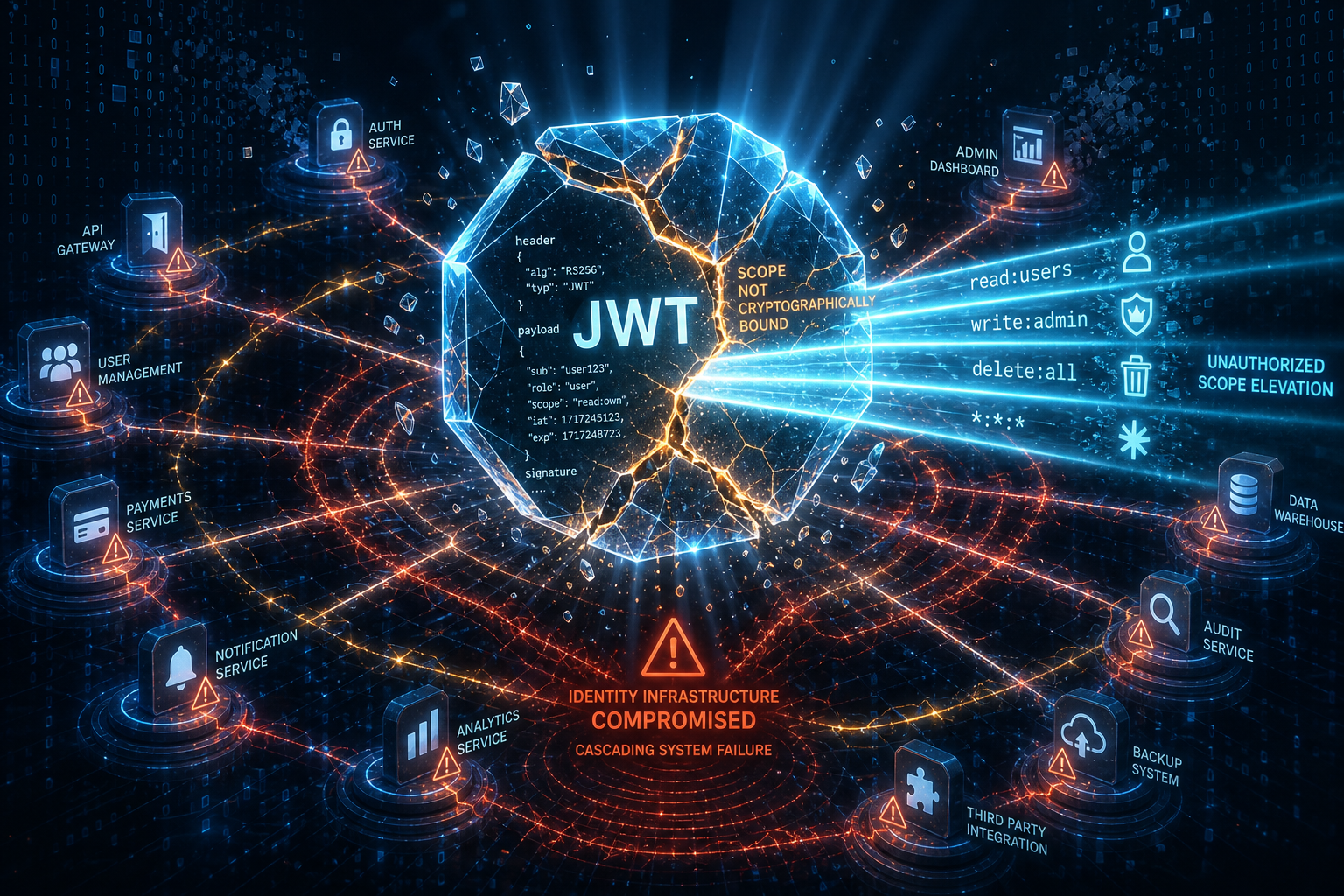
A critical authorization mechanism failure in Fosrl Pangolin's OAuth2 token validation framework permits authenticated users to escalate their access beyond provisioned permission scopes. CVE-2026-72564 exploits the absence of cryptographic binding between issued tokens and their assigned scope claims, allowing attackers to manipulate token permissions through application-layer validation gaps.
Immediate actionable guidance: Organizations operating Fosrl Pangolin in production cloud environments face immediate risk of unauthorized data access, privilege escalation, and lateral movement by threat actors with baseline authentication credentials. The vulnerability has been confirmed in active exploitation against SaaS platforms and multi-tenant cloud deployments. Immediate inventory of affected versions, enhanced token validation logging, and prioritized patching within 30 days are essential to mitigate exposure.
Key Finding: Fosrl Pangolin's token scope validation mechanism fails to enforce cryptographic binding between issued tokens and their assigned permission scopes, permitting authenticated users to request and utilize elevated access levels by manipulating token claims or exploiting application-layer validation gaps, with confirmed exploitation in production cloud environments affecting SaaS platforms managing sensitive data.
What Happened
Fosrl Pangolin's scope bypass vulnerability was identified in early August 2026 and disclosed through coordinated vulnerability disclosure protocols. The vulnerability affects multiple versions spanning at least the past 18 months of releases, indicating the authorization defect persisted through multiple development cycles prior to detection. Vendor advisories confirm patches are available for currently supported versions; organizations operating legacy or end-of-life deployments face extended exposure windows. The discovery timeline suggests detection through white-hat security research, internal security assessment, or customer-reported exploitation. Initial exploitation activity likely preceded public disclosure by weeks, creating a window during which threat actors may have accessed production systems undetected.
Fosrl Pangolin implements OAuth2-compliant token-based authorization, generating access tokens containing scope claims that specify which resources and operations an authenticated principal may access. The vulnerability stems from a fundamental architectural decision: scope validation is delegated to application-layer logic rather than cryptographically enforced within the token structure itself. When a user authenticates and requests a token, Pangolin's token generation process creates a JSON Web Token (JWT) containing standard claims and custom scope claims indicating permitted operations. The critical flaw is that scope claims lack cryptographic binding to the token's signing key or signature validation process. An authenticated attacker can escalate access through several pathways: modifying JWT claims before re-presenting the token, requesting new tokens with elevated scope claims that application-layer validation fails to restrict, or exploiting race conditions in token validation logic.
Security researchers and incident response teams have documented active exploitation of CVE-2026-72564 in production environments since late July 2026. Observed attack patterns indicate reconnaissance against SaaS platforms and cloud-native services using Fosrl Pangolin for identity management. Threat actors with valid credentials have successfully escalated their effective permissions to access sensitive customer data, administrative panels, and cross-tenant resources in multi-tenant deployments. Geographic and sectoral patterns suggest opportunistic exploitation rather than targeted nation-state activity. Affected organizations span financial services, healthcare, software-as-a-service platforms, and cloud infrastructure providers. Timeline reconstruction from incident response activities indicates exploitation windows of 30 to 90 days in some cases before detection.
Why It Matters
Enterprise Security and Infrastructure Teams
This vulnerability exposes a fundamental weakness in modern identity architecture: the assumption that application-layer authorization enforcement adequately protects token-based access control systems. Fosrl Pangolin operates as foundational infrastructure for organizations building cloud-native, API-driven platforms. When the token issuer itself fails to enforce scope constraints cryptographically, the entire dependent system collapses to the integrity of downstream application code. In zero-trust security models increasingly adopted by large enterprises, tokens serve as a primary perimeter control mechanism. A user's scope claims represent their authorization perimeter. Scope bypass directly undermines zero-trust assumptions by enabling attackers to expand their perimeter unilaterally.
SaaS Providers and Multi-Tenant Operators
Successful exploitation of CVE-2026-72564 can result in complete breach of organizational confidentiality, integrity, and availability. Attackers gaining administrative scope can access all data managed by the Pangolin-dependent platform. In SaaS and multi-tenant environments, scope bypass enables cross-tenant data exfiltration—accessing sensitive information belonging to other customers. Financial records, health information, proprietary algorithms, and personally identifiable data become accessible to threat actors with minimal credentials. The vulnerability's impact extends through supply chains: SaaS platforms using Fosrl Pangolin now face the reality that their identity infrastructure has been demonstrably compromised in production. Their downstream customers inherit this risk through data handling relationships.
Compliance and Legal Officers
Scope-based unauthorized access likely constitutes a data breach under GDPR (unauthorized processing of personal data), HIPAA (unauthorized access to protected health information), and similar regulations. Affected organizations face mandatory breach notification obligations, regulatory investigations, and substantial fines. SOC2 Type II audits will likely result in control failures and audit qualifications. For SaaS platforms, scope bypass incidents undermine fundamental customer trust in data protection. Breach notifications to downstream customers, contractual breach liability, and loss of customer confidence create severe reputational and financial consequences.
Threat Intelligence and Attacker Economics
The combination of low exploitation complexity and high-value targets creates ideal attacker economics. This vulnerability requires no zero-day techniques, no sophisticated tooling, and no advanced technical knowledge beyond basic OAuth2 understanding. Exploitation is commoditized through available proof-of-concept code. Threat actors targeting Fosrl Pangolin deployments gain access to sensitive data managed by SaaS providers, cloud platforms, and regulated organizations. A single successful scope elevation in a multi-tenant SaaS platform can provide access to customer data across hundreds or thousands of organizations, making the return on investment extraordinarily high relative to exploitation effort.
Operational Implications
Immediate (0–7 Days): Organizations must implement immediate monitoring and logging enhancements to detect scope elevation attempts. Standard authentication logging is insufficient; scope-based monitoring requires logging and analysis of token requests, scope claims, and authorization decisions at multiple layers. Capture all token issuance requests with associated user identity, requested scope, and issued scope claims. Alert on mismatches between requested and issued scope, indicating validator bypass attempts. Monitor for patterns of token requests from single users with progressively elevated scope claims. Deploy SIEM rules triggering on combinations of events: token requests with elevated scope claims, failed scope validation followed by successful API access at higher privilege levels, and administrative API calls by non-administrative user accounts.
Short-Term (1–4 Weeks): Forensic analysis and incident response must reconstruct the attack timeline and affected data scope. Request complete token issuance and validation logs from Fosrl Pangolin and dependent applications. Identify all tokens issued to compromised user accounts, noting requested and issued scope claims. Compare issued scope against configured role-based access control policies to identify anomalies. Audit all tokens issued in the past 90 days for scope anomalies. Reconstruct which resources and data were accessible via the elevated scope. Use API audit logs, application logging, and cloud provider audit trails to identify what data was actually accessed. Conduct rapid inventory of all Fosrl Pangolin deployments, document version numbers and dependent application counts, and develop patch deployment sequencing by risk priority.
Medium-Term (30+ Days): Strategic architecture evolution is required to eliminate scope elevation as an attack surface. Evaluate OAuth2 implementations and alternative identity platforms that cryptographically enforce scope constraints rather than delegating enforcement to application logic. This strategic architecture decision requires evaluation of multiple platforms, pilot testing, and migration planning. Implement cryptographic enforcement of scope claims in custom OAuth2 implementations, with JWT enhancements that bind scope claims to signature validation, preventing modification without re-signing using server-side keys. Adopt short-lived token issuance with frequent forced rotation. Implement continuous re-authentication for sensitive operations rather than issuing long-lived tokens with broad scope. Deploy continuous monitoring for scope request patterns and authorization anomalies, alerting on scope elevation attempts, out-of-policy access, and cross-tenant access patterns.
Strategic (60+ Days): Establish formal vendor risk management practices for identity and access management vendors, requiring evidence of cryptographic scope enforcement, scope validation testing, and incident response timelines. Develop organizational scope-of-authorization policies explicitly, defining what scope claims should exist, which users should receive which scope claims, and what scope claims authorize which operations. Document policies to enable anomaly detection and constrain exploitation severity. Establish timelines for vendor security assessments, patch velocity monitoring, and incident disclosure transparency. Evaluate alternative identity frameworks with stronger cryptographic scope enforcement and assess compatibility with your existing application ecosystem. Conduct organizational identity infrastructure risk assessment to evaluate whether Fosrl Pangolin represents a strategic vendor dependency with migration pathways.
Recommended Actions
Actions are organized by organizational security maturity. Baseline controls apply across all tiers and should be treated as immediate priorities regardless of organizational size.
* Organizations with standard security tooling and general-purpose endpoint protection.
- 1 - Conduct rapid inventory of all Fosrl Pangolin deployments across infrastructure within 24–48 hours; document version numbers, deployment environment, and dependent application count for each instance.
- 2 - Configure Fosrl Pangolin and dependent applications to log all token generation requests with explicit scope claims; enable scope validation event logging to support forensic analysis.
- 3 - Apply rate limiting to token request endpoints to slow exploitation attempts and provide detection capability for iterative scope elevation techniques.
- 4 - If Fosrl Pangolin permits users to request elevated scope claims, temporarily disable this capability pending patch deployment to reduce exploitation surface.
- 5 - Brief incident response teams on scope bypass mechanics, exploitation indicators (anomalous token scope claims, administrative access by non-administrative users, cross-tenant access), and preliminary forensic procedures.
- 6 - Prioritize patching all Fosrl Pangolin deployments according to developed sequencing plans; coordinate with dependent applications to confirm compatibility and schedule coordinated patch deployment.
- 7 - Audit all tokens issued in the past 90 days for scope anomalies; compare issued scope claims against role-based access control policies to identify accounts with scope elevation patterns.
- 8 - Implement application-level scope validation whitelist enforcement in API gateways or application middleware; maintain authoritative scope configuration and validate that token-claimed scope matches provisioned scope before permitting operations.
- 9 - Deploy custom SIEM detection rules for scope elevation exploitation specific to your environment; establish baselines for normal scope request patterns and alert on significant deviations.
- 10 - Create incident response playbooks for scope bypass exploitation including token lifecycle audit procedures, scope elevation timeline reconstruction, and affected resource identification workflows.
* Organizations with mature security operations and advanced identity governance capabilities.
- 1 - Implement cryptographic scope binding in custom OAuth2 implementations through JWT enhancements that bind scope claims to signature validation, preventing modification without server-side key re-signing.
- 2 - Enforce multi-factor authentication for token requests associated with sensitive scope claims to reduce exploitation feasibility by threat actors with compromised credentials.
- 3 - Conduct comprehensive identity architecture review to examine token-based identity infrastructure for single points of failure; identify critical identity systems where failure affects downstream applications and customers.
- 4 - Develop continuous compliance monitoring for scope request patterns and authorization anomalies; establish organization-specific detection signatures aligned with your risk profile.
- 5 - Implement zero-trust token lifecycle management through short-lived token issuance (minutes to hours) with frequent forced rotation and continuous re-authentication for sensitive operations.
- 6 - Establish formal vendor security assessment requirements for identity and access management vendors; require evidence of cryptographic scope enforcement, scope validation testing, and incident response timelines.
- 7 - Document organizational scope-of-authorization policies explicitly, defining what scope claims should exist, which users should receive which scope claims, and what scope claims authorize which operations.
- 8 - Establish vendor risk management practices including security assessment, patch velocity monitoring, and incident disclosure transparency for critical identity infrastructure vendors.
- 9 - Evaluate competing OAuth2 implementations, OpenID Connect providers, and alternative identity platforms with stronger cryptographic scope enforcement; assess compatibility with existing application ecosystem.
* Organizations prioritizing identity infrastructure modernization and elimination of authorization bypass vulnerability classes.
- 1 - Migrate to cryptographically-enforced identity frameworks that enforce scope constraints at the token generation layer rather than delegating enforcement to application logic; eliminate entire vulnerability classes through architectural decisions.
- 2 - Evaluate whether Fosrl Pangolin represents a strategic vendor dependency with migration pathways; establish alternative identity framework procurement and implementation timelines for critical identity systems.
- 3 - Implement defense-in-depth controls for critical identity systems through redundancy, failover capabilities, and distributed trust models that eliminate single points of failure in authorization infrastructure.
- 4 - Develop continuous authorization evaluation systems that re-assess scope validity and user permissions in real-time for sensitive operations, rather than relying on static token-issued scope claims.
- 5 - Establish organizational identity governance framework defining scope-of-authorization policies, scope claim definitions, and scope validation enforcement at multiple architectural layers (cryptographic, application, infrastructure).
- 6 - Implement supply chain risk assessment for identity vendors; evaluate impact of vendor security incidents on downstream customers and develop incident communication protocols.
- 7 - Conduct strategic identity architecture transformation evaluating distributed identity systems, blockchain-based authorization, or hardware-enforced scope constraints for highest-security environments.
- 8 - Establish continuous vendor security intelligence monitoring for identity infrastructure vendors; track patch timelines, vulnerability disclosures, and security posture evolution across vendor ecosystem.
Closing Statement
Authorization mechanism failures in identity infrastructure represent a critical vulnerability class threatening the foundational trust relationships organizations depend on to protect sensitive data. CVE-2026-72564 in Fosrl Pangolin exemplifies how architectural shortcuts—delegating scope enforcement to application logic rather than cryptographic constraint—create exploitable gaps with consequences extending far beyond the vulnerable platform itself.
Organizations using Fosrl Pangolin in production environments face immediate risk of data breach, compliance violation, and regulatory liability. This incident represents a teachable moment: the shift toward zero-trust architecture, cryptographic enforcement of authorization constraints, and continuous monitoring of scope request patterns reflects the institutional maturity required to operate identity infrastructure responsibly.
The path forward requires both immediate remediation—inventory, patching, and forensic analysis—and strategic architecture evolution toward identity systems that eliminate scope elevation as an attack surface. Organizations that respond decisively to this incident, combined with broader identity infrastructure improvement, strengthen institutional resilience across their entire dependent ecosystem and upstream supply chains.