
Compliance or Resilience: Analyzing Regulatory Frameworks and Public-Private Partnership Gaps Across CISA, NERC, and NIS2
Executive Summary
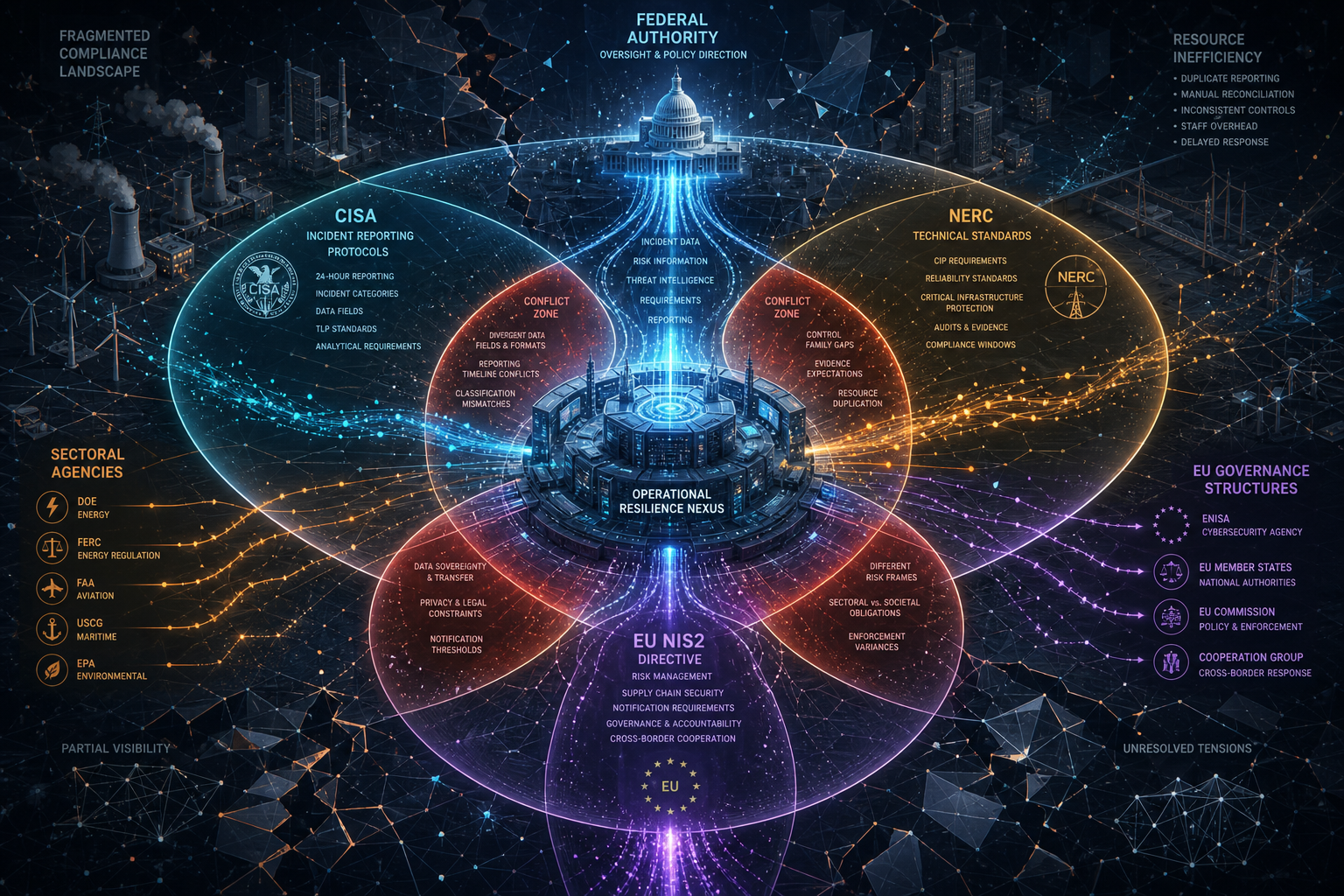
The U.S. critical infrastructure cybersecurity regulatory environment operates across at least three independent governance streams—CISA-led incident reporting, NERC technical standards, and sectoral agency authorities—while European NIS2 requirements introduce conflicting definitions of "critical" infrastructure and divergent reporting timelines. This fragmentation has created a compliance arbitrage environment where institutional resources are allocated to regulatory satisfaction rather than integrated security engineering.
For multinational operators and U.S.-based critical infrastructure entities, the result is overlapping mandates with minimal formal coordination mechanisms, asymmetric compliance burdens for smaller operators, and operational ambiguity during incident response. Organizations operating across multiple jurisdictions face multiplied third-party attestation requirements, conflicting data retention obligations, and unclear incident command authority when multiple regulatory frameworks are triggered simultaneously.
A unified approach to regulatory coordination—beginning with formal interagency memoranda and harmonized incident protocols—offers opportunity to reduce compliance friction while improving functional security posture.
Key Finding: The U.S. federal regulatory environment for critical infrastructure cybersecurity operates across at least three independent governance streams (CISA-led incident reporting, NERC CIP technical standards, and sectoral agency authorities) with minimal formal coordination mechanisms, while European NIS2 requirements introduce conflicting definitions of "critical" infrastructure and divergent reporting timelines—creating a compliance arbitrage environment where institutional resources are allocated to regulatory satisfaction rather than integrated security engineering.
What Happened
The U.S. critical infrastructure cybersecurity regulatory landscape has expanded substantially since 2022, establishing overlapping but uncoordinated compliance regimes. The Cyber Incident Reporting for Critical Infrastructure Act (CIRCIA), enacted in December 2022, mandates that owners and operators of critical infrastructure report covered cyber incidents to CISA within 72 hours for electricity and gas sectors, and within 24 hours for other critical infrastructure sectors. This federal reporting requirement operates independently from sectoral agency authorities: the Department of Energy (DOE) for electricity and natural gas, Department of Transportation (DOT) for pipeline and rail, Department of Health and Human Services (HHS) for healthcare, and the Department of the Treasury for financial services.
Simultaneously, National Security Memorandum directives (NSM-13 and NSM-15) expanded CISA's coordination authority and introduced supply chain security requirements cascading from Executive Order 14028. These include software bill of materials (SBOM) attestation, zero-trust architecture adoption, and enhanced vendor security assessments. However, NSM-driven mandates operate through CISA guidance and voluntary implementation pathways rather than legally binding regulatory authority, creating interpretive ambiguity for institutional compliance officers.
The North American Electric Reliability Corporation (NERC) maintains independent technical standards for electricity and natural gas operators. NERC's Critical Infrastructure Protection (CIP) standards—CIP-002 through CIP-009—establish technical security requirements, operational procedures, and audit protocols operating on a distinct compliance cycle: triennial NERC certification audits, semi-annual self-assessments, and standards evolution on an 18- to 24-month lag from emerging threats. NERC audit outcomes feed into the NERC compliance database but are not directly integrated with CISA's incident reporting framework or sectoral agency regulatory actions.
Executive Order 14028 and the Department of Defense joint software supply chain memorandum (September 2025) introduced a third layer: SBOM requirements and software transparency mandates for federal contractors and critical infrastructure suppliers. This supply chain security mandate overlays existing NERC technical controls and CISA incident reporting requirements but operates under separate DoD authority with its own compliance attestation processes and contractor oversight mechanism.
The European Union's Network and Information Systems Security Directive 2 (NIS2, Directive 2022/2555) established a competing regulatory framework with October 2024 transposition deadline and enforcement beginning in 2025. NIS2 defines "critical infrastructure" differently than U.S. CISA classifications, extending protections to digital service providers and essential services beyond electricity, gas, water, and telecommunications to include postal and courier services, waste management, and health services.
NIS2 mandates breach reporting to competent national authorities within 24 hours of discovery, with additional notification to national data protection authorities under GDPR where applicable—a significantly compressed timeline compared to CIRCIA's 72-hour window for electricity and gas. NIS2 Article 19 establishes supply chain security requirements distinct from DoD SBOM mandates, focusing on cybersecurity risk management contracts with suppliers and subcontractors rather than technical SBOM production and standardized formats.
Formal coordination between CISA, NERC, and sectoral agencies occurs through bilateral memoranda of understanding and voluntary participation in Sector Coordinating Councils and Information Sharing and Analysis Centers (ISACs). The Electricity Subsector Coordinating Council (ESCC), for example, provides a forum for industry-government information sharing but operates without formal incident command authority or binding protocols for multi-regulatory breach notification. CISA's Partnerships & Collaboration Portal and sector-specific engagement operate on an advisory rather than binding coordination model.
International regulatory coordination is nascent. CISA engages with European national cybersecurity agencies and ENISA (European Union Cybersecurity Agency) on information sharing and threat intelligence, but no formal regulatory harmonization mechanism exists for incident reporting timelines, asset classification, or technical standard alignment. Multinational critical infrastructure operators navigating both U.S. and EU jurisdictions operate under de facto parallel regulatory regimes with minimal coordination between CISA and EU authorities.
Why It Matters
Critical Infrastructure Operators
The proliferation of independent regulatory frameworks has created a compliance arbitrage environment where institutional resources are allocated disproportionately to regulatory satisfaction rather than integrated security engineering. Critical infrastructure organizations must maintain separate compliance calendars: NERC triennial audits with distinct audit protocols, CIRCIA annual incident reporting aggregation, NIS2 transposition implementation and compliance verification, and DoD SBOM attestation cycles. Each regulatory regime requires distinct documentation, evidence collection, and third-party validation processes. Smaller critical infrastructure operators and those operating across multiple sectors face asymmetric compliance burden. A water utility operating in the EU must satisfy both CISA incident reporting requirements (if supplying U.S.-based critical infrastructure) and NIS2 transposition requirements, while managing independent water sector technical standards in each jurisdiction.
Security Practitioners and Workforce
Regulatory frameworks optimized for audit compliance do not necessarily align with functional security posture or incident detection and response capabilities. NERC CIP standards establish prescriptive technical controls that operators must maintain and auditors must verify. However, CISA's incident detection capabilities and threat intelligence prioritization operate independently of NERC compliance status. A utility passing NERC CIP audits may still experience an incident that CISA's reporting framework captures and escalates to sectoral authorities with limited coordination back to NERC compliance processes. This creates a practical gap: incident response protocols developed for NERC audit compliance may conflict with CISA breach notification timelines or incident command procedures.
Multinational Organizations
The complexity of the U.S. critical infrastructure regulatory environment increases operational costs for U.S.-based operators relative to non-U.S. competitors facing more standardized regulatory regimes. A European critical infrastructure operator subject only to NIS2 operates with a simpler compliance calendar than a multinational operator managing CISA, NERC, NIS2, and DoD requirements. This creates a measurable competitive disadvantage: U.S. critical infrastructure organizations allocate security budget to compliance overhead while international competitors allocate proportionally more resources to functional security capability. Innovation in security product development is similarly affected. Cybersecurity vendors targeting critical infrastructure prioritize product features and compliance templates aligned with audit checklist requirements rather than threat prevention or detection innovation.
Policy and Regulatory Leadership
During active incident response, regulatory fragmentation creates operational ambiguity regarding incident command authority, information sharing protocols, and coordination across multiple regulatory notification channels. A critical infrastructure operator discovering a covered incident must determine the appropriate initial notification pathway, classification level, and legal authority for engaging different regulatory bodies. Does incident containment prioritize CISA's 72-hour reporting window or NERC's audit evidence preservation? If the incident affects international assets, which jurisdiction's timeline governs overall response coordination? Public-private partnership mechanisms—Sector Coordinating Councils, ISACs, and CISA's National Threat Assessment Division—operate without formal incident command authority.
Operational Implications
Immediate (0-6 months): Organizations operating critical infrastructure assets face a fragmented compliance calendar with no formal integration mechanism. NERC audit cycles operate on a triennial schedule; CISA's incident reporting obligations accumulate annually; NIS2 compliance verification schedules are still being finalized as member states complete transposition; DoD SBOM attestation deadlines cluster in Q1-Q2 2025 with ongoing validation requirements. Unlike a unified compliance calendar where a single assessment cycle satisfies multiple regulatory obligations, current architecture requires organizations to maintain separate evidence streams, documentation protocols, and third-party auditor coordination for each regime. Third-party attestation multiplication creates significant operational overhead. Critical infrastructure operators must engage NERC Compliance Auditors for CIP verification, CISA contractors or qualified assessors for federal compliance validation, and national competent authorities or qualified auditors for NIS2 compliance verification.
Medium-term (6-18 months): Incident response protocol ambiguity emerges when an incident triggers multiple regulatory obligations simultaneously. An electricity operator detecting a covered cyber incident must determine the incident's severity relative to NERC CIP criteria, CISA critical infrastructure definitions, and potentially NIS2 requirements. If the incident affects both U.S. and EU assets, the operator must simultaneously satisfy CIRCIA's 72-hour U.S. reporting window and NIS2's 24-hour EU reporting window. Most critical infrastructure operators currently lack formalized protocols addressing multi-regulatory incident scenarios. Data retention and privacy obligations create additional friction. CIRCIA expects operators to retain breach-related data for investigative purposes; GDPR Article 17 (right to erasure) and NIS2 data minimization requirements conflict with open-ended data retention for U.S. breach documentation. Operators must implement data governance protocols simultaneously satisfying divergent retention and minimization obligations—a technical and legal challenge without clear regulatory guidance.
Long-term (18+ months): Sector Coordinating Councils and ISACs operate without unified information sharing governance accommodating CISA, NERC, and international regulatory requirements simultaneously. An electricity ISAC receives threat intelligence from CISA, NERC threat analysis, and international CSIRT notifications operating under different classification levels, access restrictions, and distribution protocols. This fragmentation delays threat intelligence prioritization and contextualization. When threat actors target multiple critical infrastructure sectors simultaneously, threat intelligence must be rapidly understood, translated, and distributed to sector-specific ISACs, NERC coordination mechanisms, and international partners. Without unified taxonomy and governance protocols, this translation consumes time and introduces attribution delays. Security practitioners and compliance professionals operating in critical infrastructure face a bifurcated career path. NERC CIP certification programs establish specific competency requirements; CISA training programs establish a distinct competency framework; European NIS2 transposition is driving demand for NIS2-specific competency training, introducing a third certification pathway. These frameworks establish overlapping but distinct skill taxonomies with minimal cross-credential recognition.
Recommended Actions
Actions are organized by organizational security maturity. Baseline controls apply across all tiers and should be treated as immediate priorities regardless of organizational size.
* Organizations with standard security tooling and general-purpose endpoint protection.
- 1 - Conduct regulatory impact mapping to establish baseline understanding of all applicable regulatory obligations (CISA CIRCIA, NERC CIP, sectoral agency mandates, international NIS2 if applicable, DoD SBOM). Quantify resource allocation: personnel hours, budget dedicated to attestation and audit processes, external audit costs, and opportunity costs related to security engineering capacity diverted to compliance documentation.
- 2 - Establish a unified incident response framework that explicitly maps to all regulatory reporting obligations. Create incident command structure specifying authority hierarchy, notification sequence, and timing for each regulatory agency (CISA, NERC, sectoral authorities, national CSIRTs if international). Pre-stage regulatory notification templates aligned with CIRCIA 72-hour timelines, NIS2 24-hour timelines (if applicable), and NERC compliance protocols.
- 3 - Develop regulatory arbitrage mitigation strategy by assessing feasibility of exceeding minimum regulatory requirements to create a single unified security posture satisfying all applicable frameworks. Map NERC CIP technical controls to CISA Cybersecurity Framework and Zero Trust architecture components to identify functional equivalence.
- 4 - Establish internal compliance governance council convening monthly cross-functional meetings including Chief Information Security Officer, General Counsel, Compliance Officer, and Incident Response Lead. Maintain shared regulatory calendar tracking compliance deadlines, pending regulatory guidance updates, and framework alignment analysis.
* Organizations with mature security infrastructure and cross-functional governance capabilities.
- 1 - Collaborate with Sector Coordinating Councils and ISACs to create unified threat intelligence standard accommodating NERC categorization, CISA critical infrastructure definitions, and NIS2 significant incident criteria simultaneously. This taxonomy should map threat actor activity, attack vectors, and operational impacts to classifications satisfying all three regulatory regimes.
- 2 - Establish formal regulatory coordination mechanism with monthly interagency meetings including CISA representatives, NERC standards and compliance leadership, sectoral agency cybersecurity representatives, and international CSIRT coordinators or EU ENISA liaisons. Establish standing agenda addressing emerging regulatory conflicts, clarification of existing guidance, and incident coordination protocols.
- 3 - Develop practitioner competency framework mapping NERC CIP certification requirements, CISA role-based training modules, and EU NIS2 competency requirements to a unified security practitioner skill taxonomy. Identify overlapping competencies and create cross-training pathways for security professionals operating in multi-regulatory environments.
- 4 - Conduct annual tabletop exercises simulating multi-regulatory incident scenarios with representatives from incident response, compliance, legal, and executive leadership. Document outcomes and update incident response procedures based on exercise results, ensuring that incident response plans reflect realistic multi-regulatory complexity.
* Government agencies, regulatory bodies, and policy-making organizations.
- 1 - Commission formal regulatory coordination study establishing joint interagency working group (CISA, NERC, sectoral agencies, international partners) to assess compliance costs and security degradation resulting from framework fragmentation. Quantify compliance overhead as percentage of organizational security budgets, analyze workforce migration patterns, and assess whether current fragmentation produces measurable security improvement relative to unified framework alternatives.
- 2 - Establish binding incident coordination protocol through formal memoranda of understanding between CISA, NERC, sectoral agencies, and relevant international partners establishing incident reporting hierarchy and coordination authority during multi-regulatory incidents. These MOUs should specify incident severity thresholds triggering activation of multiple regulatory frameworks, authority delegation during joint response, and single-source-of-truth status update mechanisms.
- 3 - Pilot unified compliance attestation model by selecting one pilot critical infrastructure sector or specific operator to consolidate NERC CIP audit, CISA compliance assessment, and NIS2 verification into a single integrated assessment process. Design the pilot to produce comparable regulatory evidence across all three frameworks using a single audit engagement.
- 4 - Publish regulatory alignment recommendations addressing harmonization of critical infrastructure definitions across U.S. and EU regimes, alignment of reporting timelines accommodating multinational operators, standardization of technical control taxonomies, and identification of pilot programs for unified compliance assessment models.
Closing Statement
Regulatory fragmentation in critical infrastructure cybersecurity represents a structural misalignment between compliance architecture and functional institutional resilience. The proliferation of independent frameworks—CISA incident reporting, NERC technical standards, sectoral agency mandates, and European NIS2 requirements—creates a system optimized for regulatory attestation rather than integrated security improvement. This fragmentation imposes measurable compliance overhead, introduces operational ambiguity during incident response, and creates competitive disadvantage for U.S. critical infrastructure operators relative to international competitors facing more streamlined regulatory environments.
The tension between compliance requirements and security engineering is not inherent to regulation itself but rather to the current architecture's lack of formal coordination mechanisms. Establishing binding incident coordination protocols, creating unified threat intelligence taxonomies, and piloting integrated compliance assessment models offers opportunity to reduce compliance friction while strengthening functional security capabilities. Organizations cannot unilaterally resolve this fragmentation—they require regulatory coordination that only government agencies can mandate.