Targeting the Care Supply Chain: Analyzing Ransomware Encryption and PHI Exposure in AngMar Companies
Executive Summary
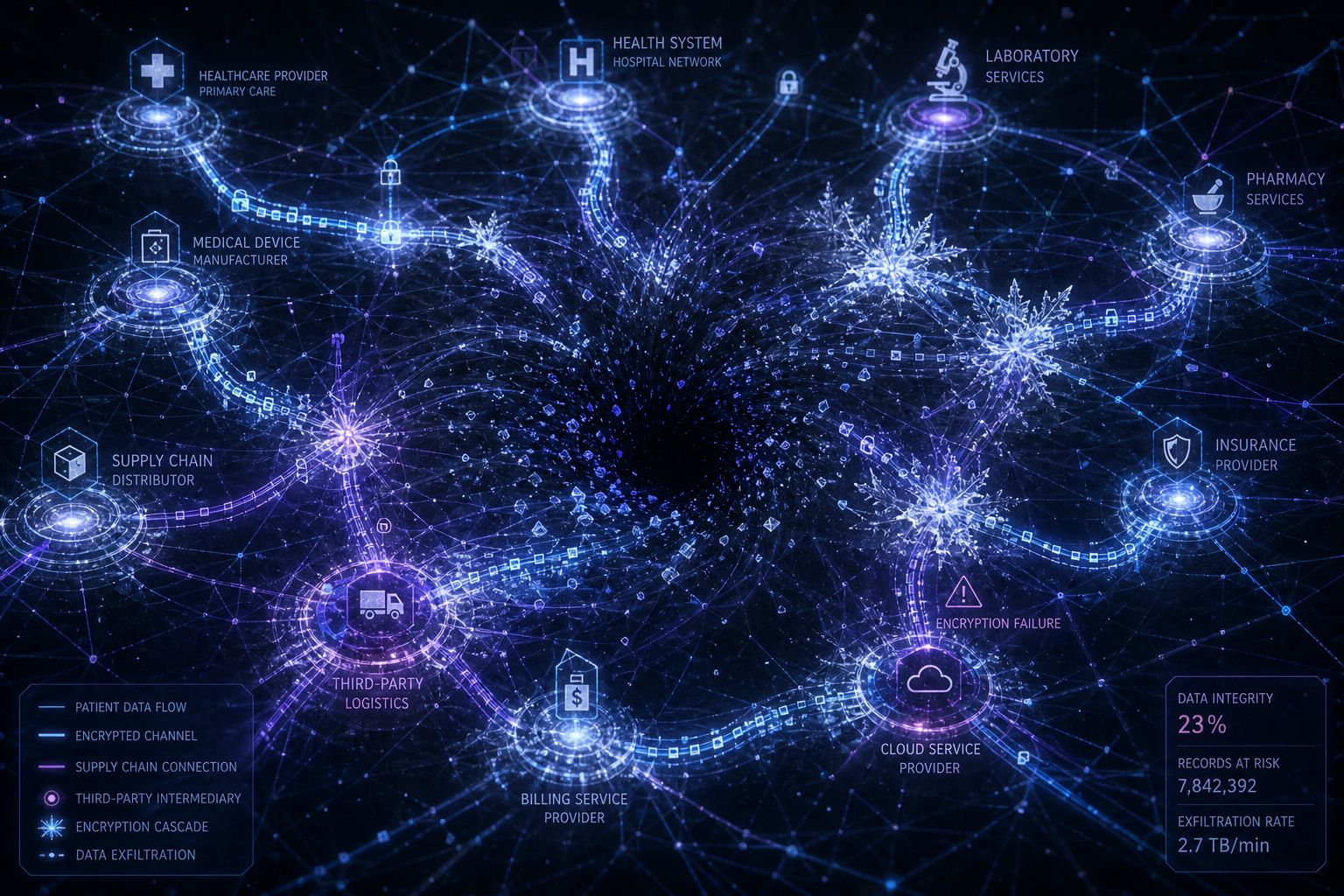
The compromise of AngMar Companies, a critical healthcare supply chain intermediary, by the Interlock ransomware operation has exposed protected health information for 3.8+ million patients across multiple healthcare delivery networks. The incident marks a significant evolution in threat actor targeting strategy: rather than confronting well-defended clinical networks, threat actors exploited supply chain infrastructure to access patient data at scale while simultaneously disrupting operational continuity.
Immediate actionable guidance: The attack demonstrates that third-party vendors—historically treated as lower-security perimeter entities—have become primary vectors for patient data exfiltration and institutional disruption. Healthcare organizations, compliance officers, and IT leadership face immediate pressures around breach notification, regulatory reporting, vendor security remediation, and institutional liability.
Key Finding: The AngMar Companies compromise demonstrates that supply chain intermediaries have become primary attack vectors for patient data exfiltration and institutional disruption, fundamentally shifting healthcare cybersecurity risk calculus from clinical network defense alone to comprehensive third-party infrastructure assessment and continuous vendor security monitoring.
What Happened
On or before August 2026, the Interlock ransomware operation successfully compromised AngMar Companies, a healthcare supply chain vendor providing logistics, inventory management, and procurement services to Angels Care Health and affiliated healthcare delivery networks. The compromise resulted in the exfiltration of protected health information (PHI) and personally identifiable information (PII) affecting an estimated 3.8 million patients, followed by encryption of critical infrastructure segments.
Initial access vector remains under forensic investigation, though supply chain compromise patterns typically involve credential theft targeting vendor or administrative access accounts, exploitation of unpatched remote access infrastructure (VPN, RDP), or social engineering targeting administrative personnel. AngMar Companies' positioning as a logistics intermediary provided consolidated access to patient data spanning multiple healthcare institutions—medical records, insurance information, Social Security numbers, contact information, and clinical documentation—making it an attractive target despite operating with security posture substantially lower than hospital-grade infrastructure.
Interlock deployed a dual-extortion model: exfiltrating data prior to encryption deployment, then demanding ransom in exchange for both decryption keys and assurances against public data disclosure. The threat actor publicly disclosed evidence of exfiltration via Ransomware.live and RansomLook.io, establishing operational activity timeline and creating immediate institutional pressure on Angels Care Health and dependent networks to evaluate payment response strategies.
Detection likely occurred through multiple mechanisms common in supply chain scenarios: hosting provider alerting, automated backup system triggers, or external security researcher notification. Supply chain intermediaries typically lack mature security operations centers (SOCs) and endpoint detection and response (EDR) infrastructure characteristic of primary healthcare institutions, extending detection windows from days to weeks. Once identified, institutional response escalated through incident response teams, law enforcement notification (FBI, CISA), and breach notification protocol activation under HIPAA Breach Notification Rule requirements. Affected healthcare networks initiated notification campaigns across multiple state jurisdictions, triggering regulatory reporting obligations to the U.S. Department of Health and Human Services Office for Civil Rights (OCR), state attorneys general, and local health authorities. The incident also triggered emergency vendor security audits and procurement processes to mitigate supply chain disruption during remediation and recovery.
Why It Matters
Healthcare IT and Security Leadership
Supply Chain Architecture as Institutional Blind Spot: Healthcare delivery systems depend on fragmented ecosystems of third-party vendors for critical functions: supply chain logistics, inventory management, billing and claims processing, payroll management, and patient scheduling. These vendors operate across organizational boundaries, accessing patient data and clinical workflows while maintaining fundamentally lower security investment than primary healthcare institutions. Vendor security questionnaires and annual compliance audits, while standard governance practice, have demonstrated poor predictive value for identifying real-world compromise. The AngMar incident demonstrates that sophisticated threat actors have identified this asymmetry and are targeting it systematically. Supply chain vendors represent single points of failure: compromise of one intermediary can expose patient data across dozens of dependent healthcare institutions simultaneously, making supply chain risk equivalent to direct clinical network risk in institutional impact terms.
Executive Leadership and Board Members
Threat Actor Operational Evolution: The incident reflects strategic targeting rationalization within the ransomware ecosystem. Rather than confronting well-resourced clinical IT teams and mature incident response infrastructure, Interlock identified a lower-friction attack surface: supply chain intermediaries with adequate data access and defensive posture substantially below clinical standards. This targeting choice reflects operational economics: supply chain compromise achieves equivalent data exfiltration and institutional disruption with reduced operational risk and detection likelihood. The precedent established by Interlock's success will likely cascade across the threat actor ecosystem, with competing ransomware operations replicating supply chain targeting methodologies.
Legal, Compliance, and Risk Management
Regulatory and Compliance Implications: The incident triggers immediate HIPAA Breach Notification Rule obligations requiring notification of all affected individuals within 60 days of discovery, concurrent notification to HHS Office for Civil Rights, and state-level data protection law compliance varying by patient jurisdiction. Institutional liability extends beyond direct remediation costs: OCR investigations historically result in settlement agreements, civil monetary penalties, and corrective action orders mandating enhanced security controls. State attorneys general increasingly pursue parallel investigations, creating jurisdictional complexity and legal defense cost multiplication. Medical malpractice exposure arises if supply chain disruption resulted in clinical care delays or adverse patient outcomes. Class action litigation is standard in healthcare data breaches affecting populations exceeding 500,000 individuals, creating ongoing legal and reputational burden extending years beyond initial breach disclosure.
Healthcare Sector Stakeholders
Systemic Risk Proliferation: The incident establishes precedent for targeting supply chain intermediaries as equivalent vectors to direct clinical infrastructure. This will accelerate peer institution threat modeling to incorporate supply chain scenarios, increase cyber insurance premium structures to reflect elevated third-party risk, and shift institutional budget allocation toward third-party vendor management and supply chain monitoring. Board-level cybersecurity oversight will intensify, with liability exposure extending to C-suite accountability for vendor risk management. The incident also creates immediate copycat targeting opportunity: competing ransomware operations have validated methodology, threat intelligence regarding healthcare vendor landscapes, and confirmation that supply chain targeting generates sufficient institutional pressure and payment probability to justify operational resource allocation.
Operational Implications
Immediate (24-72 Hours): Clinical Operations Impact: Supply chain disruption cascades directly into clinical operations. Inventory management systems dependent on vendor integration become unavailable, requiring manual workaround processes for procurement, asset tracking, and inventory reordering. Non-emergency procedures requiring specialized supplies experience scheduling delays as organizations activate secondary vendor relationships with higher unit costs and extended fulfillment timelines. Staff workload escalates managing manual processes replacing automated supply chain orchestration. Provider frustration increases due to resource unavailability, creating potential care quality degradation and staff retention risks.
Ongoing (Weeks to Months): Information Technology and Cybersecurity Operations: Incident response teams face resource-intensive forensic investigation timelines: determining compromise scope, identifying all affected systems and data access pathways, validating backup system integrity and isolation, and reconstructing attack methodology for law enforcement reporting. Systems isolation and recovery validation require weeks to months depending on backup restoration timelines and forensic evidence preservation requirements. Simultaneously, security operations must accelerate threat intelligence integration across institutional security tools to identify Interlock indicators of compromise (IOCs) in institution-specific logs, implement compensating controls pending full remediation, and establish continuous monitoring of vendor network connections for additional compromise indicators.
Short-Term (1-4 Weeks): Patient Care Continuity and Data Access: Clinical decision-making capability degrades during system recovery periods. Providers lacking access to historical patient data, medication records, and diagnostic imaging must rely on manual record request processes and delayed specialist consultations. Delayed appointment scheduling and provider communication channels create patient anxiety and provider burnout. Patient retention risk increases as populations migrate to healthcare providers with less disrupted infrastructure. Breach notification campaigns require staffing, training, and operational overhead extending months.
Extended (Months to Years): Legal, Compliance, and Regulatory Operations: Breach notification campaigns span multiple state jurisdictions with varying notification timeline requirements, content mandates, and regulatory reporting procedures. HHS OCR reporting requires comprehensive incident documentation including compromise timeline, affected data categories, remediation measures, and corrective action commitments. State attorney general reporting triggers parallel investigations with potential civil enforcement actions. Institutional legal counsel must prepare for class action litigation discovery, develop defendant strategies, and negotiate cyber insurance claim submission and coverage validation. Regulatory agency preparation includes potential OCR on-site audit, corrective action order negotiation, and civil monetary penalty defense. The operational burden extends across legal, compliance, privacy, and risk management departments for 12-24 months following initial breach disclosure.
Ongoing (Weeks to Months): Vendor Risk Management and Supply Chain Remediation: Emergency security audits of critical supply chain vendors accelerate, requiring significant internal audit resources and external forensic investigator coordination. Institutions must simultaneously identify and activate secondary vendor relationships for supply chain function diversification, negotiate emergency procurement contracts at premium pricing, and manage transition logistics. Existing vendor contracts require legal review for security obligation enforcement, indemnification clause activation, and potential termination proceedings if vendors cannot validate remediation completeness.
Recommended Actions
Actions are organized by organizational security maturity. Baseline controls apply across all tiers and should be treated as immediate priorities regardless of organizational size.
* Organizations with standard security tooling and general-purpose endpoint protection.
- 1 - IMMEDIATE (24-72 HOURS): Establish incident response team with legal, compliance, IT security, and clinical leadership representation; clarify decision authority for ransom negotiation and regulatory engagement
- 2 - IMMEDIATE (24-72 HOURS): Identify all potentially affected patient populations and initiate breach notification timeline planning
- 3 - IMMEDIATE (24-72 HOURS): Quarantine or disconnect all systems with direct or indirect AngMar Companies data access; validate backup system isolation and test recovery capability
- 4 - IMMEDIATE (24-72 HOURS): Notify cyber insurance carrier and law enforcement (FBI, CISA); document all incident response decisions for regulatory reporting and litigation defense
- 5 - SHORT-TERM (1-4 WEEKS): Execute breach notification campaign across all identified patient populations; establish call center infrastructure for patient inquiries
- 6 - SHORT-TERM (1-4 WEEKS): Prepare and submit HHS OCR breach notification reporting and state attorney general notifications per jurisdiction-specific requirements
- 7 - SHORT-TERM (1-4 WEEKS): Activate secondary supply chain vendor relationships; negotiate emergency procurement contracts to mitigate operational disruption
- 8 - SHORT-TERM (1-4 WEEKS): Implement institution-wide cybersecurity awareness training addressing supply chain compromise, third-party risk, and credential security
- 9 - MEDIUM-TERM (1-3 MONTHS): Conduct emergency security audits of all critical supply chain vendors with patient data access; establish remediation timelines and require independent validation
- 10 - MEDIUM-TERM (1-3 MONTHS): Establish vendor security assessment baseline including vulnerability assessment and network segmentation validation
- 11 - MEDIUM-TERM (1-3 MONTHS): Review and update incident response plans to incorporate supply chain compromise scenarios; conduct tabletop exercise validating response protocols
- 12 - MEDIUM-TERM (1-3 MONTHS): Implement endpoint detection and response (EDR) capability on all systems with vendor network connectivity
* Organizations with EDR deployment, security operations capability, and third-party risk management programs.
- 1 - IMMEDIATE (24-72 HOURS): Execute all baseline immediate actions; initiate threat intelligence integration to identify Interlock IOCs in institutional logs and network telemetry
- 2 - IMMEDIATE (24-72 HOURS): Coordinate forensic investigation scope with law enforcement and insurance carrier; establish evidence preservation protocols
- 3 - IMMEDIATE (24-72 HOURS): Establish vendor communication channel for real-time security posture updates and remediation progress validation
- 4 - SHORT-TERM (1-4 WEEKS): Execute all baseline short-term actions; implement enhanced monitoring and alerting on all vendor-connected systems
- 5 - SHORT-TERM (1-4 WEEKS): Initiate third-party risk management program redesign incorporating supply chain-specific threat scenarios
- 6 - SHORT-TERM (1-4 WEEKS): Develop supply chain diversification strategy with timeline and cost-impact analysis
- 7 - MEDIUM-TERM (1-3 MONTHS): Execute all baseline medium-term actions; implement data minimization program reducing PII/PHI stored in non-clinical vendor systems
- 8 - MEDIUM-TERM (1-3 MONTHS): Establish continuous vendor security monitoring program with automated compliance validation and alerting
- 9 - MEDIUM-TERM (1-3 MONTHS): Implement network segmentation isolating vendor-connected infrastructure from clinical networks; validate segmentation effectiveness through penetration testing
* Organizations with zero-trust architecture, advanced threat hunting, and mature third-party security ecosystems.
- 1 - IMMEDIATE (24-72 HOURS): Execute all baseline and intermediate immediate actions; deploy threat hunting operations to identify lateral movement indicators and additional compromise vectors
- 2 - IMMEDIATE (24-72 HOURS): Coordinate with peer institutions to share threat intelligence and identify systemic supply chain vulnerabilities
- 3 - SHORT-TERM (1-4 WEEKS): Execute all baseline and intermediate short-term actions; initiate zero-trust architecture assessment for vendor connectivity redesign
- 4 - SHORT-TERM (1-4 WEEKS): Establish supply chain transparency initiative requiring real-time vendor security attestation and continuous monitoring data sharing
- 5 - MEDIUM-TERM (1-3 MONTHS): Execute all baseline and intermediate medium-term actions; implement zero-trust network access controls with continuous authentication and authorization across vendor boundaries
- 6 - MEDIUM-TERM (1-3 MONTHS): Establish healthcare sector peer coordination through information sharing and analysis centers (ISACs); develop industry-wide threat intelligence sharing protocols
- 7 - MEDIUM-TERM (1-3 MONTHS): Redesign cyber insurance program to reflect supply chain risk elevation; negotiate vendor liability requirements in new policy structures
- 8 - LONG-TERM (3-12 MONTHS) - ALL MATURITY LEVELS: Complete full zero-trust architecture migration with emphasis on vendor connectivity isolation and continuous verification
- 9 - LONG-TERM (3-12 MONTHS) - ALL MATURITY LEVELS: Establish board-level governance framework for cybersecurity risk reporting and accountability; integrate supply chain risk into enterprise risk management
- 10 - LONG-TERM (3-12 MONTHS) - ALL MATURITY LEVELS: Participate in healthcare sector-wide policy initiatives addressing third-party vendor security standardization and government coordination mechanisms
- 11 - LONG-TERM (3-12 MONTHS) - ALL MATURITY LEVELS: Conduct comprehensive supply chain security maturity assessment; develop multi-year roadmap for vendor security enhancement
Closing Statement
The AngMar Companies compromise represents more than a single institutional breach; it marks a fundamental shift in how healthcare sector threat actors operate. Supply chain intermediaries—historically treated as lower-security perimeter entities—have become primary attack vectors for patient data compromise and institutional disruption. Organizations that continue to invest cybersecurity resources primarily in clinical network defense while maintaining legacy annual vendor assessments increasingly expose themselves to replication of this attack pattern.
The incident also illuminates governance asymmetries: healthcare organizations must make immediate remediation investments while navigating regulatory reporting, legal defense, and class action litigation spanning years. This creates institutional stress testing for governance structures, budget allocation frameworks, and leadership accountability mechanisms that historically separated cybersecurity as an IT operational concern from board-level enterprise risk management.
Strategic institutional resilience in the post-AngMar threat environment requires three concurrent imperatives: elevating supply chain risk to equivalent governance priority as clinical network security; implementing continuous third-party vendor security monitoring replacing annual questionnaire cycles; and establishing zero-trust architecture across vendor connectivity boundaries. Organizations that delay this evolution will likely experience replication of this incident pattern, with amplifying cost and reputational consequences. The critical awareness gap this incident must close is not technical understanding of supply chain vulnerability—it is institutional accountability for third-party risk management as a foundational element of healthcare sector cybersecurity maturity.