
Poisoning the Grid: Analyzing AI-Driven Threat Detection and Resilience Mechanisms in Autonomous Energy Systems
Executive Summary
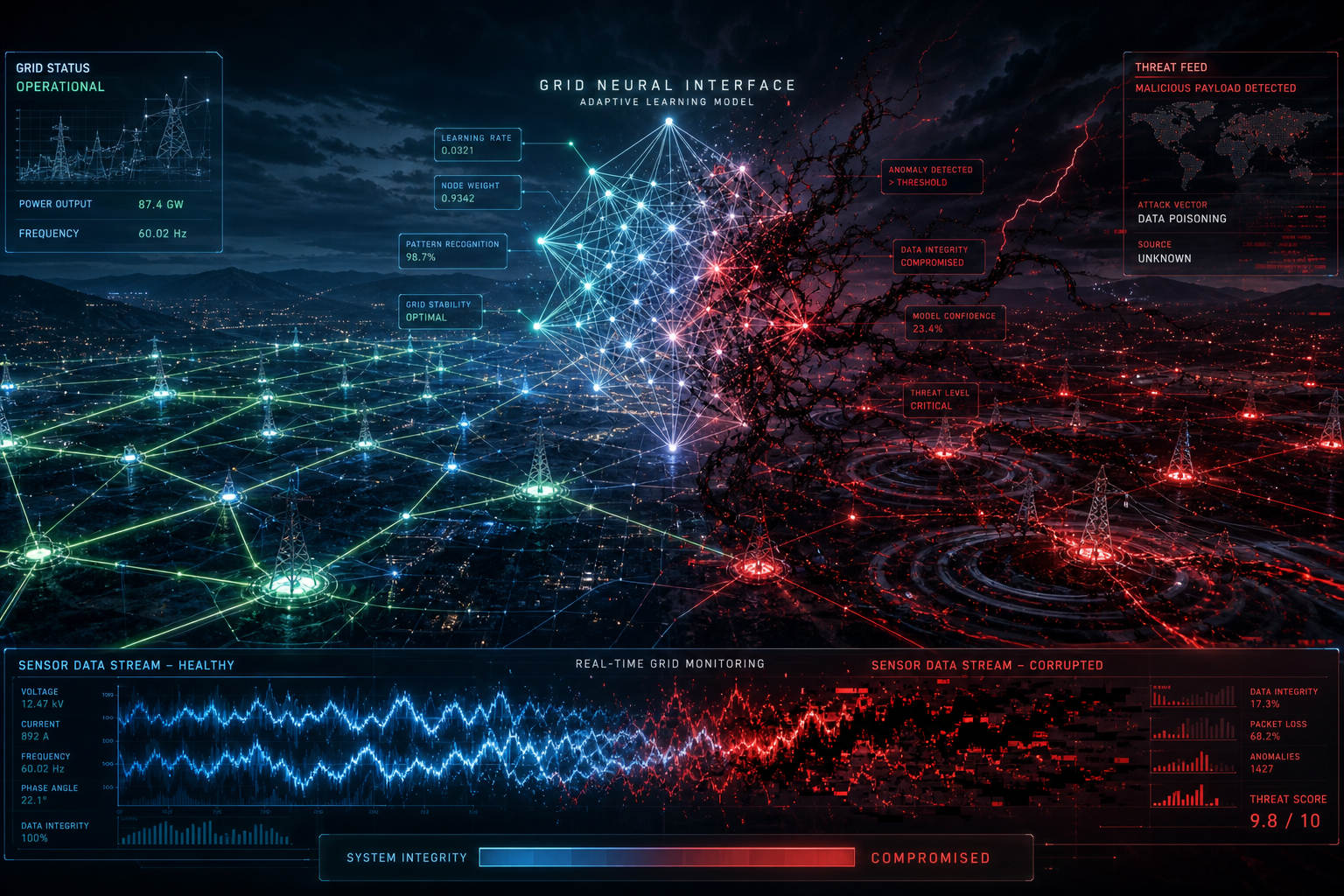
As autonomous energy systems increasingly embed machine learning-based threat detection to manage distributed grid operations, a critical vulnerability has emerged: the mechanisms designed to enhance grid resilience become attack surfaces when adversarial actors poison AI models through corrupted training data or crafted inference-time inputs. This article examines how adversarial poisoning of threat detection systems can compromise the autonomous decision-making that protects critical infrastructure, potentially enabling cascading grid failures that bypass traditional cybersecurity controls.
The convergence of AI decision-making authority and critical infrastructure operations represents a novel threat landscape that current regulatory frameworks and operational practices are not equipped to address. Organizations must adopt model validation protocols, training data integrity controls, and adversarial robustness engineering as foundational defensive practices while establishing clear governance requirements for AI systems in autonomous grid operations.
Key Finding: AI-driven grid threat detection systems present a critical vulnerability: mechanisms designed to enhance autonomous grid resilience become attack vectors when poisoned through corrupted training data or adversarial inputs, potentially causing cascading infrastructure failures that bypass traditional cybersecurity controls.
What Happened
The modernization of electrical grids toward distributed, autonomous operations has accelerated the deployment of machine learning models for real-time threat detection, anomaly identification, and predictive maintenance. The U.S. Department of Energy's strategic research plan explicitly positions AI and machine learning as core technologies for microgrid autonomy, fault detection, and demand-response optimization. Research institutions including the Pacific Northwest National Laboratory and the Electric Power Research Institute have documented extensive implementation of ML-based systems across grid distribution architectures, demand forecasting, and autonomous load balancing.
This technological evolution responds to legitimate infrastructure modernization imperatives: distributed renewable generation requires real-time load balancing; aging infrastructure demands predictive fault detection; and decentralized energy systems depend on autonomous decision-making to operate at required speed and scale. However, deployment velocity has outpaced the development of security frameworks specifically designed to protect AI systems from adversarial manipulation.
The core threat emerges from a fundamental property of machine learning systems: they learn patterns from historical data and apply those learned patterns to classify new observations. An adversary who manipulates training data or crafts inputs during inference can cause threat detection systems to misclassify malicious activity as benign operation, disabling the detection layer that protects grid autonomy.
Training Data Poisoning represents the primary attack vector. Autonomous grid systems rely on SCADA telemetry, sensor readings, and historical operational logs to train anomaly detection models. An attacker with access to training data repositories—through supply chain compromise, insider access, or cloud infrastructure breach—can inject false sensor readings that establish adversarial patterns as normal. For example, corrupted frequency stability readings could cause a model to learn that dangerous frequency instability constitutes normal operation. Once deployed, this poisoned model would fail to detect genuine frequency stability attacks, disabling a critical layer of grid protection.
Inference-Time Adversarial Attacks constitute a second attack pathway that operates in real time. Adversaries craft subtly manipulated sensor telemetry or voltage/frequency signatures designed to fool deployed models into producing incorrect threat assessments. These attacks exploit mathematical properties of deep learning systems and can be executed in milliseconds, aligned with grid control automation cycles. Unlike training data poisoning, inference-time attacks do not require model retraining and can be deployed by any actor with network access to telemetry data or sensor systems.
Model Extraction and Inversion enables adversaries to reverse-engineer threat detection models through systematic API queries. Many utilities expose demand forecasting and grid status data through dashboards or external interfaces. By systematically querying these interfaces, attackers can reconstruct model architecture and approximate weights. Once model structure is known, adversaries can develop highly tailored poisoning attacks optimized for specific regional grid configurations, dramatically increasing attack precision.
The confluence of these attack vectors creates a failure cascade scenario. A poisoned or compromised threat detection model produces false negatives, failing to alert operators to genuine anomalies. In autonomous grid systems operating without mandatory human-in-loop validation, this detection failure extends operational gaps to minutes or hours. During this window, a localized fault can escalate into regional instability and cascading blackouts affecting dependent critical infrastructure including hospitals, water treatment, and telecommunications networks.
Critically, adversarial poisoning operates within the trusted security perimeter. Traditional cybersecurity controls—firewalls, intrusion detection systems, access controls—are designed to prevent external network compromise or unauthorized data access. A poisoned model that was legitimately trained and deployed appears indistinguishable from a healthy system to conventional security tools. Grid decentralization multiplies this risk: every distributed microgrid node with autonomous threat detection capability becomes a potential ingress point for adversarial manipulation.
Why It Matters
Security Practitioners and Operational Teams
The threat landscape for grid security has traditionally centered on network-layer attacks: lateral movement through SCADA networks, firmware compromise, and direct control system manipulation. Adversarial poisoning of threat detection systems introduces a qualitatively different attack surface. Operators have no established procedures for identifying when a threat detection model has been poisoned. The poisoned model may function without visible errors; detection requires continuous statistical monitoring of inference behavior or forensic analysis of training data—capabilities that few grid operators currently possess. This represents a critical gap between the speed of autonomous grid response and human visibility into model decision rationale.
Cybersecurity Leaders and Architecture Teams
Current grid cybersecurity frameworks assume that threat detection systems are trustworthy; security architecture prioritizes protecting detection systems from external compromise. Adversarial poisoning reframes this fundamental assumption: threat detection systems themselves can become vectors for attack. This requires rethinking defensive architecture along two dimensions. First, threat detection systems must be continuously validated for integrity; this is not a traditional security function but an ML engineering and governance responsibility. Second, grid control architecture must incorporate fallback mechanisms that can operate without relying on potentially compromised AI systems. Legacy manual control procedures, ensemble-based decision-making requiring consensus across independent models, and conservative alert thresholds become necessary design features rather than optional redundancy.
Policy and Regulatory Bodies
The regulatory exposure is acute. Current grid security standards—NERC CIP and FERC requirements—do not explicitly address adversarial machine learning risks. Utility operators face ambiguity about the standard-of-care for AI system security; regulators lack frameworks for assessing compliance. NIST Special Publication 800-227 establishes baseline expectations for AI system security in federal contexts, but the energy sector has not incorporated these requirements into binding regulatory standards. This creates a compliance gap that exposes utilities to both operational vulnerability and potential regulatory enforcement.
Workforce and Organizational Development
The institutional readiness challenge is severe. Adversarial ML security requires expertise at the intersection of cybersecurity, machine learning engineering, and power systems operations—a skill combination that is scarce in the labor market. Most grid operators lack formal training in AI system security; most cybersecurity teams lack understanding of power systems vulnerabilities; most ML engineers lack familiarity with critical infrastructure constraints. Grid operators work within organizational structures where cybersecurity, engineering, and AI development are siloed. Coordinated defense against adversarial poisoning requires breaking these silos and establishing shared threat models and response procedures. Additionally, organizations currently lack forensic frameworks to distinguish between model poisoning, legitimate operational anomalies, and natural environmental variation in grid conditions.
Executive and Strategic Planning
Autonomous grid modernization represents a multi-billion-dollar institutional investment driven by regulatory mandates and climate policy. Adversarial poisoning of threat detection systems introduces a new category of operational risk to these investments. Strategic leaders must recognize that deploying autonomous grid systems without concurrent investment in AI security creates a situation where infrastructure modernization itself becomes a liability. Organizations that invest in model validation, adversarial robustness engineering, and workforce development will establish competitive advantage and regulatory resilience.
Operational Implications
Detection and Response Challenges: The core operational challenge is asymmetry between threat manifestation and detection capability. Poisoned models produce inference outputs that appear statistically normal. Traditional intrusion detection systems cannot detect model poisoning because no network violation or unauthorized access has occurred; the attack is embedded in learned model parameters. Detection requires continuous monitoring of model behavior at the inference layer. This means tracking whether output distributions remain consistent with expected operational patterns and whether confidence scores align with actual grid conditions. If a model suddenly begins producing high-confidence benign classifications for conditions that should trigger alerts, poisoning is indicated. However, distinguishing genuine model degradation from adversarial poisoning requires baseline knowledge of normal model behavior—a baseline that most organizations do not currently maintain. Additionally, response latency must be measured in seconds to minutes; delays can allow cascade failures in autonomous systems operating at grid timescales.
Supply Chain and Integration Risks: Autonomous grids rely on third-party machine learning models and algorithms developed by specialized AI vendors, cloud service providers, and equipment manufacturers. These models are integrated into grid control workflows through APIs, cloud services, and embedded systems. Each integration point introduces vulnerability: training data may be compromised; model distribution channels may be intercepted; inference engines may be manipulated; dependencies between models may create cascading failure modes. The supply chain compromise vector is consequential because poisoned models operate within the trusted security perimeter. A utility procuring a demand forecasting model from a third-party vendor and integrating it into grid operations implicitly assumes that the model was trained on legitimate data. If the vendor's training data repository has been compromised—through external attack or insider action—the compromised model will be deployed within trusted infrastructure and will persist operationally until detected. Detection of poisoning may take weeks or months, during which the compromised model influences grid control decisions.
Cascading Failure Scenarios: Autonomous grid systems operate through layered control mechanisms: real-time anomaly detection triggers alerts; alerts initiate automated protective responses such as load shedding and distributed generation ramping; sustained anomalies escalate to human operator intervention. If threat detection is poisoned, this cascade is interrupted at the first layer. Anomalies that should trigger automated protection instead go undetected. In systems designed to operate autonomously at high speed, the absence of automated response creates a gap: manual operator intervention is too slow to prevent escalation. Consider a concrete scenario: a cyberattack attempts to destabilize grid frequency by rapidly manipulating reactive power injection. In a healthy grid with functioning threat detection, anomaly detection triggers within seconds, alerting operators and initiating automated protection. If the threat detection model has been poisoned to tolerate frequency variation, the attack proceeds undetected. By the time human operators recognize the problem through alternative monitoring methods, frequency deviation may have cascaded through the interconnected grid, triggering generator trips and load shedding at multiple locations. The result is a blackout affecting a region of millions.
Post-Quantum Cryptographic Exposure: Historical grid operational data—including datasets used to train threat detection models—is currently protected through encryption. Adversaries with future quantum computing capability can decrypt this historical data retroactively. An attacker in possession of decrypted historical grid data could retrain threat detection models using poisoned inputs. This creates a long-term vulnerability window: organizations deploying AI systems today may face compromise by quantum-capable adversaries 10–20 years in the future, unless they implement quantum-resistant encryption for training data and model protection.
Recommended Actions
Actions are organized by organizational security maturity. Baseline controls apply across all tiers and should be treated as immediate priorities regardless of organizational size.
* Organizations with standard security tooling and general-purpose endpoint protection.
- 1 - Establish Model Validation Baseline: Implement continuous monitoring of threat detection model output distributions. Document expected operational behavior under normal grid conditions. Flag statistically significant deviations as potential indicators of model degradation or poisoning. Assign responsibility to AI engineering teams in coordination with grid operations.
- 2 - Segregate Training Data: Isolate grid-specific training datasets from general-purpose machine learning repositories and development environments. Implement access controls limiting who can modify or access training data. Maintain audit logs of all changes to training data. Assign responsibility to data stewardship teams and grid operations.
- 3 - Document Model Provenance: Create an inventory of all AI models deployed in grid systems, including source, training data sources, validation methodologies, and deployment dates. For third-party models, document vendor security practices and available information about training data integrity. Assign responsibility to procurement and cybersecurity teams.
- 4 - Develop Incident Response Procedures: Establish procedures to isolate a compromised threat detection model without disrupting grid operations. Document fallback mechanisms including manual control procedures, legacy system activation, and ensemble voting requirements. Conduct tabletop exercises to test response capability. Assign responsibility to grid operators and incident response teams.
* Organizations with established AI security practices and advanced monitoring capabilities.
- 1 - Implement Adversarial Robustness Testing: Conduct quarterly adversarial testing by deploying crafted attack scenarios against threat detection models and measuring robustness. Document model performance under adversarial conditions. Adjust model architectures or training procedures to increase tolerance to poisoned inputs. Assign responsibility to AI engineering teams and cybersecurity research.
- 2 - Deploy Ensemble-Based Detection: Replace single-model threat detection with ensemble approaches requiring consensus across multiple independent models. This dramatically increases the difficulty of poisoning attacks. Trade-off: ensemble approaches increase computational overhead and may introduce additional latency. Assign responsibility to grid control architects and AI engineers.
- 3 - Establish Cryptographic Integrity Controls for Training Data: Digitally sign all training datasets with cryptographic certificates; detect tampering through signature verification before model training. Implement version control for training data with cryptographic provenance tracking. Enable retroactive detection of training data tampering. Assign responsibility to data stewardship and IT security teams.
- 4 - Conduct Red Team Exercises: Simulate poisoning scenarios with controlled attack teams. Attempt to compromise threat detection models through training data injection, inference-time attacks, and model extraction. Validate detection and response capabilities against realistic attack simulations. Assign responsibility to cybersecurity and AI engineering teams.
- 5 - Develop Quantum-Resistant Encryption for AI Systems: Begin implementation of post-quantum cryptographic algorithms for encryption of training data and model weights. Assess cryptographic agility of current systems; identify dependencies on quantum-vulnerable algorithms. Develop migration timeline for quantum-resistant approaches. Assign responsibility to cryptography specialists and IT infrastructure teams.
* Organizations with sophisticated AI security infrastructure and deep technical expertise.
- 1 - Implement Continuous Adversarial Training: Develop automated frameworks that continuously generate adversarial examples and use them to retrain threat detection models. This creates models inherently more robust to poisoning attacks. Integrate adversarial training into standard model development pipelines. Assign responsibility to AI research teams and grid control architects.
- 2 - Deploy Model Extraction Detection: Monitor APIs and external interfaces for patterns consistent with model extraction attacks such as repeated queries with systematic variations. Implement rate limiting and behavioral analysis to detect extraction attempts. Assign responsibility to API security teams and AI system monitoring.
- 3 - Establish Federated Model Governance: For multi-utility or multi-region grid systems, implement federated learning approaches where models are trained on distributed data without centralizing training datasets. This reduces damage potential of any single data compromise and increases architectural resilience. Assign responsibility to cross-organization governance bodies and AI architects.
- 4 - Implement Forensic Capability for Model Compromise: Develop procedures and infrastructure to capture detailed state information during model operation including inference logs, confidence scores, input distributions, and output distributions. Enable post-incident forensic analysis to determine if and when model compromise occurred. Assign responsibility to cybersecurity forensics and AI engineering teams.
- 5 - Participate in Standards Development and Information Sharing: Engage with NERC, FERC, NIST, and industry consortia to develop and validate baseline security standards for AI in autonomous grid systems. Contribute to threat intelligence sharing about adversarial ML risks. Assign responsibility to strategic security leadership and policy engagement functions.
Closing Statement
Autonomous energy systems represent a fundamental modernization of critical infrastructure, enabling renewable integration, distributed generation, and grid resilience at unprecedented scale. However, this modernization introduces vulnerabilities that traditional cybersecurity frameworks are not designed to address. The poisoning of AI-driven threat detection systems represents a distinct threat vector: legitimate, trusted infrastructure components can be weaponized to disable the very protections they were designed to provide.
The institutional challenge is not merely technical; it requires coordination across security teams, AI engineers, grid operators, equipment manufacturers, and regulatory bodies. Organizations that recognize adversarial poisoning as a strategic risk and invest in model validation, workforce development, and governance frameworks will establish institutional resilience and competitive advantage. Those that treat AI security as secondary to traditional network security face the risk of deploying autonomous systems less secure than the systems they replace.
The convergence of grid modernization and AI deployment is irreversible. The quality of security architecture built into this convergence will determine whether autonomous grids enhance or compromise national critical infrastructure resilience. Institutional preparedness is not optional; it is foundational to the success of modernization itself.