
Escalating Privileges: Analyzing Use-After-Free Flaws in Microsoft Windows Ancillary Function Driver for WinSock (CVE-2026-68820)
Executive Summary
A critical use-after-free vulnerability in Microsoft Windows Ancillary Function Driver for WinSock (AFD.sys) has entered active exploitation by advanced threat actors. CVE-2026-68820 enables unauthenticated local privilege escalation from unprivileged application contexts to kernel-level access, circumventing modern Windows security boundaries. Confirmed attribution to Lazarus Group operatives indicates deliberate targeting of financial services, critical infrastructure, and government entities through multi-stage attack frameworks.
Immediate actionable guidance: The vulnerability affects Windows 10, 11, and Server 2016/2019/2022 installations. Organizations face a narrow remediation window estimated at 1–6 weeks depending on patch deployment maturity. Immediate action priorities include vulnerability inventory completion, threat hunting for indicators of compromise, network segmentation to limit lateral movement, and phased patch deployment with documented rollback procedures. This vulnerability represents a direct pathway to persistent kernel compromise and should trigger maximum priority within vulnerability management processes.
Key Finding: CVE-2026-68820 weaponizes local privilege escalation through a use-after-free condition in WinSock socket descriptor handling, enabling Lazarus Group operatives to achieve kernel-level access from unprivileged application contexts within financial services, critical infrastructure, and government networks.
What Happened
On August 13, 2026, Microsoft's Security Response Center (MSRC) assigned CVE-2026-68820 to a critical use-after-free vulnerability in AFD.sys, the Windows Ancillary Function Driver for WinSock. The vulnerability was identified through coordinated threat intelligence reporting indicating active exploitation in the wild, prompting accelerated disclosure and emergency patch availability rather than coordination through standard vulnerability embargo timelines.
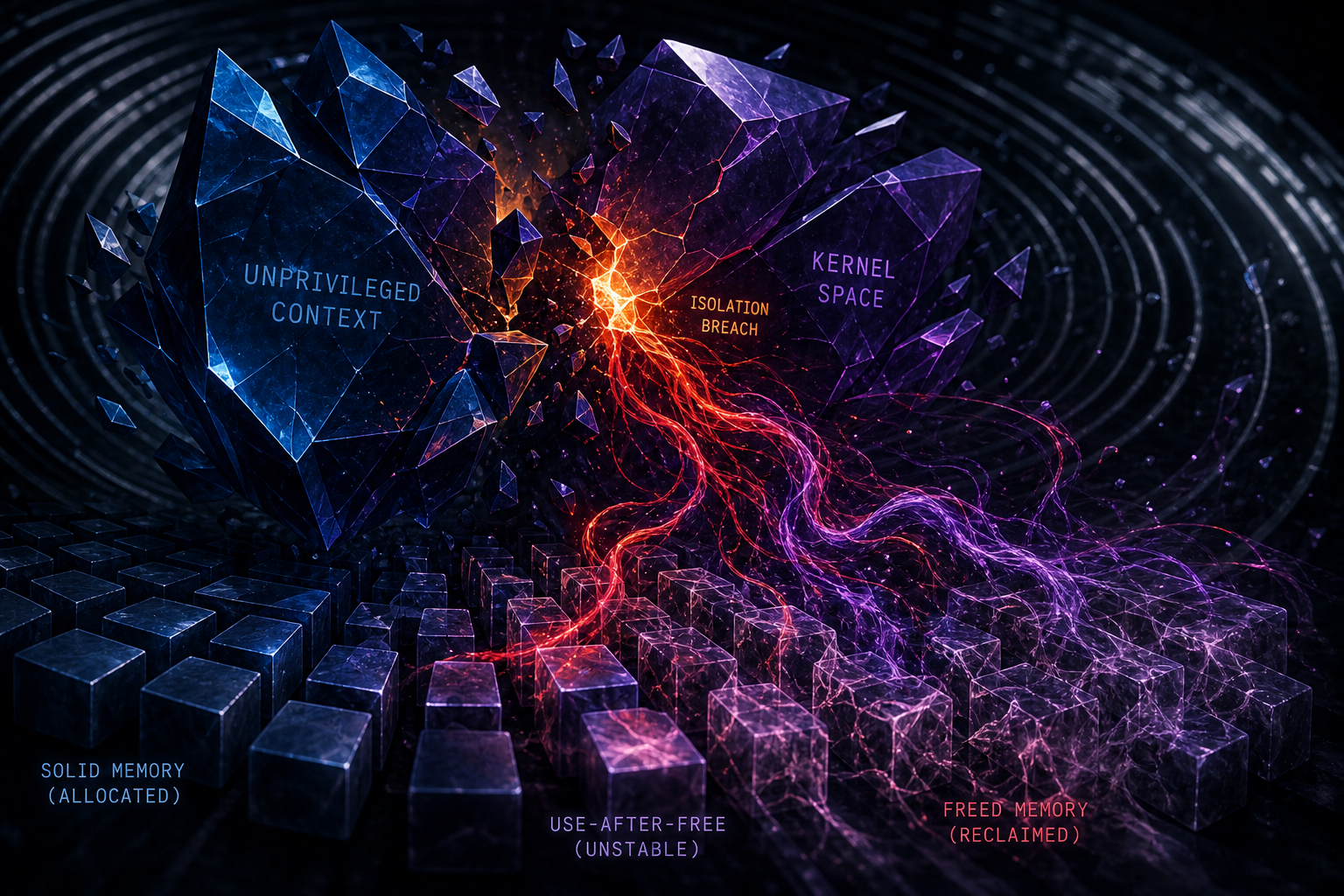
AFD.sys operates as a core component of the Windows networking stack, providing user-mode applications with low-level access to socket operations, asynchronous I/O handling, and protocol-specific functionality. The vulnerability stems from inadequate reference counting in socket descriptor lifecycle management. Specific sequences of WinSock API calls can induce a use-after-free condition—a state in which kernel-mode code attempts to access memory that has been deallocated or repurposed. This memory corruption occurs within kernel execution context, allowing attackers to read, write, or execute arbitrary kernel-mode code.
The technical trigger mechanism involves manipulation of socket descriptor closure and reuse patterns. When an application calls specific combinations of closesocket(), WSAAsyncSelect(), or WSAEventSelect() functions in particular timing sequences, the driver fails to properly maintain reference counts on internal socket data structures. This allows premature deallocation of memory regions that remain referenced by concurrent kernel-mode operations. Subsequent dereferences of these regions result in reads or writes to attacker-controlled memory locations or kernel heap metadata, enabling arbitrary code execution within kernel context.
Lazarus Group operatives began integrating CVE-2026-68820 into their multi-stage attack frameworks approximately two weeks prior to public disclosure. Observed exploitation chains follow a consistent pattern: initial compromise through phishing attachments or watering hole attacks delivers unprivileged malware payloads. These payloads embed custom WinSock API call sequences designed to trigger the use-after-free vulnerability. Upon successful exploitation, the attacker gains kernel-level execution context, enabling injection of secondary payloads—including rootkits, credential harvesting modules, and persistence mechanisms that operate below the visibility of user-mode security software.
Geographic targeting patterns indicate deliberate prioritization of financial institutions across Asia-Pacific and Europe, with secondary campaigns directed toward critical infrastructure operators and government agencies in North America. Attack telemetry shows operational adaptation following early defensive measures: initial reconnaissance phases verify system patch status and security software configuration before exploit delivery, indicating operator awareness of remediation timelines and selective targeting of higher-success environments.
Evidence of active exploitation derives from multiple independent sources. The CyberSense Radar Intelligence platform identified command-and-control infrastructure consistent with historical Lazarus Group operational patterns, including domain generation algorithm infrastructure, compromised hosting providers in third-party jurisdictions, and exfiltration paths matching previously documented campaigns. Security vendors' threat research has published detection signatures for known exploit payloads, Windows Event Log patterns indicative of successful exploitation, and network-based indicators of compromise. Threat intelligence sharing within financial services and critical infrastructure sectors has identified specific organizations experiencing active compromise attempts, with confirmed successful exploitation in at least three financial institutions and one critical infrastructure operator.
The vulnerability affects Windows 10 (all supported versions), Windows 11, and Windows Server 2016, 2019, and 2022. Early patch telemetry indicates approximately 35–45% of enterprise Windows installations remain unpatched within 96 hours of emergency patch release, reflecting the gap between patch availability and organizational deployment capacity.
Why It Matters
Financial Services Organizations
Kernel compromise enables direct access to transaction processing systems, payment gateway infrastructure, SWIFT integration points, and customer databases. An attacker achieving kernel-level access can bypass data loss prevention tools, sniff encrypted network traffic before encryption, inject transaction-modifying code into payment processing applications, or establish persistent backdoors for sustained data exfiltration or fraud operations. A single compromised workstation can become an entry point for infrastructure-wide compromise if kernel-level access enables lateral movement to critical servers.
Critical Infrastructure Operators
Supervisory control and data acquisition (SCADA) systems, power grid monitoring platforms, water treatment controllers, and telecommunications infrastructure often operate Windows-based administrative consoles or data collection servers. Kernel-level compromise of these systems enables physical-world attacks: malicious sensor modification, false data injection into control systems, disabling of safety interlocks, or corruption of historical logs that would normally trigger incident response.
Government and Defense Contractors
Compromise of a managed service provider serving government clients through a single kernel-level foothold can facilitate lateral movement to multiple customer networks. This represents compounded risk through supply chain dependencies.
All Organizations
CVE-2026-68820 invalidates fundamental Windows security architecture principles that underpin modern defense strategies. The user-mode/kernel-mode isolation boundary—enforced through CPU privilege levels—represents the foundational security separation of modern Windows operating systems. This isolation prevents untrusted application code from directly accessing kernel-controlled resources including process memory, hardware devices, cryptographic keys, and sensitive driver state. CVE-2026-68820 creates a direct pathway across this boundary, eliminating the isolation layer and granting access to kernel-controlled resources. This represents a critical degradation of defense-in-depth strategies where many organizations rely on layered controls that assume user-mode compromise as a containment point.
Operational Implications
Immediate (0–24 Hours): Organizations must implement multi-layer detection strategies recognizing that traditional endpoint antivirus cannot reliably identify exploit payloads prior to execution. WinSock API call pattern analysis represents the most direct detection methodology. Exploitation requires specific sequences of socket operations rare in legitimate application behavior. Endpoint Detection and Response tools capable of system call tracing can identify these patterns through behavioral analytics. Windows Event Log analysis provides complementary evidence through Kernel-General events that capture memory access violations and exception handling at privilege levels that isolate exploitation attempts.
Short-term (24–72 Hours): Patch testing requirements present the primary constraint on deployment timelines. System administrators must validate patch compatibility with production applications, database software, line-of-business systems, and third-party security tools before widespread deployment. This process requires 3–5 business days for straightforward environments. System reboot requirements create operational friction in 24/7 environments, necessitating business stakeholder agreement on service interruption timing, data consistency verification, and backup completion prior to reboot.
Medium-term (72 Hours – 2 Weeks): Enterprise patch deployment should follow a risk-stratified approach. Tier 1 systems (financial transaction servers, critical infrastructure control systems, external-facing services) receive patch priority with Tier 2 systems (internal infrastructure, administrative systems, departmental servers) following within 48–72 hours. Rollback procedures require planning before patch deployment, including criteria for rollback decision, system snapshots for rapid recovery, and documented rollback execution procedures.
Long-term (2–6 Weeks): Organizational resilience depends on layered defenses reducing both exploitation probability and impact scope. No single control—whether patch management, network segmentation, EDR tooling, or access controls—provides complete protection. Organizations that progress through advanced recommendations including patch deployment execution, incident response maturation, threat intelligence integration, and workforce capability development within 1–4 weeks will significantly enhance their long-term defensive posture and reduce vulnerability to future kernel-level threats.
Recommended Actions
Actions are organized by organizational security maturity. Baseline controls apply across all tiers and should be treated as immediate priorities regardless of organizational size.
* Organizations with standard security tooling and general-purpose endpoint protection.
- 1 - Complete comprehensive inventory of all Windows systems within the environment including on-premise servers and workstations, cloud-hosted Windows instances, remote access endpoints, and contractor-operated systems with network access.
- 2 - Classify systems by criticality based on direct handling of sensitive data, exposure to external networks, user population size, and support of critical business functions.
- 3 - Determine patch applicability by verifying Windows version and identifying prerequisite updates required before the CVE-2026-68820 security patch can be installed.
- 4 - Execute forensic queries against available logs and security tools using indicators of compromise from threat intelligence sources, specifically searching for known Lazarus Group malware and abnormal WinSock API call sequences.
- 5 - Review network trust boundaries and identify data flow paths from potentially compromised systems to critical infrastructure, implementing network segmentation controls to restrict lateral movement opportunities.
- 6 - Deploy the CVE-2026-68820 security patch to test systems and validate compatibility with production applications and dependencies before enterprise-wide rollout.
- 7 - Establish phased rollout schedule prioritizing critical systems with Tier 1 systems deployment within 48–72 hours, followed by Tier 2 and Tier 3 systems within 1–2 weeks.
* Organizations with advanced endpoint detection, SIEM capabilities, and mature patch management processes.
- 1 - Deploy enhanced monitoring for WinSock API abuse patterns specific to CVE-2026-68820 exploitation through EDR and kernel-level monitoring tools.
- 2 - Configure EDR detection rules capturing abnormal socket descriptor closure patterns, process privilege escalation, kernel-mode exception events, unsigned kernel driver loading, and code injection into critical system processes.
- 3 - Establish baseline normal system behavior to develop detection thresholds that reduce false positives while identifying exploitation attempts.
- 4 - Review and enforce principle of least privilege for user accounts, eliminating unnecessary administrative group memberships and implementing just-in-time elevated access.
- 5 - Implement Windows Defender Credential Guard and virtualization-based security (VBS) where hardware supports these capabilities to reduce privilege escalation effectiveness.
- 6 - Document patch testing results including any regressions, performance impacts, or application errors identified during compatibility validation.
- 7 - Prepare detailed rollback procedures documenting patch reversibility and establishing decision criteria for rollback execution.
* Organizations with comprehensive security infrastructure, threat intelligence integration, and mature incident response capabilities.
- 1 - Execute phased rollout according to established schedule with continuous monitoring of post-patch stability including application functionality, system performance, and error logs.
- 2 - Validate exploitation mitigation through controlled proof-of-concept payload testing in isolated lab environment, confirming that the patch prevents exploitation.
- 3 - Conduct tabletop exercise simulating Lazarus Group attack scenario including phishing email delivery, drive-by download, or watering hole infection followed by CVE-2026-68820 exploitation.
- 4 - Exercise communication channels, escalation procedures, and external coordination during incident response simulation.
- 5 - Update incident response procedures to reflect CVE-2026-68820–specific containment including automated system isolation upon exploitation detection, privileged access removal, and kernel-level forensic evidence collection.
- 6 - Establish ongoing subscription to Microsoft Security Update Guide for proactive vulnerability monitoring and integrate CyberSense intelligence into security operations center workflow.
- 7 - Participate in sector-specific information sharing groups to receive early warning of threats targeting the organization's sector.
- 8 - Develop predictive risk modeling for zero-day vulnerability exposure, establishing target remediation timelines for future critical vulnerabilities.
Closing Statement
CVE-2026-68820 exemplifies the contemporary threat landscape where sophisticated threat actors weaponize operating system kernel vulnerabilities to achieve comprehensive system compromise. The active exploitation by Lazarus Group operatives, combined with the vulnerability's low exploitation complexity and broad target scope, creates immediate institutional risk requiring maximum priority within organizational vulnerability management processes.
Organizations that respond within the recommended 48-hour immediate action window—completing vulnerability inventory, executing threat hunting, implementing network segmentation, and beginning patch testing—establish containment capabilities that significantly reduce exploitation probability. Those progressing through intermediate and advanced recommendations within 1–4 weeks mature their detection, response, and long-term resilience capabilities.
The vulnerability serves as a strategic reminder that security architecture assuming user-mode compromise as a containment point requires continuous validation and defense-in-depth reinforcement. No single control—whether patch management, network segmentation, EDR tooling, or access controls—provides complete protection; rather, layered defenses reduce both exploitation probability and impact scope. Organizational resilience depends not on eliminating vulnerability, but on detecting and containing compromise before it achieves the scope required for strategic attacker objectives.