
Rethinking Patch Prioritization: Analyzing Contextual Risk Signals Beyond Static CVSS Scoring

Executive Summary
CISA's Binding Operational Directive 26-04 mandates a fundamental reorientation in federal vulnerability management: the transition from CVSS-score-dependent patch scheduling to contextualized, multi-signal risk prioritization incorporating threat activity confirmation, asset criticality, organizational exposure, and exploitation probability. This mandate affects federal civilian agencies, designated critical infrastructure operators, federal contractors, and increasingly enterprise organizations pursuing institutional resilience alignment.
Immediate actionable guidance: Organizations continuing to sequence patches primarily by CVSS scores face compliance exposure, operational inefficiency, and elevated breach probability. Immediate assessment of patch management workflows, tooling capabilities, and personnel competencies is essential. Pilot integration of CISA's Stakeholder-Specific Vulnerability Categorization (SSVC) framework and FIRST's Exploit Prediction Scoring System (EPSS) should commence within 30 days for organizations subject to compliance timelines.
Key Finding: CISA's BOD 26-04 mandates transition from CVSS-dependent patch scheduling to multi-signal contextual prioritization, requiring adoption of SSVC decision-tree categorization and EPSS exploitation probability scoring to align remediation effort with organizational consequence and active threat confirmation rather than intrinsic vulnerability severity.
What Happened
In 2026, CISA formalized a strategic reorientation in federal vulnerability management through Binding Operational Directive 26-04, establishing contextual risk assessment as the authoritative framework for patch prioritization across federal civilian agencies, designated critical infrastructure sectors, and federal contractors. This represents a deliberate operational departure from decades of CVSS-primary workflows in which organizations sequenced patch deployment predominantly by Common Vulnerability Scoring System scores.
BOD 26-04 replaces CVSS-primary sequencing with a four-signal risk model drawn from CISA's Stakeholder-Specific Vulnerability Categorization (SSVC) methodology. Each vulnerability is evaluated against four decision points: Asset Exposure (is the affected asset reachable from public, untrusted networks), KEV Status (is the vulnerability listed on CISA's Known-Exploited Vulnerabilities catalog, indicating confirmed active exploitation), Exploit Automation (can an adversary automate the full exploitation chain), and Post-Exploitation Technical Impact (does exploitation yield partial or total control of the asset). The number of criteria met drives a tiered remediation clock—three days when all four are present, with 14- and 60-day tiers for lower-risk combinations. Complementary tools such as FIRST's Exploit Prediction Scoring System (EPSS) can strengthen the exploitation-probability picture, though the directive does not mandate EPSS specifically.
The third component requires real-time integration with CISA's Known-Exploited Vulnerabilities Catalog, which continuously catalogs vulnerabilities confirmed as actively exploited in the threat environment. This catalog provides definitive threat status confirmation—the first decision dimension in SSVC categorization and the primary trigger for priority remediation independent of CVSS scoring.
CISA's implementation guidance explicitly repositions CVSS scores from primary to supplementary status. Vulnerabilities with elevated CVSS scores affecting non-critical systems or experiencing no active exploitation may be legitimately deprioritized relative to lower-scored vulnerabilities affecting mission-critical assets or confirmed as exploited in active campaigns. This represents a fundamental inversion of legacy prioritization logic for organizations whose patch management platforms and workflows encode CVSS as the dominant sort mechanism.
BOD 26-04 is binding only on Federal Civilian Executive Branch agencies, which face mandatory remediation timelines, continuous asset tagging, and reporting obligations. It does not directly bind critical-infrastructure operators or federal contractors; CISA positions the directive as guidance for non-federal organizations. Its practical reach into the private sector comes through two channels: adoption as a de facto benchmark that boards, auditors, and cyber insurers increasingly reference, and FedRAMP's alignment of its Vulnerability Detection and Response rules to BOD 26-04 (effective December 7, 2026), which flows the framework down to cloud service providers serving the government.
Implementation for in-scope agencies is phased: framework deployment and tool integration first, followed by full operational transition and continuous reporting. For non-federal organizations the directive functions as the standard the market is converging on—those that adopt exposure-, exploitation-, and impact-aware prioritization now position themselves ahead of both regulatory drift and audit expectation.
This mandate emerges from accumulated operational evidence across federal agencies, critical infrastructure operators, and breach investigations demonstrating that CVSS-dependent prioritization systematically misallocates remediation effort. High-impact breaches frequently exploit vulnerabilities with moderate CVSS scores affecting high-consequence systems; conversely, many high-CVSS vulnerabilities remain unexploited despite widespread scanner alerts. CVSS reflects intrinsic severity, not organizational risk. Contextual prioritization aligns remediation with actual institutional risk surface.
Context-First Prioritization, Running Live
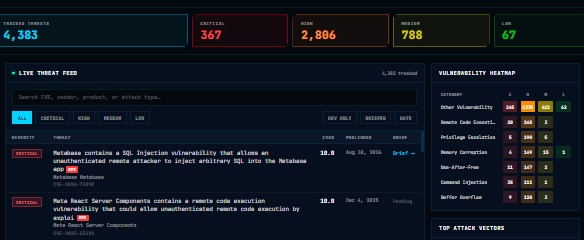
BOD 26-04 asks defenders to rank remediation by exploitation reality, not raw CVSS. The CyberSense Threat Radar operationalizes the exploitation-signal layer of that model: it merges NVD severity with CISA's live Known-Exploited Vulnerabilities catalog, flags confirmed-exploited CVEs the moment they are listed, and orders the feed by KEV status and contextual severity rather than score alone. It delivers the “is this actually being exploited” half of the directive's four-signal model—the layer organizations pair with their own asset-exposure and technical-impact context.
The third Recommended Action below—real-time CISA KEV synchronization with automated alerting—is exactly what the Radar demonstrates as a live, public feed.
Why It Matters
Security Practitioners and Vulnerability Management Teams
Static CVSS-dependent prioritization has demonstrably failed to align remediation effort with organizational breach probability. Practitioners operating under legacy workflows spend disproportionate resources remediating high-CVSS vulnerabilities affecting systems with minimal operational consequence while deferring remediation of actively exploited vulnerabilities affecting mission-critical assets. This fundamental mismatch between effort allocation and risk reduction represents both operational inefficiency and institutional risk accumulation. The shift to contextual assessment directly addresses this gap. Practitioners adopting SSVC categorization and EPSS scoring gain decision clarity anchored in organizationally relevant risk signals rather than abstract severity metrics. A vulnerability with CVSS 6.5 affecting a safety-critical industrial control system and confirmed as exploited correctly ranks above a CVSS 8.9 vulnerability affecting a development workstation with no observed exploitation. This alignment improves patch campaign effectiveness and eliminates false-priority noise that historically drives practitioner fatigue and decision-making degradation. Real-time integration with CISA's Known-Exploited Vulnerabilities Catalog provides practitioners immediate threat confirmation. Rather than waiting for incident detection, practitioners can identify confirmed exploited vulnerabilities in their environment and prioritize remediation proactively. This represents transition from reactive incident-driven models to threat-informed intelligence-driven vulnerability management.
Security Leadership and CISOs
Institutional resilience—organizational capacity to absorb cyber incidents and maintain critical function—depends fundamentally on protecting high-consequence assets. Contextual patch prioritization ensures remediation resources concentrate on systems whose compromise creates greatest operational, financial, or safety impact. Organizations implementing SSVC/EPSS workflows achieve measurably reduced exposure window duration for critical assets and demonstrably lower breach probability for high-value targets. The competitive dimension is material. Organizations implementing contextual prioritization earlier than peer institutions achieve demonstrable operational advantage: reduced remediation costs, faster exposure reduction, improved breach probability metrics, and clearer incident response preparedness posture. For critical infrastructure operators, superior vulnerability management posture supports regulatory compliance, stakeholder confidence, and competitive positioning. For federal contractors, early adoption demonstrates compliance preparedness and operational excellence—advantages in contract competition and renewal cycles. Compliance exposure is unavoidable for federal contractors and critical infrastructure operators. BOD 26-04 represents binding federal policy affecting contract eligibility, security clearance sponsorship, and regulatory standing. Organizations unable to demonstrate contextual patch prioritization workflows face explicit compliance violations with contractual and regulatory consequences.
Board-Level Risk Functions and Executives
Breach probability reduction achievable through contextual patch prioritization translates directly to reduced cyber incident costs, lower insurance premiums, and improved institutional resilience narratives. Executives can communicate to boards and stakeholders that patch prioritization now reflects organizational risk surface rather than abstract vulnerability scores—a material signal of operational maturity. Supply-chain risk visibility improves substantially. Organizations cascading BOD 26-04 compliance requirements to federal contractors and critical vendors strengthen upstream security posture. Vendor vulnerability management compliance becomes explicit governance requirement rather than assumed best practice.
Operational Implications
Immediate (0–30 Days): Most patch management, vulnerability scanning, and IT service management systems currently encode CVSS as the primary sort and prioritization mechanism. This technical architecture requires reconfiguration or replacement to support contextual prioritization. Many legacy tools lack native SSVC decision-support functionality, EPSS data integration, or real-time Known-Exploited Vulnerabilities Catalog synchronization. Organizations operating with such systems face immediate tool evaluation and replacement decisions. Vulnerability intake workflows—the processes by which vulnerabilities are discovered, scored, and sequenced for remediation—require fundamental redesign. Current workflows typically follow: scanner detection → CVSS scoring → threshold determination → patch assignment. Contextual workflows follow: scanner detection → CVSS + EPSS + KEV status + asset criticality assessment → SSVC categorization → organizational risk ranking → patch assignment. This requires integration of multiple data sources, cross-functional decision participation, and automated decision-support to remain operationally feasible at scale. Static monthly or quarterly patch cycles become operationally insufficient under contextual prioritization. When threat status changes (a vulnerability transitions to the Known-Exploited Vulnerabilities Catalog), when asset exposure shifts (a system previously isolated becomes network-accessible), or when threat intelligence surfaces novel exploitation patterns, patch sequencing must re-evaluate. Dynamic, continuous re-prioritization replaces static batch processing.
Near-Term (30–90 Days): Vulnerability analysts must develop competency in SSVC decision-tree reasoning, threat intelligence interpretation, and contextual risk assessment. Personnel trained exclusively on CVSS scoring require structured upskilling. Organizations must allocate training budget and personnel development time during transition periods, creating short-term analytical capacity constraints. Patch management now requires expanded data dependencies: real-time integration with CISA's Known-Exploited Vulnerabilities Catalog, EPSS data feeds, organizational asset management systems, network exposure monitoring platforms, and threat intelligence sources. These integrations must be technically reliable and maintained continuously. Data quality failures in any component—incorrect asset criticality classification, stale asset inventory, KEV feed delays—cascade through patch prioritization decisions. Cross-functional governance becomes necessary. Patch prioritization decisions must involve security operations, asset management, business continuity, and incident response teams. Organizations with siloed vulnerability management governance face friction and decision delays during transition. Governance structures must clarify decision authority and escalation pathways for conflicting risk signals.
Short-Term (90–180 Days): Manual SSVC categorization and contextual risk assessment for hundreds or thousands of vulnerabilities is operationally infeasible. Organizations must develop or procure automated decision-support systems integrating SSVC logic, EPSS scoring, asset criticality data, threat intelligence, and Known-Exploited Vulnerabilities status. This automation layer must remain maintainable and transparent; opaque black box automation of patch prioritization creates governance and auditability risk. Asset criticality data integrity becomes a critical security control. Organizations relying on incomplete, inaccurate, or outdated asset inventories cannot apply contextual prioritization effectively. Asset management systems must be continuously maintained, validated against operational reality, and updated as organizational infrastructure evolves. Many organizations currently operate with substantially incomplete asset visibility; remediation of asset management deficiencies becomes prerequisite for effective contextual patch prioritization. Network exposure monitoring and supply-chain threat intelligence become operational requirements. Organizations must understand which systems remain externally accessible, which are exposed to untrusted networks, and which third-party software dependencies present supply-chain vulnerability risks. This visibility directly informs SSVC environmental exposure assessment. Federal contractors face hard compliance deadlines affecting contract renewals and security clearance sponsorship. Non-compliance carries explicit contractual and regulatory consequences. Organizations must allocate project resources and executive attention commensurate with compliance risk. Critical infrastructure operators in CISA-designated sectors face sector-specific compliance timelines and regulatory oversight. Non-compliance may result in enforcement actions, operational directives, or regulatory consequences. Organizations not implementing SSVC/EPSS workflows will increasingly face competitive disadvantage in federal procurement and critical infrastructure oversight environments. Peer institutions demonstrating lower breach probability, faster remediation cycles, and improved risk metrics create implicit competitive pressure for laggard organizations to adopt contextual prioritization.
Medium-Term (180+ Days): Integrate emerging threat intelligence into ongoing contextual risk assessment. Monitor threat actor activity, exploit development timelines, and supply-chain vulnerability patterns. Update organizational context and threat signals as threat environment evolves. Refine SSVC categorization based on organizational experience and threat landscape evolution. Conduct post-mortem analysis of breaches or significant incidents to assess whether contextual prioritization would have altered vulnerability exposure timeline. Update categorization logic based on operational lessons learned. Establish predictive risk modeling to anticipate vulnerability classes likely to emerge, exploitation patterns likely to develop, and asset exposure likely to increase. Proactively update patch strategies based on forward-looking threat assessment. Establish benchmarking against peer organizations and industry vulnerability management standards. Document lessons learned and contribute organizational experience to vulnerability management community standards evolution. Establish BOD 26-04 compliance requirements in vendor security assessments and contract terms. Require suppliers and federal contractors to demonstrate contextual patch prioritization workflows aligned with organizational standards. Develop assessment and audit processes to validate contractor SSVC/EPSS implementation maturity. Establish clear compliance criteria and audit cadence. Cascade compliance expectations across multi-tier supply chains. Establish requirements for vendors' vendors, creating upstream security posture improvement across extended supply ecosystem.
Recommended Actions
Actions are organized by organizational security maturity. Baseline controls apply across all tiers and should be treated as immediate priorities regardless of organizational size.
* Organizations with standard security tooling and general-purpose endpoint protection.
- 1 - Conduct comprehensive audit of current patch management workflows to identify CVSS dependency and automation bottlenecks. Document current tool capabilities, integration points, automation logic, and escalation pathways. Identify legacy tools lacking SSVC, EPSS, or Known-Exploited Vulnerabilities Catalog support; prioritize tool replacement or integration roadmap planning.
- 2 - Map existing organizational asset criticality classifications to SSVC stakeholder categories (safety-impacting, mission-critical, supporting-function). Identify gaps in asset classification coverage, data quality issues, or systems lacking criticality assignments that prevent reliable categorization.
- 3 - Document current patch scheduling processes, remediation timelines by priority level, and existing patch backlogs stratified by CVSS score and organizational context. Quantify baseline metrics for transition comparison and performance assessment.
- 4 - Evaluate integration readiness with CISA's Known-Exploited Vulnerabilities Catalog and FIRST EPSS data feeds. Confirm technical capabilities to ingest, parse, and operationalize real-time external data sources. Document API availability, data freshness requirements, and integration complexity.
- 5 - Confirm organizational applicability of BOD 26-04 (federal contractor status, critical infrastructure sector designation, or federal agency affiliation). Review CISA implementation guidance for organization-specific compliance timelines, reporting requirements, and audit criteria.
- 6 - Establish compliance monitoring and reporting mechanisms to track implementation progress and audit readiness. Document compliance status and implementation roadmap for board and executive reporting.
- 7 - Conduct SSVC decision-tree training for vulnerability analysis, triage, and patch management personnel. Provide practical exercises applying decision trees to 20–30 representative vulnerabilities stratified across CVSS scores, asset types, and threat contexts. Establish team competency baseline before full operational deployment.
- 8 - Integrate FIRST EPSS data feed into vulnerability management platform if platform supports native EPSS scoring; alternatively, establish manual integration process or prioritize tool evaluation roadmap. Document EPSS data interpretation, score distribution, and organizational risk thresholds.
- 9 - Implement real-time CISA Known-Exploited Vulnerabilities Catalog synchronization. Establish automated alerting when vulnerabilities in the KEV Catalog are detected in organizational asset inventory. Establish remediation SLAs for known-exploited vulnerabilities independent of CVSS score.
- 10 - Prioritize pilot cohort of 50–100 representative vulnerabilities through contextual risk assessment model. Compare patch sequencing output to legacy CVSS-dependent rankings. Analyze differences: identify vulnerabilities that shift substantially in priority ranking. Assess whether new sequencing aligns with organizational risk perception and operational knowledge.
- 11 - Audit and validate organizational asset inventory against operational criticality classifications. Identify systems with missing, inaccurate, or outdated criticality assignments. Establish governance process for ongoing asset classification maintenance and validation.
- 12 - Map asset classifications explicitly to SSVC stakeholder categories. Document which systems perform safety-impacting functions, which are mission-critical, and which provide supporting capabilities. For distributed or complex systems, establish categorization at component level to enable granular contextual assessment.
- 13 - Establish governance structure for asset criticality updates. Integrate asset management, infrastructure operations, and security operations teams to ensure ongoing synchronization between operational reality and criticality classification data.
- 14 - Identify patch management, vulnerability management, and IT service management platforms with native SSVC/EPSS support or credible integration roadmaps. Request vendor demonstrations of contextual prioritization workflows, integration capabilities, and reporting features.
- 15 - Assess custom automation requirements for organizations with legacy tool limitations. Determine whether custom scripts, middleware orchestration platforms, or third-party vulnerability management solutions can bridge tool functionality gaps cost-effectively.
- 16 - Document integration dependencies, data flow requirements, and technical specifications for tool selection or custom development.
- 17 - Deploy contextual risk prioritization across entire vulnerability intake and patch scheduling workflow. Replace CVSS-primary sort logic with integrated SSVC categorization and EPSS scoring. Establish organizational risk rankings that transparently reflect asset criticality, threat status, exploit likelihood, and organizational context.
- 18 - Establish continuous synchronization with Known-Exploited Vulnerabilities Catalog, EPSS feeds, and threat intelligence sources. Automate data ingestion and trigger patch re-prioritization when threat status, asset exposure, or organizational context changes.
- 19 - Implement automated decision-support systems for high-volume vulnerability triage. Define automation rules aligned with organizational risk criteria; establish human escalation pathways for edge cases, novel vulnerability patterns, and conflicting risk signals.
- 20 - Operationalize cross-functional patch prioritization governance. Establish review cadence, decision authority, and escalation pathways for patch sequencing. Ensure representation from security operations, asset management, business continuity, and incident response functions.
- 21 - Establish baseline metrics: average patch deployment timeline by criticality level, percentage of vulnerabilities deployed within SLA windows, exposure window duration for critical assets, and mean time-to-remediation for known-exploited vulnerabilities.
- 22 - Track known-exploited vulnerability coverage and remediation velocity. Measure percentage of vulnerabilities in Known-Exploited Vulnerabilities Catalog affecting your environment and time-to-remediation for confirmed exploited vulnerabilities.
- 23 - Monitor compliance status and audit readiness. Document implementation progress against BOD 26-04 requirements. Prepare evidence of contextual patch prioritization deployment for compliance review and audit.
Closing Statement
The transition from static CVSS-dependent patch prioritization to contextual, multi-signal risk assessment represents the most significant shift in federal vulnerability management doctrine in over a decade. This evolution reflects accumulated operational evidence demonstrating that organizational breach probability depends not on abstract vulnerability severity but on the confluence of threat activity confirmation, asset consequence, environmental exposure, and organizational context. BOD 26-04 mandates this alignment for federal civilian agencies and sets the benchmark that auditors, boards, cyber insurers, and FedRAMP-regulated vendors are already adopting; early-moving enterprises gain competitive advantage through improved breach probability reduction and remediation efficiency.
The transition requires substantial operational investment: workflow redesign, tool reconfiguration or replacement, personnel retraining, and governance restructuring. Organizations delaying implementation face compliance exposure, operational inefficiency, and elevated breach probability. Immediate assessment of current patch management workflows, tooling capabilities, and compliance status establishes foundation for transition planning. Pilot integration of SSVC and EPSS within 30 days positions organizations for successful full deployment within compliance timelines.
Institutional resilience—organizational capacity to protect high-consequence assets and absorb cyber incidents—depends fundamentally on patch prioritization rigor. Contextual vulnerability assessment bridges the critical awareness gap between vulnerability scoring and organizational risk, translating technical intelligence into strategic defense aligned with institutional consequence.