
Segmenting the Perimeter: Analyzing Network Isolation Strategies in CI Fortify Guidance
Executive Summary
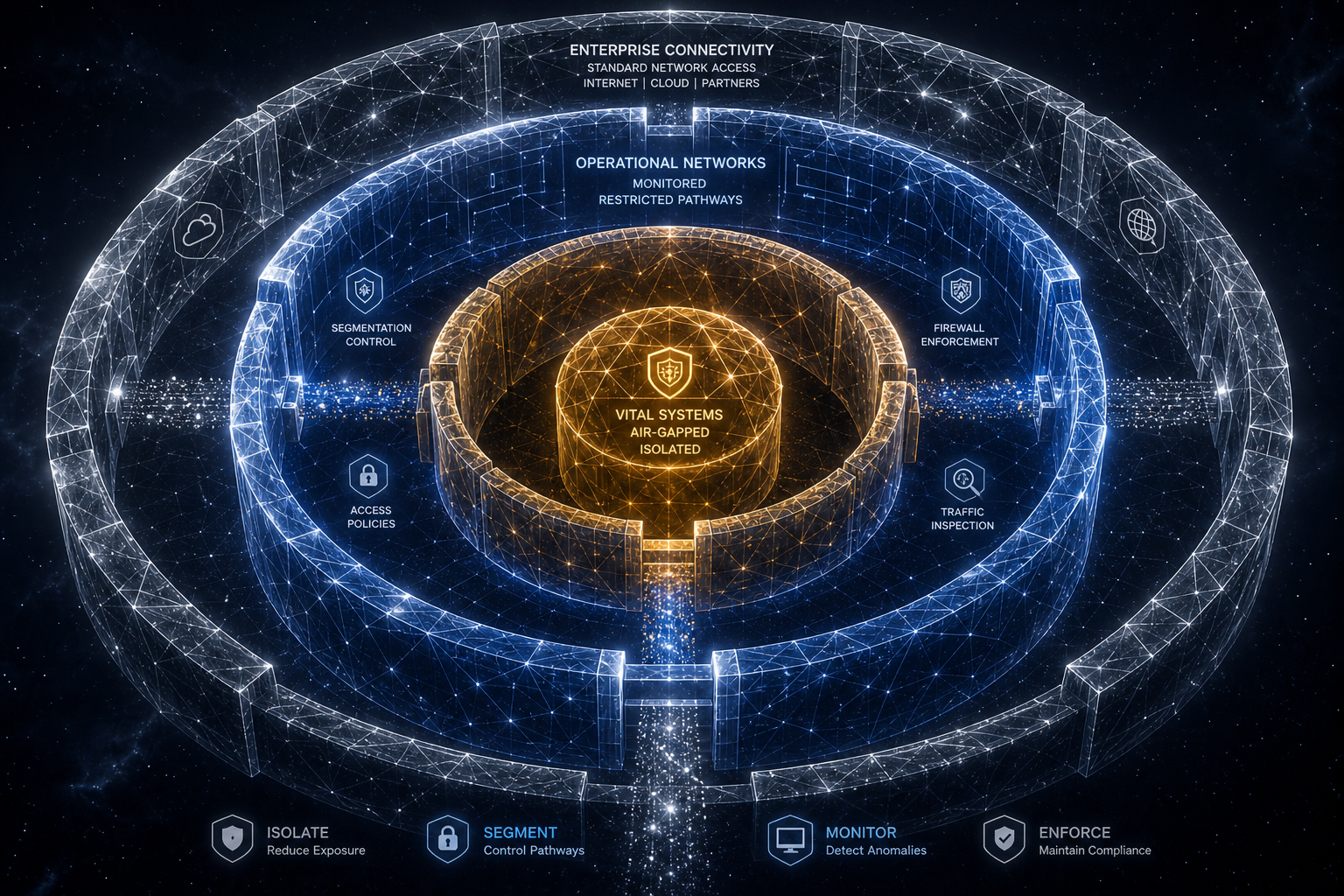
The July 2026 coordinated release of CI Fortify guidance by the Australian Cyber Security Centre, U.S. Cybersecurity and Infrastructure Security Agency, and UK National Cyber Security Centre establishes network segmentation and perimeter isolation as mandatory architectural controls for critical infrastructure operators. The three-tier isolation model—comprising air-gapped vital systems, restricted operational DMZ networks, and standard enterprise IT—now constitutes the institutional baseline for critical infrastructure resilience across three major jurisdictions and their respective supply chains.
Immediate actionable guidance: For security leaders and infrastructure operators, this represents a decisive shift from aspirational best practice to enforceable compliance expectation. Implementation timelines span 12–24 months for most organizations, requiring significant capital investment, workforce retraining, and operational redesign. The strategic imperative is immediate: operators must initiate isolation inventory and architecture planning now to align with emerging regulatory enforcement expectations and avoid compressed timelines during enforcement cycles.
Key Finding: CI Fortify guidance establishes mandatory perimeter segmentation as the primary control architecture for vital systems, with three-tier isolation models (air-gapped critical zones, DMZ operational networks, and enterprise IT) now serving as the institutional standard for critical infrastructure resilience.
What Happened
In July 2026, three major cybersecurity authorities—the Australian Cyber Security Centre, the U.S. Cybersecurity and Infrastructure Security Agency, and the UK National Cyber Security Centre—released coordinated guidance on critical infrastructure isolation. The ACSC published CI Fortify - Advice for Isolating Vital Systems, establishing prescriptive segmentation frameworks and operational isolation procedures. Simultaneously, CISA integrated isolation requirements into its Industrial Control Systems Topic Page and Shields Ready implementation program, while NCSC released Secure Connectivity for Operational Technology, providing risk assessment methodologies and connectivity mitigation protocols.
This coordinated release represents the first transatlantic alignment on mandatory isolation architecture standards for critical infrastructure. The guidance designates vital systems—those whose compromise poses direct threat to public safety, national security, or essential service continuity—as requiring enforced isolation from standard networked environments. Specific outputs include detailed architecture diagrams, segmentation implementation procedures, air-gap protocols, and compliance mapping to existing regulatory frameworks including NERC-CIP, NIST Cybersecurity Framework, and sector-specific mandates.
The CI Fortify framework prescribes a three-tier architecture: a critical zone containing air-gapped vital systems with manual or heavily restricted data transfer protocols; an operational DMZ supporting systems requiring limited external connectivity through monitored, firewall-restricted channels and technologies such as data diodes; and standard enterprise IT with conventional network security controls. The guidance explicitly addresses operational technology environments, recognizing the unique constraints of legacy systems, real-time operational requirements, and industrial settings while establishing non-negotiable isolation baselines.
The framework applies across Australian critical infrastructure operators under ACSC authority, U.S. entities subject to CISA coordination and sector-specific regulations, and UK operators within NCSC compliance expectations. Critically, the guidance creates mutual expectations for vendors, integrators, and multi-jurisdictional infrastructure operators through coordinated supply chain implications. The designation as authoritative guidance signals enforcement intent: regulatory bodies within each jurisdiction are expected to reference CI Fortify as compliance standard within forthcoming enforcement cycles.
Why It Matters
Critical Infrastructure Operators and Security Leadership
CI Fortify's coordinated release marks a fundamental institutional shift in how critical infrastructure security is architected and regulated. For decades, network isolation operated as a best-practice recommendation; it now constitutes enforceable baseline. This transition reflects demonstrated vulnerabilities in current operational technology environments. Nation-state actors have systematically targeted critical infrastructure operators, moving beyond reconnaissance into active exploitation of OT/IT convergence vulnerabilities. Ransomware groups have evolved from purely financial motivations to targeting industrial control systems themselves, directly threatening public safety. Supply chain compromise of OT components has increased in sophistication, creating exposure pathways that networked architectures cannot adequately contain. The institutional recognition underlying CI Fortify is stark: segmentation is the primary technical defense against lateral movement following IT system compromise—the most probable attack vector into operational technology. Isolation cannot prevent initial compromise, but it fundamentally restricts the consequences of breach and limits an adversary's ability to degrade, disrupt, or damage vital systems.
Workforce and Operational Technology Engineers
Current operational technology environments reflect legacy integration models, many predating modern cybersecurity architecture. Systems designed for closed industrial networks have been progressively connected to enterprise IT and, in some cases, internet-facing access points to enable remote monitoring, vendor support, and cloud integration. This convergence created operational efficiency but introduced persistent compromise vectors. CI Fortify requires systematic reversal of this trend for vital systems, with engineers tasked with designing architectures that restore isolation without degrading real-time operational performance or introducing unacceptable latency. This represents a foundational skill-set evolution for the OT engineering workforce. Systems must operate reliably in segmented, air-gapped, or heavily restricted environments. Engineers must develop competency in firewall rules, data diode technology, secure administrative access protocols, and isolation verification procedures—disciplines traditionally in IT security domains rather than operational engineering.
Regulatory and Compliance Functions
Regulatory frameworks within each jurisdiction—NERC-CIP for energy, sector-specific CRITICAL Infrastructure Protection Act requirements, and emerging state-level mandates—will increasingly reference CI Fortify as compliance standard. Compliance documentation will require evidence of vital system isolation, segmentation architecture validation, and isolation monitoring. Audit expectations will shift toward isolation verification rather than network inventory alone. This creates direct accountability for security and compliance leadership to demonstrate isolation implementation and ongoing maintenance.
Supply Chain and Vendor Relationships
CI Fortify creates mutual expectations across supply chains. Vendors providing components or integration services to critical infrastructure operators must support segmentation architectures. Traditional IT vendors accustomed to cloud-first, internet-connected service delivery models must adapt products to function in air-gapped or restricted-connectivity environments. This creates significant business continuity implications for technology vendors and integration partners serving critical infrastructure sectors and establishes compatibility expectations for future procurement decisions.
Operational Implications
Architecture Redesign and Implementation Burden: Critical infrastructure operators face mandatory inventory of vital systems and consequent network topology redesign against the CI Fortify three-tier model. Most organizations will require 12–24 months for full implementation. Initial phases involve asset identification against CI Fortify criteria, mapping of current network topology against the prescribed model, and comprehensive gap analysis. Organizations must determine which systems genuinely require air-gap isolation versus those supporting operational DMZ connectivity—a distinction requiring deep understanding of system interdependencies and operational requirements. Capital expenditure is substantial. Network infrastructure redesign, procurement of segmentation technology (firewalls, data diodes, secure access points), air-gap hardware, and monitoring infrastructure represent significant line items. Organizations operating across multiple sites or jurisdictions face compounding complexity and cost. Hybrid deployment models—where some vital systems operate air-gapped while others function in monitored DMZ environments—require sophisticated firewall rules, secure jump-server infrastructure, and multi-factor authentication systems for cross-segment administrative access.
Immediate (0–90 days): Operators must obtain CI Fortify guidance documents, designate vital systems using provided criteria, and map current topology against requirements. Security leadership must establish implementation governance, assign accountability, and secure executive awareness of resource requirements and timeline implications.
Short-term (90–360 days): Planning and preliminary implementation should occur in non-critical test environments. Organizations should establish segmentation monitoring infrastructure, develop cross-domain access policies, and conduct isolation effectiveness testing. Workforce training should begin for OT engineering teams on segmentation architecture, air-gap operations, and monitoring procedures.
Long-term (360+ days): Phased implementation into production environments, continuous isolation verification, regular penetration testing of segment boundaries, and adaptation as systems evolve. Organizational structures must stabilize around new operational roles: OT/IT integration specialists, segmentation architecture engineers, and isolation monitoring specialists.
Workforce and Skill-Set Requirements: The isolation architecture transition requires new or significantly expanded roles. OT engineers must develop competency in network security fundamentals, firewall rule development, and air-gap operations. IT operations teams must manage cross-domain access procedures, secure administrative jump servers, and DMZ segmentation. Security operations must establish continuous monitoring for isolation integrity, develop anomaly detection for cross-segment traffic, and conduct regular isolation verification testing. For organizations lacking in-house expertise, external support—consultant engagement for architecture design, vendor partnerships for technology implementation, and managed service providers for ongoing monitoring—becomes necessary. This creates labor market pressure during industry-wide transition and potential skill gaps for organizations competing in constrained talent markets.
Compliance and Regulatory Integration: Organizations must map CI Fortify requirements to existing compliance obligations. NERC-CIP entities (primarily energy sector) will find isolation requirements align with CIP-005 (System Security Management) and CIP-007 (System Security Management—Information Security Management Systems) but require specific documentation of isolation architecture. CRITICAL Infrastructure Protection Act compliance expectations will evolve toward mandatory isolation. Sector-specific regulators will incorporate CI Fortify into enforcement frameworks during standard compliance cycles. Board-level risk reporting must reflect isolation implementation status, resource commitments, and compliance timelines. Audit functions must transition from reviewing network security controls to validating isolation architecture and monitoring effectiveness. Vendor contracts and third-party risk assessments must incorporate segmentation requirements and isolation expectations.
Continuity and Performance Constraints: Critical infrastructure operators cannot afford operational degradation during isolation implementation. Real-time control systems, safety-critical functions, and customer-facing services must maintain performance and availability throughout redesign. This constraint necessitates careful phasing, extensive testing in non-production environments, and parallel operation of legacy and segmented architectures during transition periods. Organizations operating 24/7 with minimal maintenance windows face particularly acute scheduling challenges and must plan implementation during planned maintenance cycles or staged across years.
Recommended Actions
Actions are organized by organizational security maturity. Baseline controls apply across all tiers and should be treated as immediate priorities regardless of organizational size.
* Organizations with limited segmentation experience.
- 1 - Immediate (Week 1–2): Designate responsible leadership (CISO or equivalent) to own CI Fortify implementation; obtain official guidance documents from respective authority (ACSC for Australian operators, CISA for U.S., NCSC for UK); conduct all-hands briefing for security, OT engineering, IT operations, and executive leadership.
- 2 - Month 1: Conduct initial vital system inventory using CI Fortify designation criteria; develop current-state network topology documentation; identify obvious compliance gaps; establish project governance structure and preliminary timeline.
- 3 - Months 2–3: Develop business case for isolation architecture redesign, including capital and operational cost estimates, timeline implications, and resource requirements; secure executive approval and funding commitment; identify external consulting support if in-house expertise is limited.
- 4 - Months 4–6: Develop preliminary segmentation architecture for vital systems; identify technology vendors and products; conduct vendor capability and compatibility assessment; plan pilot implementation in non-critical test environments.
* Organizations with existing network segmentation practices.
- 1 - Immediate: Validate current segmentation against CI Fortify three-tier model; identify gaps between existing architecture and mandatory requirements; prioritize systems requiring air-gap conversion or DMZ restriction.
- 2 - Months 1–3: Develop detailed architecture for critical zone (air-gapped) systems; design operational DMZ with specific firewall rules and secure access controls; develop migration strategy for systems currently operating in hybrid or insufficiently segmented environments.
- 3 - Months 3–6: Implement segmentation in test environments; conduct comprehensive isolation testing; validate air-gap integrity; establish monitoring and anomaly detection infrastructure for segment boundaries.
- 4 - Months 6–12: Phased implementation into production environments, beginning with non-critical systems; establish operational procedures for cross-domain access and administrative functions; conduct workforce training for OT and IT operations teams.
* Organizations with mature segmentation and isolation capabilities.
- 1 - Immediate: Gap analysis of existing isolation architecture against CI Fortify prescriptive requirements; validation of vital system designations; assessment of monitoring and verification procedures against guidance expectations.
- 2 - Months 1–2: Develop continuous isolation assurance program; establish automated monitoring for segment boundary integrity; conduct penetration testing of segment boundaries; develop isolation restoration procedures for incident response.
- 3 - Months 3–6: Validate supplier and vendor ecosystem alignment with segmentation requirements; update procurement RFPs to mandate isolation support; assess supply chain components for compatibility with air-gap or restricted-connectivity environments.
- 4 - Ongoing: Establish quarterly isolation architecture reviews; conduct annual penetration testing; maintain awareness of emerging segmentation technologies; contribute to industry working groups defining isolation standards and best practices.
* Organizational functions across all maturity levels.
- 1 - IT Operations: Establish cross-domain access control policies; design and validate secure administrative jump servers; develop DMZ firewall rules and segment-specific network monitoring; establish change control procedures for isolation infrastructure.
- 2 - OT Engineering: Conduct training on segmentation architecture and air-gap operations; assess legacy system compatibility with isolation requirements; develop upgrade or replacement roadmap for components incompatible with segmentation.
- 3 - Incident Response and Security Operations: Update incident playbooks to include isolation verification and cross-segment containment procedures; establish quarterly testing protocols for validating segment boundary integrity; develop incident response procedures leveraging isolation architecture.
- 4 - Procurement and Vendor Management: Update RFPs to include segmentation and isolation requirements; assess current vendor ecosystem for compatibility and support commitments; identify alternative vendors where current partners cannot support segmentation.
- 5 - Compliance and Risk Functions: Map CI Fortify requirements to existing compliance obligations; develop compliance documentation templates; establish metrics for isolation implementation status and effectiveness; prepare for regulatory inquiries and compliance audits.
Closing Statement
CI Fortify's coordinated release reflects institutional consensus among three major cybersecurity jurisdictions: network segmentation and perimeter isolation are no longer optional architectural elements for critical infrastructure—they are mandatory defensive baselines. The guidance translates this principle into prescriptive, implementable frameworks that address the unique constraints of operational technology environments while establishing non-negotiable isolation standards.
For critical infrastructure operators, the strategic imperative is clarity and immediacy. Guidance has been published; regulatory enforcement frameworks will follow. Organizations that begin isolation implementation now, informed by CI Fortify frameworks, position themselves ahead of enforcement cycles and compliance requirements. Those delaying face compressed implementation timelines, elevated audit risk, and potential enforcement actions.
The broader institutional value extends beyond any single organization: CI Fortify establishes common architectural language and baseline expectations across transatlantic supply chains. Vendors can design products and integration approaches against defined standards. Operators can coordinate with partners and regulators against shared frameworks. Security professionals can plan defense-in-depth strategies knowing that isolation architecture follows consistent principles regardless of geographic jurisdiction.
The challenge ahead is organizational and operational, not merely technical. Isolation requires sustained commitment, workforce development, and architectural discipline. Yet the institutional recognition is sound: isolation fundamentally changes the mathematics of critical infrastructure defense. Breaches remain inevitable; their consequences become containable.