Decentralizing Command and Control: Analyzing Blockchain-Based Domain Resolution and Multi-Tier C2 Resilience in Kimwolf v7
Executive Summary
Kimwolf v7 represents a significant architectural shift in botnet operational design, integrating blockchain-based domain resolution and multi-tier command-and-control distribution to circumvent conventional takedown infrastructure. The malware has compromised approximately 2 million Android TV devices and similar IoT platforms, which now operate as both attack nodes and monetized residential proxy infrastructure.
Unlike previous botnet generations reliant on centralized domain registration or DNS-dependent command channels, Kimwolf v7 achieves persistence through distributed ledger mechanisms that resist traditional sinkholing, registrar intervention, and BGP hijacking. This evolution extends the exposure window indefinitely and requires enterprise defenders, critical infrastructure operators, and infrastructure providers to fundamentally reassess asset inventory practices, network segmentation strategies, and incident response capabilities.
Key Finding: Kimwolf v7 leverages blockchain-based domain resolution and multi-tier command-and-control distribution to achieve infrastructure resilience previously unattainable through conventional DNS poisoning or sinkholing operations, establishing a reference model for next-generation botnet operational security that requires enterprise and infrastructure operators to fundamentally reassess defensive assumptions.
What Happened
In the months preceding August 2026, threat researchers at Palo Alto Networks Unit 42 and analysts at Security Affairs identified and documented Kimwolf v7, a botnet variant representing a substantial departure from traditional malware command-and-control architectures. The discovery emerged through detection of compromised Android TV boxes and related ARM-based IoT devices exhibiting coordinated malicious behavior across residential networks globally.
The infection campaign achieved widespread compromise of approximately 2 million Android devices, with clustering patterns concentrated in regions where inexpensive Android TV boxes and set-top devices have achieved significant market penetration. Distribution occurred through network-based propagation exploiting vulnerable firmware implementations and credential compromise on devices with default or weak authentication configurations.
Once compromised, infected devices underwent transformation from consumer electronics into dual-purpose infrastructure nodes—simultaneously serving as distributed denial-of-service attack vectors and integrated elements within a commercialized residential proxy network. The technical architecture underlying Kimwolf v7 introduces blockchain integration as a foundational element of command-and-control resilience.
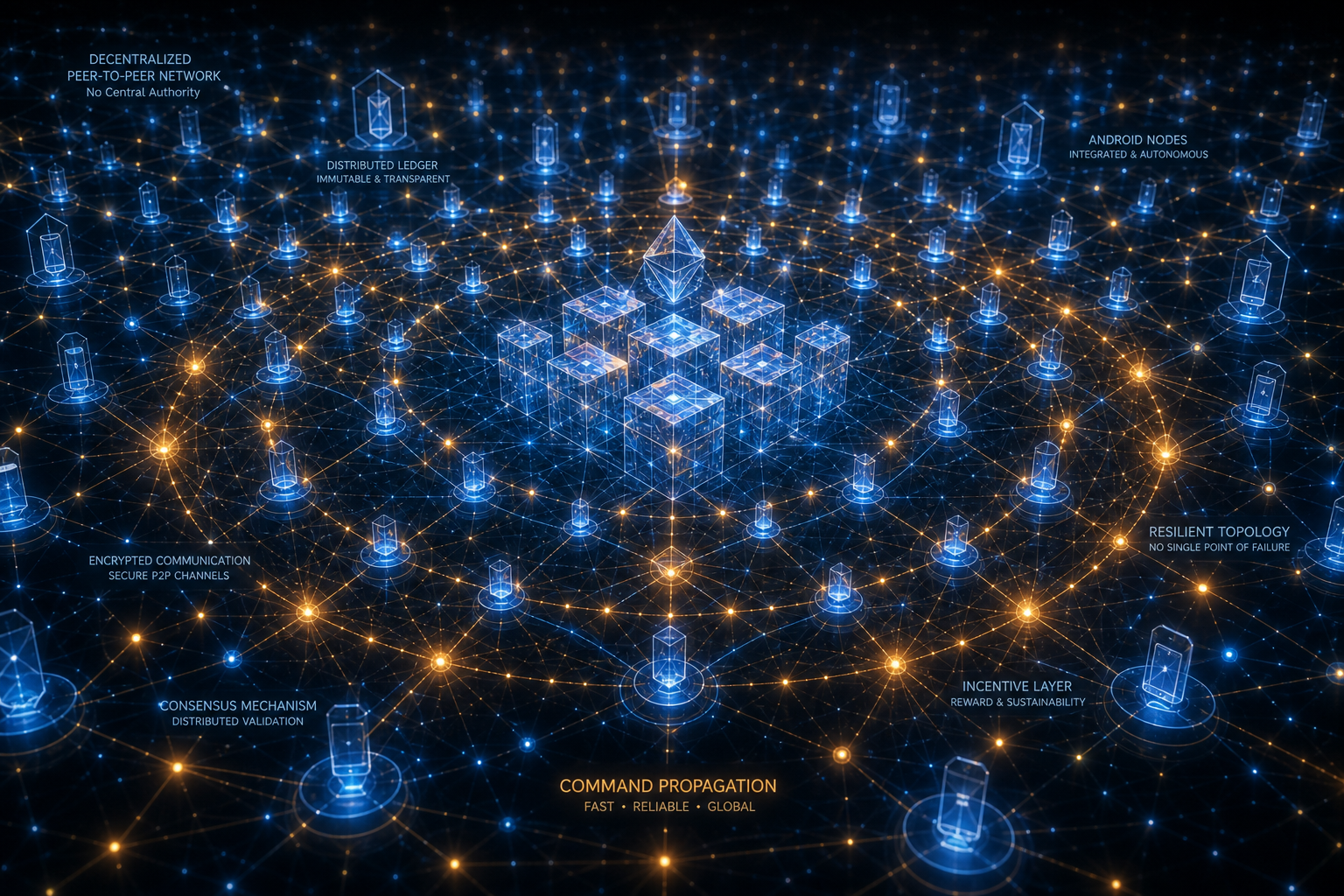
Rather than relying on centralized domain names, dynamic DNS services, or peer-to-peer networks vulnerable to infrastructure provider intervention, the botnet employs blockchain ledgers to maintain distributed domain resolution mechanisms. This approach decouples command channel availability from registrar cooperation, DNS provider intervention, or network-level sinkholing.
Command-and-control hierarchy employs multi-tier distribution. Bot nodes do not communicate directly with a central command server; instead, they interact with hierarchically distributed nodes that aggregate and propagate commands through peer-to-peer or blockchain-mediated channels. This architecture provides redundancy and resilience against the loss of individual infrastructure components.
The monetization dimension of Kimwolf v7 operations deserves particular attention. Beyond DDoS-for-hire capabilities, compromised devices have been integrated into residential proxy networks and marketed to commercial customers. This dual-monetization approach creates financial incentives for botnet persistence and expansion that exceed those present in traditional DDoS-only botnets.
Operational deployment of Kimwolf v7 malware has demonstrated active distributed denial-of-service attack capabilities across multiple target sectors. Persistence mechanisms embedded within Kimwolf v7 include anti-removal techniques specific to Android TV and IoT environments, with rootkit-level integration in certain device configurations.
Why It Matters
Enterprise Information Security and Risk Management
Enterprise organizations face expanded vulnerability across consumer electronics deployments on corporate networks. Android TV boxes, smart displays, set-top devices, and network-attached storage systems have become routine components of office environments, conference rooms, and media delivery infrastructure. These devices, typically procured through consumer channels with minimal security evaluation, frequently receive inadequate firmware maintenance and operate under default or weak authentication credentials. Compromise of a single such device within a corporate network provides threat actors with internal network access, lateral movement vectors, and persistent reconnaissance capabilities. The Kimwolf v7 campaign demonstrates that compromised consumer electronics can be weaponized at scale with minimal friction. This blind spot extends to detection and response capabilities; most enterprise security operations centers maintain detection rules optimized for traditional endpoints and mobile phones, while ARM-based IoT devices operating custom or minimal operating systems frequently fall outside standard endpoint detection and response platforms.
Critical Infrastructure Operators
Critical infrastructure organizations—particularly those in energy, communications, and financial sectors—depend on absorbing volumetric denial-of-service attacks through architectural redundancy, upstream mitigation, and internet service provider cooperation. Conventional DDoS mitigation assumes attack infrastructure that can be located, identified, and rate-limited through ISP intervention or BGP-level filtering. Kimwolf v7's distributed architecture complicates these assumptions. If attack volume originates from thousands of geographically dispersed residential networks, traditional upstream mitigation becomes logistically challenging. Organizations must plan for DDoS scenarios in which conventional upstream mitigation proves insufficient or delayed, potentially requiring architectural enhancements to absorb larger attacks and redundancy across multiple service providers.
Internet Service Providers and Telecom Infrastructure
ISPs occupy an increasingly complex position in the adversarial landscape. Residential networks under ISP management constitute the operational infrastructure for botnets like Kimwolf v7. The compromise of these networks facilitates attack capabilities that target ISPs' own customers and critical infrastructure. Current industry practice places significant burden on ISPs to detect and remediate compromised residential devices, but detection capabilities remain inconsistent and response timelines often extend across weeks or months. Kimwolf v7 demonstrates the monetization of compromised residential infrastructure through proxy network integration, creating customer satisfaction and privacy concerns, along with potential legal liability questions regarding ISP responsibility for proactive detection and remediation.
Regulatory and Policy Bodies
The distributed, blockchain-integrated nature of Kimwolf v7 introduces novel questions regarding jurisdiction, enforcement authority, and international legal cooperation. Takedown operations against traditional botnets often involve coordinated law enforcement action to seize centralized infrastructure or obtain court orders requiring registrars to disable domain names. Blockchain infrastructure operates outside traditional jurisdiction and registrar control frameworks. The question of ISP liability for residential network compromise remains unresolved across most regulatory jurisdictions. Kimwolf v7's scale may prompt regulatory examination of these questions and potential establishment of stronger mandates for ISP-level detection and response capability.
Operational Implications
Immediate Tactical (0-30 Days): Enterprise security teams face an urgent requirement to identify and catalog all Android TV boxes, smart displays, streaming devices, set-top boxes, and similar consumer electronics currently deployed on corporate networks. Once inventory is established, security practitioners must assess network segmentation surrounding these devices and prioritize isolation of consumer electronics onto separate network segments with restricted access to critical infrastructure. Network-level detection represents a third immediate requirement; security teams should establish behavioral detection rules identifying residential proxy traffic patterns originating from internal networks.
Medium-Term Strategic (30-90 Days): Beyond immediate inventory and detection activities, organizations must reassess incident response capabilities and establish cross-functional processes for blockchain-integrated threats. Blockchain forensics represents a novel capability area requiring personnel training, tool procurement, and process development. ISP and telecom coordination represents a second strategic requirement with establishment of formal communication channels and defined expectations regarding detection and response timelines. Threat hunting program development represents a third priority, identifying whether consumer electronics on corporate networks have been compromised through behavioral analytics.
Long-Term Resilience (90+ Days): Organizations must reassess procurement and architectural standards regarding consumer electronics, treating them as interchangeable commodities with minimal security evaluation rather than strategic infrastructure components. Insurance and risk transfer mechanisms require reassessment with insurance carriers to clarify coverage applicability for attacks originating from botnet infrastructure. Technology investment priorities should shift to accommodate emerging threat models, potentially including behavioral analytics platforms, blockchain forensics tools, and distributed ledger monitoring capabilities. Critical infrastructure operators must reassess DDoS absorption and mitigation strategies, potentially necessitating architectural changes including greater redundancy and more sophisticated edge-based mitigation.
Recommended Actions
Actions are organized by organizational security maturity. Baseline controls apply across all tiers and should be treated as immediate priorities regardless of organizational size.
* Organizations with standard security tooling and general-purpose endpoint protection.
- 1 - Conduct comprehensive network scans to identify all Android TV boxes, smart displays, streaming devices, and ARM-based IoT platforms on corporate networks. Document findings with network segment location, firmware version, and current access controls.
- 2 - Review network segmentation to identify whether consumer electronics share segments with business-critical systems. Develop remediation plans prioritizing separation of consumer devices from critical infrastructure.
- 3 - Contact internet service providers to confirm communication procedures for reporting residential network compromise and establish expected response timelines.
- 4 - Brief security operations and incident response personnel on Kimwolf v7 indicators of compromise, including suspicious proxy-like traffic patterns and behavioral anomalies on Android TV devices.
* Organizations with established security operations and dedicated threat detection capabilities.
- 1 - Deploy network-level behavioral detection identifying residential proxy traffic signatures originating from internal networks. Configure alerts for blockchain ledger queries from consumer electronics on corporate networks.
- 2 - Execute network segmentation changes isolating consumer electronics from critical infrastructure. Implement access controls restricting outbound connectivity to legitimate streaming and media delivery destinations.
- 3 - Identify and evaluate specialized forensics service providers offering blockchain analysis capabilities. Establish relationships enabling rapid engagement if incident response requiring blockchain ledger analysis becomes necessary.
- 4 - Establish formal communication protocols with ISPs including vulnerability briefings, requirements for proactive detection capability, and contractual mechanisms for rapid notification and remediation of residential network compromise.
- 5 - Extend incident response procedures to address potential compromise of consumer electronics, including investigation scope, forensics engagement triggers, and escalation requirements.
* Organizations with mature security operations, dedicated research capability, and strategic technology investment capacity.
- 1 - Deploy and operate nodes on relevant blockchain networks enabling real-time threat intelligence collection, transaction analysis, and C2 command identification.
- 2 - Develop or procure specialized platforms enabling automated analysis of blockchain transactions, identification of command patterns, and real-time alert generation when known malicious addresses are accessed.
- 3 - Develop extended threat hunting capability targeting blockchain-integrated C2 infrastructure, including behavioral analytics identifying command submission patterns and cross-referencing against emerging threat intelligence indicators.
- 4 - Establish formalized security requirements for consumer electronics procurement, including firmware update mechanisms, vulnerability disclosure timelines, and authentication security standards. Restrict procurement to vendors meeting established standards.
- 5 - Commit resources to procurement and deployment of behavioral analytics platforms, blockchain forensics tools, and distributed ledger monitoring infrastructure. Establish dedicated personnel responsible for blockchain threat landscape monitoring.
- 6 - Participate in industry standards development advocating for inclusion of blockchain-resilient botnet threat models in security architecture guidance and incident response procedures.
Closing Statement
Kimwolf v7 represents more than a tactical incident requiring malware containment; it signals a methodological maturation in adversarial operational design that extends beyond traditional cybersecurity defense frameworks. The integration of blockchain infrastructure into command-and-control architecture, combined with dual-monetization through proxy network integration, demonstrates that threat actors have moved beyond simple exploitation toward sustainable business models requiring architectural innovation and significant technical sophistication.
The distributed, blockchain-integrated nature of Kimwolf v7 invalidates key assumptions embedded in conventional defensive strategies. Takedown operations, registrar intervention, and upstream mitigation lose efficacy when adversarial infrastructure operates on distributed ledgers outside traditional enforcement jurisdiction. Organizations that do not reassess asset inventory practices, network segmentation strategies, and forensic investigation capabilities risk operational continuity violations and investigation capability gaps that will require years to remediate.
Institutional resilience in the emerging threat landscape requires recognition that consumer electronics have become legitimate targets of sophisticated malware campaigns and integral components of adversarial infrastructure. The path forward demands integration of blockchain forensics capabilities, redefinition of procurement standards, and fundamental reassessment of network architecture assumptions. These investments, though substantial, represent the operational cost of maintaining resilience against threat models that operate at the intersection of residential infrastructure, distributed systems, and criminal commerce.