
Evading Detection: Analyzing Safe Mode Exploitation in Akira Ransomware EDR Circumvention
Executive Summary
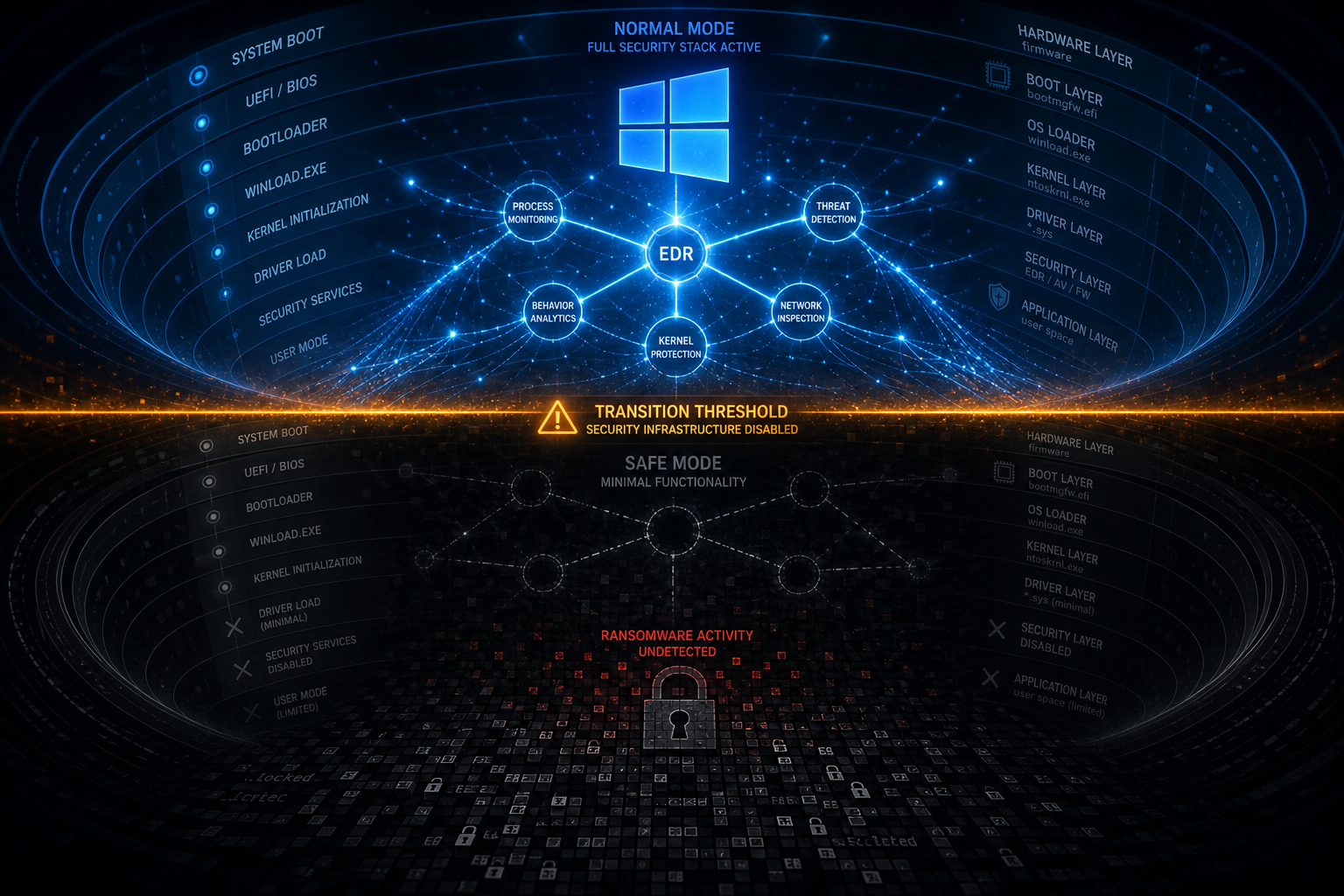
Akira ransomware operators have operationalized Windows Safe Mode reboot sequences as a systematic method to forcibly disable Endpoint Detection and Response (EDR) solutions before deploying encryption payloads. This technique exploits a fundamental architectural characteristic of Windows Safe Mode rather than a discrete software vulnerability. When systems transition to Safe Mode, EDR kernel drivers and monitoring processes fail to load, creating a protection gap of 15–30 minutes during which ransomware can execute with minimal detection risk.
Immediate actionable guidance: The development represents significant maturation of ransomware sophistication, moving beyond runtime evasion to boot-level manipulation previously considered operationally complex for commodity threat groups. Organizations relying primarily on EDR for ransomware detection now face critical blind spots during infection progression. Urgent action is required to validate backup immutability, assess EDR resilience during boot transitions, and implement detection controls for unusual reboot sequences. This shift demands immediate architectural reassessment across endpoint protection, incident response, and business continuity planning.
Key Finding: Akira ransomware operators have successfully weaponized Windows Safe Mode boot sequences to forcibly disable Endpoint Detection and Response solutions before payload execution, demonstrating that traditional endpoint protection architectures remain vulnerable to boot-level manipulation techniques previously considered operationally complex for commodity ransomware groups.
What Happened
Akira operators have integrated Windows Safe Mode reboot exploitation into a multi-stage attack methodology that fundamentally restructures the infection timeline. The attack sequence typically begins with network compromise through phishing, exposed Remote Desktop Protocol (RDP) services, or supply chain vulnerabilities. Once initial access is established, operators conduct lateral movement and privilege escalation to acquire administrative or SYSTEM-level credentials necessary for subsequent exploitation phases.
The critical divergence from standard ransomware deployment occurs during the payload execution phase. Rather than executing the ransomware binary directly from the compromised user context, operators force the affected Windows system into Safe Mode with Networking enabled. This reboot can be triggered through multiple mechanisms: Group Policy modification targeting boot configuration, scheduled task creation executing shutdown commands with Safe Mode parameters, direct command-line invocation through compromised administrative shells, or Windows Management Instrumentation (WMI) remote command execution.
During Safe Mode boot sequences, Windows loads a minimal driver set and suppresses initialization of non-critical services. Critically, EDR platform kernel-level drivers and real-time monitoring agents fail to load during Safe Mode because their startup requirements exceed the constraints of Safe Mode operation. EDR platforms including Crowdstrike Falcon, Microsoft Defender for Endpoint, SentinelOne, and Palo Alto Networks Cortex XDR all depend on kernel-level drivers, system services, and continuous process monitoring—capabilities deliberately suppressed in Safe Mode to enable system troubleshooting and recovery operations.
Akira operators exploit this protection gap by executing the ransomware payload immediately after system stabilization in Safe Mode, typically within five to ten minutes of the reboot completing. Because EDR monitoring infrastructure has not initialized, the ransomware executable loads, establishes persistence mechanisms, and begins file system encryption without generating the process creation events, file modification alerts, or behavioral anomaly detections that normally trigger EDR prevention or containment actions. Concurrent with encryption initiation, operators target backup and recovery infrastructure—deliberately corrupting backup repositories, deleting shadow copies, and disabling recovery services—while these systems remain unmonitored by the disabled EDR platform.
The Safe Mode reboot exploitation technique exploits a documented Windows operating system design characteristic rather than a discrete security vulnerability. Safe Mode boot sequences intentionally restrict driver loading and service initialization to simplify troubleshooting and system recovery operations. Modern EDR platforms achieve continuous endpoint visibility through kernel-level drivers, user-mode agents, and system service processes. Safe Mode boot sequences deliberately exclude drivers not marked as required for basic system operation. EDR platform drivers, by Windows design classification, fall into the optional category because Safe Mode is intended to enable system recovery without the overhead of security monitoring infrastructure.
Akira emerged as an operational ransomware family in 2023, deployed by a sophisticated affiliate network targeting mid-to-large enterprise organizations across financial services, healthcare, manufacturing, and technology sectors. The threat group operates under a ransomware-as-a-service (RaaS) model, providing ransomware tooling, infrastructure, and operational support to affiliated operators who conduct target reconnaissance, network compromise, and negotiation activities in exchange for a percentage of ransom proceeds. Safe Mode exploitation represents a continuation of this sophistication trajectory.
Why It Matters
Enterprise Security Leaders and Risk Officers
The operationalization of Safe Mode reboot exploitation fundamentally invalidates a core assumption underlying enterprise security architecture: that EDR platforms provide continuous or near-continuous endpoint monitoring during the infection lifecycle. Organizations that deployed EDR solutions specifically to detect and respond to ransomware activity now face a critical blind spot during the exact phase when ransomware establishes persistence and executes encryption operations. This represents a structural shift in ransomware threat sophistication. Safe Mode exploitation eliminates the monitoring framework entirely during the critical exploitation phase, creating detection immunity rather than evasion.
Security Operations and Incident Response Teams
Safe Mode exploitation creates immediate impact across multiple operational security domains, each requiring rapid assessment and remediation. Organizations must immediately audit their assumptions regarding EDR coverage during system startup and boot sequence transitions. Current EDR platforms provide no monitoring capability during Safe Mode operation, and transitions into and out of Safe Mode may be associated with EDR driver loading delays of 30 seconds to several minutes. During this window, ransomware can execute with complete detection immunity. Security operations center (SOC) teams must acknowledge this blind spot in their operational security models and develop alternative detection mechanisms that do not depend on endpoint agents.
Backup and Business Continuity Professionals
Concurrent targeting of backup and recovery infrastructure during Safe Mode exploitation compounds institutional risk. Ransomware has historically attacked backup systems and shadow copy services as a secondary attack vector. The addition of Safe Mode timing coordination transforms this into a sophisticated multi-vector attack: backup systems, shadow copy services, and recovery infrastructure are deliberately destroyed while EDR monitoring is disabled. By the time EDR services reinitialize and detect the ransomware's presence, backup recovery options have already been eliminated, creating cascading failure scenarios where both detection-based response and recovery-based remediation become unavailable.
Ransomware Threat Intelligence Community
Safe Mode exploitation represents evidence of convergence between distinct ransomware attack techniques and bootkit/rootkit exploitation methodologies. Akira's approach integrates boot-level manipulation into the primary attack chain, demonstrating that commodity ransomware groups now possess or have access to boot-level manipulation expertise previously limited to nation-state threat actors and advanced persistent threat (APT) groups. The likely consequence is rapid proliferation of this technique across the ransomware ecosystem. Competing ransomware-as-a-service operators face operational pressure to develop comparable Safe Mode exploitation capabilities or risk losing market share to more sophisticated competitors.
Operational Implications
Immediate (0–7 Days): Organizations must begin real-time monitoring for forced reboot sequences and Safe Mode triggers. Conduct an inventory of all scheduled tasks within network infrastructure that execute shutdown or reboot commands and compare against known maintenance and patching schedules. Deploy SIEM alerting rules targeting Windows Event Log channels for system shutdown/restart events and process creation events for shutdown commands executed by unexpected accounts. Verify immediately that all backup repositories support immutability mechanisms and that these mechanisms are actively enforced. Implement backup-specific alerting for unauthorized deletion attempts, modification of backup retention policies, and access patterns inconsistent with normal backup management activities. Restrict Group Policy modification rights to a minimal set of security-approved administrative accounts and implement multi-factor authentication on all accounts with reboot or shutdown capabilities.
Short-Term (1–4 Weeks): Conduct a complete inventory of BIOS and UEFI firmware versions across enterprise endpoint populations and establish a patching schedule for outdated firmware. Implement Secure Boot enforcement on all systems where supported. Engage EDR platform vendors directly regarding Safe Mode exploitation and request detailed technical documentation of platform resilience mechanisms during Safe Mode transitions. Develop Safe Mode exploitation-specific incident response playbooks documenting detection indicators, forensic analysis procedures, timeline reconstruction methodologies, and recovery procedures. Train incident response personnel on boot-sequence forensics, focusing on analysis of Windows Event Log data, registry artifacts, and firmware-level system state. Develop SIEM correlation rules that detect characteristic patterns of ransomware activity even without EDR telemetry.
Medium-Term (1–3 Months): Conduct feasibility assessments on advanced boot security mechanisms including Secure Boot enforcement, full-disk encryption with boot-phase attestation, and application whitelisting at boot-sequence level. Evaluate next-generation EDR platforms with advertised enhanced boot-phase monitoring and Safe Mode resilience. Implement behavioral analytics platforms capable of identifying shutdown/reboot anomalies at scale, distinguishing between normal maintenance reboot patterns and forced reboot sequences that may indicate ransomware activity. Establish threat intelligence feeds or partnerships focused on Safe Mode exploitation variant tracking, enabling organizations to monitor ecosystem-wide adoption of this technique. Conduct full recovery capability testing incorporating parallel infrastructure targeting scenarios where both EDR monitoring and backup systems are simultaneously compromised or unavailable.
Strategic Reassessment (Ongoing): The coming months will determine whether Safe Mode exploitation remains primarily an Akira capability or becomes a standard feature of ransomware-as-a-service platforms deployed across the ecosystem. Organizations must establish ongoing governance conversations with business stakeholders regarding recovery time expectations and risk acceptance in scenarios where rapid detection-based response becomes impossible. Institutional resilience requires immediate acknowledgment of EDR monitoring limitations and rapid restoration of backup and recovery infrastructure as primary containment mechanisms. Organizations that immediately validate their backup resilience, implement detection controls for forced reboot sequences, and prepare incident response procedures for boot-level attacks will be positioned to respond effectively to ecosystem-wide adoption scenarios.
Recommended Actions
Actions are organized by organizational security maturity. Baseline controls apply across all tiers and should be treated as immediate priorities regardless of organizational size.
* Organizations with standard security tooling and general-purpose endpoint protection.
- 1 - Deploy SIEM alerting rules targeting Windows Event Log channels for system shutdown and restart events (Event ID 1076, 1077) and process creation events for shutdown commands executed by non-standard accounts
- 2 - Conduct inventory of all scheduled tasks executing shutdown or reboot commands and validate against known maintenance schedules to identify anomalous reboot tasks
- 3 - Enable real-time alerts on Group Policy modifications affecting boot behavior and registry paths controlling Safe Mode configuration
- 4 - Verify backup repository immutability mechanisms are actively enforced and test restoration procedures from offline backup copies
- 5 - Implement multi-factor authentication on all administrative accounts with reboot, shutdown, or Group Policy modification capabilities
- 6 - Disable local shutdown commands for standard user accounts and force all shutdown requests through administrative approval workflows
- 7 - Document EDR platform reinitialize timing after Safe Mode exit and confirm monitoring telemetry resumes within 5–10 minutes of system stabilization
* Organizations with mature security operations and established incident response capabilities.
- 1 - Conduct complete BIOS and UEFI firmware inventory and establish patching schedule for outdated firmware lacking current security patches
- 2 - Implement Secure Boot enforcement on all systems where supported and validate that endpoint management infrastructure enforces Secure Boot configurations
- 3 - Establish bootloader security configurations and implement firmware integrity monitoring through Trusted Platform Module (TPM) attestation
- 4 - Engage EDR platform vendors directly for detailed technical documentation regarding Safe Mode resilience, driver loading timing, and fallback monitoring mechanisms
- 5 - Develop Safe Mode exploitation-specific incident response playbooks with detection indicators, forensic analysis procedures, timeline reconstruction methodologies, and escalation procedures
- 6 - Train incident response personnel on boot-sequence forensics including Windows Event Log analysis, registry artifact examination, and firmware-level system state investigation
- 7 - Implement behavioral analytics platforms capable of identifying shutdown and reboot anomalies at scale and distinguishing between normal maintenance patterns and forced reboot sequences
- 8 - Establish threat intelligence feeds focused on ransomware family Safe Mode exploitation capability tracking and ecosystem-wide variant adoption monitoring
* Organizations with sophisticated security architectures and advanced threat intelligence capabilities.
- 1 - Evaluate and implement advanced boot security mechanisms including full-disk encryption with boot-phase attestation and application whitelisting at boot-sequence level
- 2 - Deploy third-party kernel-level monitoring tools operating independently of EDR driver stacks to provide redundant monitoring during periods when primary EDR drivers have not yet loaded
- 3 - Implement EDR failover detection through SIEM log correlation and network-based detection rules that identify ransomware activity patterns without EDR telemetry
- 4 - Conduct feasibility assessments of next-generation EDR platforms with advertised enhanced boot-phase monitoring and Safe Mode resilience capabilities
- 5 - Implement kernel shim layers or alternative security monitoring architectures that provide continuous visibility during Windows boot sequence transitions and Safe Mode operation
- 6 - Establish recovery capability testing incorporating parallel infrastructure targeting scenarios where both EDR monitoring and backup systems are simultaneously compromised
- 7 - Develop alternative recovery pathways for scenarios where primary backup systems are inaccessible, including air-gapped backup systems, cloud-based backup services, and third-party recovery partnerships
- 8 - Create organizational resilience metrics specific to Safe Mode exploitation scenarios and communicate updated recovery time objective and recovery point objective assessments to business stakeholders
Closing Statement
The operationalization of Windows Safe Mode reboot exploitation by Akira ransomware represents more than a tactical escalation in ransomware threat sophistication—it signals a fundamental restructuring of assumptions underlying contemporary enterprise security architecture. For organizations that have invested heavily in EDR platforms as primary ransomware detection controls, this technique exposes critical blind spots that cannot be eliminated through platform tuning or operational refinement. Boot-level attack vectors operate outside the monitoring frameworks that modern endpoint security strategies depend upon.
Institutional resilience against this threat requires immediate acknowledgment of EDR monitoring limitations and rapid restoration of backup and recovery infrastructure as primary containment mechanisms. It demands investment in detection mechanisms that operate independently of endpoint agents and forensic capabilities that can reconstruct attack timelines when real-time monitoring fails. It necessitates governance conversations with business stakeholders regarding recovery time expectations and risk acceptance in scenarios where rapid detection-based response becomes impossible.
The coming months will determine whether Safe Mode exploitation remains primarily an Akira capability or becomes a standard feature of ransomware-as-a-service platforms deployed across the ecosystem. Organizations that immediately validate their backup resilience, implement detection controls for forced reboot sequences, and prepare incident response procedures for boot-level attacks will be positioned to respond effectively to either scenario. Those that defer this assessment risk discovering critical gaps exactly when gaps are most consequential.