
Insecure by Design: Analyzing Cleartext and Unauthenticated Protocols in Legacy Industrial Field Networks
Executive Summary
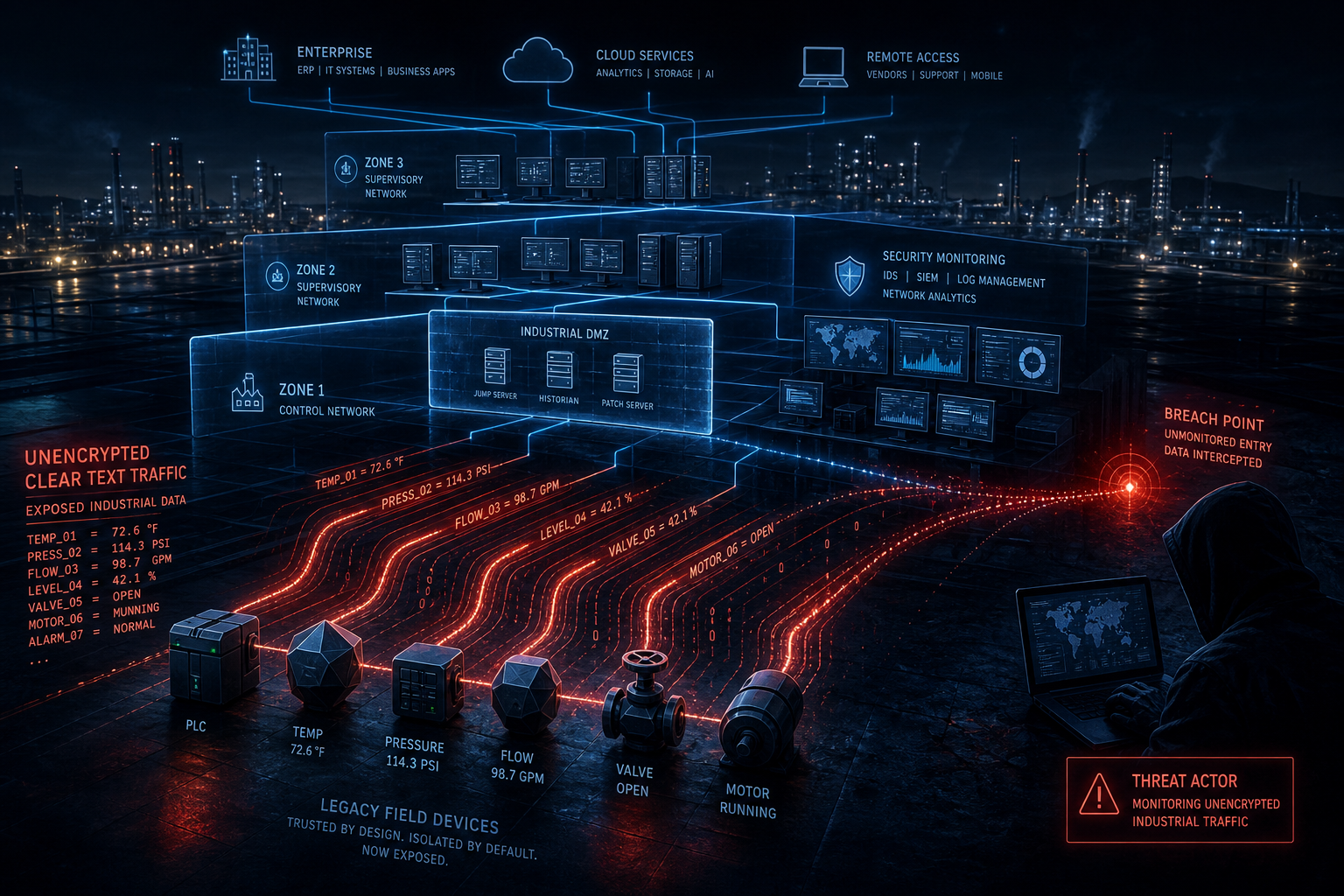
Industrial field networks remain architected around isolation-dependent security models from the 1970s and 1980s, when systems operated in air-gapped environments disconnected from external threat exposure. Today, Modbus, DNP3, PROFIBUS, and similar legacy protocols continue operating in production environments without cryptographic authentication, message integrity verification, or encryption—creating directional pathways for passive network reconnaissance and active protocol manipulation.
An estimated 70–80% of deployed legacy industrial environments across utilities, manufacturing, and infrastructure sectors transmit critical operational data in cleartext without authentication mechanisms. This analysis examines the technical foundations of this systemic exposure, organizational factors perpetuating protocol acceptance, documented attack methodologies, and remediation pathways compatible with operational continuity constraints.
Immediate actionable guidance: Organizations operating legacy field devices require immediate asset visibility, network segmentation, and continuous monitoring strategies while developing multi-year modernization roadmaps to replace or isolate vulnerable protocols.
Key Finding: Field-level ICS devices utilizing Modbus, DNP3, and legacy PROFIBUS implementations operate without cryptographic authentication or message integrity verification, creating directional attack pathways exploitable via passive network reconnaissance and active protocol manipulation—a systemic condition affecting an estimated 70–80% of deployed legacy industrial environments and documented in active threat campaigns targeting critical infrastructure.
What Happened
The protocols dominating contemporary industrial field networks emerged during technology cycles predating modern cybersecurity threat modeling. Modbus, developed in 1979 by Modicon for industrial controller communication, operated in environments where network access was physically constrained by dedicated serial lines and proprietary hardware interfaces. DNP3 (Distributed Network Protocol, version 3), standardized in 1993 for utility SCADA communication, and PROFIBUS, deployed extensively in European manufacturing since the 1980s, reflected similar design assumptions centered on isolated network topologies where physical access to communication channels represented the primary threat vector.
These protocols share fundamental architectural characteristics embedded in production systems today. Modbus transmits register values, coil states, and device parameters in sequential request-response cycles over serial or TCP connections without any authentication layer. DNP3 operates similarly, with devices communicating supervisory control information without message-level cryptographic protection. PROFIBUS maintains token-passing topologies and serial communication assumptions that predate encryption integration.
The shift from isolated to hybrid and cloud-connected industrial infrastructure over the past six years has fundamentally altered the threat model for legacy protocols. Remote access enablement accelerated post-2020, driven by pandemic-related workforce distribution, competitive pressure for industrial-as-a-service offerings, and integration of cloud analytics with field operations. VPN connections now link remote engineering teams to production networks. Industrial equipment manufacturers increasingly provide cloud-based dashboards integrated with field device data. Edge computing architectures create intermediate network segments bridging isolated OT environments to enterprise systems.
This convergence has dismantled the isolation assumptions underlying legacy protocol design. Field devices that operated in physically protected closed networks now transmit the same cleartext data across potentially compromised network segments. An attacker with network access to an industrial facility's field network—achievable through compromised enterprise connections, supply chain infiltration, or physical proximity with wireless interception—can passively monitor unencrypted protocol traffic to extract operational parameters, device configurations, and system topology without triggering any authentication event or security alert.
Documented attack campaigns demonstrate this pathway. The 2015–2016 Ukraine power grid incidents employed passive network reconnaissance to map field device topology and operational state using unencrypted protocol analysis, followed by direct manipulation of cleartext control signals to disable protective relays and disrupt grid synchronization. The Colonial Pipeline ransomware incident (2021) included a lateral movement phase where attackers transitioned from enterprise systems into operational technology segments, likely exploiting unencrypted protocol communication and absence of authentication barriers at network boundaries.
Industrial field networks inherently resist integration with modern security monitoring frameworks designed for enterprise systems. Standard SIEM platforms expect structured logging from devices with native security event generation—capabilities absent in legacy field devices. Modbus devices responding to read requests generate no security log entry; they simply return the requested data. There is no authentication failure event, no audit trail of parameter modifications, no tamper indication.
Why It Matters
Critical Infrastructure Operators
The sectors most affected by legacy protocol insecurity directly support national economic function and public safety. Electrical grid distribution systems rely extensively on DNP3 and Modbus implementations for distribution automation, substation control, and protection relay communication. Water and wastewater treatment facilities employ legacy SCADA systems communicating via Modbus for process control, treatment sequencing, and distribution management. Natural gas pipeline control infrastructure similarly depends on decades-old field devices transmitting setpoints and operational parameters without cryptographic protection.
Security and Risk Leadership
The consequence mapping reveals three distinct threat dimensions. Confidentiality: Cleartext protocol transmission exposes operational parameters, system configuration, process setpoints, and temporal scheduling to anyone with network access. Integrity: The ability to modify cleartext command sequences or inject unauthorized control signals creates potential for physical system compromise. Availability: Compromised field devices may become unresponsive, provide inconsistent data, or behave unpredictably, degrading situational awareness for operators.
Engineering and Operations Teams
Multiple reinforcing factors explain why organizations continue operating field networks with known protocol-level vulnerabilities. Technical Debt Dynamics: The cost of comprehensive protocol replacement is substantial and operationally disruptive, while perceived risk remains historically low due to decades of uncompromised operation in isolated environments. Operational Continuity Constraints: Field device replacements require extensive validation and testing to ensure compatibility with existing supervisory control systems, protection schemes, and safety interlocks.
Compliance and Governance Functions
NERC CIP standards apply primarily to Bulk Electric System operators and focus on enterprise-level controls rather than field device protocol security. NIST Cybersecurity Framework provides guidance on risk management processes but lacks specific requirements for legacy device replacement timelines. IEC 62443 permits compliance through compensating controls rather than mandating cryptographic protocol modernization. This flexibility allows organizations to document risk acceptance and argue compliance through network segmentation and monitoring rather than fundamental protocol upgrade.
Operational Implications
Immediate (0–3 Months): Establishing effective security monitoring in field networks operating legacy protocols requires understanding baseline normal behavior—a challenge in environments deploying heterogeneous devices from competing manufacturers with different communication patterns and firmware versions. Current monitoring architectures typically employ passive network analysis positioned at field network boundaries using SPAN configuration, network taps, or wireless monitoring. Traffic captured at collection points must be analyzed using ICS-specific tools designed to understand protocol semantics. Current industry capability estimates suggest fewer than 30% of field-level communications in legacy industrial environments receive any continuous security-focused monitoring.
Short-Term (3–12 Months): Organizations unable to immediately replace legacy protocols must implement comprehensive compensating controls to reduce exploitation risk while capital planning proceeds. Network Segmentation: Physically or logically isolate field networks from enterprise systems and the internet, restricting all boundary-crossing communication to authorized supervisory control channels. Remote Access Architecture: If remote engineering access is necessary, implement secure enclave design with jump servers, multi-factor authentication, and session recording. Protocol Gateway Solutions: Intelligent intermediaries can translate legacy cleartext protocols into authenticated and encrypted versions before transmission.
Medium-Term (1–3 Years): Field device replacement strategies require multi-year planning horizons compatible with capital budgeting cycles. Organizations must cluster legacy devices by criticality, functional group, and protocol type to establish replacement priorities. Modern protocol alternatives include MQTT with TLS encryption, OPC UA (incorporating cryptographic authentication and encryption as native elements), and updated versions of traditional protocols with security extensions. Field device replacement requires extensive validation and interoperability testing in stage environments before production deployment. Testing timelines extend 6–18 months depending on environment complexity.
Recommended Actions
Actions are organized by organizational security maturity. Baseline controls apply across all tiers and should be treated as immediate priorities regardless of organizational size.
* Organizations with standard security tooling and general-purpose endpoint protection.
- 1 - Conduct Legacy Protocol Asset Inventory: Create comprehensive documentation of all field devices utilizing Modbus, DNP3, PROFIBUS, and other cleartext protocols. Classify devices by criticality and protocol type. Success metric: 100% of field devices documented with protocol, firmware version, and connectivity details.
- 2 - Establish Cleartext Communication Baseline: Document all unencrypted industrial protocol transmissions in current use, transmission frequency, data sensitivity classification, and communication endpoints. Success metric: Documented map of all cleartext ICS protocols with data classification and frequency profiles.
- 3 - Implement Field Network Segmentation: Establish physical or logical isolation between field device networks and enterprise systems. Configure firewalls restricting crossing traffic to authorized supervisory control channels only. Success metric: Production field network isolated from enterprise segment with restricted, monitored crossing points.
- 4 - Deploy Passive Network Monitoring at Field Network Boundary: Install network analysis infrastructure capturing field network traffic. Configure anomaly detection analyzing communication patterns for unusual volumes, unauthorized device communication, or evidence of manipulation. Success metric: Continuous monitoring active with documented baseline of normal communication patterns and alert escalation procedures.
- 5 - Establish Incident Response Procedures for Protocol-Level Attacks: Develop documented procedures for detecting and responding to field device compromise, including escalation pathways, forensic preservation requirements, and communication protocols with operations teams. Success metric: Documented procedures for field device compromise scenarios with test evidence and operational team acknowledgment.
* Organizations with segmented OT environments and dedicated security resources.
- 1 - Evaluate Protocol Gateway Solutions for High-Risk Segments: Identify segments with highest criticality or connectivity risk. Conduct proof-of-concept testing of protocol gateway solutions that add authentication and encryption layers to legacy cleartext protocols. Success metric: Proof-of-concept completion documenting compatibility, performance impact, and feasibility for production deployment.
- 2 - Develop Field Device Access Controls: Implement multi-factor authentication or restricted network access controls for any remote or non-local access to field devices. Establish zero-trust principles for field device access even within controlled environments. Success metric: Access control policy implemented with documented exceptions and compensating controls for devices unable to support modern authentication.
- 3 - Implement Change Management Controls for Field Devices: Establish formalized approval workflows for firmware updates, parameter modifications, and configuration changes on legacy devices. Create audit trails of all authorized changes. Success metric: Change approval process operational with 100% compliance on documented changes; audit logging active.
- 4 - Conduct OT-Specific Security Awareness Training: Develop and deliver curriculum focused on ICS protocol security, phishing threats targeting field device credentials, and cultural shift from isolation-based to active threat awareness. Success metric: 100% of OT operations and maintenance staff completing protocol security awareness training with validated understanding.
- 5 - Establish Vendor Communication Protocol for Legacy Device Security: Formalize communication channels with field device manufacturers for CVE notifications and security updates. Document product end-of-life timelines and support availability. Success metric: Communication agreement established with each major equipment manufacturer and documented in asset inventory.
* Organizations with comprehensive OT security programs and multi-year capital planning.
- 1 - Develop Field Device Replacement Roadmap: Create multi-year replacement schedule prioritizing highest-criticality and highest-risk legacy protocols. Align replacement with capital planning cycles and scheduled maintenance windows. Integrate requirements for modern protocol support and cryptographic capabilities. Success metric: Documented replacement roadmap with device-level prioritization, timeline, and capital requirements.
- 2 - Pilot Modern Protocol Implementations: Deploy pilot implementations of encrypted modern protocols in non-critical field network segments. Validate interoperability with existing supervisory control systems and performance characteristics. Success metric: Successful pilot deployment demonstrating equivalent or superior performance compared to legacy baseline.
- 3 - Establish Secure Enclave Architecture for Irreplaceable Legacy Segments: Design and implement network isolation for legacy systems that cannot be replaced due to operational constraints. Deploy comprehensive monitoring and implement strict access controls. Success metric: Isolated legacy segment operational with documented compensating controls and continuous monitoring.
- 4 - Establish Security Requirements in Procurement Specifications: Update RFP templates and vendor contracts for field device procurement to mandate security features including cryptographic authentication, encrypted communication, native logging, and commitment to security update availability. Success metric: Updated procurement templates incorporating security requirements; contracts with new vendors including security provisions.
- 5 - Conduct Protocol-Level Penetration Testing in Test Environments: Perform penetration testing on legacy protocol implementations in isolated test environments to validate exploitation feasibility and identify protocol-specific attack chains. Use results to inform risk acceptance decisions and remediation prioritization. Success metric: Documented findings on legacy protocol exploitation feasibility with evidence from controlled testing.
Closing Statement
Legacy industrial control system protocol insecurity represents a systemic architectural condition embedded in production critical infrastructure across utilities, manufacturing, and infrastructure sectors. The fundamental absence of cryptographic authentication and message integrity verification in protocols like Modbus, DNP3, and PROFIBUS reflects design-era assumptions about network isolation that no longer characterize contemporary operational environments.
Modern threat actors have demonstrated both capability and intent to exploit these vulnerabilities through documented attack campaigns, yet organizational remediation remains constrained by technical debt, operational continuity requirements, capital planning limitations, and workforce knowledge gaps. This condition cannot be resolved through incremental tactical improvements alone.
Organizations must integrate field device replacement and protocol modernization into strategic capital planning over multi-year horizons while simultaneously implementing compensating controls—network segmentation, passive monitoring, change management rigor—that reduce exploitation risk in the interim. Risk acceptance decisions should be explicit and documented at governance levels appropriate to institutional criticality.
The pathway forward requires alignment across OT operations, IT security, capital planning, and institutional leadership to prioritize foundational security infrastructure alongside competing investments. The convergence of legacy protocol vulnerability, documented threat capability, and increasing regulatory pressure creates a decision inflection point for organizations operating critical infrastructure.