
Unmaintained Memory: Analyzing Buffer Overflow and RCE Vulnerabilities in Legacy VxWorks, QNX, and Embedded Linux SCADA Systems
Executive Summary
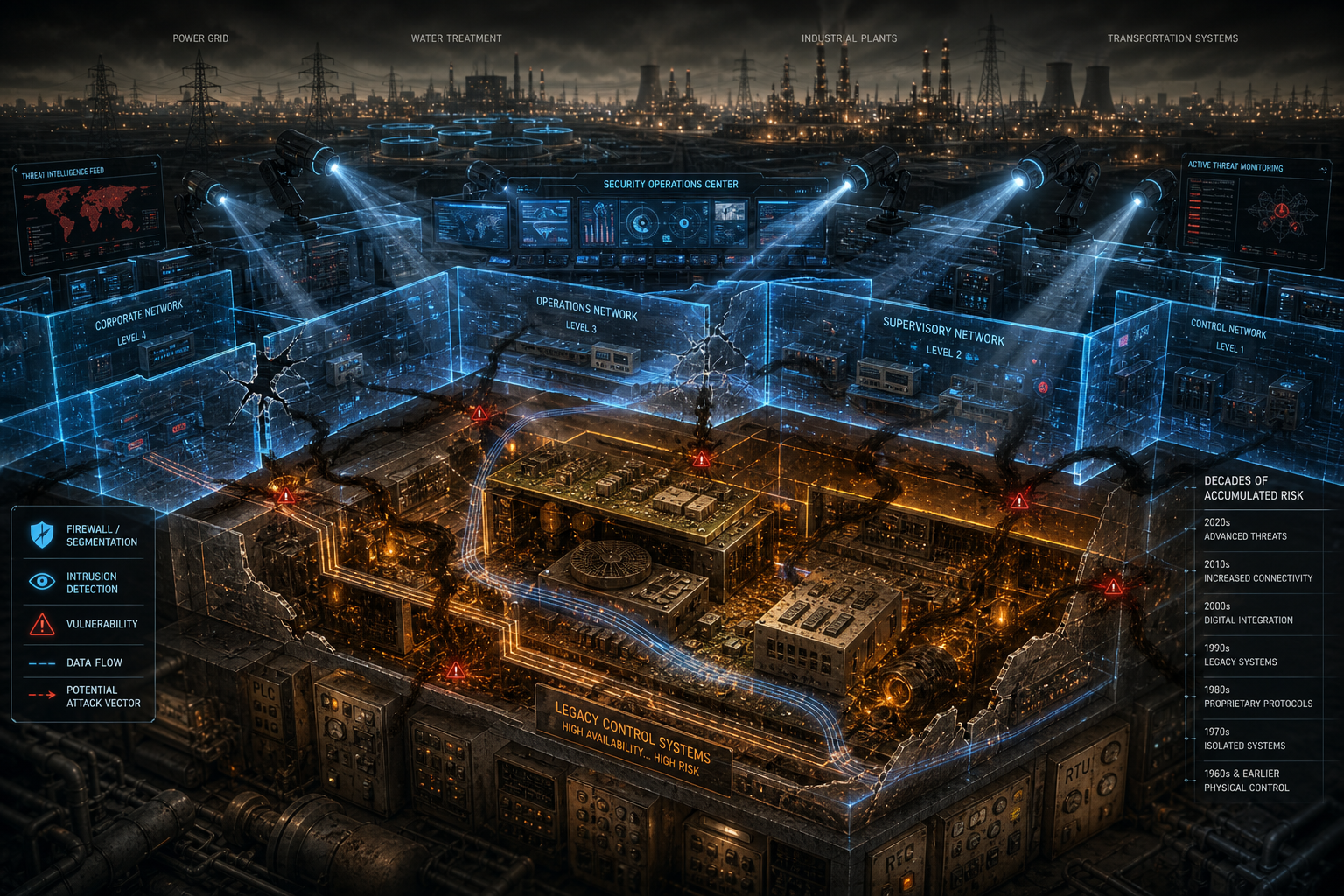
Decades-old embedded operating systems—VxWorks, QNX, and legacy Embedded Linux distributions—continue to power critical infrastructure SCADA environments despite containing well-documented, unpatched buffer overflow and remote code execution vulnerabilities. The persistence of these systems reflects institutional constraints rather than technical inability: regulatory certification requirements, multi-year capital cycles, safety system interdependencies, and the operational impossibility of downtime in 24/7/365 environments create barriers to remediation that extend across decades.
Organizations operating legacy embedded systems face an asymmetric risk dynamic: attackers require only one successful exploit across vulnerability windows spanning 15–30 years, while defenders must sustain multiple compensating controls indefinitely. This analysis examines the technical, operational, and strategic dimensions of legacy embedded system exposure and establishes actionable mitigation frameworks for environments where patching or replacement remains impractical. The central challenge is not vulnerability remediation but institutional decision-making under conditions of persistent, manageable—but not eliminable—risk.
Key Finding: Legacy embedded operating systems in operational SCADA environments contain exploitable buffer overflow and remote code execution vulnerabilities with decades-long exposure windows; vulnerability remediation is constrained not by technical feasibility but by institutional dependencies on systems that cannot be patched, replaced, or isolated without triggering cascading operational failure across interconnected industrial infrastructure.
What Happened
Wind River's VxWorks operating system, first released in 1987 and widely deployed across SCADA, power generation, water treatment, and industrial automation environments, contains buffer overflow vulnerabilities affecting versions 5.x through 6.x that remain operational in field systems today. CISA ICS Advisory ICSA-19-211-01 formally disclosed these vulnerabilities in 2019, affecting multiple architectural platforms including x86, ARM, PowerPC, and MIPS processors. The vulnerabilities enable remote code execution through network-accessible services; exploitation typically requires network access to a vulnerable process but generally does not require authentication, depending on service configuration. The vulnerability class stems from legacy memory management practices common to real-time operating systems developed in the 1990s and early 2000s, when performance optimization and memory efficiency took priority over modern buffer protection mechanisms.
BlackBerry's QNX Neutrino real-time operating system, prevalent in automotive systems, aerospace applications, industrial controllers, and medical devices, contains similar vulnerabilities documented in CISA ICS Advisory ICSA-20-168-01. QNX vulnerabilities affect versions 4.x through 6.x and enable buffer overflow exploitation and remote code execution through network services or local privilege escalation. Unlike VxWorks, which is used primarily in industrial control systems, QNX deployment is diffuse across automotive, medical, and aerospace sectors, making vulnerability management particularly complex.
Custom and forked Embedded Linux distributions running on industrial controllers, HVAC systems, power distribution equipment, and networked sensors present a distinct vulnerability challenge. Unlike VxWorks and QNX, which are maintained by specific vendors, Embedded Linux variants deployed in SCADA systems are often based on 2.x and 3.x kernel versions with custom patches and application-layer modifications. Many systems have not received upstream kernel security patches in 10 or more years. The kernel versions in question contained critical buffer overflows, memory corruption vulnerabilities, and privilege escalation exploits now well-documented in academic literature and exploit databases.
Industry surveys and CISA advisories indicate that VxWorks, QNX, and legacy Embedded Linux systems remain deployed across critical infrastructure at scale. Estimates suggest that 10–15% of active SCADA controllers in electrical utilities, water/wastewater systems, and manufacturing environments run VxWorks or QNX versions with known unpatched vulnerabilities. The Embedded Operating Systems Survey (February 2026) identified over 500,000 deployed instances of legacy embedded systems in North American infrastructure environments alone, with global deployment exceeding 2 million units.
While comprehensive public disclosure of attacks leveraging legacy OS vulnerabilities remains limited, evidence suggests reconnaissance activity is ongoing. Threat actors conduct vulnerability scanning targeting VxWorks and QNX instances, use internet-accessible search engines (SHODAN) to identify vulnerable systems, and probe SCADA systems accessible through internet-exposed interfaces. The commercial availability of exploit frameworks and proof-of-concept code for known VxWorks and QNX vulnerabilities in underground forums indicates that exploitation capability is accessible to moderately sophisticated threat actors.
Why It Matters
Critical Infrastructure Operators
Buffer overflow vulnerabilities in embedded operating systems present distinct technical challenges compared to exploitation in modern systems. Embedded systems operate under severe resource constraints: limited memory (often 64–512 MB total), minimal CPU capability, and absent sophisticated address space layout randomization (ASLR) or data execution prevention (DEP) protections. These constraints mean that buffer overflow exploitation in embedded contexts is often more reliable than in modern commodity systems. In a typical exploitation scenario, an attacker sends a crafted network packet to a vulnerable VxWorks or QNX service, allocates a fixed-size stack buffer, copies attacker-supplied data into that buffer without length checking, and overwrites the return address. Because VxWorks and legacy QNX lack modern stack protection mechanisms, return address corruption remains undetected. The practical consequence is complete system compromise: an attacker achieving remote code execution on a SCADA controller can manipulate sensor readings, alter control signals to industrial equipment, modify log files, or persist through firmware modification.
Technology and Security Leadership
The persistence of legacy embedded systems reflects a complex intersection of technical, regulatory, economic, and safety considerations that make system replacement extraordinarily difficult. Organizations operate under multi-year capital planning cycles; system replacement may require approval in the current fiscal year but deployment may not occur for 3–4 years. For utilities, manufacturers, and healthcare systems operating under constrained capital budgets, legacy system replacement competes with other infrastructure investments. In healthcare, energy, and aviation sectors, systems are certified to specific regulatory standards. Any modification to a certified system—including security patches—requires re-validation, a process taking 6 to 24 months and costing hundreds of thousands of dollars. Additionally, many legacy SCADA systems were designed by original equipment manufacturers that no longer exist or ceased supporting legacy product lines 10–20 years ago, making independent remediation impossible.
Risk and Compliance Officers
The vulnerability landscape for legacy embedded systems creates asymmetric risk dynamics favoring attackers. Defenders must maintain operational continuity, comply with regulations, manage capital cycles, and coordinate across complex supply chains. They must defend against every conceivable attack vector simultaneously and sustain defenses indefinitely. Attackers face no such constraints: an attacker needs only a single successful exploitation path; they can choose targets opportunistically; they can invest years in reconnaissance and exploit development before launching attacks; and they can operate patiently across decades of vulnerability windows. Vulnerability windows extend across decades. A VxWorks system deployed in 2005 and never patched remains vulnerable in 2026. An organization operating such a system must accept the vulnerability as part of their operational risk profile, implementing compensating controls such as network segmentation, intrusion detection, and enhanced monitoring, though these controls are not absolute.
Operational Implications
Immediate (0–30 Days): Organizations must develop comprehensive visibility into legacy embedded systems within their infrastructure. This requires collaboration between IT, security, and operational technology teams to identify all VxWorks, QNX, and legacy Embedded Linux systems, cross-reference findings with CISA vulnerability advisories, and document system characteristics: location, operational function, dependencies, connectivity status, and estimated deployment date. Simultaneously, organizations should formally document risk acceptance decisions: why legacy systems are being maintained, what compensating controls are in place, and what conditions would trigger system replacement or shutdown. This documentation creates audit trail for compliance and liability defense, ensures organizational leadership understands and accepts the risk, and informs insurance and regulatory engagement.
Short-Term (30–90 Days): Technical compensating controls should be implemented to reduce attack surface and detection likelihood. Network segmentation must isolate legacy systems on dedicated VLANs with strict ingress and egress filtering; firewall rules should restrict traffic to specific authorized sources and required protocols. Intrusion detection/prevention (IDS/IPS) should be deployed at segment boundaries with active threat intelligence feeds. For systems that cannot support agent-based endpoint detection and response, network-based behavioral monitoring should establish baseline traffic patterns and alert on deviations. Organizations should also engage vendors and original equipment manufacturers to assess extended support options, inquire about security patches or custom patch development, and initiate strategic discussions on system replacement timelines.
Medium-Term (90 Days–2 Years): Organizations should execute phased system replacement programs prioritized by risk: systems with highest vulnerability severity, largest attack surface, critical operational function, or extensive external connectivity should be replaced first. For regulated environments, engage regulatory bodies early in replacement planning. Where full system replacement is not feasible in the near term, implement secure interface layers or proxies between legacy systems and modern networks through API gateways and application-layer firewalls. Develop advanced forensics and incident response capabilities adapted to legacy system constraints through tabletop scenarios, relationships with specialized forensics vendors, and procedures for evidence collection and system preservation.
Strategic Long-Term (2+ Years): Establish formal end-of-life dates for legacy systems and plan decommissioning in coordination with operational transition schedules. Ensure replacement systems are procured, tested, and validated before existing systems are taken offline. Design new systems with security as foundational requirement, specifying regular security patching, vulnerability disclosure programs, and architecture supporting modern protection mechanisms. Develop internal expertise in legacy system security through staff specialization, training and certification, and internal knowledge repositories. Establish relationships with industry partners, research institutions, and information-sharing organizations such as sector-specific Information Sharing and Analysis Centers (ISACs) to provide early warning of emerging threats and collaborative incident response capabilities.
Recommended Actions
Actions are organized by organizational security maturity. Baseline controls apply across all tiers and should be treated as immediate priorities regardless of organizational size.
* Organizations with standard security tooling and general-purpose endpoint protection.
- 1 - Conduct comprehensive asset inventory of all VxWorks, QNX, and legacy Embedded Linux systems through network scanning and CISA vulnerability advisory cross-reference; document system location, operational function, dependencies, connectivity status, and deployment date.
- 2 - Perform risk assessment for each identified legacy system considering exploitability (proof-of-concept availability, network/local access requirements, authentication requirements) and impact (critical operation disruption, lateral movement enablement, safety risks); document risk acceptance decisions formally for audit and liability purposes.
- 3 - Deliver targeted threat landscape awareness training for security staff, OT personnel, and leadership covering legacy system vulnerabilities, exploitation techniques, incident response procedures, and business-context understanding of remediation costs.
* Organizations with network segmentation and advanced monitoring capabilities.
- 1 - Implement dedicated network segments for legacy systems with strict firewall access controls restricting ingress to authorized sources, required protocols only, and blocking suspicious traffic patterns.
- 2 - Deploy intrusion detection/prevention (IDS/IPS) at legacy system segment boundaries with active threat intelligence feeds from CISA, vendor security bulletins, and threat intelligence providers; maintain updated signatures for known legacy OS exploitation techniques.
- 3 - Deploy network-based behavioral monitoring to establish baseline traffic patterns for each legacy system and configure alerting for deviations (unusual data volumes, unexpected protocols, unexpected communication destinations); implement centralized logging for all traffic destined to legacy systems.
- 4 - Engage original equipment manufacturers and third-party legacy system support vendors to assess extended support options, custom patch development, firmware updates, and security advisory relationships; initiate strategic discussions on system replacement timelines.
* Organizations with sophisticated monitoring, replacement planning, and forensic capabilities.
- 1 - Develop multi-year capital plan for staged replacement of legacy systems prioritized by risk (highest vulnerability severity, largest attack surface, critical operations, external connectivity); engage regulatory bodies early for approval requirements.
- 2 - Design replacement systems with security-first architecture: active security maintenance, memory protection mechanisms (ASLR, DEP, stack canaries), agent-based endpoint detection and response, regular security updates throughout lifecycle.
- 3 - Implement secure interface layers or proxies between legacy systems and modern networks through API gateways and application-layer firewalls to mediate interactions, validate requests, enforce access controls, and log all interactions.
- 4 - Develop incident response procedures adapted to legacy system constraints through tabletop scenarios, relationships with specialized embedded system forensics vendors, and procedures for rapid evidence collection and system preservation during compromise.
- 5 - Establish formal end-of-life dates for all legacy systems and plan decommissioning in coordination with operational transitions; ensure replacement systems are procured, tested, and validated before existing systems are taken offline.
* Organizations prioritizing institutional capability development and industry collaboration.
- 1 - Develop internal expertise in legacy embedded system security through staff specialization, training and certification (VxWorks architecture, QNX security, Embedded Linux forensics), and internal knowledge repositories of legacy system configurations and remediation strategies.
- 2 - Establish relationships with industry partners, research institutions, and sector-specific Information Sharing and Analysis Centers (ISACs): Electricity ISAC, Water ISAC, Manufacturing ISAC to provide early warning of emerging threats and collaborative incident response.
- 3 - Implement technology refresh and formal sunset planning with clear decommissioning timelines; design new systems specifying security requirements in procurement including regular patching, vulnerability disclosure programs, and integration with centralized monitoring.
- 4 - Participate in industry initiatives and information-sharing forums dedicated to embedded system security; contribute organizational knowledge and threat intelligence to broader ecosystem; engage with government agencies and standards bodies on legacy system vulnerability policy.
Closing Statement
The persistence of legacy embedded operating systems in critical infrastructure represents not a failure of security practice but a reality of institutional constraints: capital cycles, regulatory requirements, operational continuity demands, and supplier dependency create barriers to remediation that often cannot be overcome through technology alone. The vulnerability landscape for VxWorks, QNX, and Embedded Linux systems will likely persist for decades—until systems age out of service or organizations finally allocate sufficient capital for replacement.
The strategic imperative is not to eliminate legacy system vulnerabilities—a goal often unachievable within reasonable timelines and budgets—but to manage them within explicit risk frameworks, implement layered compensating controls, and execute deliberate long-term replacement programs. Organizations that acknowledge legacy system vulnerability openly, document risk acceptance formally, and invest in compensating controls are better positioned than organizations that ignore the problem passively.
The path forward requires partnership across security, operations, procurement, and leadership; investment in capabilities and infrastructure; and realistic acknowledgment of tradeoffs between remediation ideals and operational constraints. Institutional resilience in the face of legacy system vulnerabilities depends not on perfect remediation but on deliberate, evidence-based risk management under conditions of persistent but manageable exposure.