
Bypassing Email Verification: Analyzing Authentication State Validation Flaws in Keycloak's Password-Reset Flow (CVE-2026-18963)
Executive Summary
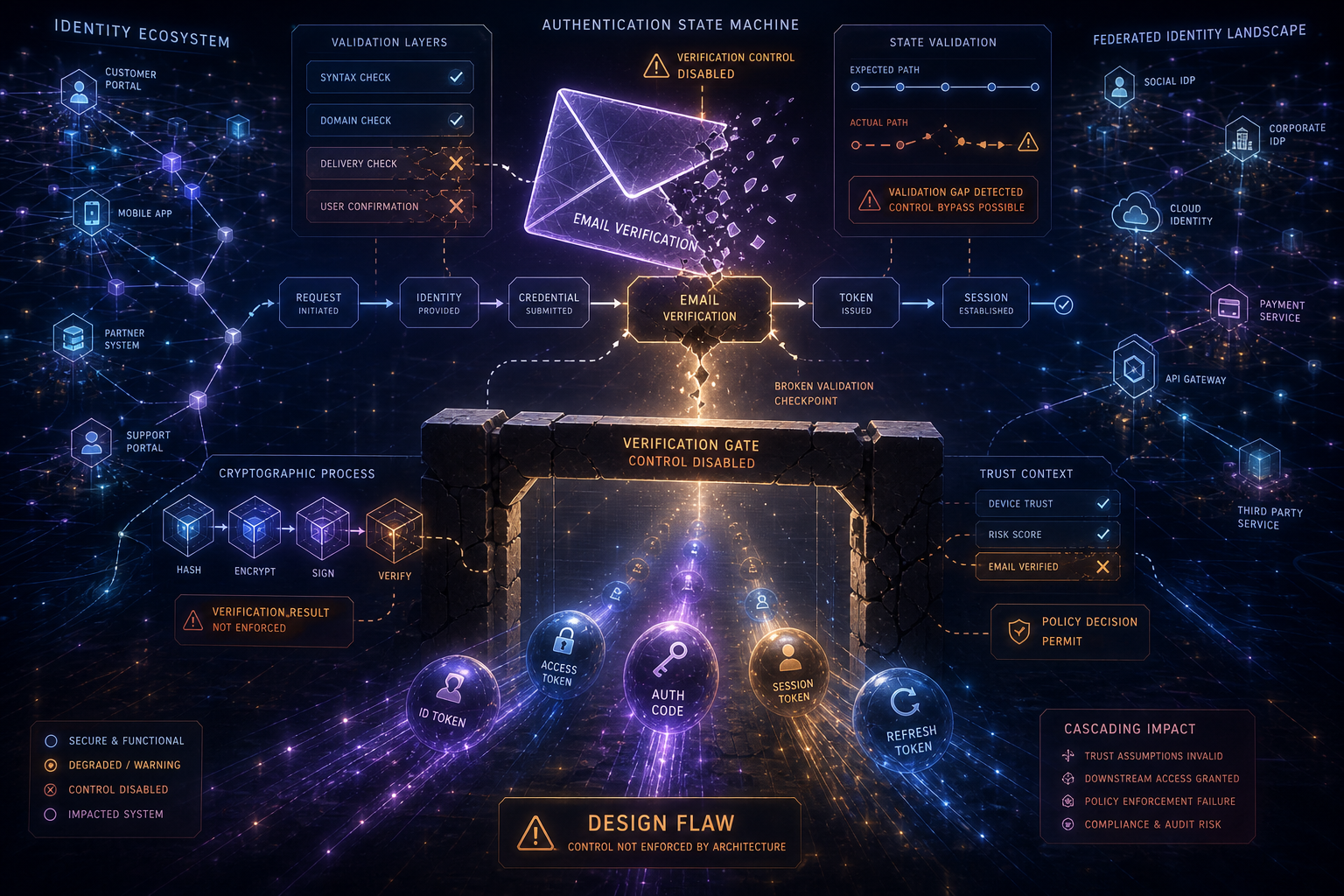
A critical vulnerability in Red Hat's Keycloak identity management platform enables attackers to bypass email verification controls during password-reset operations, permitting unauthorized credential modification without user confirmation. CVE-2026-18963 affects Keycloak deployments across enterprise authentication infrastructures and creates direct pathways to account takeover in federated identity environments. The flaw resides in the authentication state validation logic of the reset-credentials workflow, allowing unauthenticated threat actors to circumvent the primary control designed to confirm user identity during account recovery.
Organizations operating Keycloak instances should prioritize inventory assessment and patch deployment within 7 days. Temporary mitigations including rate limiting and email backend hardening can reduce exposure risk pending patch availability, but do not eliminate the underlying vulnerability. This article provides technical context, operational implications, and stratified remediation guidance for security practitioners and organizational decision-makers.
Key Finding: CVE-2026-18963 enables unauthenticated attackers to reset user credentials without completing required email verification steps, bypassing the primary authentication state validation control designed to confirm user identity during account recovery—affecting all Keycloak deployments lacking immediate security patches and creating persistent lateral-movement risk for federated identity ecosystems.
What Happened
Red Hat's Keycloak platform, a widely deployed open-source identity and access management solution, contains a critical flaw in its password-reset credential recovery mechanism. The vulnerability exists within the reset-credentials flow component, which is responsible for securely validating user identity during account recovery operations. Keycloak's baseline architecture requires that users requesting password resets complete an email verification step—a time-limited token is sent to the user's registered email address, which must be submitted before credential modification is permitted.
CVE-2026-18963 represents a failure in the authentication state validation logic that enforces this email verification requirement. The vulnerability permits threat actors to bypass the email confirmation control entirely, submitting credential-reset requests that are processed and accepted by the system without requiring proof of email access. This bypass occurs at the application logic level rather than through network-based attack vectors, making it a form of authorization control failure rather than a cryptographic or protocol-level weakness.
The technical exploitation path is network-accessible and requires no user interaction from the target account holder. An attacker with knowledge of a valid username or email address associated with a Keycloak user can initiate password-reset operations that complete successfully without the standard verification step. The attacker then possesses credentials sufficient to authenticate to dependent services that rely on Keycloak for federated identity verification through OpenID Connect or SAML protocols.
CVE-2026-18963 received official publication on August 20, 2026, through the National Vulnerability Database (NVD) and the CVE Mitre registry. Red Hat's security advisory synchronized with this public disclosure, providing patch availability information and affected product version details. The vulnerability followed coordinated disclosure practices, with a reasonable embargo period between vendor awareness and public notification.
The vulnerability affects multiple Keycloak deployment models including Red Hat Build of Keycloak versions prior to 26.4.15, open-source Keycloak corresponding versions, and deployment models spanning on-premises installations, containerized deployments (Docker, Kubernetes), and cloud-managed Keycloak instances. Version scope is extensive because Keycloak maintains backward compatibility across release series.
The attack vector is network-accessible and unauthenticated, requiring only knowledge of a valid username or email address associated with a Keycloak-managed user account, network connectivity to the Keycloak password-reset endpoint, and ability to formulate HTTP requests to the credential-reset API. An attacker sends a password-reset request, Keycloak initiates the flow, and due to the authentication state validation failure, the attacker submits credential-reset completion requests without the verification token, and these requests are accepted.
Why It Matters
Enterprise Security Architects
Password recovery mechanisms represent a critical security boundary in authentication systems. This vulnerability exemplifies a design-level weakness rather than a simple implementation error. The flaw reflects a failure in state machine validation that should enforce email verification must succeed before credential modification is permitted. The presence of this weakness suggests that authentication state validation may be implemented inconsistently across Keycloak's credential management flows, creating potential for similar vulnerabilities in other account recovery pathways.
Identity and Access Management Teams
The impact extends beyond the Keycloak instance itself into the entire federated identity ecosystem it supports. Keycloak commonly serves as a central identity provider for multiple dependent applications and services. A successful password-reset bypass enables account takeover, which permits attackers to access dependent applications with legitimate credentials, establish persistent lateral movement pathways through legitimate authentication channels, exfiltrate data available to compromised user accounts, and modify application configurations or permissions if the compromised account holds administrative privileges.
Compliance and Risk Officers
Password-reset control requirements appear across multiple compliance frameworks including NIST SP 800-63B, SOC 2 Type II, PCI-DSS Requirement 6.5.10, HIPAA, and GDPR. The email verification bypass violates these requirements. Organizations operating Keycloak for regulated workloads will face audit findings and compliance documentation requirements. This extends remediation beyond technical patching into compliance evidence collection, control effectiveness re-assessment, and potentially breach notification procedures.
Threat and Vulnerability Analysts
The exploitation barrier is low, requiring no specialized tools, exploit kits, or sophisticated reconnaissance. Any threat actor with basic HTTP request capabilities can attempt exploitation. This accessibility means automated exploitation tooling will likely emerge, vulnerability scanning systems will identify exposed Keycloak instances and attempt exploitation, and nation-state and advanced persistent threat actors will incorporate this vulnerability into initial access and lateral movement playbooks. The value of compromised credentials combined with low exploitation cost creates significant motivation for widespread exploitation.
Operational Implications
Immediate (0-24 hours): Organizations face substantial detection difficulties because password-reset requests are legitimate system operations and Keycloak's default logging often lacks detailed visibility into the credential-reset workflow. Effective detection requires event correlation across multiple log sources including Keycloak authentication logs, email system logs, dependent application logs, and network logs. Organizations without this log aggregation capability will struggle to detect exploitation. The time window for detection extends from credential reset through first application access by the attacker.
Short-term (1-7 days): Detection of unauthorized password-reset activity triggers complex response procedures including account recovery protocol (temporary lockout, forced password reset, session invalidation, multi-factor authentication enforcement), forensic evidence collection, scope determination of affected accounts, containment procedures, and third-party notification. Organizations must assess how many user accounts experienced unauthorized resets, whether reset activity correlates to specific IP addresses, and whether attackers successfully authenticated to dependent services. Remediation through patching introduces operational complexity around testing requirements, downtime implications, configuration management, and rollback scenarios.
Medium-term (1-30 days): Organizations unable to patch immediately face trade-offs between partial risk reduction and operational complexity through temporary mitigations including network segmentation, web application firewall rules, rate limiting, and email backend hardening. However, none of these mitigations eliminate the vulnerability—a sophisticated threat actor can likely circumvent rate limiting or WAF rules. These measures reduce mass-scale automated exploitation risk but do not provide defense against targeted attacks. Speed matters in patch deployment, but validation also matters to avoid introducing new operational risks through hasty patching without testing.
Long-term (30+ days): Strategic organizations should implement advanced password-reset security controls including multi-factor verification for password-reset operations, IP reputation scoring, and passwordless authentication alternatives. Comprehensive Keycloak security assessments should review other credential management flows for similar state validation weaknesses, evaluate passwordless authentication migration pathways, implement risk-based authentication policies, and establish zero-trust identity architecture. Red-team validation should confirm control effectiveness and defense detection capabilities. Establishment of Keycloak security advisory subscription and automated version detection in vulnerability scanning systems ensures proactive identification of future vulnerabilities.
Recommended Actions
Actions are organized by organizational security maturity. Baseline controls apply across all tiers and should be treated as immediate priorities regardless of organizational size.
* Organizations with standard security tooling and general-purpose endpoint protection.
- 1 - Identify all Keycloak instances across on-premises infrastructure, cloud deployments, and managed services; document version numbers for each instance
- 2 - Consult the CVE record to confirm whether deployed versions fall within affected ranges (Red Hat Build of Keycloak versions prior to 26.4.15)
- 3 - Assess user population served by each Keycloak instance and identify critical applications requiring password-reset functionality
- 4 - Confirm email backend service availability and audit log retention policies; ensure sufficient log storage exists for forensic analysis
- 5 - Establish incident command structure identifying CISO, vulnerability management lead, IAM engineer, SOC lead, and operations lead
- 6 - Brief compliance and legal teams on regulatory implications and breach notification procedures
- 7 - Obtain security patches from Red Hat and conduct patch testing in non-production environments that mirror production configuration
- 8 - Deploy temporary mitigations including rate limiting on password-reset endpoint and IP-based rate limiting
- 9 - Enable detailed logging of password-reset requests, including email verification status
- 10 - Configure SOC alerting on password-reset requests completing without email verification event logs
* Organizations with mature security operations and coordinated incident response capabilities.
- 1 - Execute comprehensive patch testing validating password-reset workflow functionality end-to-end including request initiation, email delivery, verification token submission, and credential modification
- 2 - Test dependent application authentication to confirm OpenID Connect or SAML endpoints function normally
- 3 - Deploy web application firewall or application-level filtering to reject password-reset requests lacking valid email verification tokens
- 4 - Establish monitoring dashboard tracking password-reset request volume, geographic origin, and success/failure rate with defined alert thresholds for suspicious patterns
- 5 - Schedule maintenance windows for patch deployment coordinated with dependent service owners with communication to affected users
- 6 - Execute staged patch deployment with rollback procedures and database backup verification
- 7 - Conduct post-patch validation confirming email verification requirement is enforced in production
- 8 - Collect patch deployment evidence including deployment timestamps, version confirmation, and testing results for compliance documentation
- 9 - Audit critical supply chain partners for Keycloak deployment and vulnerability exposure
- 10 - Update vendor SLAs to include security patch deployment commitments
* Organizations with zero-trust architectures and comprehensive identity governance frameworks.
- 1 - Implement multi-factor verification for password-reset operations including SMS code or authenticator app in addition to email verification
- 2 - Integrate IP reputation scoring to block requests from known VPN exit nodes while allowing legitimate users to bypass through security questions
- 3 - Implement passwordless authentication alternatives including WebAuthn FIDO2 security keys to reduce reliance on password reset functionality
- 4 - Conduct security code review of Keycloak deployment covering configuration, custom authentication flows, and integration points
- 5 - Review other credential management flows including registration, profile updates, and account linking for similar state validation weaknesses
- 6 - Assess token issuance controls and session management for vulnerabilities related to account takeover
- 7 - Establish Keycloak security advisory subscription and automated notification procedures with defined SLAs for patch assessment and deployment
- 8 - Evaluate passwordless authentication migration pathways and implement risk-based authentication policies for password-reset flows requiring additional verification for unusual locations or times
- 9 - Review password-reset mechanism necessity in zero-trust model and establish federated identity provider redundancy
- 10 - Conduct penetration testing targeting patched password-reset flow and validate incident response procedures through tabletop exercise
Closing Statement
CVE-2026-18963 represents a critical vulnerability in a foundational identity platform deployed across enterprise authentication infrastructures. The weakness lies not in cryptography or protocol design, but in the architecture of a core security control—the email verification step that protects account recovery. This vulnerability illustrates a principle central to institutional resilience: authentication controls that appear operational may harbor hidden weaknesses.
Organizations should view this event as both an immediate remediation imperative and an inflection point for broader identity security architecture assessment. Patching represents the definitive remediation. However, the remediation process itself creates operational friction and coordination complexity. Organizations that establish effective vulnerability response coordination across security, infrastructure, compliance, and application ownership teams will reduce their exposure window and strengthen institutional decision-making capabilities for future incidents.
The pathway from patch availability to full organizational remediation is where institutional discipline separates resilient organizations from vulnerable ones. Speed matters—every day of delayed patching expands the window for exploitation. But validation also matters—hasty patching without testing can introduce new operational risks. The stratified approach enables organizations to reduce immediate risk while executing thorough patch testing and deployment.