
Automating Vulnerability Coordination: Analyzing CISA's AI-Driven Gold Eagle Clearinghouse Framework
Executive Summary
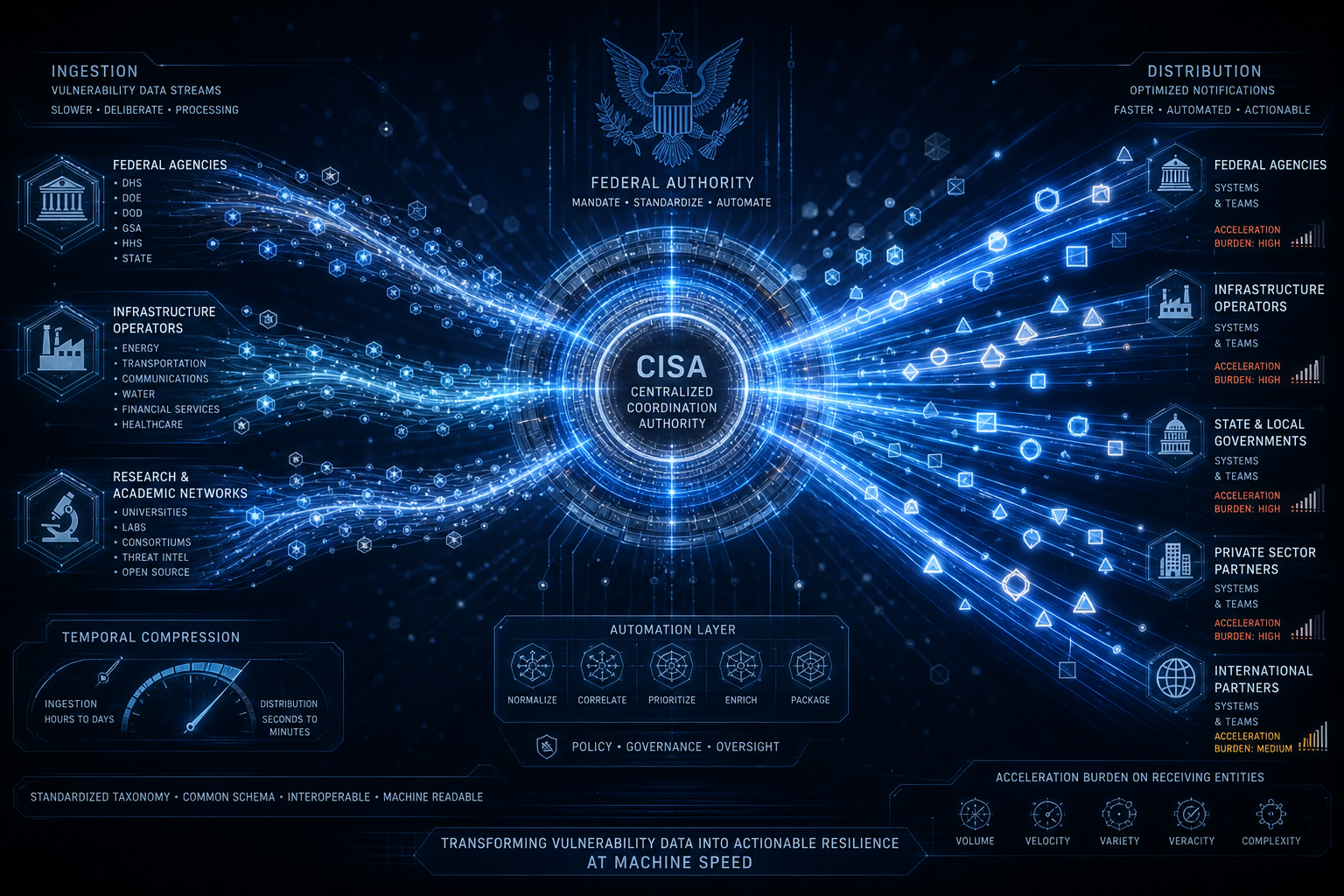
The Gold Eagle Clearinghouse, launched by the White House and operationalized by CISA in July 2026, restructures vulnerability coordination from manual, time-intensive disclosure processes to AI-accelerated systematic management. The framework reduces coordinated vulnerability disclosure cycles from months to weeks while establishing binding federal-private sector coordination protocols.
Federal agencies face mandatory participation; critical infrastructure operators and private sector researchers encounter binding or strongly expected compliance requirements. Organizations must compress vulnerability assessment and remediation decision-making timelines while integrating with CISA-managed coordination protocols.
Immediate actionable guidance: The central institutional challenge is not technological but organizational: accelerating human decision-making velocity and remediation execution to match machine-assisted triage and automated notification timelines. Strategic readiness assessment and accelerated capability development are immediate priorities for federal agencies and critical infrastructure operators.
Key Finding: Gold Eagle introduces AI-driven automation to vulnerability coordination workflows, reducing disclosure cycle times from months to weeks while establishing binding federal-private sector coordination protocols that directly impact organizational remediation schedules, security posture requirements, and workforce role definitions across federal agencies and critical infrastructure sectors.
What Happened
The White House announced the Gold Eagle initiative in July 2026 as an interagency vulnerability coordination framework designed to address systemic delays in coordinated vulnerability disclosure across federal, critical infrastructure, and private sector domains. CISA, designated as the operational lead and clearinghouse administrator, integrated Gold Eagle capabilities into the existing Coordinated Vulnerability Disclosure (CVD) program.
The framework encompasses federal agencies, critical infrastructure operators, private sector vulnerability researchers, and frontier artificial intelligence model developers. Gold Eagle establishes a single operational clearinghouse responsible for triage, severity assessment, timeline calculation, and multi-party notification coordination.
The technical architecture centers on AI-assisted automation of four core vulnerability coordination functions: machine-learning models classify vulnerability severity and exploitability; automated protocols calculate disclosure timelines based on vulnerability characteristics and organizational capacity; real-time coordination dashboards provide centralized visibility into disclosure status; and machine-readable vulnerability documentation standards enable automated ingestion into organizational vulnerability management systems.
Integration with VINCE (Vulnerability Information and Coordination Environment) occurs at the data layer: Gold Eagle automation feeds assessment results and notification protocols into VINCE, which continues to serve as the communication backbone for disclosure coordination.
The rollout occurs in phased deployment with initial operations commencing in August 2026 with federal agencies as primary participants, followed by sector-specific adoption roadmaps for critical infrastructure operators. Frontier AI model developers received executive order directives establishing voluntary yet strongly expected participation.
Gold Eagle establishes machine-calculated timelines based on vulnerability severity, organizational size, and technical complexity, with limited exemptions. High-severity vulnerabilities in critical systems face disclosure windows as short as 14 days; moderate-severity vulnerabilities typically encounter 30-45 day windows; low-severity vulnerabilities may receive 60+ day remediation periods.
Why It Matters
Federal Agencies and CISO Leadership
Gold Eagle addresses systemic fragmentation in federal vulnerability coordination by establishing binding federal-private sector protocols, centralizing triage authority in CISA, and eliminating manual coordination overhead. This creates predictability and standardization but demands significant operational restructuring and compressed decision-making timelines that exceed current federal agency capacity.
Critical Infrastructure Operators and Sector Regulators
The framework creates both coordination benefits and regulatory conflict risks. Standardized timelines reduce opacity and improve federal visibility, but compressed windows may conflict with existing sector-specific regulatory requirements (NERC, SEC, FCC, HHS), creating dual-compliance dilemmas requiring immediate regulatory coordination and potential exception requests.
Vulnerability Researchers and Private Sector Security Vendors
Compressed disclosure windows reduce time-to-exploitation economics and compress zero-day acquisition market value, fundamentally altering vulnerability research incentives and market dynamics. Validation and threat intelligence publication processes must accelerate substantially to maintain quality under shortened disclosure timelines.
Cybersecurity Workforce and Talent Management
Gold Eagle transforms vulnerability coordinator roles from timeline negotiators to assessment validators and remediation decision-makers operating under federal mandates and compressed cycles. This role transformation requires rapid competency development and capability maturation that exceeds available federal cybersecurity workforce training capacity.
Operational Implications
Immediate (August-September 2026): Federal agencies must designate Gold Eagle program leads, conduct current-state vulnerability management inventory assessments, and schedule regulatory coordination meetings to clarify timeline conflicts. Critical infrastructure operators must establish sector-specific regulator coordination to resolve potential conflicts between Gold Eagle and existing regulatory disclosure requirements. All organizations must update responsible disclosure procedures and establish Gold Eagle communication protocols.
Short-term (October 2026-December 2026): Federal agencies must implement parallel processing workflows, procure automated assessment tools, and develop governance guidance for timeline extensions. Critical infrastructure operators must integrate vendor disclosure agreements, assess remediation capacity constraints, and develop compressed remediation playbooks. Private sector organizations must update disclosure procedures, implement machine-readable documentation standards, and develop staff training programs.
Medium-term (January 2027-March 2027): Organizations must complete workforce training and competency validation, operationalize automated vulnerability tracking systems, and establish compliance reporting mechanisms. Federal agencies must resolve conflicts between Gold Eagle timelines and existing governance structures; critical infrastructure operators must secure regulatory exception approval for conflicting timelines. All organizations must validate that internal remediation capacity supports Gold Eagle timeline compliance.
Long-term (Beyond March 2027): Organizations must sustain accelerated remediation execution, monitor Gold Eagle compliance performance, and adjust staffing and resource allocation based on operational experience. Federal authorities must assess framework effectiveness in reducing disclosure cycle times and window-of-exposure periods, identifying systematic performance gaps and framework refinements needed to support continued participation.
Recommended Actions
Actions are organized by organizational security maturity. Baseline controls apply across all tiers and should be treated as immediate priorities regardless of organizational size.
* Organizations with standard security tooling and general-purpose endpoint protection.
- 1 - Designate a Gold Eagle Program Lead within your CISO office serving as the single point of contact for CISA coordination, policy interpretation, and escalation procedures, allocating 50% of this person's time to program implementation.
- 2 - Conduct a current-state vulnerability management process inventory documenting how vulnerabilities flow through your organization from discovery to remediation completion, identifying decision points, approval authorities, and typical timeline durations.
- 3 - Schedule coordination meetings with sector-specific regulators and agency leadership to clarify how Gold Eagle timelines integrate with existing regulatory requirements and identify potential conflicts requiring resolution.
- 4 - Establish a Gold Eagle compliance tracking system to document CISA notifications, assigned timelines, remediation status, and compliance milestones.
- 5 - Update responsible disclosure procedures to reference Gold Eagle and CISA's clearinghouse, adding language clarifying that vulnerabilities affecting federal systems or critical infrastructure should be reported to CISA.
- 6 - Establish regulatory coordination with your sector regulator by scheduling immediate meetings to clarify how Gold Eagle timelines interact with existing regulatory disclosure requirements.
- 7 - Conduct a current vulnerability inventory assessment documenting all known vulnerabilities in critical systems, their remediation status, and estimated time-to-remediation.
- 8 - Develop a Gold Eagle communication plan designating coordination leads in security operations, executive leadership, regulatory affairs, and technical operations.
* Organizations with established but not optimized vulnerability management processes and mature security operations.
- 1 - Implement parallel processing workflows restructuring vulnerability management to conduct assessment, regulatory coordination, and remediation planning simultaneously rather than sequentially.
- 2 - Procure or develop automated vulnerability assessment tools compatible with Gold Eagle formats and evaluate whether your current vulnerability management platform can ingest CISA assessments automatically.
- 3 - Develop Gold Eagle-specific governance guidance creating decision frameworks clarifying which federal authorities can approve timeline extensions and how conflicts with regulatory requirements are escalated.
- 4 - Conduct staff training on Gold Eagle protocols and accelerated decision-making for all personnel involved in vulnerability triage, remediation planning, and CISA coordination.
- 5 - Integrate vendor vulnerability disclosure agreements into procurement and contract management by auditing critical vendors' disclosure procedures for alignment with Gold Eagle timelines.
- 6 - Conduct a remediation capacity assessment modeling your organization's current patching velocity, testing procedures, and deployment frequency to identify bottlenecks preventing timeline compliance.
- 7 - Develop compressed remediation playbooks for high-severity vulnerabilities pre-staging testing environments and establishing emergency change procedures.
- 8 - Implement automated vulnerability tracking systems compatible with Gold Eagle formats, establishing data pipelines enabling CISA notifications to flow into your vulnerability management platforms.
- 9 - Update vulnerability disclosure program timelines to align with Gold Eagle expectations (14-45 days rather than 90+ days), communicating timeline changes to vulnerability researchers.
- 10 - Implement machine-readable vulnerability documentation standards compatible with Gold Eagle specifications.
* Organizations with mature, automated vulnerability management operations and sophisticated remediation capabilities.
- 1 - Develop predictive remediation capacity models forecasting whether your remediation capacity can support Gold Eagle timelines or whether resource expansion is required.
- 2 - Implement automated compliance reporting to CISA that automatically reports remediation status, timeline adherence, and exception requests, eliminating manual reporting overhead.
- 3 - Establish inter-agency coordination protocols for shared systems ensuring consistent timeline adherence and cross-agency remediation planning.
- 4 - Design organizational contingency procedures for timeline non-compliance defining circumstances when your organization cannot meet timelines and establishing escalation procedures.
- 5 - Design predictive timeline extension requests using remediation capacity models to forecast scenarios where you cannot meet CISA timelines and develop data-driven requests.
- 6 - Establish vendor remediation coordination procedures ensuring vendors' remediation timelines align with your Gold Eagle compliance requirements.
- 7 - Implement regulatory exception management procedures for situations where Gold Eagle timelines conflict with sector-specific regulatory requirements.
- 8 - Develop supply chain vulnerability disclosure transparency mechanisms working with regulators to clarify whether supply chain vulnerabilities fall under Gold Eagle protocols.
- 9 - Implement automated vulnerability assessment tools compatible with CISA specifications, designing systems that ingest Gold Eagle assessment results automatically.
- 10 - Develop predictive threat intelligence modeling using historical vulnerability data and emerging threat actor patterns to forecast which disclosed vulnerabilities are likely to be exploited.
* Cross-functional capability development and change management initiatives applicable across all organizational maturity levels.
- 1 - Conduct a role-impact assessment identifying positions and functions affected by Gold Eagle implementation, classifying impacts as immediate (August-September 2026), short-term (October 2026-March 2027), or long-term (beyond March 2027).
- 2 - Develop competency frameworks for accelerated vulnerability management defining knowledge, skills, and decision-making authorities required for personnel operating under Gold Eagle protocols.
- 3 - Establish training and certification timelines scheduling training delivery and competency validation to precede Gold Eagle implementation, prioritizing CISA coordinators, vulnerability assessors, and remediation decision-makers.
- 4 - Assess staffing implications by modeling resource requirements for operating under compressed vulnerability cycles to determine whether existing staff can manage increased velocity or additional hiring is required.
- 5 - Establish change management and communication protocols planning how you will communicate Gold Eagle requirements, timeline changes, and role transformations to affected staff.
Closing Statement
Gold Eagle represents a systematic federal commitment to compressing the vulnerability management decision cycle from months to weeks. This compression carries genuine security value: reduced window-of-exposure periods, eliminated coordination overhead, and standardized federal-private sector protocols all contribute to aggregate risk reduction.
However, the framework's success depends entirely on organizations' ability to compress their internal remediation velocity and decision-making cycles to match the new timeline baseline. The challenge is not technological but institutional: can organizations with varying levels of vulnerability management maturity simultaneously accelerate remediation execution, compress internal approval workflows, and operate under federal mandates binding them to timelines they may not have built capacity to meet?
Success requires immediate capability assessment, honest acknowledgment of timeline risks, and sustained effort toward workforce development and operational restructuring. Organizations that conduct these assessments in August and September 2026 will position themselves for Gold Eagle compliance by Q1 2027. Organizations that delay this work will face escalating pressure, potential compliance violations, and increased window-of-exposure risk.
The broader institutional insight is this: automation of federal coordination protocols does not eliminate organizational burden—it redistributes burden from dialogue management to execution velocity. Vulnerability management is becoming less about negotiating disclosure timelines and more about executing remediation at machine speed. Organizations must build capacity for that speed or accept increasing operational and regulatory risk.