
Chaining Authentication Bypass: Analyzing Pre-Auth RCE Through Access Control and JDBC Injection in PaperCut NG/MF (CVE-2026-81578, CVE-2026-82078)
Executive Summary
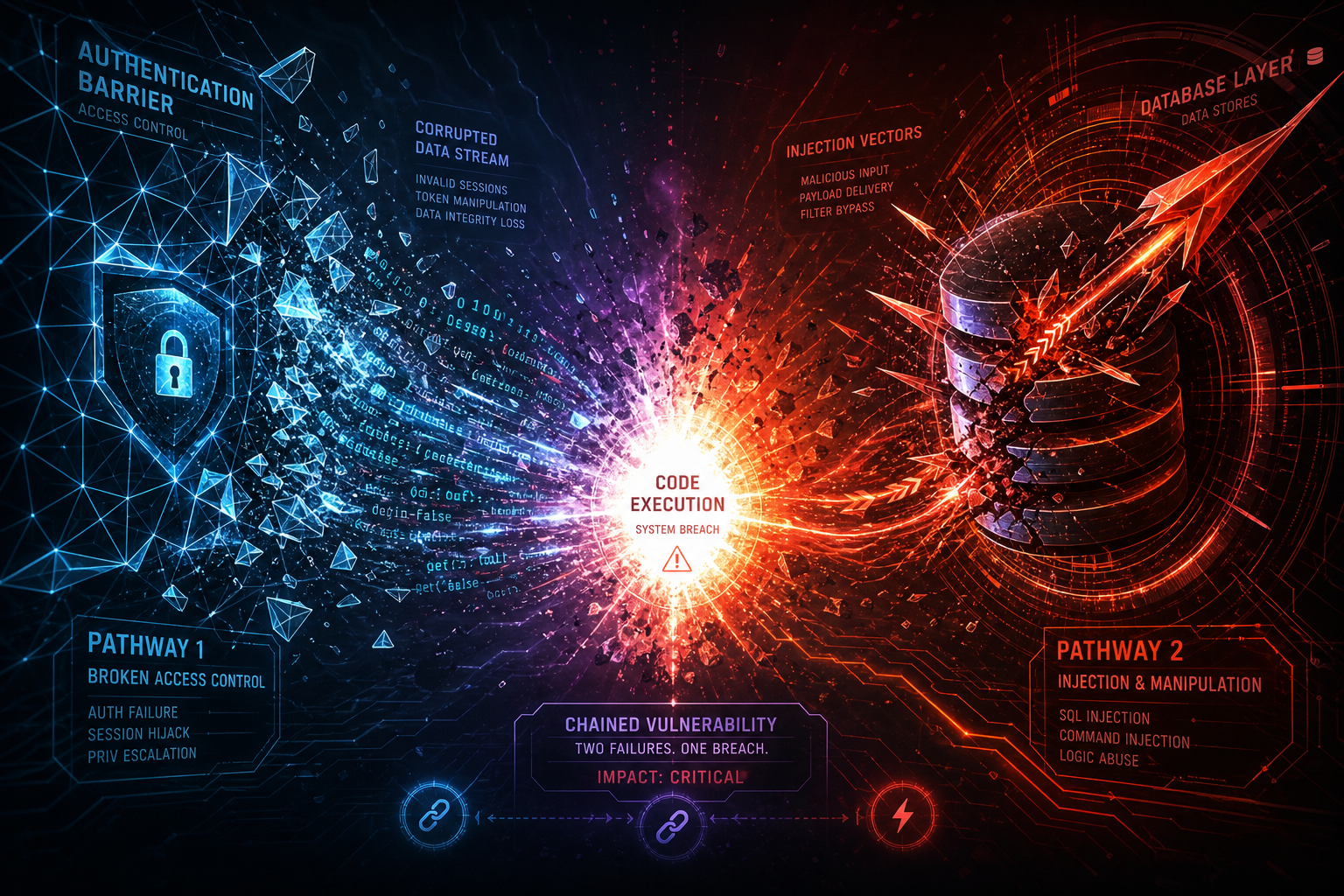
Two distinct vulnerabilities in PaperCut NG/MF combine to create an unauthenticated remote code execution pathway that bypasses credential systems and traditional detection signatures. CVE-2026-81578 (broken access control) chains with CVE-2026-82078 (unsafe JDBC query construction) to enable attackers to execute arbitrary commands within the PaperCut application context without authentication, administrative notification, or credential compromise.
Immediate actionable guidance: Active exploitation has been confirmed in operational environments within three days of public disclosure. Organizations deploying affected versions require immediate patching regardless of network topology. Those unable to patch within 48 hours should implement temporary network-level access restrictions to mitigate exposure until remediation is possible.
Key Finding: Unauthenticated attackers can execute arbitrary code within PaperCut application context by chaining a pre-authentication bypass (CVE-2026-81578) with unsafe database query construction (CVE-2026-82078), bypassing credential systems, administrative logging, and traditional detection mechanisms—requiring immediate patching of all affected deployments within 72 hours regardless of network segmentation status.
What Happened
On August 27, 2026, PaperCut released a critical security bulletin disclosing two distinct vulnerabilities affecting NG (Next Generation) and MF (Multi Functional) product lines. These vulnerabilities form an exploitation chain in which the first vulnerability enables the second, ultimately delivering remote code execution without any requirement for user authentication or credential compromise.
CVE-2026-81578 represents broken access control in PaperCut's authentication handler. The vulnerability stems from insufficient validation on a pre-authentication API endpoint designed to be accessible before user login. An attacker can manipulate parameters or bypass authentication steps (CWE-305) to gain access to protected functionality without submitting valid credentials, exposing protected endpoints that should require authentication.
CVE-2026-82078 involves unsafe Java Database Connectivity (JDBC) query construction within the application's database layer. Rather than using parameterized queries, the application concatenates untrusted user input directly into dynamic SQL command strings (CWE-470). This allows an attacker with access to the vulnerable endpoint to inject arbitrary SQL commands that execute within the database service account context—typically a service account with elevated privileges necessary for PaperCut operations.
The attack sequence proceeds as follows: an attacker exploits CVE-2026-81578 by sending a specially crafted request to a pre-authentication endpoint, bypassing credential validation. The application grants unauthenticated access to a protected API endpoint. The attacker then submits malicious JDBC parameters containing SQL injection payloads through this unauthorized access point. The vulnerable JDBC query construction mechanism processes these payloads as legitimate SQL commands. The database layer executes attacker-controlled commands within the application service account context, potentially enabling code execution through database stored procedures (such as xp_cmdshell in SQL Server environments) or direct exfiltration of sensitive data.
By August 30, 2026—three days post-disclosure—security researchers at Huntress confirmed active exploitation in operational environments. As of September 15, 2026, exploitation activity remains ongoing, indicating that many organizations have not yet applied available patches. The rapid weaponization timeline suggests sophisticated threat group involvement or broad availability of proof-of-concept code.
PaperCut NG/MF is widely deployed across enterprise, educational, governmental, and healthcare sectors as centralized print management infrastructure, controlling document queuing, user authentication, print job accounting, and resource allocation across networked printing devices.
Why It Matters
Security Practitioners
The pre-authentication nature of this vulnerability eliminates entire defensive layers. Credential-based access controls, password policies, multi-factor authentication, and compromised credential detection systems provide no protection. The vulnerability requires only network accessibility to the PaperCut instance—either direct external access or internal network access. The JDBC injection component operates at the database layer, potentially bypassing application-level logging if not specifically configured to capture raw SQL commands. Detection becomes significantly more difficult than identifying unusual authentication patterns or suspicious login behavior.
Security Leaders and Executives
PaperCut manages print queues and document accounting—functions organizations often consider operational utility rather than security-sensitive systems. However, PaperCut installations control access to sensitive data across sectors: student records and research data in educational institutions; protected health information (PHI) in healthcare organizations; classified documents in government agencies; intellectual property and financial data in enterprises. Compromise creates direct data exfiltration risk and enables lateral movement throughout organizational IT infrastructure. The RCE capability establishes a persistent foothold enabling establishment of long-term attacker presence within sensitive infrastructure.
Infrastructure and Operations Teams
The vulnerability requires immediate response despite operational disruption risks. PaperCut typically integrates deeply into organizational print infrastructure; patching may require service downtime, laboratory testing, and coordination with user departments. The 72-hour urgency window between disclosure and active exploitation leaves minimal time for traditional staged testing and change management processes.
Policy-Aware Leadership
The incident highlights vendor dependency and supply chain vulnerability. Security posture becomes partially dependent on third-party vendors' vulnerability disclosure practices, patch development timelines, and deployment guidance. Similar vulnerabilities in other infrastructure components reinforce the need for mature vulnerability management processes and vendor relationship frameworks. The institutional impact spans confidentiality, integrity, and availability. Confidentiality is compromised through direct database access enabling exfiltration of print job metadata, user information, and organizational documents. Integrity is threatened through modification of print queues, user accounts, print settings, and potential injection of malicious content. Availability is compromised through denial-of-service attacks leveraging JDBC injection to crash the database or consume resources, as well as through application compromise and infrastructure takeover.
Operational Implications
Immediate Detection and Response (Day 0-1): Establish detection capabilities focused on anomalous HTTP/HTTPS requests to unauthenticated API endpoints—unusual request patterns, unexpected parameter values, or rapid sequential requests from single source IPs. Capture application logs recording unauthenticated access attempts and database transaction logs capturing unusual SQL commands, system procedure invocations, or query patterns inconsistent with normal PaperCut operations. Preserve web server access logs providing timing information linking network-layer events to application-layer actions. Evidence preservation is essential for forensic analysis before patching or system restoration overwrites logs.
Short-Term Containment (Day 1-3): Organizations must weigh immediate service shutdown against operational continuity with elevated risk. Institutions with high print service criticality face greater disruption from service shutdown. Alternative approaches include network-level access restrictions—implementing firewall rules limiting API endpoint access to known legitimate internal subnets, restricting access to specific VLANs or security groups, or deploying Web Application Firewall rules blocking JDBC injection payload patterns. These approaches maintain operational continuity while reducing but not eliminating risk; sophisticated attackers or compromised internal systems can still exploit the vulnerability.
Medium-Term Remediation (Day 3-14): Patch deployment must proceed through established change management while maintaining awareness of active exploitation timelines. Pre-patch testing in isolated laboratory environments verifies that updates do not introduce regressions or break dependent workflows. Staggered production rollout—beginning with non-critical systems and progressing to critical infrastructure—reduces organizational impact of any patch-related issues while maintaining reasonable remediation timelines. Post-patch verification must confirm not only successful application startup but also correct print service functionality and normal print job processing.
Forensic and Investigative Implications: If exploitation has occurred, determining compromise scope is complex. Database query logs may reveal what data attackers accessed, but JDBC injection may allow skilled attackers to modify logs or cover tracks. Code execution through database stored procedures may trigger system-level logging (process creation, file modification events), but these logs may exist on systems administrators do not routinely monitor. The absence of detected exploitation attempts does not guarantee the vulnerability was not exploited.
Long-Term Architecture Implications: This vulnerability should trigger broader architectural assessment. PaperCut's network position significantly affects both exploitation risk and containment feasibility. Organizations with PaperCut instances exposed to the internet face the highest risk and should prioritize rapid patching or service shutdown. Organizations with strictly internal network positioning have more flexibility for temporary compensating controls pending patching. Database-level security assessment should verify that PaperCut service accounts have only minimum necessary permissions and that privileged database operations are restricted and audited.
Recommended Actions
Actions are organized by organizational security maturity. Baseline controls apply across all tiers and should be treated as immediate priorities regardless of organizational size.
* Essential immediate response steps for all organizations regardless of size or resources.
- 1 - Identify all PaperCut NG/MF instances through network scanning and asset inventory review
- 2 - Create a prioritized list noting network accessibility of each instance (externally exposed, DMZ-positioned, internal network only)
- 3 - Verify that application and database logging are enabled; enable logging on non-compliant systems
- 4 - Brief organizational leadership on CVE facts, institutional exposure, and expected remediation timelines
- 5 - Communicate to print service users that security updates may require temporary service interruption
- 6 - For instances exposed to external networks or accessible from untrusted internal segments, immediately implement network-level access restrictions limiting API endpoint access to known legitimate internal subnets only
* Resourced organizations capable of testing and staged deployment.
- 1 - Obtain patches from PaperCut for all affected versions
- 2 - Test patches in isolated laboratory environments to verify functionality and backward compatibility with dependent systems
- 3 - Develop a patch deployment plan specifying the sequence and timing of updates, starting with systems accessible from external networks and progressing to internal-only systems
- 4 - For systems that cannot be patched within 72 hours, deploy temporary mitigations including Web Application Firewall rules blocking common SQL injection patterns, IDS/IPS signatures detecting authentication bypass attempts, and enhanced monitoring with rapid escalation procedures for suspicious database query patterns
- 5 - Execute staggered patch deployment beginning with non-critical systems; verify post-patch application functionality on each system before proceeding to the next instance
* Comprehensive forensic and hardening activities for security-mature organizations.
- 1 - Conduct comprehensive forensic analysis of all PaperCut instances to determine whether exploitation has occurred, focusing on systems with highest external exposure and elevated database privileges
- 2 - Analyze application, database, and web server logs spanning the disclosure period (August 27, 2026 onwards) for authentication bypass attempts, JDBC injection payloads, and unusual database query patterns
- 3 - If exploitation is confirmed, determine the scope of data accessed or modified and initiate incident response procedures including notification obligations and remediation of unauthorized changes
- 4 - Perform security hardening beyond patching, including assessment of PaperCut network positioning, database access controls, application endpoint configuration, and logging completeness
- 5 - Evaluate whether current PaperCut deployment model (on-premises vs. managed cloud service) aligns with organizational risk tolerance and consider migration to vendor-managed instances if this option reduces future vulnerability exposure
* Long-term organizational and vendor management improvements.
- 1 - Establish vendor security assessment criteria covering vulnerability disclosure timeliness, patch development cycles, and technical detail provided in security advisories
- 2 - Assess whether PaperCut's historical security posture meets organizational standards; if frequent critical vulnerabilities emerge, consider alternative document management solutions
- 3 - Integrate this incident into lessons-learned processes, documenting response timelines, obstacles encountered, and process improvements for future critical vulnerability responses
- 4 - Evaluate whether patch management and vulnerability response processes can accommodate aggressive timelines required for critical infrastructure vulnerabilities, and implement process adjustments if current procedures cannot achieve remediation within 72-hour windows
Closing Statement
This vulnerability exemplifies how organizational assumptions about infrastructure security can be rapidly invalidated by the convergence of technical weaknesses in widely deployed third-party components. The pre-authentication nature of the bypass eliminates traditional credential-based defenses; the database-layer injection extends impact beyond application boundaries; the active exploitation timeline compresses remediation windows. The incident reinforces that internal utility infrastructure components merit the same security rigor as systems directly handling sensitive data, that vendor dependency requires proactive vulnerability management, and that institutional resilience depends on the ability to execute rapid security response under operational pressure.
Organizations that respond effectively will be those that have invested in mature asset inventory processes, monitoring and detection capabilities, patch management infrastructure, and vendor relationship frameworks. Those that have not will face urgent decisions between service disruption and residual risk. Both paths carry institutional consequence; neither is without cost. The value of institutional preparation becomes evident precisely in moments when the window for deliberate response collapses.
Ultimately, organizational security capability is measured not by the vulnerabilities discovered in third-party components, but by the speed and rigor with which institutions identify, validate, and deploy fixes to critical infrastructure under active threat conditions.