
The Deceptive Assessment: Inside the Deserialization Collapse of Enterprise SharePoint Frameworks
Executive Summary
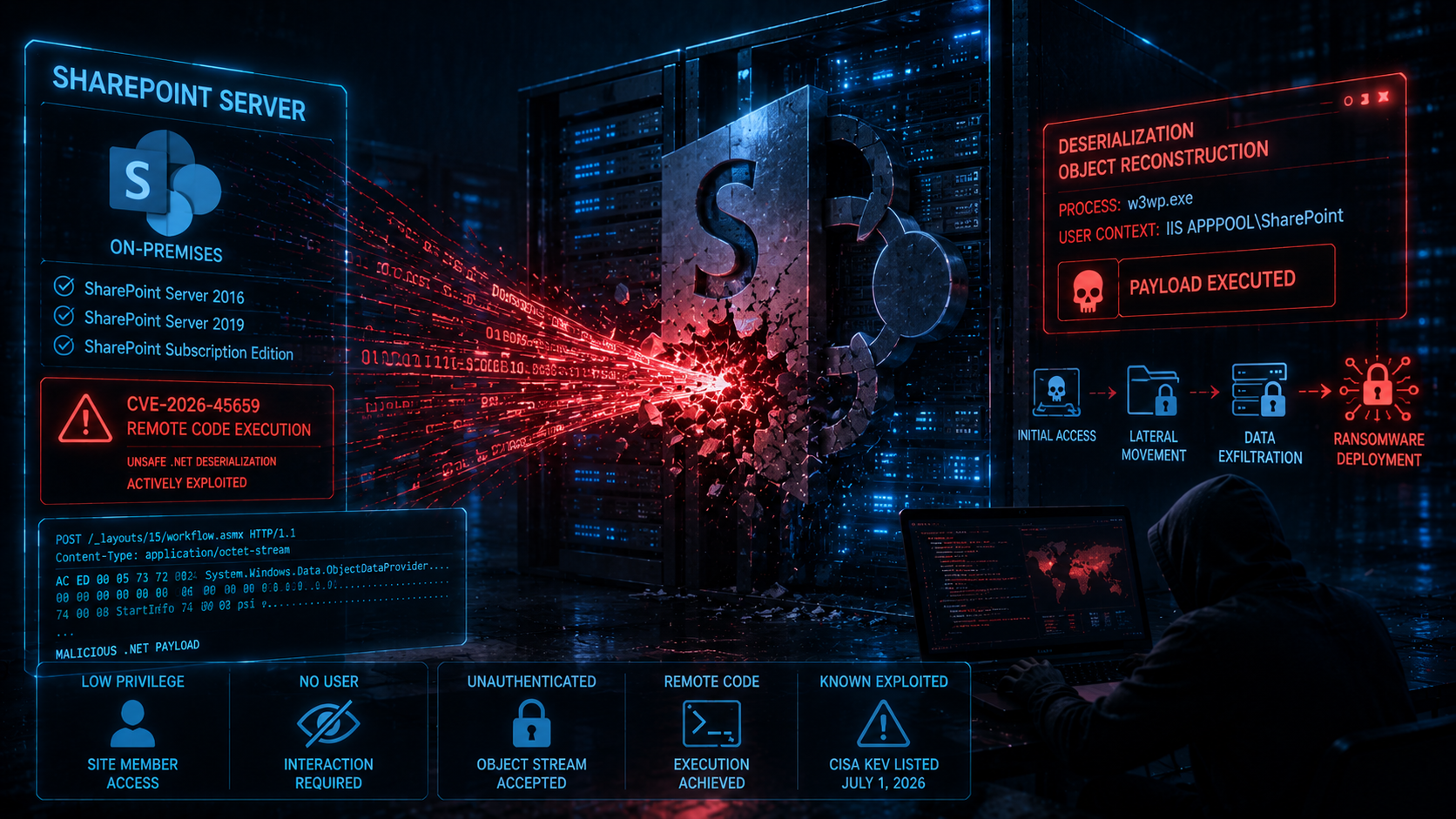
Microsoft's May 2026 security patches addressed a critical remote code execution vulnerability (CVE-2026-45659) in on-premises SharePoint Server 2016, 2019, and Subscription Edition, stemming from unsafe .NET deserialization of untrusted object streams. Microsoft initially designated the flaw as "Exploitation Less Likely," an assessment that proved inaccurate when threat actors rapidly weaponized the vulnerability in production environments. On July 1, 2026, the Cybersecurity and Infrastructure Security Agency formally cataloged CVE-2026-45659 in its Known Exploited Vulnerabilities list, establishing an emergency compliance deadline of July 4, 2026. The vulnerability permits any authenticated user with minimum "Site Member" permissions to execute arbitrary code remotely within the SharePoint worker process context without requiring user interaction or complex exploitation techniques. The incident exposes a critical organizational vulnerability: reliance on vendor exploit likelihood assessments as primary patching prioritization metrics creates unmonitored exposure windows during which initial access brokers and ransomware campaigns actively target production environments. Organizations must immediately verify all SharePoint deployments match current build versions and implement endpoint detection rules flagging anomalous process spawning from IIS worker processes.
Key Finding: CVE-2026-45659 was actively weaponized against SharePoint Server deployments despite Microsoft's initial "Exploitation Less Likely" designation, exposing a systemic failure in vendor-dependent patch prioritization. Any authenticated user with baseline Site Member permissions can achieve remote code execution — no user interaction, no elevated credentials required.
What Happened
In May 2026, Microsoft released security patches addressing multiple vulnerabilities across its SharePoint Server product line. Among these patches was a fix for CVE-2026-45659, a high-severity remote code execution flaw affecting SharePoint Server 2016, 2019, and Subscription Edition. The patches were distributed through standard update channels across multiple build versions: Build 16.0.19725.20280 for Subscription Edition, Build 16.0.10417.20128 for Server 2019, and Build 16.0.5552.1002 for Server 2016.
The underlying vulnerability stems from unsafe deserialization processing within SharePoint's object reconstruction layer. SharePoint components accept serialized .NET objects transmitted over network interfaces and rebuild them in memory without cryptographic validation or type checking. An attacker can craft malicious object streams that leverage .NET Framework class layouts—known in security research as "gadget chains"—to achieve arbitrary code execution during deserialization. Because the vulnerability exists in a core SharePoint component, resulting code execution operates within the Internet Information Services (IIS) worker process context, typically running with elevated privileges.
A critical operational complication emerged during initial patch release. While Microsoft included the technical fixes in the May 2026 update packages, the specific CVE designation was inadvertently omitted from Microsoft's security advisory documentation. This documentation gap created a visibility problem: organizations relying on automated vulnerability scanning tools and threat intelligence feeds could not easily correlate the vulnerability with released fixes. Many organizations therefore did not recognize that their May 2026 patching cycle had addressed this specific vulnerability, leaving deployments in a state of false confidence.
On July 1, 2026, the Cybersecurity and Infrastructure Security Agency published formal assessment that CVE-2026-45659 was being actively exploited. CISA added the vulnerability to its Known Exploited Vulnerabilities catalog under emergency directive BOD 26-04, establishing a compliance deadline of July 4, 2026 for federal organizations. The escalation from "Exploitation Less Likely" (Microsoft's initial assessment) to active exploitation represents a significant divergence between vendor risk prediction and real-world threat actor behavior. Security research teams confirmed that attackers had weaponized the vulnerability and were executing automated scanning and exploitation campaigns against SharePoint Server deployments.
Why It Matters
For Security Practitioners & Threat Hunting Teams
The vulnerability exposes a critical operational reality: the technical barrier to exploitation is extremely low. An attacker requires only a standard "Site Member" permission—the most basic authenticated user status on a SharePoint portal. Many organizations grant Site Member permissions broadly and often fail to revoke access for departed employees, contractors, or temporary staff. An attacker with a compromised low-privilege account can deliver a malicious object serialization payload over a simple HTTP POST request, with no user interaction required. The exploit is network-reachable from any location with connectivity to the SharePoint portal.
For Corporate Executives & Security Resource Directors
The operational impact of a full SharePoint Server compromise is substantial. SharePoint environments centralize an organization's most sensitive operational data, intellectual property repositories, financial records, and internal communications. A successful remote code execution within the SharePoint worker process grants an attacker complete access to all content stored within the portal, including document libraries and shared repositories. The attacker gains access to user credentials cached within SharePoint's authentication contexts, can establish persistent backdoor accounts, and can pivot laterally into adjacent backend infrastructure. The scope of potential exfiltration extends to every sensitive asset that any user has uploaded or accessed through the portal.
For Policy & Risk Management Stakeholders
The incident exposes a fundamental flaw in how organizations prioritize security patches. Many organizations implement tiered patching strategies, prioritizing patches marked "Exploitation Likely" or "Critical" while deferring patches marked "Exploitation Less Likely" to standard quarterly windows. This risk-based prioritization is theoretically sound when vendor assessments are accurate. However, CVE-2026-45659 demonstrates that vendor assessments can diverge significantly from real-world threat actor behavior. Organizations that deferred this patch based on Microsoft's initial assessment created an unmonitored exposure window during which initial access brokers and ransomware operators actively targeted their environments.
Operational Implications
The immediate operational implication is the high accessibility of exploitation. The attack requires only network-reachable access to the SharePoint portal and a valid low-privilege user credential. Many organizations grant Site Member permissions broadly and frequently fail to revoke access for departed employees or contractors. Additionally, SharePoint credentials are often cached in web browsers or exposed through credential leakage incidents on other platforms. An attacker with a low-privilege account can execute the exploitation without detection by endpoint security systems, because malicious activity occurs within legitimate application workflows.
The detection obstacles create a substantial investigative challenge for security operations teams. Code execution within the SharePoint worker process blends seamlessly with legitimate application activity. Endpoint Detection and Response systems must be configured specifically to flag anomalous subprocess spawning from w3wp.exe (the IIS worker process)—such as launches of cmd.exe, powershell.exe, or compiler commands. Without specific detection rules, malicious code execution may persist undetected.
The compliance deadline compression created operational stress. CISA's July 4, 2026 deadline provided only three days from KEV addition to required remediation, a timeline forcing emergency response procedures. Patch testing and validation procedures that normally span weeks must compress into hours. This urgency increases the risk of deployment errors, service disruption, or incomplete coverage of all affected instances.
Long-term implications center on the inadequacy of vendor risk assessments as primary decision-making inputs. Organizations cannot rely on vendor "Exploitation Less Likely" designations as justification for deferring critical patches, because vendor assessments may not account for real-world threat actor motivations, capabilities, or target prioritization. Organizations must establish internal exploit likelihood assessments based on their own threat modeling.
Recommended Actions
* Emergency patching is the highest priority.
- 1 - Immediately verify that all on-premises SharePoint deployments match or exceed the patched build versions: Subscription Edition at Build 16.0.19725.20280 or later (KB 5002863), Server 2019 at Build 16.0.10417.20128 or later (KB 5002870), and Server 2016 at Build 16.0.5552.1002 or later (KB 5002868).
- 2 - Prioritize internet-facing SharePoint portals ahead of internal-only deployments.
- 3 - For organizations unable to patch immediately, implement compensating controls including restricting network access to the SharePoint portal to authenticated corporate networks only and disabling external access pending patch deployment.
- 4 - Additionally, configure Endpoint Detection and Response systems to immediately flag any instances where the IIS worker process (w3wp.exe) spawns unexpected child processes such as cmd.exe or powershell.exe.
* Focus shifts toward access control hardening and network inspection.
- 1 - Conduct an immediate audit of SharePoint user roles and permissions, identifying accounts holding Site Member or higher privileges.
- 2 - Strip away outdated contributor permissions and remove access for former employees, contractors, and inactive accounts. This access reduction limits the attack surface by reducing the number of valid credentials that could be compromised.
- 3 - Additionally, harden network perimeter controls by configuring Web Application Firewalls to actively inspect HTTP POST requests targeting SharePoint folders.
- 4 - Create blocking rules flagging encoded .NET binary payload strings characteristic of BinaryFormatter serialization.
* Implement deep runtime inspection and network isolation.
- 1 - Deploy Antimalware Scan Interface (AMSI) hooks across the entire SharePoint topology to actively intercept and scan object serialization behaviors before objects are reconstituted in system memory.
- 2 - Remove direct public internet access from all self-hosted SharePoint front-end servers.
- 3 - Require all external connections to pass through identity-aware reverse proxies or Zero Trust Network Access brokers enforcing device health validation and continuous authentication verification.
Closing Statement
CVE-2026-45659 demonstrates that vendor exploit likelihood assessments, while valuable inputs to risk management decisions, cannot be treated as definitive. Real-world threat actors do not respect vendor theoretical frameworks; they target vulnerabilities based on their own capability assessments, perceived target value, and operational feasibility. Organizations that deferred this patch based on Microsoft's initial assessment created an unmonitored exposure window during which active exploitation campaigns targeted their environments.
Institutional resilience requires building organizational capability to assess exploit likelihood independently, based on thorough threat modeling, technical understanding of vulnerability mechanisms, and real-time threat intelligence monitoring. This means treating all high-severity vulnerabilities in critical systems with urgency regardless of vendor assessments, implementing rapid patch verification and deployment procedures, and maintaining continuous visibility into whether patches have actually been deployed. Bridging the awareness gap requires connecting patch management decisions directly to operational risk exposure, making clear to organizational leadership that deferring patches to reduce testing overhead creates direct exposure to real-world attack campaigns.