
The Exploited Hunter: Weaponizing Urgency and Package Dependency Confusion Against the Vulnerability Research Community
Executive Summary
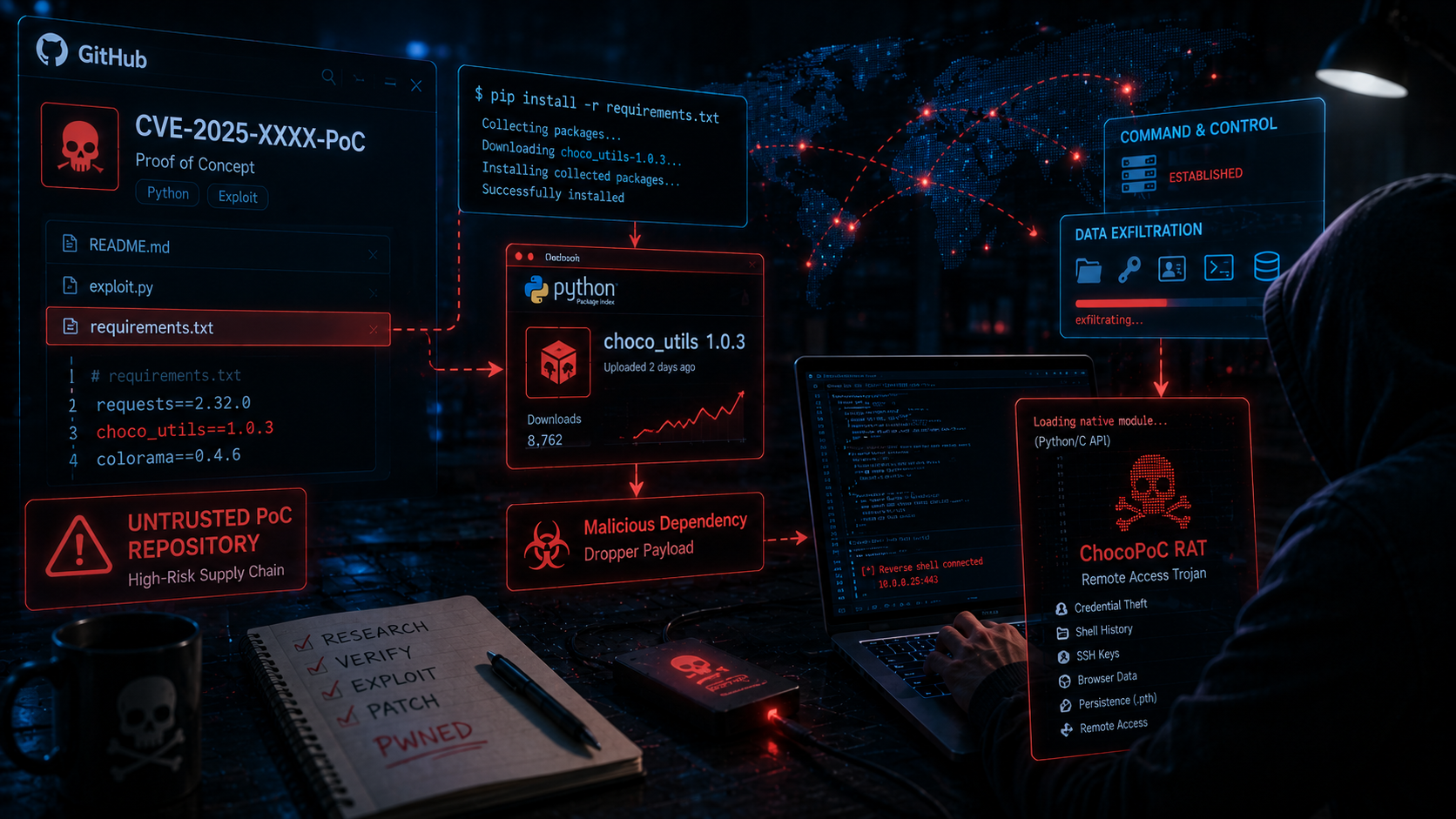
Security researchers and vulnerability analysts have become targets of a sophisticated campaign distributing trojanized proof-of-concept exploit repositories on GitHub. The "ChocoPoC" Remote Access Trojan campaign, discovered by YesWeHack and Sekoia, exploits the professional urgency of cybersecurity practitioners by distributing weaponized repositories for high-severity, newly disclosed vulnerabilities. The attack leverages dependency confusion tactics, embedding malicious PyPI packages inside innocuous-appearing requirements.txt files. When researchers execute standard installation procedures, the malicious dependencies activate an obfuscated dropper that utilizes Python/C API dynamic loading to bypass endpoint detection systems and bootstrap ChocoPoC—a fully functional Remote Access Trojan establishing persistent access via .pth hook files. The malware targets saved browser credentials, shell histories, SSH profiles, and configuration keys, transforming a researcher's workstation into an entry point for enterprise espionage. Organizations must mandate that all unverified exploit code execute exclusively within ephemeral, network-isolated sandbox environments and require manual auditing of all package dependencies before installation from public repositories.
Key Finding:The ChocoPoC campaign weaponizes the professional urgency of security researchers by embedding malicious PyPI packages inside trojanized GitHub PoC repositories, bypassing endpoint detection through Python/C API native loading. A single infected researcher workstation becomes an enterprise-wide breach vector, exposing client networks, SSH profiles, API credentials, and active remote access sessions.
What Happened
Between late 2025 and mid-2026, threat actors established at least seven distinct GitHub repositories mimicking urgent, working proof-of-concept exploits for high-severity, recently disclosed CVEs. The repositories appeared designed with meticulous attention to technical credibility: visible Python code appeared entirely clean upon inspection, with proper error handling, documentation, and functionality matching the claimed vulnerability. For security professionals operating under time pressure to validate vulnerabilities or develop detection signatures, these repositories presented as legitimate resources.
The infection mechanism operated through dependency confusion tactics embedded within requirements.txt files. When researchers cloned the repository and executed pip install -r requirements.txt, the command retrieved packages from PyPI—the public Python package repository. However, requirements.txt contained intentional references to malicious, poisoned packages under legitimate-appearing names such as skytext and frint. These packages contained no visible Python code; instead, they leveraged Python's C extension mechanism to execute compiled native binary code.
The execution chain begins when pip installs the poisoned package. The setup.py triggers during installation, executing an obfuscated dropper utilizing custom decryption tied to execution context. The dropper maps native operating system APIs (dlopen on Linux and macOS, LoadLibrary on Windows) to bootstrap native code execution via Python/C API initialization, completely bypassing traditional string-matching analytics and signature-based detection.
Once the native extension executes, it initiates a downloader querying Mapbox dead drop resolver infrastructure to retrieve ChocoPoC. The RAT itself is implemented in Python, ensuring cross-platform compatibility across Windows, macOS, and Linux. Upon execution, ChocoPoC establishes persistence by creating .pth hook files in system Python directories. These legitimate Python mechanisms designed for automatic startup code execution become vectors for malicious agent activation across every subsequent Python interpreter launch.
The technical sophistication reflects advanced operational expertise: legitimate API infrastructure (Mapbox datasets) used as command-and-control dead drops, DNS-over-HTTPS for communication obscurement, and leveraging legitimate Python mechanisms as obfuscation vectors to evade standard Endpoint Detection and Response baselines.
Why It Matters
For Security Practitioners & Vulnerability Researchers
The ChocoPoC campaign signals a definitive end to the assumption that running exploit code from unvetted sources on active corporate endpoints carries acceptable risk. The malware specifically targets saved browser credentials, shell histories, configuration keys, and SSH profiles. A successful infection of a security professional's workstation immediately exposes client networks, internal penetration testing portals, vulnerability research databases, and active remote access infrastructure.
For Chief Information Security Officers & Security Firm Executives
The threat is particularly acute because vulnerability researchers' workstations are inherently high-privilege domains containing proprietary source control integrations, API credentials for internal systems, vulnerability research notes, active remote access sessions into client networks, and often serving as jump hosts. A single researcher's workstation compromise can cascade into a widespread supply chain threat affecting an organization's entire client base.
For Threat Intelligence & DevOps Teams
The campaign reveals advanced operational sophistication moving beyond simple malware distribution. The threat actors demonstrate understanding of Python packaging mechanisms, native binary compilation, API dead drop infrastructure, and endpoint detection evasion techniques. The use of legitimate infrastructure and mechanisms as obfuscation vectors suggests either state-level resources or highly skilled criminal operators.
Operational Implications
The immediate operational implication is the conflict between professional velocity and verification rigor. Security analysts face extraordinary time pressure when high-severity vulnerabilities are disclosed. The organizational expectation is rapid development of detection signatures and exploitation assessments. Adversaries weaponize this time deficit to execute social engineering campaigns exploiting legitimate professional urgency. The faster an organization needs to validate a vulnerability, the greater the likelihood that corner-cutting verification procedures will occur.
The cross-platform nature of the threat creates substantial remediation complexity. While the skytext PyPI module received approximately 2,400 downloads with heavy concentration on Linux research environments, ChocoPoC itself is engineered as a native cross-platform RAT capable of compromising Windows, macOS, and Linux testing laboratories. Organizations managing heterogeneous security research environments must assume equivalent exposure across all platforms.
Remediation persistence represents a critical challenge that standard incident response procedures may not address. Because the malware alters the core Python runtime via .pth hook precedence files, standard remediation such as deleting malicious folders or rotating credentials will not strip the persistent re-spawner mechanism. Complete removal requires forensic-level artifact discovery to identify and eliminate backup payload mechanisms that could silently reactivate when Python scripts execute.
Long-term implications center on the targeting of the security research community itself. The campaign demonstrates that threat actors recognize vulnerability research infrastructure as a high-value target worthy of industry-specific social engineering campaigns. Organizations managing security research teams should expect continued targeting through similar mechanisms.
Recommended Actions
Organizations should implement controls stratified by operational maturity and security research requirements.
* Immediate isolation and verification procedures are essential.
- 1 - Mandate that all public or unverified exploit code, proof-of-concept packages, and administrative scripts execute exclusively within ephemeral, non-persistent, network-isolated sandbox environments or disposable virtual machines completely cut off from production domains and corporate networks.
- 2 - Enforce mandatory manual dependency audits: forbid automated batch installation of package requirements from unverified repositories.
- 3 - Require security practitioners to manually open and read exact package names and versions listed in requirements.txt files before retrieving packages from public repositories.
- * This friction is intentional—it disrupts the time-pressure exploitation vector.
* Implement active network and system monitoring.
- 1 - Configure egress network logging to alert on anomalous outbound traffic from developer and security testing machines, specifically flagging programmatic uploads to suspicious IP addresses, unusual DNS-over-HTTPS queries hitting third-party datasets, and outbound connections to command-and-control infrastructure.
- 2 - Execute automated system scans searching for unapproved modifications inside standard Python library paths, specifically looking for injected .pth bootstrapper configurations or rogue additions inside directories that might indicate persistence mechanisms.
* Transition away from public package repositories entirely.
- 1 - Move engineering and penetration testing units toward internal, containerized, private package registries performing automated code structure validation, checking for malicious native binary extensions and compiled dropper components before execution.
- 2 - Configure Endpoint Detection and Response systems to flag when administrative processes or local Python interpreters unexpectedly trigger native low-level system mapping hooks to inject obfuscated native compiled extensions into active runtime space.
All organizations should establish code review procedures for proof-of-concept exploits before execution, treating unverified PoC code with the same scrutiny applied to unknown malware samples.
Closing Statement
The ChocoPoC campaign represents a critical inflection point in threat actor strategy: the systematic targeting of the cybersecurity research community itself. Rather than attempting to penetrate enterprise networks directly, threat actors are weaponizing the foundational workflows and urgent timelines characterizing vulnerability research. By embedding trojanized dependencies inside seemingly legitimate exploit code, attackers turn researchers' professional diligence into an initial access vector.
Institutional resilience in this threat environment requires recognizing that security professionals are not immune to supply chain compromises simply because of their technical expertise. The same verification rigor applied to untrusted external code must be applied to seemingly benign exploit repositories. Bridging this awareness gap requires that security teams acknowledge the time-pressure exploitation vector and implement procedural friction preventing corner-cutting verification, even when organizational deadlines create urgency.