
The Exposed Lens: Unpacking Memory Exhaustion, Path Traversal, And Tenant Segregation Breakdown in DICOM Software Components
Executive Summary
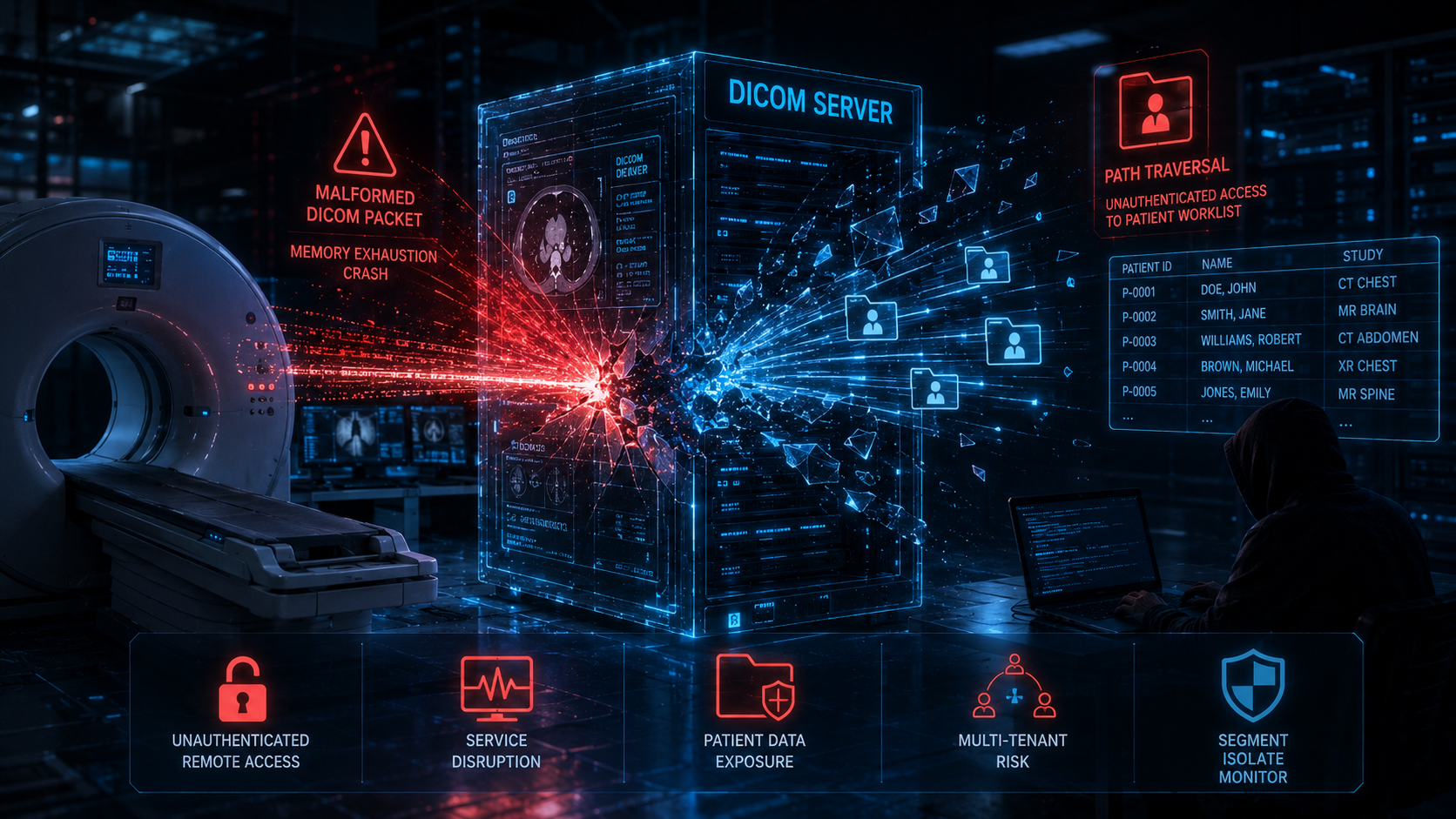
On June 30, 2026, the Cybersecurity and Infrastructure Security Agency issued Medical Advisory ICSMA-26-181-01 disclosing five high-severity vulnerabilities in the OFFIS DICOM Communications Toolkit (DCMTK), versions 3.7.0 and earlier — an open-source library that serves as the foundational software layer for thousands of commercial Picture Archiving and Communication Systems, diagnostic workstations, and medical imaging devices worldwide. The disclosed flaws include unauthenticated memory exhaustion vectors capable of crashing imaging server processes with a single malformed network packet, and a path traversal vulnerability that allows unauthenticated remote access to patient worklist records across multi-tenant clinical deployments.
Because DCMTK is compiled directly into proprietary healthcare software packages by downstream vendors, remediation does not follow standard operating system patch pathways — affected systems require vendor-specific compiled updates that may not be uniformly available. For health system security teams, clinical operations leaders, and compliance officers, these vulnerabilities represent an intersection of patient data privacy exposure and immediate operational availability risk that demands prioritized architectural response.
Key Finding: Unauthenticated attackers require only network access to TCP port 104 or 11112 to crash DICOM imaging servers with a single malformed packet or traverse tenant boundaries to read patient worklist records across clinical departments — with no credentials, no elevated privileges, and no user interaction required. Because DCMTK is compiled directly into proprietary vendor products, standard patch management cannot close this exposure; remediation is entirely dependent on each downstream vendor's individual update timeline.
What Happened
On June 30, 2026, CISA published Medical Advisory ICSMA-26-181-01 formalizing the disclosure of five vulnerabilities identified by independent security researchers within the OFFIS DICOM Communications Toolkit, an open-source software library implementing the Digital Imaging and Communications in Medicine protocol used by medical imaging systems globally. DCMTK occupies a structurally significant position in healthcare technology: it is not primarily deployed as a standalone application but is instead compiled as a dependency into the commercial software packages powering Picture Archiving and Communication Systems, radiology workstations, computed tomography acquisition systems, MRI platforms, and related clinical imaging infrastructure. This integration pattern means that vulnerability exposure is not bounded by the number of organizations directly using DCMTK — it extends to every downstream vendor product built on the library and every clinical environment running those products.
The first and most operationally consequential vulnerability class involves memory exhaustion. Under CVE-2026-35505 and CVE-2026-50254, both classified under CWE-401, an unauthenticated remote actor can transmit a sequence of malformed network connection packets in the form of crafted A-ASSOCIATE-RQ blocks — the standard DICOM protocol messages used to initiate associations between imaging components. The DCMTK library parses these packets and allocates memory for the presentation contexts they contain, but fails to release allocated memory when parsing encounters an error condition. Each malformed packet that arrives consumes memory that is never reclaimed. When transmitted continuously against a system running the storescp utility — the commonly deployed DICOM storage server component — in its default single-process configuration, memory accumulates until the operating system terminates the process. The result is a complete loss of the communication port, halting imaging intake operations until an operator manually restarts the service.
The second significant vulnerability, CVE-2026-52868, introduces a path traversal flaw in the toolkit's worklist management functionality. An unauthenticated remote actor can submit DICOM queries containing relative path notation that bypasses the intended directory boundaries for Application Entity storage areas. In deployments serving multiple clinical departments, floors, or facilities — configurations common in health systems where a single PACS infrastructure serves radiologists, cardiologists, and emergency departments concurrently — this flaw allows an actor to read worklist records belonging to departments or facilities other than the one the query was directed toward. The cross-tenant data exposure is not incidental; it is the functional result of directory boundary controls failing to validate the query path before resolving it.
A fifth vulnerability, CVE-2026-44628, compounds the availability risk by enabling service disruption through a distinct mechanism affecting worklist server operations, further broadening the attack surface available to unauthenticated network actors within clinical environments.
Why It Matters
For Technical Security Practitioners & Healthcare Information Technology Teams
The DCMTK vulnerabilities present a supply chain remediation challenge that differs materially from standard enterprise vulnerability management. Because the library is compiled into commercial imaging products rather than deployed as a standalone package, the patch path runs through downstream vendors — each of whom must independently integrate the upstream DCMTK fixes, compile updated product builds, and release them through their own support channels. Not all vendors will do so on the same timeline, and some legacy products may not receive updates at all. Practitioners cannot assume that a confirmed DCMTK patch release resolves exposure within their environment without verifying that the specific vendor products in use have incorporated those fixes. This creates an extended remediation window during which network-level controls represent the primary available mitigation.
For Clinical Directors, Hospital Administrators, & Health System Executives
The availability dimension of these vulnerabilities translates directly to patient care continuity risk. The ability to crash a DICOM storage server or worklist management process with a single malformed packet — without authentication, without elevated privilege, and without user interaction — means that any actor with network access to a clinical imaging environment can induce immediate operational disruption. In practical terms, this can manifest as the sudden unavailability of imaging orders for emergency radiological assessment, disruption of surgical scheduling workflows dependent on pre-operative imaging, and loss of real-time diagnostic visibility for specialists managing time-sensitive cases. These are not data incidents with delayed consequences — they are operational events with potential immediate clinical impact.
For Compliance & Privacy Officers Operating Under HIPAA & Related Regulatory Frameworks
The path traversal vulnerability introduces a data exposure category carrying direct regulatory consequence. Unauthorized access to patient worklist records across Application Entity boundaries — which may include patient identifiers, study descriptions, scheduling information, and referring physician details — constitutes a potential disclosure of Protected Health Information to unauthenticated parties. The absence of an authentication requirement compounds this regulatory exposure by removing the argument that access required circumventing a deliberate access control.
For Workforce Development Professionals
This advisory illustrates why open-source software dependency mapping must be a standard competency for healthcare security teams — not an advanced specialty reserved for mature security programs.
Operational Implications
The most immediate operational implication is the inadequacy of standard network perimeter assumptions in clinical imaging environments. The A-ASSOCIATE-RQ memory exhaustion vulnerabilities require only network-level access to DICOM service ports — typically TCP port 104 or 11112 — to execute. In health system environments where PACS systems, modality interfaces, and clinical workstations share internal network segments treated as trusted by default, any device or user with internal network connectivity may have sufficient access to exploit these flaws without any credential or privilege requirement. Flat trusted-network models, common across clinical environments, are not defensible postures against unauthenticated network-layer exploitation.
The single-process deployment default for the storescp utility represents a specific configuration risk that magnifies the availability impact of the memory exhaustion vulnerabilities. When a single process handles all incoming DICOM connections, a memory exhaustion attack terminates all imaging intake simultaneously. This design characteristic is not a secondary concern — it is the reason a single malformed packet stream can produce a complete service outage rather than a degraded partial availability scenario. Reconfiguring receiving daemon architectures to forked or multi-process execution models limits the blast radius of a successful exploitation attempt to the affected process instance rather than the entire service.
The path traversal vulnerability affecting multi-tenant deployments introduces an implication that extends beyond individual systems. In health system environments where a single PACS infrastructure serves multiple facilities, departments, or care settings, cross-Application Entity data exposure means that exploitation in any one segment can produce unauthorized access to data belonging to all segments sharing the infrastructure. Incident response planning should account for this systemic characteristic when scoping potential exposure following a confirmed exploitation event.
Over the longer term, the DCMTK advisory is illustrative of a broader challenge in healthcare technology: the accumulation of open-source software dependencies within commercial products creates a remediation dependency chain that health system security teams do not control and often cannot fully map. Establishing software bill of materials requirements in clinical technology procurement — requiring vendors to disclose the open-source components embedded in their products — provides the visibility necessary to assess exposure accurately when advisories such as ICSMA-26-181-01 are issued.
Recommended Actions
info
* Treat two actions as non-deferrable.
- 1 - Organizations operating open-source DCMTK deployments directly should immediately synchronize with the upstream codebase, incorporating the maintainer's published commit fixes — including the memory release loop corrections documented in commit 2312891a8 — to resolve the CWE-401 allocation failures.
- 2 - Concurrently, and regardless of patch status, all PACS systems, modality interfaces, and diagnostic workstations should be isolated onto dedicated VLAN segments that prevent unvetted internal devices from initiating direct DICOM protocol connections.
- 3 - Network segmentation is the most immediately actionable mitigation for unauthenticated network-layer exploitation and remains effective independent of vendor patch timelines.
* Pursue two additional architectural controls.
- 1 - DICOM receiving daemon configurations running in default single-process mode should be reconfigured to forked or multi-process execution architectures, limiting the service impact of a successful memory exhaustion attempt to individual process instances rather than the full service.
- 2 - Simultaneously, DICOM routing engines should be configured with strict Application Entity title filtering and destination verification rules that detect and discard incoming query packets containing relative path notation — specifically sequences containing directory traversal patterns — before those packets reach the toolkit's parsing layer.
* Invest in two higher-order capabilities.
- 1 - Protocol-aware network inspection infrastructure — specifically security controls capable of parsing and validating the syntax of incoming DICOM A-ASSOCIATE-RQ data streams at the network boundary — provides a preventive layer that terminates malformed packets before they reach system processes, addressing the memory exhaustion vector at the ingestion point rather than at the software layer.
- 2 - Separately, automated runtime health monitoring configured to track memory consumption across imaging service containers, with automated restart and fallback mechanisms triggered by threshold breaches, ensures that clinical imaging functions can continue in degraded-but-operational states during an active exploitation attempt rather than requiring manual operator intervention for service restoration.
Closing Statement
The OFFIS DCMTK advisory illustrates with precision the kind of structural vulnerability that sits beneath the surface of clinical healthcare operations — not in the enterprise systems that receive security investment and executive attention, but in the open-source foundations on which proprietary medical technology quietly depends. Bridging the awareness gap here means recognizing that the patch for a medical imaging vulnerability may not arrive through an operating system update or a standard vendor notification — it may require a compliance officer, a clinical IT director, and a vendor support contact to coordinate a custom compiled release before the exposure closes.
The assumption that internal clinical networks are trustworthy simply because they are internal is one that adversaries have demonstrated, repeatedly and at scale, to be false. DCMTK's vulnerabilities are unauthenticated by design — they require no trusted insider, only a trusted network. Institutional resilience in healthcare requires building environments that assume hostile payloads will arrive and are structured to contain them.