
The Compilation Evasion: How Cavern Manticore Weaponizes Non-Standard .Net Architectural Structures to Defeat Security Perimeters
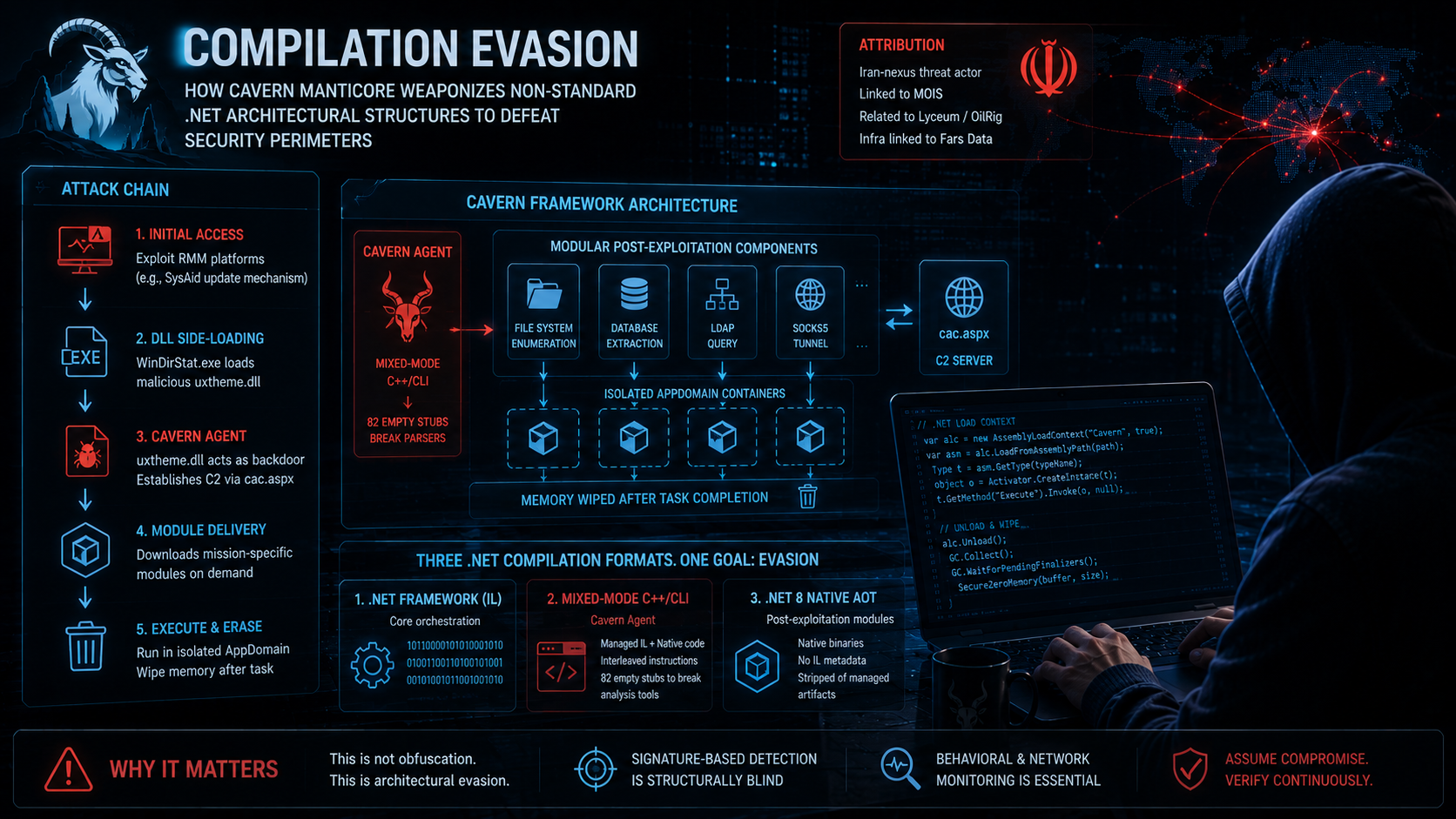
Executive Summary
In July 2026, Check Point Research published a technical analysis of Cavern Manticore, an Iran-nexus cyber espionage group attributed to actors linked to the Ministry of Intelligence and Security and assessed as related to the Lyceum and OilRig subgroups. The group operates a modular command-and-control framework designated Cavern, active against Israeli government, defense, and information technology sector organizations since at least early 2026.
What distinguishes the Cavern framework from conventional espionage tooling is its evasion architecture: rather than relying on packers, encrypted strings, or control-flow obfuscation, the framework achieves near-zero detection rates by varying the .NET compilation format of its components across Standard Framework, Mixed-Mode C++/CLI, and Native AOT binaries. Post-exploitation modules execute within isolated memory containers that are wiped upon task completion, leaving minimal forensic artifacts on compromised hosts. For enterprise defenders, this approach exposes a fundamental gap between signature-based detection capabilities and the behavioral monitoring necessary to identify compilation-level evasion.
Key Finding: Cavern Manticore achieves near-zero detection rates by varying .NET compilation formats across three binary types rather than using traditional obfuscation, exposing a structural blind spot in signature-based defenses. Post-exploitation modules execute in isolated memory containers that self-wipe after task completion, producing minimal forensic artifacts on compromised hosts.
What Happened
Beginning in early 2026, cybersecurity researchers tracked a sustained cyber espionage campaign conducted by a threat actor group designated Cavern Manticore, assessed as linked to Iran's Ministry of Intelligence and Security and attributed with moderate confidence to the Lyceum and OilRig subgroup ecosystem. The campaign targeted information technology providers, defense sector organizations, and government entities, with primary concentration on Israeli institutional targets. The selection of IT providers as an initial compromise layer reflects a strategic prioritization consistent with supply chain pivot objectives — establishing access within technology service organizations to create downstream visibility into the government and defense clients those organizations serve.
Initial network access was obtained by exploiting Remote Monitoring and Management software platforms already deployed within target environments. RMM tools present an attractive initial access vector for state-sponsored actors because they operate with elevated administrative privileges, are frequently excluded from standard security monitoring as trusted administrative utilities, and provide authenticated remote execution capabilities that can be repurposed for adversarial use without introducing new binaries. In documented execution chains, Cavern Manticore operators triggered malicious application update routines — with SysAid software update channels identified as one observed delivery mechanism — to initiate a DLL side-loading sequence using WinDirStat.exe, a legitimate disk analysis utility. The side-loading process caused the application to load a trojanized version of uxtheme.dll, the Windows theming library, which serves as the Cavern Agent.
The Cavern Agent functions as a lightweight persistent backdoor establishing command-and-control communication through an ASP.NET webshell-style handler designated cac.aspx. This handler processes operator instructions and facilitates the dynamic retrieval of mission-specific post-exploitation modules. The modular architecture is the framework's defining operational characteristic: rather than deploying a comprehensive implant containing all capabilities at installation, the Cavern Agent pulls purpose-built modules on demand — including components for file system enumeration, database extraction, LDAP directory querying, and SOCKS5 traffic tunneling — and executes them within isolated AppDomain memory containers. Upon task completion, each AppDomain is unloaded and its contents cleared from system memory, removing the in-memory assembly artifacts that forensic investigations would otherwise recover.
The anti-analysis architecture of the framework is distributed across three binary compilation formats presenting distinct analytical challenges. The core orchestration component uses standard .NET Framework Intermediate Language, providing a conventional execution baseline. The Cavern Agent itself is compiled as Mixed-Mode C++/CLI — a format that interleaves managed Intermediate Language code with native compiled code, and which includes 82 structurally empty code stubs that break the parsing logic of standard analysis tools without constituting traditional obfuscation. Post-exploitation mission modules are compiled using .NET 8 Native AOT, which eliminates the managed code metadata that analysis tooling relies on for type reconstruction and behavioral inference. Public malware scanning platforms returned near-zero detection rates for the framework's components at the time of disclosure.
Infrastructure attribution analysis identified WHOIS registration patterns consistent with Fars Data, an Iranian hosting provider, and noted infrastructure overlaps with previously documented Lyceum-associated assets.
Why It Matters
For Reverse Engineers, Malware Analysts, & Threat Hunters
The Cavern framework represents a methodological shift in evasion technique that carries direct implications for tooling and analytical workflow. Conventional anti-analysis techniques — packers, encrypted string tables, control-flow flattening, anti-debugging routines — are detectable precisely because they introduce structural anomalies that detection systems are configured to identify. Cavern's approach inverts this: the three compilation formats it employs are all legitimate .NET build outputs that individual analysis tools are capable of processing, but their combination within a single framework, and the specific architectural choices within each component, defeats the parsing and behavioral inference logic of standard automated analysis platforms without introducing the signature artifacts that trigger detection. An analyst encountering a Mixed-Mode C++/CLI binary with 82 empty stubs is examining a structurally valid file format being used in a manner that defeats tooling without technically constituting obfuscation. This distinction matters directly for detection rule development and triage prioritization.
For Incident Response Teams & Digital Forensics Practitioners
The AppDomain isolation and post-execution memory wipe mechanism presents an evidence preservation challenge that requires procedural adaptation. Post-incident device analysis of a host compromised by Cavern is unlikely to yield in-memory module artifacts, because the framework is specifically engineered to ensure those artifacts do not persist beyond task execution. Effective investigation requires telemetry captured during the intrusion period — memory snapshots, EDR behavioral logs, and network flow data — rather than post-compromise host forensics. Teams whose incident response procedures assume host-based artifact recovery as a primary investigation pathway will encounter evidence gaps that cannot be closed retrospectively.
For Executives, Technology Directors, & Institutional Risk Officers
The campaign's targeting of IT service providers as a primary entry layer reflects a threat model that prioritizes access breadth over initial access depth. Compromise of a managed service provider, IT outsourcing partner, or technology vendor creates a vantage point from which downstream client environments — including government and defense entities — can be accessed through legitimate administrative channels that may not generate anomalous alerts within those client environments.
Operational Implications
The most immediate operational implication of the Cavern framework's compilation-level evasion architecture is the structural limitation it exposes in signature-based endpoint detection and automated sandbox analysis. These tools identify malicious software by comparing file characteristics, behavioral signatures, and code patterns against known-malicious reference sets. When evasion is achieved through legitimate compilation format variation rather than through packing or obfuscation, the resulting binaries do not present the structural anomalies those tools are calibrated to detect. Near-zero detection rates at public malware scanning platforms at the time of disclosure are a direct consequence of this design, not an incidental property. Security operations teams whose detection coverage relies primarily on endpoint antivirus and hash-based scanning should treat those controls as insufficient against this threat category and prioritize behavioral and network-layer monitoring investments accordingly.
The use of compromised internal IIS infrastructure to proxy command-and-control traffic introduces a complementary evasion layer at the network level. When malicious command traffic routes through internal web server infrastructure rather than directly to external command nodes, perimeter monitoring tools observe outbound traffic originating from a trusted internal server rather than a compromised endpoint. This technique requires that network monitoring strategy account for the behavior of internal servers as potential relay points — not exclusively as trusted sources.
The RMM software exploitation vector used for initial access represents a near-term operational priority. RMM platforms that operate with elevated privilege, reduced monitoring scrutiny, and broad internal network access are consistently targeted by state-sponsored actors precisely because they provide authenticated administrative capability that can be repurposed without introducing new tooling. Organizations that have not audited their RMM deployment configurations, update authorization workflows, and execution permission scope are operating with an initial access surface that the Cavern campaign demonstrates is actively and deliberately targeted.
Over the longer term, the architectural sophistication of the Cavern framework — modular payload delivery, AppDomain-isolated execution, memory-cleared post-task cleanup, and compilation-format evasion — reflects a level of investment indicative of a sustained, intelligence-driven collection objective rather than opportunistic access. Organizations operating in the sectors targeted by this campaign, or serving clients in those sectors, should incorporate this threat profile into long-range security architecture planning.
Recommended Actions
* Prioritize two immediate actions with direct relevance to the initial access vector documented in the campaign.
- 1 - All Remote Monitoring and Management platforms within the environment should undergo a comprehensive configuration audit: administrative script execution permissions should be restricted to explicitly authorized workflows, and multi-factor authentication should be enforced across all update authorization and remote execution pathways without exception.
- 2 - Concurrently, security monitoring configurations should be updated to flag process creation chains in which legitimate utility applications — including disk analysis tools and similar low-profile system utilities — unexpectedly spawn auxiliary runtime libraries or initiate network connections inconsistent with their normal operational profile. The WinDirStat.exe side-loading chain documented in the Cavern campaign is detectable through this behavioral lens.
* Address two specific technical controls.
- 1 - Windows DLL loading order can be hardened through registry configuration and secure loading policy enforcement to prevent applications from loading libraries from their own root directories when those libraries should be sourced from system paths — a control that directly mitigates the uxtheme.dll side-loading mechanism.
- 2 - Separately, file integrity monitoring on internal IIS application directories should be configured to generate high-priority alerts upon the creation or modification of unexpected ASP.NET handler files, providing early detection of the webshell-style command-and-control handler component the Cavern Agent relies on for instruction processing.
* Pursue two higher-order capabilities.
- 1 - Endpoint Detection and Response platforms capable of tracking transient AppDomain allocation and deallocation events provide the behavioral telemetry necessary to identify Cavern's post-exploitation module execution pattern before those modules complete their cleanup cycle — the only window in which in-memory evidence remains recoverable.
- 2 - Additionally, application-aware zero-trust network boundaries that enforce explicit egress allowlists for production systems and database containers prevent compromised internal infrastructure from communicating with unauthorized external destinations, limiting the command-and-control connectivity the framework requires to function.
Closing Statement
The Cavern Manticore framework is a precise illustration of how state-sponsored threat actors adapt to the defensive ecosystem they operate against. Signature-based detection has matured to the point where it reliably identifies conventionally obfuscated malware; the logical adversarial response is to abandon conventional obfuscation in favor of architectural variation that achieves equivalent evasion without triggering the detection signatures obfuscation creates. The result is a framework that is, in a technical sense, structurally clean — and operationally invisible to the tools most widely deployed to find it.
Bridging the awareness gap here means accepting that detection tooling calibrated for the previous generation of threats requires architectural supplementation, not merely updated signatures. Cultivating institutional resilience against compilation-level evasion and memory-isolated execution requires behavioral monitoring infrastructure that observes what software does rather than what it looks like — a shift in defensive posture that the Cavern campaign makes the case for with precision.