
The JVM Contagion: Deconstructing Multi-Platform Persistence & Modular Expansion In Java-Based MaaS Pipelines
Executive Summary
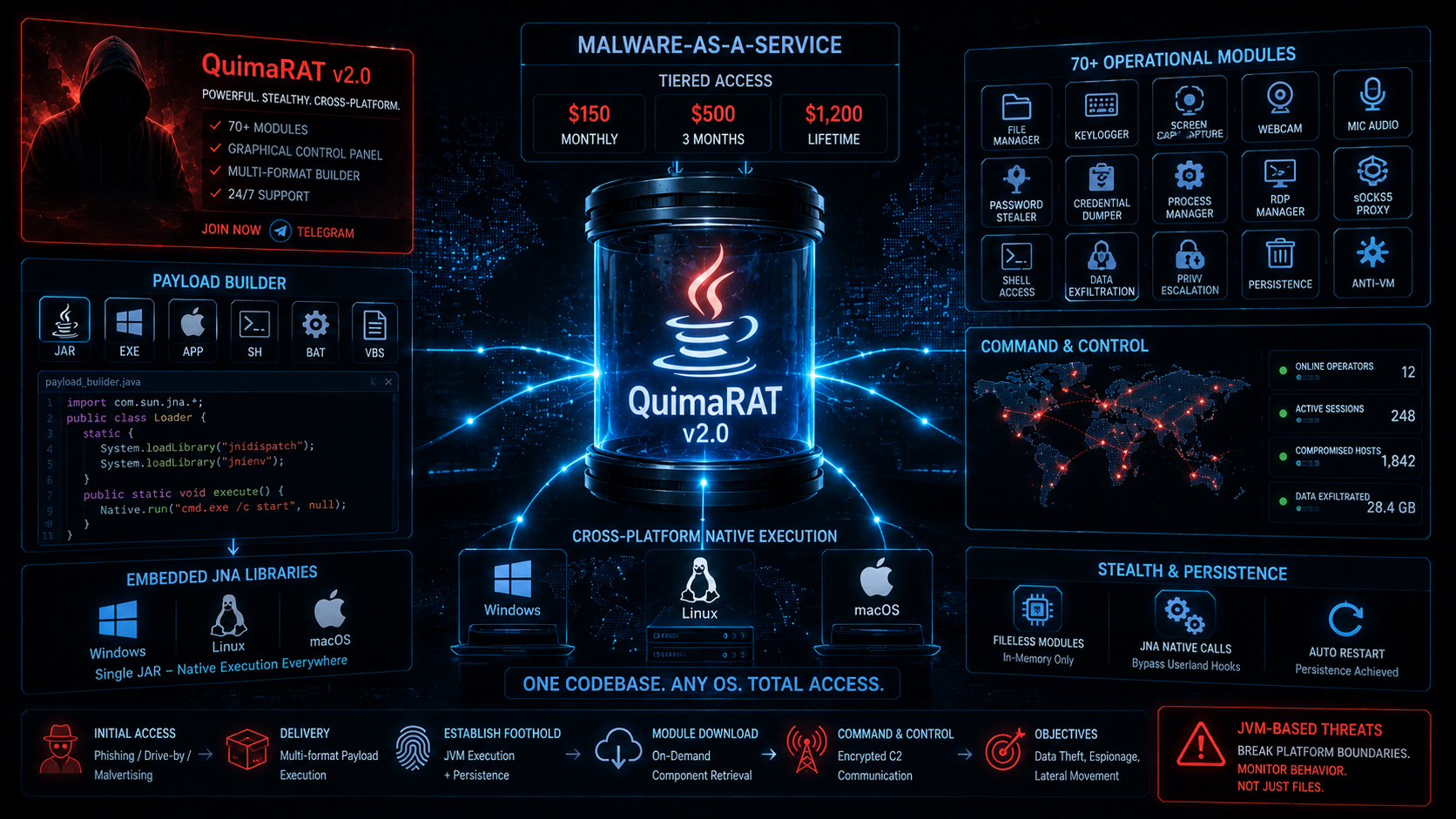
Security researchers at LevelBlue Labs published a detailed analysis on June 25, 2026, documenting QuimaRAT, a Java-based Remote Access Trojan actively marketed across dark web forums under an industrialized Malware-as-a-Service subscription model offering tiered access from $150 monthly to $1,200 for lifetime licensing. The framework's defining characteristic is architectural: by embedding Java Native Access libraries within a single compiled JAR archive, QuimaRAT achieves native execution across Windows, Linux, and macOS environments without requiring separate platform-specific binaries. The payload builder generates output formats including JAR, EXE, APP, SH, BAT, and VBS, enabling customized deployment across target environments from a single operator toolkit.
The framework's commercial accessibility — marketed as "QuimaRAT v2.0" with more than 70 operational modules and a graphical control panel — lowers the technical barrier for cross-platform intrusion to a subscription purchase. For enterprise security architects, the JVM-based execution model invalidates platform-segregation assumptions and shifts detection priority from OS-specific binary signatures to behavioral monitoring of Java runtime activity.
Key Finding: QuimaRAT embeds Java Native Access libraries within a single JAR archive to achieve native execution across Windows, Linux, and macOS without separate platform binaries, directly invalidating OS-based network segmentation as a containment strategy. With 212 undeveloped command slots, the base implant functions as a minimum-footprint beachhead — operators can expand capability dynamically via encrypted plugin delivery without triggering installation-time detection.
What Happened
On June 25, 2026, LevelBlue Labs published a reverse-engineering analysis of QuimaRAT, a commercially marketed Java-based Remote Access Trojan identified through active dark web forum monitoring. The tool is advertised as QuimaRAT v2.0 and offered through a tiered subscription model ranging from $150 for monthly access to $1,200 for a lifetime license, with access granted through Telegram channels and dark web forum listings. The subscription includes a graphical user interface control panel, more than 70 standalone operational modules, and a payload builder capable of generating output in multiple formats.
The technical foundation that distinguishes QuimaRAT from conventional platform-specific malware is its use of the Java Virtual Machine as a cross-platform execution layer combined with Java Native Access library integration. JNA allows Java applications to call native operating system functions — system APIs, kernel interfaces, and hardware-level operations — without requiring separately compiled binaries for each target architecture. By embedding the relevant JNA libraries directly inside the primary JAR container, QuimaRAT carries the native interface components for Windows x86, Windows ARM, Linux x86, Linux ARM, and macOS CoreFoundation interactions within a single distributable archive. The payload builder packages this JAR into the appropriate output format for the target environment: EXE or BAT wrappers for Windows, SH scripts for Linux, and APP bundles for macOS.
Upon execution on a target host, the malware performs an initial environment validation sequence. It checks for the presence of a .lock file in the system's temporary directory using Java's FileLock class — a single-instance enforcement mechanism that prevents duplicate installations from running concurrently. If no existing instance is detected, the malware decrypts an embedded configuration file designated config.dat using a repeating-key XOR routine to retrieve C2 addresses and operational parameters. Platform-specific persistence is then established: registry run keys and scheduled tasks on Windows, init.d script placement and cron scheduling on Linux, and LaunchAgent or LaunchDaemon deployment on macOS. Following persistence establishment, the malware initiates C2 communication through distinct HANDSHAKE and HEARTBEAT sequences.
Static analysis of the framework revealed 23 actively implemented command modules alongside 212 protocol-level placeholder structures. This architecture indicates that the operator's installed capability set can be expanded dynamically: encrypted Java plugins, custom binary uploads, and Windows-specific in-memory shellcode execution can be pushed to compromised endpoints post-installation without modifying the base implant. The framework is advertised as fully undetectable at the time of its release, a claim consistent with its reliance on legitimate Java runtime processes as execution context.
Why It Matters
For Incident Responders & Threat Hunters
The JNA integration architecture presents a specific detection challenge. When QuimaRAT executes native system calls, those calls are made from within a legitimate, authorized Java runtime process — java.exe on Windows or its equivalent on Linux and macOS. Process-behavior monitoring tools that evaluate activity against process reputation and expected behavior profiles may not flag malicious operations — clipboard access, file enumeration, network scanning, and credential harvesting — as anomalous when they occur under a recognized Java runtime context. The malicious activity inherits the legitimacy signal of the host process, creating a detection gap that signature-based and process-reputation-based tools are not positioned to close without behavioral baseline analysis specific to Java runtime activity patterns.
For Security Architects & Identity and Access Management Specialists
The 212 placeholder command slots documented in static analysis represent a forward-looking capability expansion risk. The base implant constitutes a minimum capability footprint; the operational toolset available to a licensed QuimaRAT operator can be extended dynamically through encrypted plugin delivery without triggering installation-time detection events. Security postures designed to catch QuimaRAT at deployment may not detect capability expansion after the implant is established.
For Executives & Resource Planning Leaders
The MaaS pricing model is the strategically significant development. At $150 for monthly access to a cross-platform implant with GUI-driven control and more than 70 modules, the technical sophistication barrier for multi-platform enterprise intrusion has been effectively removed for a broad category of lower-tier actors. Linux cloud infrastructure and macOS developer workstations — environments that have historically received less endpoint security investment than Windows systems under the assumption of lower malware prevalence — are now within reach of actors who could not previously build or maintain multi-platform tooling independently.
For workforce development professionals, QuimaRAT's commercial model and cross-platform reach provide a concrete illustration of why endpoint security investment cannot be distributed according to operating system market share assumptions.
Operational Implications
The most immediate operational implication is the structural exposure created by network architectures that treat macOS or Linux endpoints as isolated from Windows-targeted threats. QuimaRAT's JNA-based cross-platform architecture directly invalidates that assumption. A single JAR payload, delivered through any initial access vector, can establish persistence and initiate C2 communication across all three major operating system families without requiring additional tooling or configuration. Endpoint security investments concentrated on Windows environments should be reassessed for coverage gaps in Linux server infrastructure and macOS developer workstation populations.
The execution-under-legitimate-process characteristic introduces a specific incident response challenge. When malicious activity occurs within the memory space of an authorized Java runtime, log correlation becomes more difficult: file access events, network connections, and system API calls attributed to java.exe do not immediately indicate compromise without contextual analysis of what the Java process was expected to be doing at that time. Security operations teams should establish behavioral baselines for Java application activity in their environments — including expected network destinations, file system access patterns, and system call profiles — to enable detection of deviations consistent with RAT operation.
The .lock file single-instance check provides a behavioral artifact that detection rules can target directly. The creation of a .lock file in a system temporary directory by a Java process — particularly outside the context of a recognized enterprise Java application — is an anomalous behavior pattern that SIEM rules and endpoint detection platforms can be configured to flag with relatively low false-positive risk in environments where Java application inventory is maintained.
Over the longer term, the commercialization of cross-platform RAT capabilities at sub-$200 price points indicates a directional trend in the MaaS market toward runtime-agnostic tooling that will require corresponding architectural adaptation in enterprise monitoring strategy — specifically, greater investment in JVM process behavioral analysis and Java runtime sandboxing.
Recommended Actions
* Implement two controls with immediate detection value.
- 1 - Endpoint protection platforms — particularly those with cloud reputation capabilities such as Carbon Black Cloud or equivalent EDR solutions — should be configured to enforce an execution delay and cloud reputation scan for unverified standalone Java archives, particularly those initiated from temporary directories, browser download paths, or email attachment extraction locations.
- 2 - Separately, local security policy should be configured to block initialization of unverified JAR archives from temporary or user-writable directories, removing a common initial execution pathway without disrupting enterprise Java applications deployed through managed installation channels.
* Pursue two behavioral monitoring investments.
- 1 - SIEM hunting rules should be established to track Java process activity patterns inconsistent with expected application behavior — specifically flagging instances where JVM processes invoke native system calls associated with environment enumeration, clipboard access, or lateral network scanning outside the context of recognized enterprise applications.
- 2 - Additionally, write-access permissions to operating system temporary directories — specifically /tmp/ on Linux and macOS and %TEMP% on Windows — should be restricted to prevent unauthorized creation of the .lock state files QuimaRAT uses for single-instance enforcement, as this control disrupts the malware's initialization sequence without affecting standard application behavior.
* Address two architectural controls.
- 1 - Enterprise Java applications should be transitioned to containerized or sandboxed execution environments where the underlying JVM is restricted from accessing the system clipboard, mapping arbitrary local network connections, or loading dynamic extensions from unverified sources — a configuration that limits the operational utility of a compromised Java runtime without affecting legitimately scoped application functionality.
- 2 - Real-time memory inspection across corporate server infrastructure should be extended to flag dynamic loading of encrypted plugin extensions into active JVM application pools, providing detection coverage against the post-installation capability expansion mechanism that the 212 placeholder command architecture facilitates.
Closing Statement
QuimaRAT's emergence as a commercially distributed, cross-platform Remote Access Trojan reflects a maturation of the Malware-as-a-Service market that security architecture has not uniformly kept pace with. The assumption that operating system choice provides meaningful isolation from a common threat pool — never fully warranted — is now demonstrably inadequate against a framework that carries native execution capability for three major platforms inside a single archive, sold at a price accessible to virtually any motivated actor.
Bridging the awareness gap here means updating both monitoring strategy and security investment allocation to reflect the reality that platform diversity is no longer a defensive asset in environments where JVM-based tooling provides uniform access across the entire endpoint population. Cultivating institutional resilience against runtime-agnostic threats requires moving detection investment from OS-specific binary signatures toward behavioral analysis of process activity — a structural shift the QuimaRAT campaign makes operationally necessary.