
Manufactured Distance: How UAT-7810's ORB Network Infrastructure is Rewriting the Rules of Attribution
Executive Summary
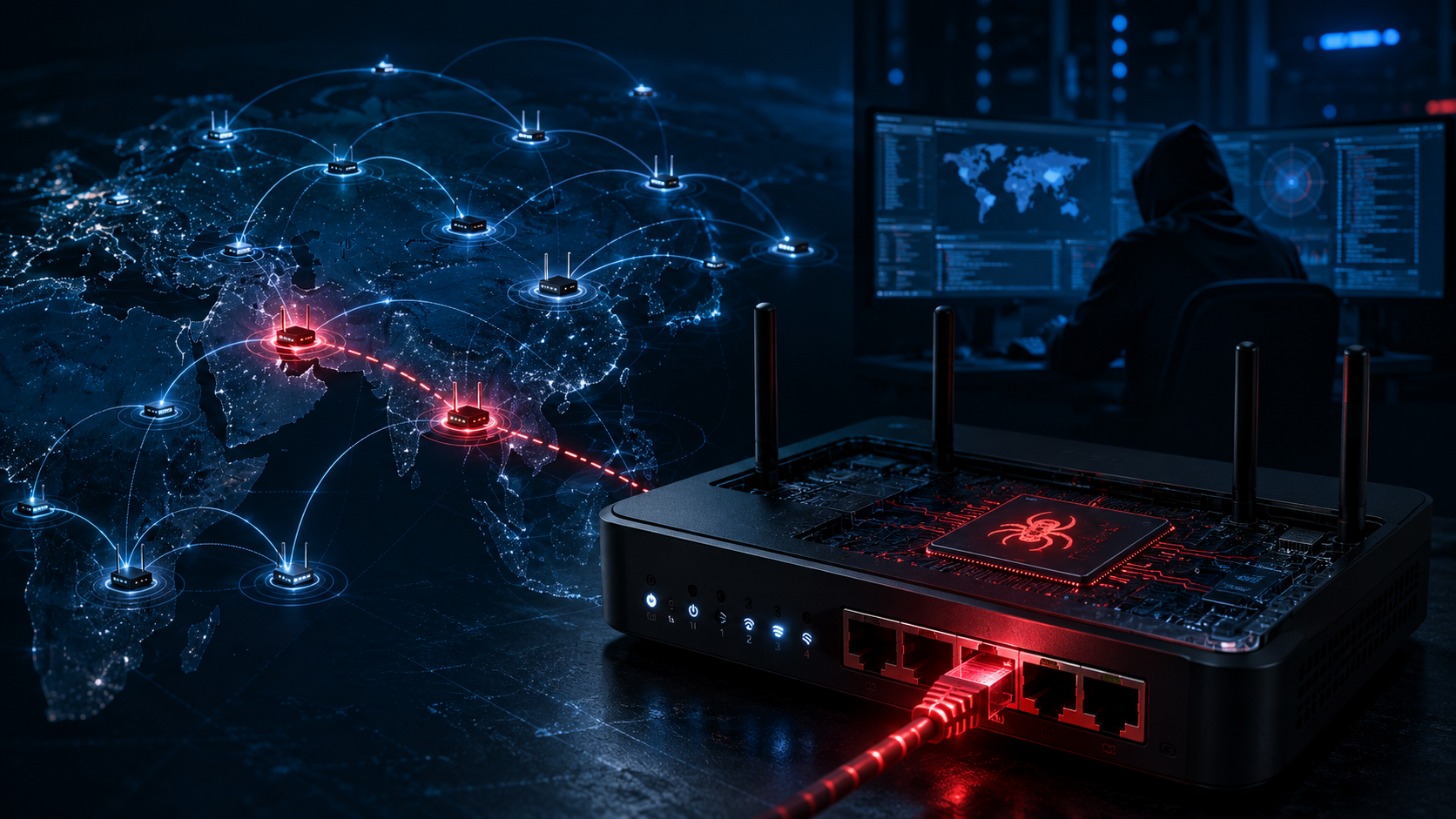
On July 7, 2026, Cisco Talos Intelligence Group published technical findings documenting the continued expansion of a China-nexus operational relay infrastructure campaign attributed to the threat broker designated UAT-7810. Rather than conducting intelligence collection directly, UAT-7810 functions as a specialized infrastructure provisioner, building and maintaining the "LapDogs" Operational Relay Box network — a layered proxy architecture that allows downstream espionage actors to conduct operations through compromised residential and commercial networking devices while appearing to originate from trusted domestic sources.
The expansion centers on a new modular malware suite — LONGLEASH, DOGLEASH, and JARLEASH — designed to infect multi-architecture edge devices, establish covert command channels, and self-erase forensic traces upon detection. For enterprise defenders, the operational consequence is direct: IP-based perimeter indicators and geolocation blocking are no longer sufficient detection mechanisms against this class of infrastructure. Behavioral detection, protocol anomaly hunting, and systematic edge-device firmware hygiene must now be treated as foundational controls rather than supplementary ones.
Key Finding: UAT-7810 operates not as a direct intrusion actor but as a specialized infrastructure broker — building and leasing ORB relay capacity to downstream espionage groups, making attribution structurally expensive while keeping operational costs low. LONGLEASH's self-erasing anti-forensic routine eliminates binary artifacts and logs upon detection, meaning out-of-band network telemetry is the only forensic source that survives a sophisticated deployment.
What Happened
The Cisco Talos Intelligence Group's July 7, 2026 publication documented the latest operational evolution of UAT-7810, a China-nexus threat group whose primary function within the broader state-aligned espionage ecosystem is not direct intelligence collection but rather the construction and maintenance of scalable transit infrastructure. UAT-7810 operates the "LapDogs" Operational Relay Box network — a distributed overlay of compromised networking devices that downstream actor’s access to conduct espionage campaigns with substantially reduced attribution risk. One documented downstream user of this infrastructure is UAT-5918, a separate China-aligned group focused on intelligence collection against high-value targets.
The July 2026 reporting establishes that UAT-7810 has significantly expanded both the technical sophistication and geographic reach of the LapDogs network through a newly identified, modular malware family designed to operate across the heterogeneous processor architectures common to edge networking equipment — specifically MIPS, ARM, and x64 platforms.
The most technically substantial component of this suite is LONGLEASH, designated internally as Project nz1.0. Described as an advanced asynchronous variant of the group's earlier SHORTLEASH implant, LONGLEASH is built on the Boost.Asio C++ networking library — a choice that reflects deliberate engineering for high-throughput, non-blocking network redirection on resource-constrained hardware. The implant integrates MbedTLS for encrypted communications and Nanopb for processing protobuf-encoded command-and-control packets, and it supports proxying across multiple protocols simultaneously — HTTP, DNS, SOCKS, TCP, ICMP, and UDP. This protocol breadth is operationally significant: it allows LONGLEASH nodes to relay traffic in formats that blend into legitimate network activity rather than generating the unusual protocol signatures that network monitoring tools are calibrated to flag.
The second component, DOGLEASH, is a lightweight C-based backdoor that operates passively on compromised devices. Rather than actively reaching out to command infrastructure, DOGLEASH modifies local firewall rules through iptables and listens for hardcoded cryptographic trigger signals before executing memory-resident shellcode. The passive listening posture substantially reduces the network-visible indicators that might otherwise surface during routine traffic analysis. A third component, JARLEASH, is a Java-based administration payload deployed on attacker-controlled virtual private server infrastructure to manage file handling, FTP and SFTP tunneling, and Netcat-based command channels for the broader network management operation.
UAT-7810's node acquisition strategy relies on the systematic exploitation of n-day vulnerabilities across Small Office/Home Office and corporate perimeter appliances. Specifically documented targets include Ruckus wireless access point systems and ASUS AiCloud router products. The exploitation of these device categories is not incidental: SOHO and prosumer-grade networking hardware occupies a perimeter position adjacent to corporate environments while remaining largely outside the scope of enterprise endpoint detection programs. Compromising these devices provides relay capacity that carries no internally monitored footprint from the targeted organization's perspective.
LONGLEASH includes automated anti-forensic routines that erase binary artifacts, terminate local processes, and clear system logs upon detection of suspicious diagnostic activity, compressing the forensic window available to incident responders to near zero in successful deployments.
Why It Matters
The structural significance of the UAT-7810 operational model extends beyond the technical sophistication of any individual malware component. What this campaign documents is the maturation of an espionage supply chain model in which distinct groups specialize in distinct functions — infrastructure provisioning, access brokerage, and intelligence collection — operating with the organizational coherence of a service industry.
For Security Operations Center Analysts & Incident Responders
The immediate practical consequence is that IP-based indicators of compromise have limited utility against ORB-routed traffic. When a probe or intrusion attempt routes through a LapDogs node, the observable source address belongs to a residential router or commercial access point located within a domestic jurisdiction — potentially within the same metropolitan area as the targeted organization. That traffic profile matches normal consumer or partner access patterns rather than the foreign-origin signatures that traditional perimeter monitoring is calibrated to detect. Behavioral indicators — what the connection does rather than where it appears to originate — become the primary viable detection surface.
For CISOs & Security Leadership
This pattern represents a meaningful shift in the threat model underlying perimeter defense investment. Legacy defensive architectures premised on the assumption that adversarial traffic will exhibit foreign-origin characteristics are structurally misaligned with an operational environment in which that traffic deliberately mimics domestic access. The investment implication is a rebalancing away from perimeter reputation systems and toward internal behavioral analytics, protocol anomaly detection, and threat hunting capabilities focused on adversary techniques rather than adversary addresses.
For Policy & Risk Strategists
The attribution complexity introduced by ORB infrastructure carries institutional consequences that extend beyond individual incident response. When a compromise originates from a residential router within the same city as the targeted facility, the technical evidence chain required to attribute that activity to a foreign state actor becomes substantially longer and more resource-intensive to construct. This asymmetry — low cost for the adversary to achieve plausible deniability, high cost for the defender to establish attribution — represents a structural advantage that state-aligned infrastructure brokers are deliberately engineering into their operational model. Organizations participating in information-sharing frameworks or subject to regulatory reporting requirements should factor this attribution complexity into their incident documentation and notification workflows.
For Workforce Development Professionals
The LapDogs campaign illustrates why edge-device security literacy must be incorporated into awareness curricula that have historically focused on endpoint and email-based threat vectors. The compromise of a hybrid worker's home router or a branch office access point represents a viable network infiltration pathway that requires no action by the end user and leaves no visible indicator on managed endpoints.
Operational Implications
The operational implications of the LapDogs ORB network architecture manifest across several distinct defensive domains with varying planning horizons.
In the near term, the most significant vulnerability surface is the category of internet-facing edge networking hardware that falls outside standard enterprise endpoint detection and response coverage. SOHO routers, wireless access points, and cloud-extended router accessories — including specifically the Ruckus and ASUS AiCloud products documented in the Talos reporting — occupy a perimeter position that many enterprise security architectures treat as a trusted boundary rather than an active monitoring target. Devices in this category that have not received firmware updates addressing documented vulnerabilities — including CVE-2023-25717, CVE-2020-22653, CVE-2020-22658, and CVE-2025-2492 — should be treated as potentially compromised until verified otherwise, particularly in environments where hybrid workforce deployments extend corporate network access through consumer-grade hardware.
The traffic evasion methodology employed by LONGLEASH has concrete implications for detection engineering. The implant wraps command-and-control communications inside TLS sessions with generic field parameters, uses realistic browser User-Agent strings, and routes traffic across multiple protocols to blend into legitimate network baselines. Detection strategies premised on blocking known malicious IP addresses or flagging foreign-origin connections will not surface this activity. Detection engineering efforts should be redirected toward internal behavioral signatures: anomalous cross-protocol proxying activity, ICMP or DNS tunneling patterns inconsistent with normal network baselines, and TLS handshake characteristics that diverge from parameters established by the organization's documented application inventory.
LONGLEASH's anti-forensic self-cleaning routine compresses the incident response window in a way that has direct implications for forensic preparedness. By the time an anomalous connection is investigated and a compromised device is isolated, binary artifacts and log entries may already have been purged. This elevates the importance of out-of-band network telemetry — traffic capture at the network layer rather than at the device layer — as a forensic source that persists independently of device-level log manipulation. Organizations without continuous network traffic capture capability on ingress and egress paths are operationally dependent on forensic evidence that a sophisticated adversary can unilaterally eliminate.
On a longer strategic horizon, the industrialization of infrastructure-as-a-service within the state-aligned espionage ecosystem signals that the volume and accessibility of ORB-type proxy capacity is more likely to increase than to decrease. The barrier to entry for downstream actors seeking attribution-resistant transit infrastructure has been substantially lowered by the existence of specialized provisioning groups. Defensive architectures that treat traffic from domestic IP ranges as carrying lower risk by default will face compounding detection gaps as this operational model proliferates.
Recommended Actions
- 1 - Begin with a structured audit of all internet-facing edge networking hardware within the organization's perimeter, with particular attention to remote-office access points, hybrid workforce home networking equipment used for corporate access, and any Ruckus or ASUS AiCloud devices in the environment.
- 2 - Firmware versions should be verified against available updates, and devices that cannot be patched to address the documented CVEs should be evaluated for replacement or isolated from internal administrative networks through strict access-control list enforcement. This is not a sophisticated or expensive control — it is a hygiene measure that directly removes the primary access vector the LapDogs campaign exploits.
- 3 - Security operations teams should concurrently establish behavioral detection rules targeting the specific traffic patterns associated with LONGLEASH operation, including atypical cross-protocol proxying behavior and ICMP or DNS traffic exhibiting tunneling characteristics inconsistent with network baselines.
- 4 - Detection content should be calibrated to adversary technique patterns rather than indicator lists, as the latter will not surface ORB-routed traffic by design.
- 1 - Implement or validate zero-trust boundary segmentation ensuring that edge networking devices cannot reach internal administrative planes.
- 2 - A compromised edge device should be architecturally constrained to its local segment and denied the lateral movement capability that would allow it to function as a staging point for deeper network access.
- 3 - Access-control lists and isolated subnet configurations enforcing this separation should be tested actively rather than assumed effective based on configuration documentation.
- 4 - Vendor and third-party risk assessment frameworks should also be expanded to include the consumer-grade edge hardware deployed by high-value remote workers, executives, and external development partners with corporate network access — current frameworks that assess vendor security posture based on organizational policies rather than device-level hygiene may carry unacknowledged exposure in hybrid workforce environments.
- 1 - Evaluate threat intelligence program investment against the behavioral paradigm shift this reporting documents.
- 2 - Indicator-driven ingest loops that consume IP reputation feeds and geolocation blocklists provide diminishing defensive return against ORB-infrastructure-routed campaigns.
- 3 - Hunting models focused on adversary infrastructure behaviors, protocol anomalies, and internal traffic pattern deviations represent the detection investment aligned with the current threat landscape.
- 4 - Organizations without continuous out-of-band network traffic capture on ingress and egress paths should treat that capability gap as a near-term architectural priority, as it represents the primary forensic mechanism that remains viable against an adversary capable of device-level log manipulation.
Closing Statement
The LapDogs ORB network campaign is a case study in adversarial patience and structural ingenuity. UAT-7810 is not attempting to breach organizational perimeters directly — it is building the transit architecture that makes other actors' breaches invisible to the defenses organizations have spent years calibrating. Understanding this emerging risk requires accepting that the threat landscape has moved past the perimeter, past the IP address, and into the behavioral interior of network traffic that appears, on every available surface indicator, to originate from trusted domestic sources.
Cultivating institutional resilience against this threat model means investing in what can be observed when the source address can no longer be trusted: what the traffic does, what protocols it uses, and what behavioral patterns it leaves in network telemetry that adversaries cannot erase. The organizations that close this visibility gap now will be positioned to detect what others will not see until much later.