
The Soft Target Doctrine: How the Texas Hearing Institute Breach Exposes Mid-Market Healthcare's Structural Security Deficit
Executive Summary
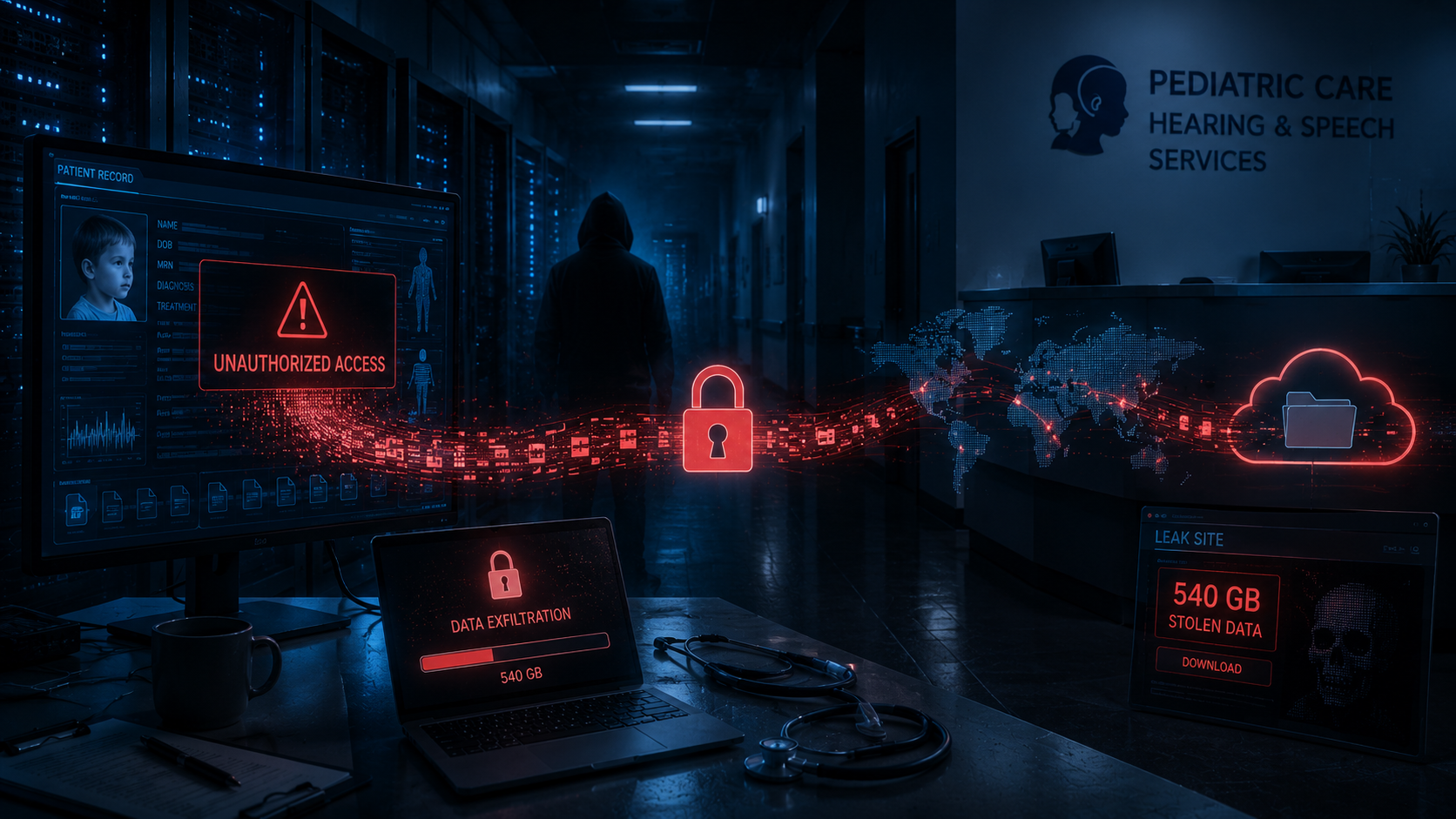
In March 2026, the Center for Hearing and Speech — operating as the Texas Hearing Institute, a pediatric non-profit facility based in Houston — identified unauthorized access to its internal network environment following a compromise that had been active since at least February 11. The Interlock ransomware syndicate, an emergent double-extortion group, had exfiltrated 540 gigabytes of sensitive data before detection occurred, and posted its claim to a dark web leak site on April 2 — weeks before the organization had completed preliminary forensic scoping.
By June 26, 2026, formal notifications were issued to 29,498 individuals whose Protected Health Information and Personally Identifiable Information — including Social Security numbers, medical records, and financial account numbers — had been exposed. The incident's 37-day undetected access window, its 84-day forensic verification timeline, and the class-action investigations launched within days of public disclosure together constitute a case study in the compounding institutional consequences of resource asymmetry in regional healthcare cybersecurity.
The primary actionable takeaway: mid-market healthcare organizations must implement behavioral endpoint monitoring and automated data classification before the next incident — not after it.
Key Finding: The 58-day gap between forensic confirmation of data access and individual victim identification was not a forensic complexity problem — it was a pre-existing data architecture failure. Without classified, inventoried PHI repositories, breach scope reconstruction under litigation pressure becomes the default at catastrophic cost. The Interlock group's dark web disclosure on April 2 — 13 days into THI's investigation — is operationally deliberate, starting the regulatory and litigation clock before the organization could accurately characterize its own exposure.
What Happened
Based on forensic findings, unauthorized access to THI's internal network environment began on or around February 11, 2026. The intrusion was not detected through internal monitoring during the period it was active. It was not until March 20, 2026 — 37 days after the estimated initial compromise date — that THI identified suspicious system behavior that triggered a formal forensic investigation.
The threat group responsible is identified as the Interlock ransomware syndicate, which operates a double-extortion model — a methodology in which threat actors exfiltrate sensitive data prior to any encryption or destructive action, then use the threat of public data disclosure as independent leverage. This approach is particularly effective against organizations for which the regulatory and reputational consequences of data exposure outweigh the operational impact of system downtime. A non-profit pediatric healthcare facility holding patient medical records and associated financial data falls squarely within the targeting profile that double-extortion economics favor.
Prior to THI's detection on March 20, Interlock exfiltrated 540 gigabytes of internal data. On April 2, 2026 — 13 days after THI had identified the suspicious activity — the Interlock group published THI on its dark web leak site. This sequencing is operationally deliberate: publicizing the claim before the victim organization has completed its own impact assessment maximizes extortion pressure and complicates the organization's public communications posture.
Forensic confirmation that data had been accessed was documented on April 22, 2026. The complexity of auditing specific files accessed within the 540-gigabyte exfiltration volume delayed final impact identification until June 19, 2026. A total of 29,498 individuals were identified as affected. Formal consumer notification letters were issued on June 26, 2026, with regulatory filings submitted to the Massachusetts Office of Consumer Affairs and Business Regulation and the Texas Attorney General's office.
Within days of the public notification, two national consumer protection law firms — Emery Reddy PC and Federman and Sherwood LLC — announced class-action investigations, a response timeline that reflects the increasing speed with which litigation infrastructure mobilizes following healthcare breach disclosures of this scale.
Why It Matters
For Security Operations Center Analysts & Incident Response Professionals
The 37-day undetected access window is the operationally critical data point. During that period, Interlock actors moved laterally through the THI environment and staged and executed a 540-gigabyte exfiltration without generating alerts that triggered a response. This is not an anomaly in mid-market healthcare environments — it reflects the absence of continuous behavioral telemetry monitoring that would surface high-volume, anomalous data movement in near-real-time. Static perimeter controls and signature-based detection tools are insufficient against threat groups that operate patiently and at volumes that fall below the threshold of obvious system disruption.
For Healthcare CISOs & Executive Leadership
The economic logic driving Interlock's targeting decision merits direct examination. Non-profit healthcare organizations operate on constrained margins that translate into small internal IT teams, limited security tooling budgets, and frequent dependence on shared managed service provider architectures. The THI incident illustrates that threat groups are performing this calculation explicitly: the organization's data value and extortion leverage were high precisely because the compliance burden of exposure under HIPAA and state breach notification frameworks is substantial.
For Compliance Officers & Legal Counsel
The sequencing of this incident exposes a gap in standard incident response planning that creates compounding liability. The Interlock dark web disclosure on April 2 created a condition in which public awareness of the breach — and the legal and regulatory clock that awareness starts — preceded the organization's ability to characterize the scope of the incident accurately. When class-action investigations are launched within days of a public notification that the organization itself could not fully scope until June 19, the litigation exposure timeline begins before the forensic process concludes. This sequencing is increasingly standard in double-extortion incidents and requires incident response playbooks that explicitly account for the public disclosure phase beginning before internal analysis is complete.
Operational Implications
The most structurally significant gap is the absence of unstructured data inventory mapping prior to the incident. The 58-day delay between forensic confirmation of data access on April 22 and the identification of individual victims on June 19 is not primarily a forensic complexity problem — it is a data architecture problem. When an organization cannot rapidly map a set of accessed files to specific individuals and data categories, it is because those files were not cataloged, classified, and linked to individual records before the incident occurred. Data classification is not a post-breach remediation measure — it is a pre-breach operational requirement.
The 540-gigabyte exfiltration volume also has implications for network traffic monitoring architecture. Exfiltrating that quantity of data from an internal environment requires sustained, high-volume outbound data transfer over a period of time. In a network environment with behavioral baseline monitoring and outbound data transfer anomaly detection, a transfer of this magnitude should generate observable signals. The absence of detection during the exfiltration window suggests that outbound traffic monitoring either was not deployed or was not calibrated to flag the transfer characteristics associated with this activity.
The mixed-dataset composition of the exposed data — Social Security numbers combined with medical records and direct financial account information — creates a downstream risk profile for affected individuals more severe than single-category breaches. In combination, the dataset supports identity fraud, financial account compromise, and targeted social engineering schemes that can persist for years beyond the initial breach event.
For non-profit healthcare organizations specifically, the post-breach cost structure documented in this incident — external forensic firm fees, consumer notification expenses, identity monitoring service costs, and class-action litigation defense — presents a financial burden that can materially impair operational capacity. Organizations that have not pre-positioned cyber insurance coverage calibrated to healthcare-specific breach scenarios, including double-extortion incidents with extended notification timelines, should evaluate whether their current coverage adequately addresses the full cost profile of a comparable event.
Recommended Actions
- 1 - Treat automated data discovery and classification as the most operationally urgent priority — scan internal network environments including legacy file shares, unstructured document repositories, and archival patient record systems to produce a current, searchable inventory of where PHI, PII, and financial data reside.
- 2 - Organizations that complete this work before an incident can characterize their exposure in days rather than months; those that have not will reconstruct it under litigation and regulatory pressure at substantially higher cost.
- 3 - Validate least-privilege access enforcement on systems containing PHI and financial data rather than assuming it is correctly configured, with specific attention to mixed-dataset environments where a single credential compromise should not extend access across all data categories.
- 4 - Evaluate current cyber insurance coverage specifically against healthcare-sector breach cost profiles, including extended notification timelines and litigation costs that predictably follow double-extortion disclosures of this scale.
- 1 - Organizations currently relying on traditional antivirus or signature-based detection tools should treat behavioral endpoint detection and response capability as a near-term investment priority.
- 2 - The specific gap exploited in the THI incident — 37 days of undetected lateral movement and data staging — is precisely the gap behavioral EDR solutions are designed to close by monitoring for anomalous process behavior and high-volume data movement.
- 3 - Mid-market healthcare non-profits that cannot sustain 24/7 internal security operations coverage should evaluate Managed Detection and Response service partnerships as a structural alternative.
- 4 - Specifically address the late-night and weekend lateral movement patterns that threat actors frequently use to extend dwell time before detection.
- 1 - Update incident response playbooks to explicitly address double-extortion scenarios in which a threat actor's public disclosure precedes the completion of internal forensic analysis.
- 2 - Communications protocols, legal notification timelines, and regulatory filing procedures should all account for the possibility that the organization will be responding publicly to an incident whose full scope it has not yet determined.
- 3 - Pre-authorize response language and coordinate with external legal counsel before crisis conditions arise rather than improvising under litigation pressure.
- 4 - Review cyber insurance coverage specifically against healthcare-sector breach cost profiles, including the extended notification timelines and class-action litigation defense costs that predictably follow double-extortion disclosures of this scale.
Closing Statement
The Texas Hearing Institute breach is not an outlier — it is a representative data point in a targeting pattern that the ransomware ecosystem has been refining for several years. Mid-market healthcare organizations hold some of the most sensitive and legally protected data categories that exist in the civilian sector, and many operate with security infrastructure calibrated for a threat environment that no longer exists.
Building institutional resilience in this sector means recalibrating what security adequacy requires in practice: not checkbox HIPAA compliance or perimeter firewalls alone, but continuous behavioral visibility into where sensitive data lives and who is accessing it at every hour of the day. The patients whose Social Security numbers, medical histories, and financial accounts were exposed in this incident trusted that their care provider would protect that information. Bridging the awareness gap between that expectation and the current security reality of regional healthcare is not a long-cycle strategic project — it is the operational work that should have been completed before February 11.