
Fortinet FortiSandbox Zero-Days: Active Exploitation Under Federal Mandate
Executive Summary
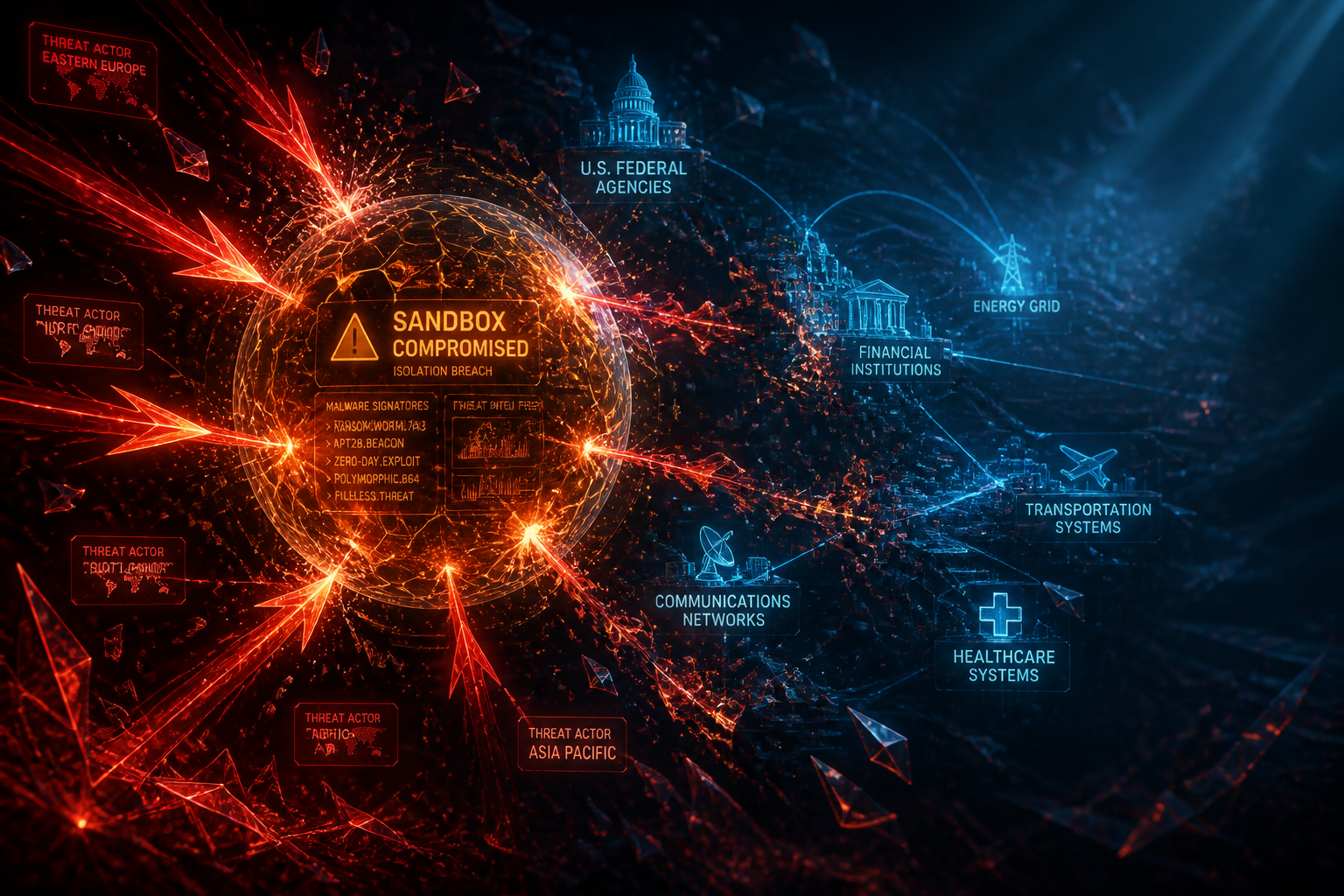
Two actively exploited zero-day vulnerabilities in Fortinet FortiSandbox have triggered an emergency federal patch mandate with a July 21, 2026 compliance deadline—creating a compressed 48-72 hour remediation window for federal agencies and critical infrastructure operators. CVE-2026-25089 (CVSS 8.8) and CVE-2026-39808 (CVSS 9.1) enable unauthenticated remote code execution and privilege escalation on appliances running versions 3.2.0 through 4.2.5.
CISA's inclusion of both vulnerabilities in its Known Exploited Vulnerabilities catalog signals active threat actor engagement across multiple geographic regions and operational sectors, including federal agencies, financial institutions, healthcare systems, and critical infrastructure networks. An estimated 15,000 or more FortiSandbox instances operate globally, with between 2,000 and 3,000 deployed within U.S. federal agencies and critical infrastructure sectors.
Immediate actionable guidance: Organizations unable to patch by the deadline face regulatory enforcement action and heightened exposure to advanced threat actor campaigns targeting sandbox infrastructure as a high-value defensive chokepoint. Immediate inventory and prioritized patch deployment, coupled with interim network isolation if patching cannot complete on schedule, represents the baseline institutional response required to mitigate regulatory and operational risk within the compressed timeline.
Key Finding: CISA has mandated federal agencies and critical infrastructure operators patch two actively exploited Fortinet FortiSandbox vulnerabilities (CVE-2026-25089 and CVE-2026-39808) by July 21, 2026—creating a 48-72 hour operational remediation window during which active exploitation attempts continue against unpatched systems.
What Happened
The vulnerability disclosure and exploitation timeline compressed significantly between July 14 and July 17, 2026. Fortinet released security advisories on July 14, 2026, disclosing two remote code execution and privilege escalation flaws affecting FortiSandbox appliance versions 3.2.0 through 4.2.5, alongside select FortiProxy product variants. Within 24 hours of public disclosure, active exploitation attempts were documented against vulnerable appliances across multiple geographic regions and operational sectors. By July 16, 2026, CISA formally added both CVE-2026-25089 and CVE-2026-39808 to its Known Exploited Vulnerabilities catalog and issued a federal binding operational directive mandating remediation by July 21, 2026.
The technical characteristics underscore their operational severity. CVE-2026-25089 stems from improper input validation in FortiSandbox API endpoints, permitting unauthenticated attackers to submit specially crafted requests that trigger remote code execution with FortiSandbox process privileges. The vulnerability requires no authentication, no user interaction, and no exploit chain—characteristics that dramatically accelerate threat actor adoption. CVE-2026-39808 enables privilege escalation on affected appliances, particularly when chained with CVE-2026-25089 in multi-stage exploitation campaigns. Proof-of-concept code has circulated in underground security communities and been integrated into commodity exploitation frameworks, substantially lowering the technical barrier for opportunistic threat actors.
An estimated 15,000 or more FortiSandbox instances operate globally, with between 2,000 and 3,000 deployed within U.S. federal agencies, critical infrastructure sectors, and regulated industries including financial services and healthcare. FortiSandbox functions as a primary malware analysis and threat intelligence gateway, embedded across enterprise security operations centers and government malware detonation environments. The widespread deployment combined with the unauthenticated attack vector means the exploitation surface extends to any organization with internet-accessible FortiSandbox instances or internal appliances reachable by threat actors who have compromised perimeter systems or supply chain partners.
Threat intelligence reports confirm exploitation attempts across diverse threat actor profiles—nation-state advanced persistent threat groups, financially motivated cybercriminals, and indiscriminate vulnerability scanners. Geographic distribution indicators suggest multiple source regions with targeting patterns indicating both opportunistic scanning and deliberate campaigns against specific institutional targets, particularly those operating critical infrastructure or managing sensitive national security research.
Why It Matters
For Federal Agencies and National Security Institutions
Federal agencies operate FortiSandbox instances as part of classified and unclassified threat analysis infrastructure, using the platform to detonate suspected malware samples, extract indicators of compromise, and inform intelligence assessments. A compromised appliance provides threat actors visibility into threat detection methodologies, specific malware samples under analysis, and emerging threat indicators that drive intelligence-led defensive operations. For agencies conducting counterintelligence operations or managing sensitive national security research, this exposure creates secondary intelligence loss beyond immediate compromise. CISA's federal mandate reflects recognition of this elevated risk—binding federal agencies to patch within 72 hours rather than standard 30-60 day federal patching windows. The compressed timeline signals severity while creating operational friction as federal IT organizations navigate emergency change management, documentation requirements, and compliance verification.
For Critical Infrastructure Operators
Electricity, water, natural gas, and communications sectors depend on commercial security tools for operational technology and information technology network segmentation and threat intelligence. A compromised FortiSandbox instance may provide threat actors visibility into network architecture, security appliance configurations, and sector-specific threats that organizations have identified. For threat actors engaged in long-term infrastructure reconnaissance or preparation for disruptive operations, this intelligence represents substantial operational advantage. The extended exposure window increases the probability that threat actors will obtain intelligence to inform follow-on infrastructure compromise operations.
For Financial Services and Regulated Industries
FortiSandbox instances used by financial institutions provide threat actors access to banking sector threat intelligence metadata, emerging fraud threats, and malware samples targeting financial networks. Breach of this metadata can undermine confidence in threat intelligence platforms, delay detection of sector-wide threats, and create cascading effects across interconnected financial institutions relying on shared threat intelligence. Regulatory implications are substantial—institutions failing to meet federal compliance deadlines may face enforcement action from banking regulators (Office of the Comptroller of the Currency, Federal Reserve) independently of the CISA mandate. Healthcare organizations face similar dual pressure: CISA compliance deadline combined with HIPAA breach notification obligations if patient data exposure is confirmed through forensic analysis.
Operational Implications
Immediate (Days to Weeks): Organizations face simultaneous competing pressures: patching critical appliances by July 21, 2026, combined with ongoing risk of exploitation attempts during the patching window. This creates operational triage complexity, as security teams must prioritize FortiSandbox instances based on criticality, internet-facing exposure, and downstream network impact. Many organizations may lack comprehensive inventory accuracy on appliance versions, deployment locations, and network criticality, creating discovery delays that compress the already-constrained remediation window. For organizations with complex change management requirements—federal agencies, financial institutions, healthcare systems—obtaining emergency change authorization, scheduling maintenance windows, and coordinating across IT and security teams may consume significant portions of available time. Exploitation attempt volume will likely increase as the deadline approaches. Security operations teams may experience elevated alert volumes from vulnerability scanning traffic, exploitation attempt detection, and legitimate patching activity, creating alert fatigue that could mask actual successful compromise attempts.
Short-Term (Weeks to Months): After patching completes, organizations must conduct forensic analysis to determine whether exploitation occurred on systems remaining unpatched during the exposure window. This requires incident response team capacity diversion from routine operations, specialized technical expertise in FortiSandbox audit log analysis and network traffic forensics, and potentially engagement of external incident response providers if internal capability is insufficient. Supply chain complexity amplifies these challenges. Managed service providers and security integrators managing FortiSandbox instances on behalf of multiple customer organizations will face simultaneous patching requests, creating deployment capacity bottlenecks. Customers dependent on MSP support for patching may experience delays if MSP resources are exhausted. Organizations should anticipate 1-2 week delays in MSP patch deployment if the MSP is supporting numerous customer environments. Regulatory notification obligations may be triggered if forensic analysis reveals that sensitive data was accessed through compromised appliances. Financial institutions, healthcare organizations, and government contractors may be required to notify regulators (banking regulators, HHS Office of Civil Rights, Defense Counterintelligence and Security Agency) of confirmed breaches, triggering formal investigation protocols and documentation requirements extending well beyond the immediate patch timeline.
Long-Term (Months to Years): The vulnerability sequence will likely prompt organizational review of vendor dependency and commercial product risk. FortiSandbox is a widely deployed platform with limited direct competitors, creating vendor concentration risk. Organizations may initiate architectural reviews to assess whether maintaining FortiSandbox as the primary malware analysis platform remains strategically justified, or whether diversification toward alternative solutions would reduce future vulnerability risk. Vendor risk assessment frameworks may be updated to incorporate more aggressive response timelines for zero-day vulnerabilities affecting critical infrastructure components. Organizations may reassess appliance placement—instances currently exposed to internet-accessible networks may be repositioned to non-exposed locations, or access controls may be substantially tightened to reduce the practical attack surface. Budget reallocation may be required to fund emergency infrastructure upgrades, incident response services, or vendor risk diversification initiatives, creating downstream opportunity cost as funds allocated to emergency remediation may not be available for planned strategic security investments.
Recommended Actions
Actions are organized by organizational security maturity. Baseline controls apply across all tiers and should be treated as immediate priorities regardless of organizational size.
* Organizations with standard security tooling and general-purpose endpoint protection.
- 1 - Execute appliance inventory. Identify all FortiSandbox instances through network scans, asset management systems, or vendor product registration databases. Document version number, deployment location (on-premises, cloud, hybrid), network exposure (internet-accessible, internal-only), and downstream system dependencies. Complete within 12 hours of reading this article if not already completed.
- 2 - Obtain and stage patches. Download Fortinet security patches for all identified vulnerable versions from Fortinet's support portal or official distribution channels. Verify patch authenticity through digital signature verification.
- 3 - Prioritize patching sequence. Apply patches first to internet-facing or perimeter-adjacent FortiSandbox instances, followed by appliances processing sensitive data or supporting critical infrastructure operations. Defer development and test environment appliances until after production systems are remediated if timing requires prioritization.
- 4 - Document compliance status. Create formal record of patching timeline, affected systems, and remediation status for compliance reporting to CISA, regulators, or internal governance bodies. Identify any systems unable to patch by July 21 deadline and document justification for formal waiver if required by organizational policy.
* Organizations with dedicated security functions, SIEM coverage, and structured incident response capability.
- 1 - Implement interim compensating controls. For systems unable to patch by the deadline, immediately restrict inbound access to FortiSandbox management interfaces to whitelisted source IP addresses; disable or restrict API access; implement additional authentication requirements (multi-factor authentication, VPN requirement) for administrative access; increase monitoring and alerting on suspicious API activity or administrative access patterns.
- 2 - Conduct forensic analysis. Preserve FortiSandbox audit logs, syslog output, and network traffic captures from the exposure window (July 15–July 21, 2026). Engage internal incident response teams or external forensic specialists to examine logs for indicators of exploitation: unexpected API access patterns, privilege escalation events, file system modifications, or process execution anomalies. Cross-reference with known indicators of compromise published by CISA, vendor advisories, or threat intelligence platforms.
- 3 - Execute credential rotation. Reset FortiSandbox administrative passwords; revoke and reissue API tokens or service accounts used for automated integration; audit SSH keys and certificate-based authentication mechanisms for unauthorized additions. Extend credential rotation to downstream systems that accept credentials from FortiSandbox if exploitation may have exposed credential material.
- 4 - Establish vendor communication channel. File formal support ticket with Fortinet requesting confirmation of patch deployment success, assistance with forensic analysis if compromise is suspected, and guidance on post-incident validation. Request Fortinet incident response support if internal capability is insufficient.
* Organizations with mature security programs, threat intelligence capacity, and advanced monitoring capability.
- 1 - Post-incident review and playbook revision. Conduct structured incident commander briefing within five days of completing patching. Document decision points, resource constraints encountered, communication failures, and process gaps. Revise incident response playbooks to incorporate lessons learned; update FortiSandbox compromise detection rules based on observed exploitation indicators.
- 2 - Architecture hardening for appliance management. Implement zero-trust network access principles for FortiSandbox administrative interfaces—require VPN or private network access, implement multi-factor authentication for all administrative sessions, deploy endpoint detection and response tools on systems used for appliance management to detect lateral movement attempts originating from compromised appliances.
- 3 - Vendor risk diversification. Initiate formal evaluation of alternative sandbox and malware analysis platforms to reduce dependency on single-vendor solutions. Assess cloud-based detonation services, open-source sandbox infrastructure, or multi-vendor approaches. Develop transition roadmap to reduce FortiSandbox dependency over 6-12 months without disrupting operational threat analysis capability.
- 4 - Workforce training and security awareness. Conduct incident response team training on FortiSandbox forensic examination, audit log analysis, and compromise indicators. Update general cybersecurity awareness training to include appliance compromise scenarios and supply chain risk implications. Conduct tabletop exercise or red-team simulation targeting FortiSandbox compromise with downstream lateral movement scenarios.
Closing Statement
The Fortinet FortiSandbox vulnerability sequence—from disclosure through active exploitation to federal mandate enforcement—represents a critical test of institutional readiness to respond to zero-day vulnerabilities affecting critical defensive infrastructure under compressed timelines and regulatory pressure. The 48-72 hour remediation window leaves minimal margin for discovery delays, change management friction, or resource constraints. Organizations that prioritize appliance inventory, implement risk-based patching sequences, and deploy interim compensating controls for systems unable to patch on schedule will substantially mitigate regulatory and operational risk. Those that delay response, assume their FortiSandbox deployment is unaffected, or rely on vendor support exclusively without parallel internal action will face heightened exposure to exploitation, forensic investigation burden, and potential regulatory enforcement action.
The broader institutional lesson extends beyond this specific vulnerability: defensive infrastructure components deserve equivalent or higher patch priority than standard enterprise systems, because their compromise undermines the effectiveness of downstream security controls and provides threat actors intelligence to defeat organizational defenses at scale. Organizations that embed this principle into vendor risk management, architecture decision-making, and change management processes will build resilience against the recurring pattern of zero-day exploitation targeting the tools security teams depend on to maintain institutional defense.