Inside WRDA 2026’s Autonomous Critical Infrastructure Mandates
Executive Summary
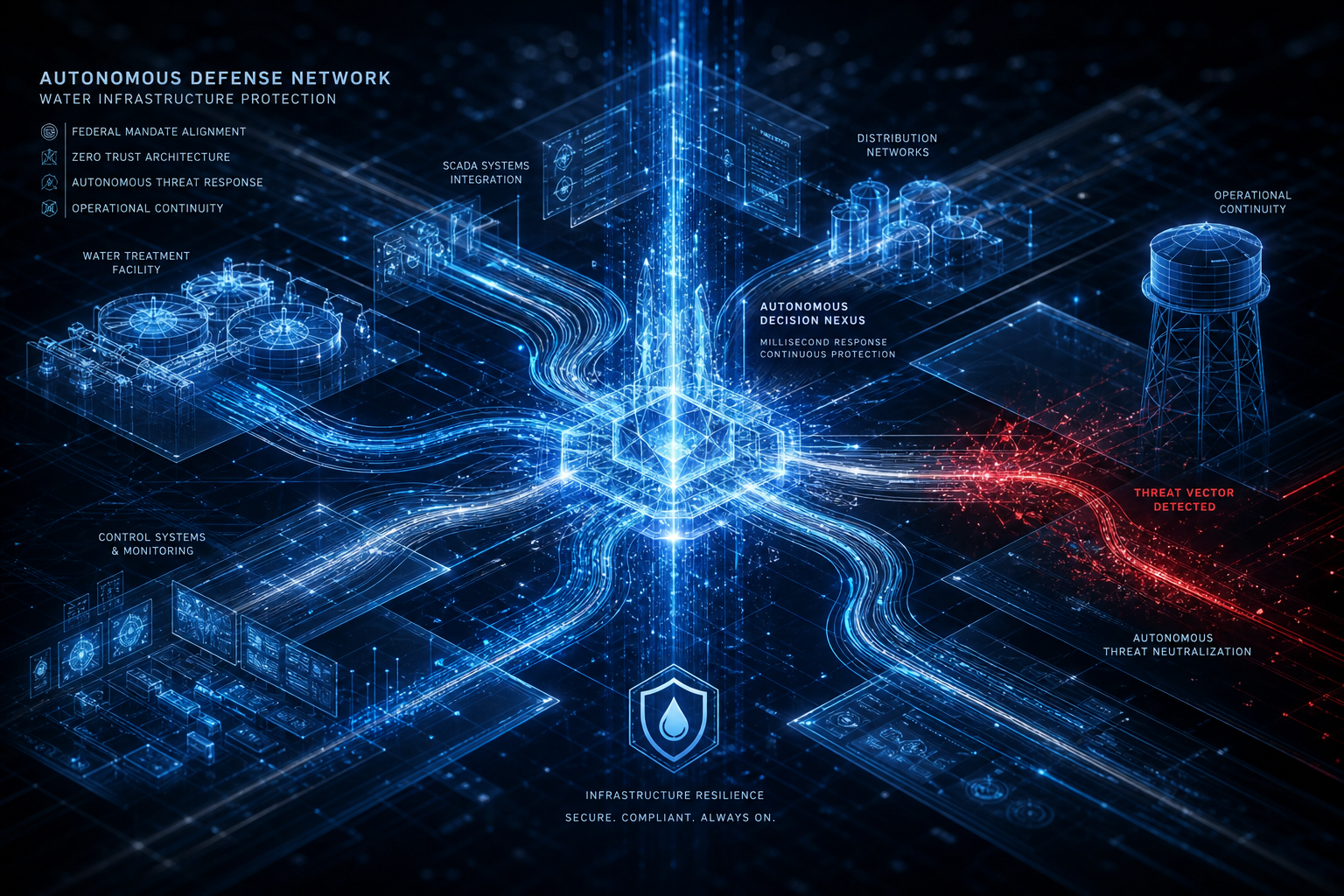
The Water Resources Development Act of 2026 introduces the first federal statutory mandate requiring autonomous cybersecurity defense capabilities in water infrastructure systems receiving federal funding. Rather than positioning autonomous response as a discretionary security enhancement, WRDA 2026 establishes it as a compliance requirement, reshaping how water utilities and interdependent critical infrastructure operators detect and respond to cyber threats.
The legislation compresses traditional incident response decision-making timelines from hours to milliseconds, establishes binding implementation deadlines, and creates material liability exposure for utilities maintaining human-dependent protocols.
Immediate actionable guidance: Water utilities, state governments, and energy operators must immediately initiate compliance assessments, vendor evaluations, and workforce readiness planning. Organizations dependent on water infrastructure should assess cascading compliance obligations through supplier relationships and mutual aid agreements.
Key Finding: WRDA 2026 establishes autonomous cybersecurity response as a statutory compliance requirement—not a discretionary enhancement—for federally-funded water infrastructure, effectively mandating machine-speed threat detection and response while compressing human decision-making windows from hours to milliseconds and creating liability exposure for utilities unable to meet autonomous defense standards.
What Happened
The Water Resources Development Act of 2026 advanced through legislative consideration in June-July 2026, with significant cybersecurity provisions incorporated during Senate committee markup and House Transportation Committee review. As of publication, WRDA 2026 remains in the legislative pipeline with anticipated passage and presidential action within the current congressional calendar.
The legislation mandates that water utilities receiving federal funding implement autonomous cyber defense capabilities meeting specific statutory performance thresholds. The statutory language defines "autonomous cyber defense" as technology systems capable of detecting cyber threats, classifying attack characteristics, and initiating defensive responses within defined parameters without human intervention at the decision point. Compliance applies to utilities receiving federal infrastructure funding, including water treatment facilities, distribution systems, and regional water authority control networks.
Implementation occurs on a phased timeline based on utility size and federal funding classification. Larger utilities serving populations exceeding 250,000 with substantial federal support face compliance deadlines of 18-24 months from passage. Mid-sized and smaller utilities receive extended windows accommodating capital planning cycles, with all utilities required to achieve full compliance by December 31, 2030. WRDA 2026 allocates explicit federal funding for autonomous defense deployment, though preliminary analysis suggests allocation levels may not fully cover implementation costs for smaller utilities and rural water systems. The legislation establishes a vendor certification framework requiring autonomous defense solutions to meet federal interoperability standards, demonstrate integration compatibility with existing SCADA and industrial control systems, and provide performance attestations regarding threat detection latency, response accuracy, and false-positive rates.
Stakeholder responses have been measured. The U.S. Chamber of Commerce identified compliance as operationally feasible but flagged significant cost burden, particularly for utilities with aging infrastructure requiring concurrent modernization. The National Association of Counties expressed implementation concerns specific to smaller jurisdictions and rural systems, citing resource constraints and workforce readiness gaps. Water utility sector associations have begun preliminary compliance planning while acknowledging substantial uncertainty regarding specific technical requirements and vendor availability. Energy sector stakeholders have identified cascading compliance implications through interdependent infrastructure relationships, recognizing that water system autonomous responses may affect power demand and grid stability. Technical guidance from House Transportation Committee briefings provides architectural frameworks for integrating autonomous defense into existing control systems, specifies minimum detection latency requirements (sub-second threat identification), and establishes baseline accuracy thresholds for attack classification. Detailed implementation specifications remain subject to regulatory development, creating ongoing uncertainty in vendor product roadmaps and utility procurement planning.
Why It Matters
For Water Utility Operations and Governance
The compression of incident response timelines from hours to milliseconds creates immediate operational and governance challenges. Traditional incident response assumes human decision-makers evaluate threat data, assess operational impact, coordinate with relevant stakeholders, and authorize defensive actions—a process typically consuming 4-24 hours. Autonomous defense systems must make equivalent decisions in milliseconds, without human involvement at the decision point. This requires utilities to pre-define threat response thresholds, establish automated escalation procedures, and implement override mechanisms for scenarios where autonomous decisions might create unintended consequences. Operationally, utilities must develop new governance models for autonomous response authorization. The critical question shifts from "Should we respond to this threat?" in real-time to "For which threat categories and operational scenarios have we pre-authorized autonomous response?" This requires comprehensive threat modeling, coordination between cybersecurity and operations teams, and clear definition of acceptable risk boundaries. The process is conceptually straightforward but operationally complex in systems managing critical human dependencies such as water treatment chemical dosing, pressure regulation, and contamination detection.
For Interdependent Energy and Transportation Infrastructure
Water systems depend on energy infrastructure for continuous operation of treatment plants, pumps, chemical systems, and monitoring equipment. Any autonomous response decision affecting power demand or availability cascades through water infrastructure. Energy operators dependent on water for cooling operations and hydroelectric generation simultaneously face cascading compliance obligations through supplier relationships. When water utilities implement autonomous responses affecting power demand, energy operators must adjust their own autonomous defenses to account for this variable. This creates potential for cascading failures where autonomous responses in one sector trigger unintended consequences in interdependent infrastructure. Transportation systems dependent on water logistics face similar cascading risks. If autonomous defense responses disrupt water system operations, transportation infrastructure dependent on those systems experiences secondary effects. Conversely, transportation infrastructure disruptions affect water supply chains and emergency response capabilities.
For Workforce Development and Institutional Readiness
Current water utility cybersecurity staffing is insufficient for autonomous system management at scale. Most utilities operate with small IT teams focused on basic system maintenance, network security, and compliance documentation. Managing autonomous defense systems requires new skill sets: autonomous systems governance, machine learning model validation, threat classification algorithm assessment, and autonomous response protocol development. These roles lack standardized certifications, established career pathways, and clear salary and advancement structures. The workforce gap is particularly acute in mid-sized and rural utilities. While major metropolitan water systems may recruit cybersecurity talent and achieve compliance within expected timelines, utilities serving 10,000-50,000 people face significant talent acquisition challenges. These organizations lack the salary and career development resources to compete for scarce cybersecurity professionals and cannot justify large IT teams. Compliance may require outsourced autonomous defense management, creating vendor dependency and potentially concentrating decision-making authority with external contractors rather than utility operators responsible for safe water delivery.
For Capital Planning and Resource Allocation
Autonomous defense implementation requires substantial capital investment: hardware upgrades, software licensing, system integration, testing, and deployment. While federal funding covers a portion of costs, preliminary analysis suggests inadequacy for comprehensive deployment across aging infrastructure. Utilities face competing capital pressures from aging pipes requiring replacement, treatment facilities needing modernization, and increasing cybersecurity mandates. Autonomous defense compliance may displace other infrastructure investments, with indirect consequences for water system reliability and resilience. Small utilities face disproportionate financial burden. Implementation costs per capita are significantly higher for systems serving 5,000 people than systems serving 500,000. Federal funding allocation often based on absolute utility size rather than per-capita burden disadvantages smaller jurisdictions. This financial pressure may force consolidation of smaller utilities into larger systems to achieve economies of scale, with unknown consequences for local governance and service models.
Operational Implications
Immediate (Days to Weeks): Compliance requires immediate initiation of technical and governance assessment. Utilities must inventory existing SCADA and industrial control systems, assess compatibility with autonomous defense solutions, and develop realistic timelines for system modernization. Legacy systems—particularly those operating 10-20 years without major upgrades—may require replacement rather than modification, significantly increasing implementation costs. Operationally, utilities must develop autonomous response protocols defining threat scenarios, authorized responses, escalation procedures, and human override mechanisms. This work requires collaboration between cybersecurity teams (who understand threat characteristics), operations teams (who understand system safety implications), and legal/compliance teams (who understand regulatory and liability frameworks). The process is iterative and time-consuming, and many utilities lack sufficient in-house expertise to complete this independently. Vendor selection decisions have long-term consequences. Autonomous defense solutions vary significantly in architecture, integration approaches, threat classification methodologies, and operational interfaces. This selection establishes technical dependency lasting 5-10 years. Utility teams must evaluate not only current product capability but vendor financial stability, roadmap commitments, support infrastructure, and liability frameworks. Many utilities lack procurement expertise in autonomous systems and may require external consulting support. Workforce development is substantial. Utilities must recruit or develop personnel capable of managing autonomous defense systems, understanding autonomous response decision logic, and overseeing continuous system improvement. Smaller utilities may require shared services arrangements with neighboring systems or outsourced management.
Short-Term (Weeks to Months): Energy utilities must develop coordination protocols with water systems regarding autonomous response impacts. Water system responses affecting power demand—such as large-scale facility shutdowns or massive pump operations—must be communicated to energy operators managing grid stability. Conversely, energy operator responses affecting water system operations must be coordinated with water utilities. This requires establishment of mutual aid agreements, information sharing protocols, and joint threat assessment frameworks. Grid stability implications require particular attention. Water treatment plants represent significant power consumers with volatile demand patterns. If autonomous defenses respond to cyber threats by automatically shutting down treatment systems, power demand changes rapidly and unpredictably. Energy operators must account for this variability in grid balancing and contingency planning. Transportation sector coordination becomes necessary for multi-modal supply chains. If water system autonomous responses disrupt barge operations or rail logistics, transportation operators must understand these cascading effects and adjust contingency plans accordingly. States and regional authorities must develop compliance verification mechanisms to audit utilities for autonomous defense implementation and capability. This requires establishing clear compliance standards, developing assessment frameworks, and training auditors capable of evaluating autonomous system architectures. Many state environmental or water quality agencies currently lack cybersecurity expertise and must recruit personnel or contract with external specialists. Interstate coordination becomes critical for multi-state water systems. River basin authorities and interstate compacts managing shared water resources must develop protocols for coordinating autonomous responses that affect water availability, flow rates, or quality parameters across state boundaries. Grant administration and federal funding distribution require new compliance verification mechanisms. States must establish frameworks for distributing federal funding equitably while recognizing that per-capita costs vary significantly across utility sizes.
Long-Term (Months to Years): WRDA 2026 creates significant market expansion opportunity for autonomous defense vendors. However, this opportunity is accompanied by substantial liability exposure. Vendors must develop solutions meeting federal interoperability standards, demonstrate integration compatibility across diverse legacy systems, and provide performance guarantees regarding threat detection accuracy and response reliability. Liability frameworks for autonomous response errors remain unsettled—if a vendor's autonomous defense system causes harm (water system disruption, false-positive response creating operational damage), liability allocation between vendor, utility, and regulators is unclear. Vendors must invest in professional services and support infrastructure to help utilities develop appropriate autonomous response protocols, which increases operating costs and may limit vendor profitability. Insurance frameworks for autonomous systems remain nascent. Cyber liability policies traditionally cover losses resulting from negligent decisions by insured parties. Autonomous systems make decisions without human involvement, making liability allocation ambiguous. Insurance carriers must develop new policy frameworks allocating liability between utilities, vendors, and insurers. Risk management professionals must develop new frameworks for evaluating and managing autonomous system decisions, requiring expertise currently rare in insurance and risk management communities.
Recommended Actions
Actions are organized by organizational security maturity. Baseline controls apply across all tiers and should be treated as immediate priorities regardless of organizational size.
* Organizations with standard security tooling and general-purpose endpoint protection.
- 1 - Establish WRDA 2026 compliance task force with representation from IT, operations, legal, and executive leadership. Assign clear responsibility for compliance planning and authorization.
- 2 - Immediately conduct inventory of existing SCADA and industrial control systems, documenting system age, upgrade history, vendor relationships, and current cybersecurity posture. Identify which facilities and systems fall under WRDA 2026 compliance requirements.
- 3 - Determine applicable compliance deadline based on utility classification. Understanding your specific deadline enables realistic planning and resource allocation.
- 4 - Engage with peer utilities and state water associations to share information about compliance approaches, vendor evaluations, and implementation challenges.
- 5 - Commission formal technical and governance gap assessment comparing current incident response capabilities with statutory autonomous defense requirements.
- 6 - Issue Request for Proposal or initiate structured vendor evaluation process for autonomous defense solutions. Develop evaluation criteria addressing federal interoperability compliance, integration compatibility, threat detection metrics, and vendor financial stability.
- 7 - Establish cross-functional governance model for autonomous response authorization. Define which threat scenarios permit autonomous response without human authorization.
* Organizations with dedicated security functions, SIEM coverage, and structured incident response capability.
- 1 - Complete vendor selection and finalize contract negotiations with liability and warranty alignment. Ensure contracts address performance guarantees, liability allocation, warranty frameworks, and interoperability standards compliance.
- 2 - Develop detailed operational protocols for autonomous response, including threat scenario definitions, authorized response actions, escalation procedures, human override mechanisms, and post-incident review processes.
- 3 - Deploy pilot autonomous defense installation in isolated test environment or non-critical facility to validate system integration and provide workforce training.
- 4 - Establish cross-utility information sharing agreements for threat intelligence coordination. Formalize agreements addressing data sharing scope, confidentiality, and liability.
- 5 - Develop organizational change management strategy for autonomous defense integration. Establish communication plans, training programs, and stakeholder engagement.
- 6 - Design alert triage and response procedures balancing autonomous speed with human oversight. Develop procedures for validating autonomous response decisions and escalating ambiguous scenarios.
- 7 - Build workforce readiness through certification programs, peer learning networks, and cross-functional training ensuring both operations and IT personnel understand autonomous defense capabilities.
* Organizations with mature security programs, threat intelligence capacity, and advanced monitoring capability.
- 1 - Execute full autonomous defense system integration across all required facilities and systems. Conduct comprehensive testing across normal operations, stress scenarios, and known threat simulations.
- 2 - Validate that autonomous responses function as designed and do not create unintended operational consequences. Develop performance metrics including threat detection rate, detection latency, response accuracy, false-positive rates, and mean-time-to-response.
- 3 - Complete workforce training and certification for personnel managing autonomous defense systems. Ensure all stakeholders understand system capabilities and governance frameworks.
- 4 - Prepare regulatory compliance documentation and reporting required by federal agencies, including system architecture descriptions, capability attestations, threat detection and response metrics, and ongoing performance monitoring protocols.
- 5 - Establish continuous monitoring and improvement processes to track autonomous defense performance, identify false-positive rates, refine threat classification, and optimize response protocols based on operational experience.
- 6 - Treat WRDA 2026 compliance as enterprise risk requiring C-suite oversight. Establish governance committee with board-level visibility into compliance status and timeline management.
- 7 - Develop vendor relationship strategy with contractual risk allocation frameworks. Plan workforce recruitment and retention strategy supporting new autonomous defense operational roles. Develop external communication strategy addressing cybersecurity improvements.
Closing Statement
WRDA 2026 establishes autonomous defense as operational necessity rather than competitive advantage for water infrastructure operators. Organizations implementing autonomous cybersecurity response transition from reactive incident response models to pre-authorized machine-speed defense protocols. This shift compresses decision-making timelines, simplifies governance for anticipated threats, and creates new liability exposure for unanticipated consequences.
The legislation serves as bellwether for broader critical infrastructure cybersecurity mandates likely extending to energy, transportation, healthcare, and telecommunications sectors in subsequent years. Understanding WRDA 2026's policy logic, implementation challenges, and institutional response patterns provides foundation for understanding future autonomous defense mandates across critical infrastructure. Organizations should view WRDA 2026 compliance not as isolated regulatory burden but as signal of broader strategic direction toward machine-speed autonomous defense across critical infrastructure sectors. The transition to autonomous defense represents fundamental institutional change requiring alignment of technology, governance, workforce, and risk management frameworks. Organizations beginning compliance planning now position themselves favorably for seamless implementation; those delaying face compressed timelines and elevated implementation risk. The intelligence value of autonomous defense readiness extends beyond compliance—it establishes foundation for broader institutional cybersecurity modernization and critical infrastructure resilience.