Project CAV3RN Expansion: New Framework Module Signals Escalated Threat Activity
Executive Summary
Project CAV3RN represents a critical escalation in Iranian state-sponsored cyberespionage capability through the integration of modular command-and-control infrastructure that exploits legitimate enterprise communication channels—specifically Microsoft Outlook calendar functions and DNS tunneling protocols—to establish resilient C2 pathways resistant to traditional detection mechanisms. The framework's modular architecture enables operators to execute commands and exfiltrate data through authenticated, encrypted enterprise communication channels that circumvent standard network monitoring tools.
This development signals a deliberate strategic shift toward supply-chain diversification of C2 infrastructure, substantially extending operational dwell time and complicating forensic attribution. Organizations dependent on Outlook and standard DNS infrastructure—particularly government agencies, critical infrastructure operators, and defense contractors—face elevated operational risk.
Immediate action includes baselining Outlook and DNS traffic patterns, implementing calendar-specific anomaly detection, and establishing DNS query monitoring with threat intelligence integration.
Key Finding: Project CAV3RN operators have successfully integrated legitimate Microsoft Outlook calendar functionality and DNS tunneling protocols into their modular C2 framework, enabling command execution and data exfiltration through authenticated enterprise communication channels that bypass traditional network detection mechanisms and substantially complicate forensic attribution.
What Happened
Project CAV3RN emerged within the Iranian state-sponsored cyber operations landscape as a modular, framework-based command-and-control infrastructure designed to facilitate persistent espionage against high-value targets in government, diplomacy, defense, and critical infrastructure sectors. The framework's evolution represents a deliberate architectural shift away from single-vector malware families toward distributed, legitimate-channel-exploiting C2 infrastructure.
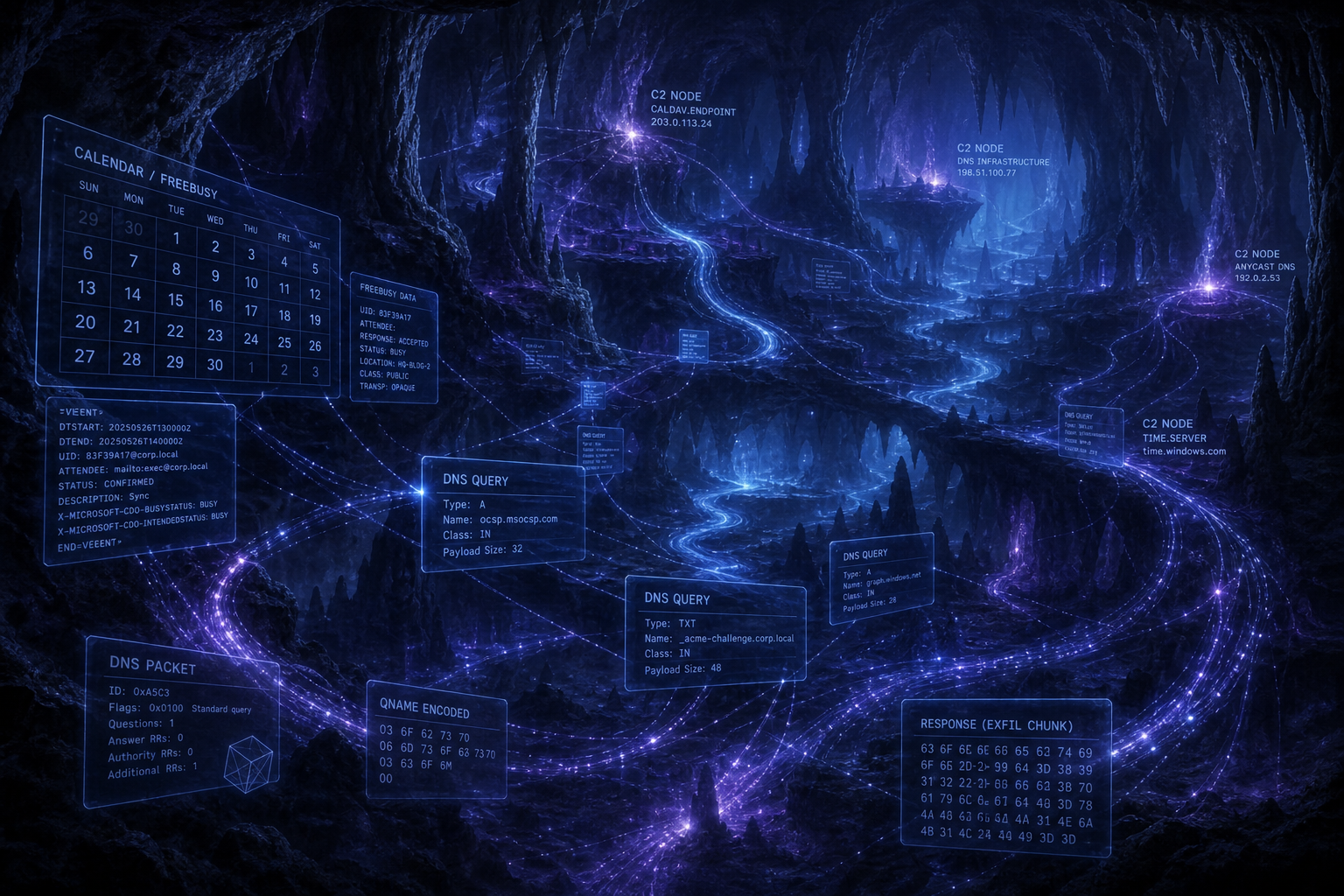
Outlook Calendar as Command Channel: The technical integration of Outlook calendar functionality into Project CAV3RN's C2 apparatus operates through systematic abuse of legitimate calendar infrastructure rather than exploitation of software vulnerabilities. Operators create or modify calendar events containing encoded command instructions, which infected endpoint systems retrieve through normal calendar synchronization operations; calendar event properties, metadata fields, and descriptive content serve as command vectors, while operator-directed responses encode within calendar availability status updates or subsequent event modifications. This methodology exploits inherent architectural features of calendar synchronization: traffic traverses enterprise networks encrypted via HTTPS to Microsoft cloud infrastructure or on-premises Exchange servers, event creation requires no elevated privileges, synchronization occurs asynchronously at intervals consistent with legitimate user activity, and calendar API calls remain invisible to intrusion detection systems that classify calendar traffic as low-risk business operations.
DNS Tunneling Infrastructure: The DNS tunneling component extends operational resilience by encapsulating command and control traffic within the Domain Name System protocol, a ubiquitous infrastructure service present in virtually all enterprise and residential networks. Project CAV3RN's DNS implementation encodes command instructions within DNS query formatting and embeds response data within DNS answer records, leveraging legitimate recursive resolver infrastructure to tunnel malicious traffic through standard DNS channels. This approach exploits multiple architectural vulnerabilities in contemporary DNS monitoring: outbound DNS traffic traverses firewall configurations as a trusted, essential service; DNS queries occur in high volumes with naturally variable patterns, complicating statistical anomaly detection; query content inspection requires specialized capability absent from many enterprise deployments; and log retention remains inconsistent, with many organizations truncating or deleting logs within days.
Modular Framework Architecture: The technical binding of calendar and DNS C2 components within a modular framework reflects sophisticated software engineering discipline. Each operational module—calendar C2, DNS tunneling, command execution, data staging—interfaces through standardized protocols, enabling operators to upgrade, swap, or add capabilities without recompiling framework core components or redeploying infected endpoints. Version control and infrastructure-side module management permit operators to update capabilities independently from endpoint infections, substantially extending individual endpoint persistence lifespans and ensuring endpoint-level artifact analysis cannot definitively link specific C2 operations to particular campaign versions or phases.
Attribution Analysis: Attribution to Iranian state-sponsored actors affiliated with the Islamic Revolutionary Guard Corps (IRGC) derives from converging technical and operational indicators documented in Kaspersky SecureList and Check Point Research disclosures. Infrastructure analysis reveals C2 domain registration patterns, IP address allocations, and relay infrastructure arrangements consistent with previously identified Iranian operations; command syntax and linguistic patterns align with Iranian operational tradecraft; timezone analysis of activity logs correlates with Iranian Standard Time; and targeting preference patterns—government agencies, diplomatic missions, nuclear and energy sector organizations, and regional geopolitical adversaries—demonstrate strategic alignment with documented Iranian state espionage priorities. Infrastructure reuse and toolchain consistency with earlier campaigns provide temporal continuity linking Project CAV3RN to established Iranian cyber operations attribution frameworks.
Campaign Scope and Infrastructure Footprint: Campaign scope assessments indicate active targeting across multiple victim organizations, with specific sector concentrations and victim counts remaining partially obfuscated within publicly available source material. Government agencies and critical infrastructure operators in regions of Iranian strategic interest receive primary targeting emphasis; technology companies, research institutions, and telecommunications providers receive secondary focus. Infrastructure analysis reveals C2 servers, DNS relay systems, and domain registration arrangements distributed across multiple jurisdictions, indicating planned resilience against takedown operations or sanctions-based infrastructure disruption.
Why It Matters
Project CAV3RN's technical sophistication and modular architecture create a qualitative escalation in the operational difficulty of detecting, attributing, and responding to Iranian state-sponsored cyberespionage activities. The framework's reliance on legitimate enterprise communication channels represents a fundamental strategic shift that exploits not software vulnerabilities but rather the inherent trust and normalization granted to core business infrastructure.
Detection Evasion & Extended Operational Dwell Time
Contemporary enterprise security monitoring architectures contain systematic blind spots directly exploited by Project CAV3RN's operational design. Network-based intrusion detection systems, deep packet inspection appliances, and traffic analytics tools treat calendar synchronization as legitimate business operations, and the asynchronous, low-volume nature of calendar operations renders statistical anomaly detection ineffective. DNS monitoring demonstrates parallel limitations, as enterprise teams typically apply permissive outbound DNS filtering and detecting tunneling requires specialized query pattern analysis, payload size examination, and threat intelligence correlation absent from many deployments. This convergence of detection limitations creates dwell time advantages measured in weeks or months rather than days, extending reconnaissance periods, facilitating lateral network movement, and permitting data exfiltration at operator-controlled pacing.
Enterprise Vulnerability Surface Expansion
Project CAV3RN's attack surface reflects contemporary enterprise reality: legitimate business applications have become preferred operational infrastructure for espionage activities. Outlook's installed base—present across the majority of enterprise endpoints globally—combined with Office 365 cloud adoption creates substantial attack surface, and calendar functionality is enabled by default, requiring no administrative elevation. DNS infrastructure presents a parallel vulnerability surface: DNS is universal, essential, and expected, and organizations frequently lack comprehensive DNS query logging, audit trails, or behavioral baselines. Both systems represent "background" infrastructure—essential but low-visibility components that receive comparatively limited monitoring and analytical attention, a detection hierarchy Project CAV3RN's architecture directly exploits.
Institutional Risk & Multi-Stage Compromise
Project CAV3RN's modular framework design and infrastructure sophistication indicate significant institutional investment by Iranian state decision-makers, a level of investment typically correlating with high-value targets and long-term operational priorities. Modular framework architecture enables multi-stage compromise scenarios where initial calendar or DNS-based C2 establishes persistence, enabling subsequent lateral movement, privilege escalation, and access to centralized information repositories—initial endpoint compromise may serve as foothold for infrastructure-wide compromise. Attribution complexity presents distinct institutional risk: Project CAV3RN's reliance on legitimate enterprise infrastructure complicates analysis, and attribution delays complicate diplomatic response, government-led infrastructure disruption, and confidence sufficient to justify major security investment.
Strategic Evolution Indicators
Project CAV3RN's technical architecture indicates deliberate strategic evolution by Iranian cyber operations leadership. The move toward modular, framework-based infrastructure reflects lessons learned from previous campaigns where single-vector malware families suffered public attribution, detection, or disruption, and the emphasis on legitimate-channel exploitation acknowledges that enterprise security monitoring focuses on obvious attack indicators. Infrastructure diversification across calendar and DNS vectors suggests acknowledgment that single-vector dependencies create operational fragility, with distributed C2 infrastructure enabling continued operations if particular vectors suffer detection or disruption—demonstrating sustained state-level investment toward greater operational resilience and supply-chain diversification of critical attack infrastructure.
Operational Implications
Project CAV3RN's technical architecture creates concrete operational implications across detection, response, organizational risk stratification, and incident response workflow integration.
Detection and Response Capability Gaps: Network detection tools lack visibility into encrypted Outlook calendar payloads, treating calendar synchronization as legitimate business traffic, while EDR platforms observe Outlook process execution but lack application-specific visibility into calendar event properties or command payload formats without supplementary monitoring. DNS monitoring remains underdeveloped in many environments, with most solutions focused on malware domain blocking rather than tunnel pattern detection. SIEM systems typically lack correlation rules for calendar-based C2 or DNS tunneling in standard use-case libraries, requiring organizations to build custom detection logic. Forensic recovery presents distinct challenges: calendar events reside in encrypted databases accessed via HTTPS, requiring specialized Microsoft toolkits and server-level encryption key access, while DNS queries exist transiently and cannot be reconstructed post-incident without comprehensive logging with extended retention.
Organizational Risk Stratification: Risk exposure varies substantially across organizational types. Government agencies, diplomatic services, and defense contractors represent critical targeting scope, while critical infrastructure operators—energy, telecommunications, nuclear facilities—face elevated risk due to Iranian strategic interest in infrastructure reconnaissance. Risk severity scales inversely with detection capability maturity: organizations with advanced DNS monitoring, Office 365 audit logging, EDR behavioral analytics, and threat intelligence integration benefit from reduced dwell time, while organizations with minimal logging and monitoring face substantially higher undetected compromise risk. Remote workforce dependencies further elevate attack surface through distributed endpoints with reduced physical security oversight.
Security Control Effectiveness Assessment: Email gateway filtering provides limited effectiveness against calendar-based C2, as gateways inspect messages but provide limited visibility into calendar synchronization, particularly in cloud-based Office 365 environments. Firewall and network monitoring controls demonstrate similar limitations—standard rules permitting outbound DNS or HTTPS to Microsoft infrastructure cannot distinguish legitimate traffic from abuse. Endpoint detection effectiveness depends on monitoring maturity and customization beyond standard EDR capabilities. Critically, vulnerability management provides no direct defense: the framework exploits no known software vulnerabilities, so patching Outlook, Exchange, or DNS resolvers provides no security improvement against legitimate-channel-based C2.
Incident Response Workflow Integration: Triage procedures must incorporate calendar anomaly investigation and DNS query pattern analysis alongside authentication log review, since legitimate calendar access requires authentication and unusual patterns during compromise periods indicate potential malicious operations. Containment must address calendar-specific threats—account isolation encompassing calendar access restriction, coordination with email administrators, and DNS sinkhole implementation with firewall rule modifications. Remediation workflows must address modular framework characteristics: single endpoint remediation may prove insufficient, requiring enterprise-wide assessment and framework-wide removal rather than single module disablement, since operators can re-establish C2 connectivity through alternative modules. Evidence preservation must span weeks or months of suspected compromise to enable comprehensive dwell time and lateral movement analysis.
Recommended Actions
Project CAV3RN's technical sophistication requires organizational response spanning detection infrastructure investment, monitoring procedure implementation, and incident response readiness enhancement. Actions below are stratified by role-specific responsibility rather than organizational maturity tier.
- 1 - Elevate Project CAV3RN to Executive Risk Registers: Establish it as a prioritized board-level reporting item, and conduct rapid risk exposure assessment covering Iranian targeting scope, Outlook/DNS dependency, and detection capability maturity.
- 2 - Mandate Threat Intelligence Integration: Ensure IOC feeds and targeting pattern updates specific to Project CAV3RN are integrated into detection infrastructure.
- 3 - Fund Detection Infrastructure Advancement: Implement or upgrade DNS query logging, Office 365 audit log integration with calendar anomaly detection, and EDR behavioral analytics within 90 days.
- 4 - Initiate Supply-Chain Risk Assessments: Evaluate email platform and DNS service provider security posture, and establish vendor risk criteria addressing legitimate-channel-exploitation monitoring.
- 5 - Pre-Stage Incident Response Capability: Train IR teams on calendar forensics and DNS log analysis, develop Project CAV3RN-specific playbooks, and validate through tabletop exercises.
- 1 - Implement Comprehensive DNS Query Logging: Deploy logging across all recursive resolvers, firewall DNS inspection appliances, and managed DNS services, with a 90-day minimum retention period.
- 2 - Integrate DNS Logs with Threat Intelligence: Enable automated IOC matching against query patterns, and deploy DNS sinkhole or passive DNS monitoring for identified C2 domains.
- 3 - Baseline DNS Traffic Patterns: Document normal query types, volume thresholds, and domain popularity, and build detection rules for tunnel indicators such as oversized responses and subdomain query cascades.
- 4 - Harden DNS Filtering Rules: Restrict outbound queries to trusted recursive resolvers, deploy DNS security appliance monitoring, and establish rapid sinkhole deployment procedures for malicious domains.
- 1 - Deploy Outlook-Specific Monitoring: Configure Office 365 audit logging for calendar event creation, modification, and deletion, with attention to unusual properties, attendees, or non-human process activity.
- 2 - Establish Calendar Behavioral Baselines: Build EDR rules flagging calendar access inconsistent with normal user patterns—off-hours access, service accounts, or non-standard authentication.
- 3 - Implement Endpoint DNS Client Monitoring: Identify unusual query patterns, high-volume traffic from unexpected processes, and queries to suspicious domains against established baselines.
- 4 - Control Outlook Plugins and Extensions: Apply whitelisting or approval procedures to prevent unauthorized third-party calendar integration or API hijacking.
- 1 - Develop Project CAV3RN-Specific Playbooks: Document detection triggers, triage procedures, calendar forensic investigation steps, and DNS tunnel reconstruction methodology.
- 2 - Pre-Stage Forensic Tooling: Prepare Microsoft forensic toolkits and calendar export utilities, and establish rapid audit-log preservation coordination with Office 365 support.
- 3 - Manage IOCs and Threat Intel Subscriptions: Automate IOC updates into detection infrastructure and maintain rapid access to evolving Project CAV3RN indicators.
- 4 - Validate Readiness via Tabletop Exercises: Simulate detection, triage, containment, and remediation scenarios, and refine playbooks based on findings.
- 1 - Brief the Workforce on Legitimate-Channel Risks: Educate employees on calendar security and DNS-based threats, and reporting procedures for unexplained events or modifications.
- 2 - Run Targeted Phishing Education: Address Project CAV3RN initial access vectors and credential compromise prevention, prioritizing users with broad calendar and email access.
- 3 - Establish Non-Security Reporting Channels: Enable employees to report calendar anomalies or suspicious activity directly to designated security teams.
- 1 - Update IR and Continuity Plans for Extended Dwell Time: Build procedures accommodating weeks-to-months undetected compromise, including multi-stage and enterprise-wide investigation.
- 2 - Assess Third-Party Vendor Risk: Review Outlook dependency, DNS provider security posture, and cloud email monitoring capability against defined vendor selection criteria.
- 3 - Formalize Notification and Disclosure Procedures: Define stakeholder notification timelines, government coordination steps, and regulatory notification alignment for suspected intrusions.
- 4 - Review Cyber Insurance Coverage: Confirm adequacy for state-sponsored compromise scenarios, extended investigation timelines, and multi-system remediation costs.
Closing Statement
Project CAV3RN's evolution represents a strategic inflection point in state-sponsored cyber operations architecture. The framework's integration of legitimate enterprise infrastructure—Outlook calendars and DNS protocols—as primary command-and-control vectors signals a fundamental shift in adversarial capability and operational sophistication. This evolution exploits not software vulnerability but rather the inherent trust and normalization granted to core business infrastructure, creating detection challenges requiring fundamentally different monitoring approaches than traditional malware-based threat models.
For security practitioners and organizational leaders, Project CAV3RN demands recognition that institutional resilience increasingly depends on visibility into legitimate infrastructure operations. Detection infrastructure spanning DNS query analysis, calendar event monitoring, and behavioral baseline analytics represents contemporary defensive necessity rather than advanced specialization. Organizations with exposure to Iranian targeting scope—government agencies, critical infrastructure operators, defense contractors—must acknowledge that detection capability gaps represent material institutional risk; investment in detection infrastructure, monitoring procedure implementation, and incident response readiness enhancement provide concrete risk reduction pathways.