Beyond PUE: Integrating Hyperscale AI Data Centers into Fragile Power Networks
Executive Summary
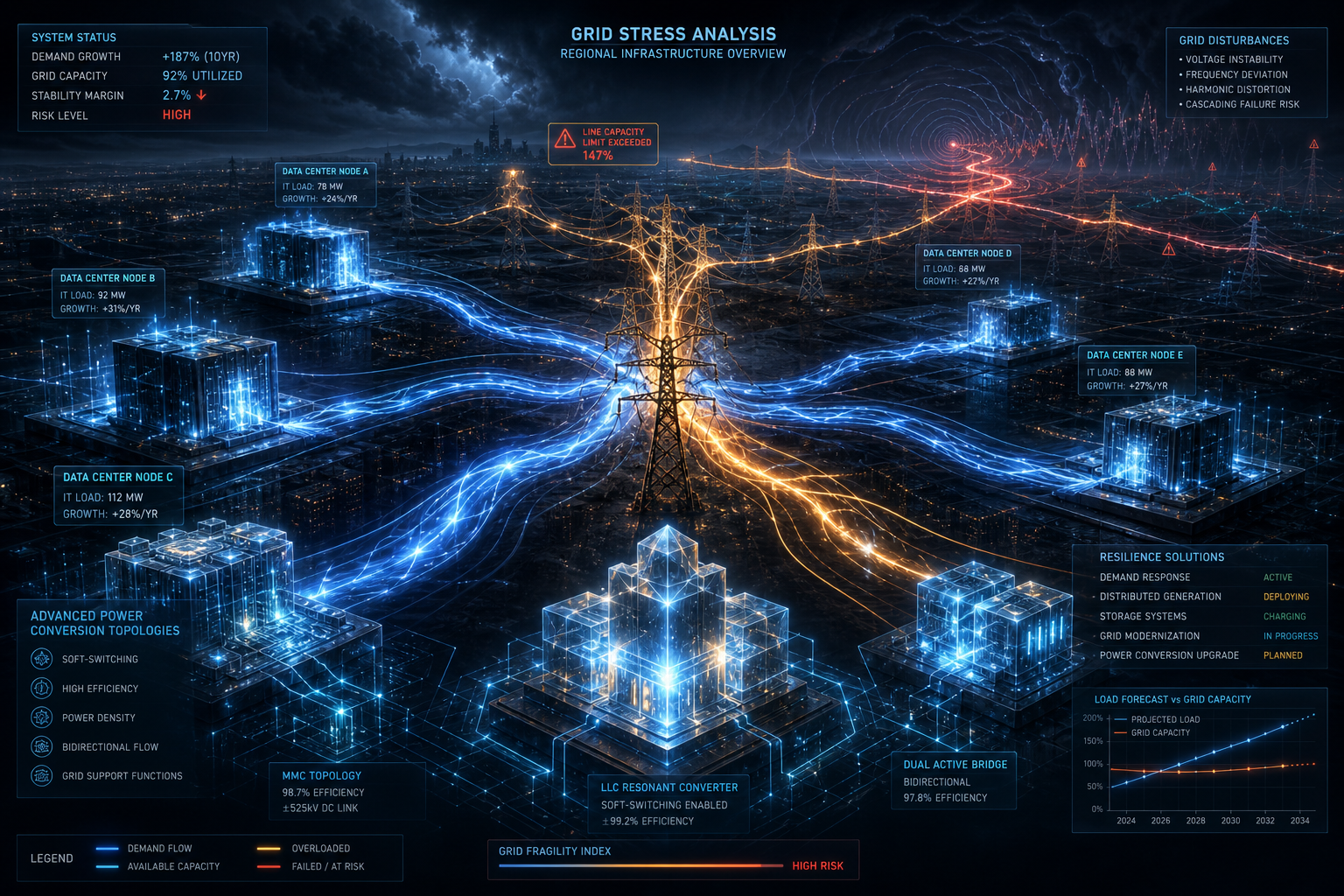
Hyperscale artificial intelligence deployment is driving data center power consumption beyond regional grid capacity, creating institutional risk across infrastructure operations, enterprise procurement, and regulatory frameworks. Data centers now represent 4–5% of total U.S. electricity consumption, with AI-capable facilities consuming 10–15% more annually than previous projections.
A July 2026 cascading power delivery failure affecting a regional transmission corridor exposed critical vulnerabilities in multi-facility coordination and standardized grid-integration protocols. The immediate risk window spans 2026–2028 as AI-driven demand compounds transmission stress without corresponding grid modernization or resilience standards.
Immediate actionable guidance: Security practitioners, infrastructure teams, and enterprise leadership require immediate grid-visibility assessments, standardized demand-response coordination mechanisms, and workforce capability development to mitigate cascading failure scenarios and maintain mission-critical service availability.
Key Finding: Data centers now represent 4–5% of total U.S. electricity consumption with 10–15% annual growth for hyperscale AI facilities, yet grid operators, facility architects, and procurement teams operate under fragmented regulatory frameworks lacking standardized integration protocols—creating cascading failure risk where a single regional transmission constraint can simultaneously affect multiple facilities and dependent enterprise ecosystems.
What Happened
In July 2026, a cascading power delivery failure across a regional transmission corridor exposed systemic vulnerabilities in multi-facility AI data center coordination. The incident triggered brownout conditions and forced sequential power-down sequences affecting AI inference workloads across multiple operators. Post-incident analysis identified two primary contributing factors: the absence of standardized grid communication protocols between hyperscale operators and regional transmission authorities, and insufficient visibility into coordinated demand-response mechanisms.
The underlying condition reflects accelerated infrastructure-demand mismatch. Global hyperscale AI data center deployment has expanded 40–60% beyond 2021–2023 projections. Individual AI-capable facilities now require 50–500 MW sustained capacity compared to 10–20 MW for conventional data centers, creating concentrated demand stress in three core U.S. regions: Northern California, the Virginia data corridor, and Texas.
A structural timing mismatch amplifies this vulnerability. Grid planning operates on 5–7 year development cycles; hyperscale facility deployment has compressed to 12–18 months. The Federal Energy Regulatory Commission interconnection queue currently imposes 18–36 month delays before facility connection approval, creating financing uncertainty and infrastructure-demand misalignment. Simultaneously, no enforceable standardized demand-response protocols exist between hyperscale operators and Independent System Operators (ISO) or Regional Transmission Organizations (RTO).
From a technical substrate perspective, current data center power supply architectures require 4–6 conversion stages from grid edge to point-of-load, each introducing efficiency losses and potential grid-interaction complications. The power architecture diversity across facilities creates operational fragmentation when multiple facilities coordinate on shared transmission networks.
Why It Matters
Infrastructure Operations and Resilience Teams
AI infrastructure resilience cannot be decoupled from regional grid reliability. Unplanned facility outages cascade across dependent customer applications; a single transmission constraint can force coordinated load-shedding across multiple facilities simultaneously. Without standardized failover protocols or coordinated load-balancing frameworks, operations teams lack visibility into grid-driven failure scenarios. This expanded operational scope requires new competencies, communication protocols, and incident response procedures that remain largely undefined across the industry. Most organizations treat grid integration as a peripheral operations concern; institutions that establish grid-coordination expertise will maintain service continuity where others face cascading outages.
Enterprise Procurement and Strategic Risk
Enterprise customers increasingly specify mission-critical AI workload service-level agreements requiring 99.99%+ availability. Data center operators cannot credibly guarantee these commitments without demonstrated grid-level coordination capability—a transparency gap that creates contractual and reputational risk. Procurement teams selecting facilities lack standardized resilience metrics to assess regional grid vulnerability, making facility risk assessment largely opaque. Capital allocation decisions now depend on grid-stress scenario analysis that procurement teams are typically ill-equipped to evaluate. Organizations that fail to incorporate grid-resilience factors into facility selection will incur unexpected availability disruptions and competitive disadvantage.
Workforce Development and Organizational Capability
Operations and infrastructure teams currently lack standardized training in grid-integration protocols and demand-response mechanics. Incident response procedures assume facility-level autonomy; grid-coordinated failure scenarios are absent from standard operational playbooks. The institutional transition from reactive troubleshooting to predictive grid-coordination and demand-forecasting remains incomplete. This knowledge gap creates vulnerability to cascading failures: when grid stress occurs, organizations lack the collective muscle to respond coherently. Establishing workforce capability in grid-coordination and demand-response participation is a strategic requirement for operational resilience through 2028.
Capital Planning and Regulatory Exposure
Grid interconnection costs now represent 10–20% of facility development budgets. Extended interconnection queue delays create financing uncertainty and project timeline risk. Investment in on-site generation and storage increases operational expense without guaranteed revenue offset. Stranded infrastructure risk emerges if regional transmission constraints force facility relocation or capacity reduction. Emerging state-level grid-resilience mandates lack harmonization across regional markets, creating compliance fragmentation and potential retroactive regulatory requirements that retrofit poorly onto existing facility architectures.
Long-Term Infrastructure Sustainability
A fundamental tension underlies this challenge: AI data center deployment is driven by economic demand, yet sustained hyperscale growth on regional grids dependent on fossil fuel generation conflicts with decarbonization mandates. Renewable energy procurement requirements reduce grid flexibility precisely when data centers require dynamic load-following capacity. Decarbonization-versus-resilience tradeoffs will shape infrastructure investment decisions and regulatory frameworks through 2030. Organizations that develop grid-responsive, renewable-compatible operational models will align with regulatory direction; those that rely on conventional generation and inflexible loads will face increasing regulatory pressure and sustainability costs.
Operational Implications
Immediate Phase (Weeks 1–12): Conduct a comprehensive facility-level grid coordination audit documenting current monitoring capabilities, communication channels, and automated response mechanisms. Designate a primary point-of-contact for grid-stress communication with ISO/RTO entities. Implement automated load-forecasting integrating facility AI workload demand prediction with regional grid stress indicators. Deploy real-time grid frequency and voltage monitoring at the facility interconnection point and establish automated alerting thresholds. Develop tiered load-shedding procedures distinguishing between curtailable workloads and non-curtailable loads. Establish workforce grid-integration literacy training ensuring operations, engineering, and leadership teams understand grid-stress mechanics and facility response procedures.
Medium-term Development (Months 6–18): Negotiate direct automated dispatch capability with the ISO/RTO for real-time demand-response signals. Commission a technical feasibility study evaluating grid-harmonizing power architecture upgrades including solid-state transformers and zero-voltage-switching topologies. Develop multi-facility load-balancing coordination agreements with other regional operators through a formal consortial framework. Quantify cost-benefit case for grid-scale energy storage deployment providing both backup capacity and grid-support service revenue opportunities. Implement automated demand-response capability aligned with regional ISO/RTO market structures and eliminate manual intervention delays in load-shedding decisions.
Strategic Phase (Months 18–36): Implement advanced bidirectional power flow capability enabling facilities to provide grid-support services including reactive power provision, frequency response, voltage support, and synthetic inertia generation. Update facility resilience profiles to explicitly document grid-support service capabilities. Establish systematic processes monitoring regional transmission planning and interconnection queue status to align capital expansion planning with grid constraints and timelines. Deploy consortial grid-coordination platform enabling real-time load-balancing across multiple regional facilities. Develop tiered SLA framework explicitly addressing grid-stress risk and renegotiate customer contracts reflecting facility grid-resilience capabilities.
Recommended Actions
Actions are organized by organizational security maturity. Baseline controls apply across all tiers and should be treated as immediate priorities regardless of organizational size.
* Immediate actions establishing grid visibility, coordination protocols, and workforce capability baseline.
- 1 - Grid Visibility Assessment and Gap Analysis: Establish baseline documentation of facility-level grid monitoring, communication channels, and coordination capability. Audit real-time monitoring (frequency, voltage, power factor at interconnection); communication channel inventory with ISO/RTO; tiered load-shedding capability assessment.
- 2 - Formal Grid-Coordination Protocol Establishment: Establish standing operational interfaces with regional ISO/RTO entities for demand-response participation and grid-stress coordination. Sign demand-response participation agreement; designate facility representative contacts; establish automated alert routing; schedule quarterly coordination reviews.
- 3 - Workforce Grid-Integration Literacy Program: Develop and deploy standardized training ensuring operations, engineering, and leadership teams understand grid mechanics, facility response procedures, and incident coordination. Deliver role-specific training with common core content; establish competency certification; conduct annual refresher training and incident response drills.
* Advanced operational systems and infrastructure enhancements improving grid coordination effectiveness.
- 1 - Automated Load-Forecasting and Grid-Stress Prediction System: Commission platform integrating facility AI workload demand forecasting with regional grid stress indicators enabling proactive demand management. Deploy real-time dashboard providing 24–48 hour facility demand forecast versus regional transmission capacity; integrate ISO/RTO grid stress indicators; implement automated alerting for predicted stress conditions.
- 2 - Demand-Response Architecture and Automation: Implement automated demand-response capability aligned with ISO/RTO market structures eliminating manual intervention delays. Formalize tiered load-shedding procedures; automate demand-response signal ingestion; execute load-shedding activation in <2 minutes; integrate revenue-tracking systems.
- 3 - Power Supply Architecture Evaluation and Upgrade Roadmap: Conduct technical feasibility study evaluating grid-harmonizing converter upgrades (solid-state transformers, zero-voltage-switching topologies, resonant dc-link systems). Assess current facility architecture; evaluate upgrade options; perform cost-benefit analysis; develop phased implementation roadmap.
* Strategic initiatives establishing multi-facility coordination, storage deployment, and customer alignment.
- 1 - Multi-Facility Grid-Coordination Consortium: Establish consortial platform enabling real-time load-balancing and coordinated demand-response across multiple regional facilities reducing peak transmission stress. Develop consortial governance structure; standardize inter-facility communication protocol; aggregate demand-response market participation; establish pricing and compensation mechanisms.
- 2 - Energy Storage Deployment Strategy: Quantify and implement cost-justified energy storage deployments balancing backup capacity provision against grid-support service revenue opportunities. Conduct storage cost-benefit analysis; develop prioritized deployment roadmap; update facility resilience profiles; establish operational procedures for storage coordination with demand-response.
- 3 - Enterprise SLA Harmonization and Customer Engagement: Develop tiered SLA framework explicitly addressing grid-stress risk and renegotiate customer contracts reflecting facility grid-resilience capabilities. Assess SLA gaps; create resilience-enhanced SLA tier options; update customer agreements; establish transparent reporting on grid-stress events and impact; conduct quarterly customer resilience reviews.
Closing Statement
The July 2026 power delivery failure represents a critical institutional inflection point. For the past decade, data center optimization has focused narrowly on facility-level efficiency and redundancy; grid-integration considerations remained peripheral to operational and procurement decision-making. The convergence of hyperscale AI deployment, regional transmission constraints, and fragmented regulatory frameworks has eliminated this analytical luxury.
Institutions now operate within a narrow strategic window—2026 through 2028—to establish grid-coordination protocols, upgrade infrastructure for monitoring and automation, and develop workforce capability before cascading failures transition from exceptional to routine. This is not fundamentally a technology challenge. Technical solutions exist: modern power converter architectures, automation frameworks, and demand-response mechanisms are either mature or near-deployment. The core challenge is institutional coordination—standardization across fragmented operators, regulatory harmonization, and distributed capital investment in resilience infrastructure.
Organizations that establish grid-coordination competencies, formalize stakeholder protocols, and invest in visibility and automation tools will emerge as trusted partners capable of maintaining service availability in a grid-constrained environment. Those that treat grid integration as a peripheral operations concern will face recurring service disruptions, escalating regulatory exposure, and competitive disadvantage relative to more resilient competitors.