Modernizing Veteran Services: Department of Veterans Affairs Awards Salesforce $1.6B AI Agent Contract
Executive Summary
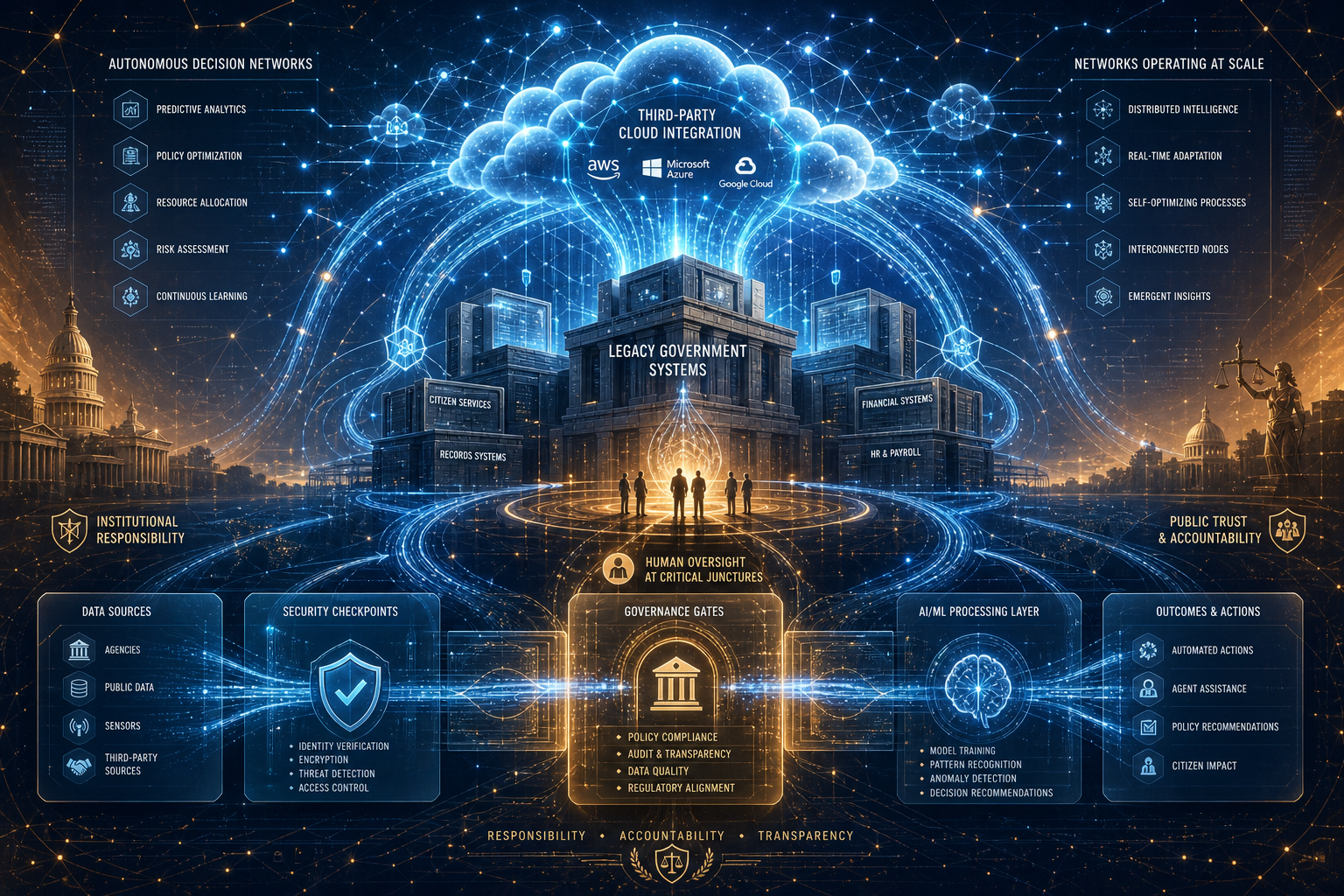
On July 24, 2026, the Department of Veterans Affairs awarded a $1.6 billion contract to Salesforce to deploy AI agents across veteran-facing services, representing the largest federal commitment to autonomous service delivery infrastructure to date. The initiative promises operational efficiency gains in benefits processing, claims management, and care coordination while introducing cybersecurity, data governance, workforce adaptation, and accountability challenges that extend beyond traditional IT risk frameworks.
The deployment tests federal capacity to implement mission-critical AI systems at scale while maintaining service reliability, institutional transparency, and public trust. This represents a critical institutional juncture in how the federal government approaches modernization, vendor relationships, and organizational change at scale.
Key Finding: The VA's AI agent deployment contract establishes federally-operated autonomous service infrastructure managing veteran benefits and care at enterprise scale, creating a distinct category of mission-critical AI system subject to heightened security, transparency, and performance accountability requirements not yet fully codified in federal acquisition or operational security standards.
What Happened
On July 24, 2026, the Department of Veterans Affairs awarded a $1.6 billion contract to Salesforce to deploy the MissionForce AI agent platform across the agency's veteran-facing service operations. The contract represents a structural commitment to autonomous service delivery systems managing benefits processing, claims adjudication, care coordination, and customer service functions at federal scale. Salesforce's MissionForce platform consists of AI agents—autonomous software systems trained to perform specific tasks with minimal human intervention—integrated with existing VA infrastructure including the VistA health records system, eBenefits portal, and VA.gov digital ecosystem.
The contract scope encompasses deployment across multiple VA regional offices and service lines, with phased implementation expected over 24 to 36 months. According to Salesforce's official announcement, the platform will automate routine determinations, escalate complex cases to human reviewers, and provide real-time decision support to VA employees processing veteran benefit applications.
Implementation timing places initial deployment within the current fiscal year, with full operational scope expected by mid-2028. The underlying organizational imperative reflects broader federal modernization objectives articulated in Executive Order 14110 on safe, secure, and trustworthy AI development and deployment.
The veteran stakeholder perspective, reflected in initial public statements from veteran service organizations, acknowledges modernization necessity while emphasizing concerns about service continuity, appeal procedures for AI-generated determinations, and transparency regarding how AI agents make benefits decisions.
Why It Matters
VA Leadership and Mission Continuity
The contract represents an inflection point in how the VA operationalizes its core mission: delivering timely, accurate benefits and healthcare services to the veteran population. Mission-critical dependency on AI agent systems introduces a novel category of operational risk. Systematic AI failures cascade directly to millions of veteran beneficiaries. The deployment concentrates operational dependency on a single third-party vendor for infrastructure managing mission-critical processes, introducing strategic vulnerability requiring explicit mitigation planning and contractual safeguards.
Cybersecurity and Data Governance
The contract integrates third-party cloud-hosted AI services with sensitive veteran personal data—including Social Security numbers, medical records, disability ratings, financial information, and benefit entitlements. The attack surface expands substantially with multiple exploitation vectors. Veteran health information qualifies as protected health information (PHI) under HIPAA, introducing compliance obligations. AI training data requirements create governance questions about dataset sources, validation, and potential bias in high-stakes determinations.
Workforce and Organizational Adaptation
The VA employs approximately 450,000 personnel whose roles and workflows are directly affected by AI agent deployment. AI agent deployment directly affects roles in benefits processing, claims adjudication, and customer service functions. This organizational transformation occurs within a federal workforce context where employee retention, morale, and engagement are ongoing challenges. The transformation tests organizational capacity for learning and adaptation, requiring training, leadership alignment, and change management infrastructure.
Accountability, Transparency, and Governance
The deployment exposes gaps in federal governance frameworks for mission-critical AI systems. When AI agents deny veteran disability claims or determine ineligibility, what recourse exists? Federal law assumes human decision-makers who articulate reasoning and provide explanations. Federal governance does not yet codify minimum standards for transparency in government-deployed AI systems. These governance gaps create situations where mission-critical AI systems operate without standardized transparency requirements or oversight mechanisms proportional to their impact.
Operational Implications
IT Security Operations and Attack Surface Expansion: The VA's IT security operations expand significantly with cloud-hosted AI agent integration. Third-party cloud infrastructure introduces new attack vectors including direct attacks on Salesforce systems, exploitation of APIs connecting VA legacy systems to cloud services, supply chain attacks, and insider threats. The VA's security operations center must develop monitoring and detection capabilities specifically designed for cloud-hosted AI systems. Incident response procedures must distinguish between security incidents and AI agent operational failures requiring different investigative approaches and remediation timelines.
Data Protection and Compliance Coordination: HIPAA compliance obligations for veteran health data require explicit governance with Salesforce. Business Associate Agreements must specify how veteran health information is handled and enforced through ongoing monitoring. Federal contractor information handling requirements apply if systems contain classified or controlled unclassified information. Records management requirements mandate that AI agent determinations create audit trails documenting the determination, data inputs, decision rationale, and timestamp. FOIA compliance for AI decision-making introduces novel challenges regarding adequate explanation of AI reasoning.
Operational Resilience and Vendor Dependency: The $1.6 billion investment in Salesforce MissionForce creates substantial vendor lock-in risk affecting the VA's capacity to process benefits if services degrade or become unavailable. Mitigating this risk requires explicit contractual provisions and operational planning including maintenance of manual processing capacity, rollback procedures, and defined recovery objectives. Long-term resilience depends on contractual provisions establishing transition assistance requirements if the VA exits the Salesforce relationship, including data export in standardized formats and knowledge transfer.
Change Management and Organizational Learning: VA employees require training on AI agent capabilities and limitations, escalation procedures, and their evolving roles within AI-augmented workflows. Quality assurance processes for AI-generated outputs require approaches distinct from traditional software testing, involving monitoring real-time performance, identifying systematic errors or bias patterns, and assessing accuracy across different veteran populations. Feedback mechanisms must systematically capture instances where AI determinations were incorrect or where system behavior diverged from expectations.
Recommended Actions
Actions are organized by organizational security maturity. Baseline controls apply across all tiers and should be treated as immediate priorities regardless of organizational size.
* Strategic-level decisions establishing governance frameworks, transparency requirements, and institutional accountability.
- 1 - Establish independent AI system auditing capability separate from vendor oversight before full deployment, contracting with third parties not affiliated with Salesforce for quarterly security assessments and reliability evaluations using SOC 2 Type II standards.
- 2 - Codify transparent decision-making requirements in vendor contract amendments before AI agents make live benefits determinations, specifying requirements for documented explanations of AI determinations in formats suitable for veteran and Congressional review.
- 3 - Develop veteran-facing documentation explaining how AI agents work, what decisions they make, what human review processes apply, and how veterans can appeal determinations, available in multiple languages and accessible formats.
- 4 - Create structured appeal processes specifically designed for AI-generated determinations that distinguish from traditional appeals by acknowledging veterans may challenge both the AI's factual determinations and appropriateness of automation for specific decisions.
- 5 - Establish quarterly public reporting requirements for AI system performance including accuracy rates by claim category, denial rates by claim type, percentage of determinations overturned on appeal, processing time comparisons, and comparative fairness metrics across veteran populations.
* Organizations with advanced security operations and specialized cloud security monitoring capabilities.
- 1 - Conduct comprehensive threat modeling specific to cloud-hosted AI agent integration architecture before pilot deployment, mapping all data flows between VA legacy systems and Salesforce infrastructure and assessing risks from insider threats, supply chain compromise, and direct attacks.
- 2 - Implement real-time monitoring for AI model behavior anomalies separate from traditional SIEM systems with automated alerting when AI agents exceed confidence thresholds, show unusual decision-making patterns, or process data triggering defined security rules.
- 3 - Establish data loss prevention (DLP) controls specific to veteran PII and health data flowing to third-party systems, preventing exfiltration of unencrypted PII and blocking transfers to unapproved locations with audit trails for all data access.
- 4 - Define and document API security standards for legacy system integrations, including authentication requirements (mutual TLS, API keys, OAuth 2.0), encryption in transit and at rest, rate limiting, and audit logging for all API calls.
- 5 - Conduct tabletop exercises modeling scenarios where AI agents make systematic erroneous determinations, testing response procedures, decision-making authority, communication protocols, and remediation timelines with inclusion of Congressional liaison and veteran advocacy organizations.
* Organizations with standard HR operations and workforce management protocols.
- 1 - Develop workforce transition plans identifying specific roles affected by automation, timeline for transitions, and career pathways for affected employees, making assessments transparent to employees and union representatives early in deployment planning.
- 2 - Establish retraining programs for employees transitioning to AI oversight, quality assurance, and exception handling roles, providing training in AI system principles, data analysis, decision review procedures, and escalation judgment.
- 3 - Create career pathway documentation addressing long-term employment security and advancement opportunities in AI-augmented workflows with clear criteria for promotion, specialty certifications, and career progression expectations.
- 4 - Establish labor-management consultation protocols for each implementation phase including regular meetings to discuss deployment challenges, workforce impacts, and employee concerns with formal mechanisms for union input.
- 5 - Develop performance metrics for human reviewers of AI decisions that recognize careful review value without penalizing identification of AI errors or override decisions, rebalancing metrics from processing speed emphasis toward accuracy and fairness.
* Legislative and oversight-level governance establishing standards, requirements, and accountability mechanisms.
- 1 - Mandate quarterly public reporting on AI agent performance metrics with accessibility for oversight committees, veteran advocacy organizations, and public stakeholders using standardized formats allowing performance comparison.
- 2 - Establish legislation requiring federal agencies to publish AI decision-making documentation including model architecture summaries, training data sources and characteristics, performance benchmarking against human decision-makers, and identified limitations or bias concerns.
- 3 - Create independent evaluation panel authority with power to assess federally-deployed AI systems before full operational deployment and conduct follow-up evaluations during production operation with authority to recommend deployment delays or modifications.
- 4 - Define minimum standards for AI transparency in federal benefits administration including requirements for explaining determinations to beneficiaries, establishing appeal procedures, documenting training data and model performance, and maintaining audit trails.
- 5 - Establish veteran advocacy group consultation requirements in federal procurement for AI systems affecting veteran benefits or services, creating formal mechanisms for veteran organizations to provide input during design, testing, and deployment phases.
* Operational-level implementation addressing employee training, communication, and change management.
- 1 - Develop training curriculum for VA employees addressing AI system principles, limitations, proper escalation procedures, ethical considerations in human-AI collaboration, and security responsibilities in cloud-hosted infrastructure environments at multiple proficiency levels.
- 2 - Establish internal communication protocols addressing employee concerns about job security, organizational change, and evolving roles, creating regular forums where employees can ask questions and provide feedback on deployment challenges.
- 3 - Create champion networks within VA regional offices composed of employees understanding both AI systems and local operations, empowering them to guide implementation, troubleshoot local challenges, provide peer training, and escalate systemic issues.
- 4 - Develop cybersecurity awareness content specific to third-party cloud service dependencies including best practices for protecting login credentials, recognizing social engineering, and reporting suspicious activity to security teams.
- 5 - Establish psychological resilience and change management support for the workforce during transition including access to employee assistance programs, leadership coaching for managers, and cultural messaging acknowledging concerns while emphasizing institutional commitment.
Closing Statement
The VA's $1.6 billion commitment to AI agent deployment represents a critical institutional juncture in how the federal government approaches modernization, vendor relationships, and organizational change at scale. The contract itself is not the inflection point; the institutional choices made during deployment will determine whether this deployment serves as a model for successful federal AI integration or as a cautionary case study in technology implementation risk.
The most significant institutional challenge is not technological but organizational: managing simultaneous demands of operational modernization, cybersecurity vigilance, workforce adaptation, Congressional accountability, and veteran trust. These requirements do not compete; they reinforce each other. Transparency builds public confidence; comprehensive security prevents incidents that undermine trust; effective workforce management ensures systems operate as designed.
The VA's institutional resilience depends on recognizing that identifying emerging risks is inseparable from building institutional capacity to manage them. The weeks ahead—before full deployment commences—represent the critical window for establishing governance structures, security protocols, and organizational practices that will determine whether this modernization strengthens or strains the institution's ability to serve veterans with integrity and reliability.