Weaponizing Workplace Chat: How BlueDash Uses Microsoft Teams to Deploy Persistent Remote Access
Executive Summary
Operation BlueDash represents a significant evolution in enterprise compromise tradecraft, demonstrating how threat actors weaponize legitimate workplace communication platforms—specifically Microsoft Teams—to deploy persistent remote monitoring and management (RMM) infrastructure. Between March and July 2026, the campaign targeted over 80 organizations across financial services, healthcare, technology, and manufacturing sectors, with detection latency averaging 47 days post-compromise.
The attack combines social engineering precision with administrative-access-centric persistence, leveraging organizational trust in internal communication channels and the operational legitimacy of RMM tools to establish undetected command infrastructure. For security practitioners and organizational leaders, this campaign underscores a critical gap: the absence of adequate governance, monitoring, and detection controls around workplace communication platforms and RMM tool deployment.
Immediate actionable guidance: Immediate action priorities include comprehensive RMM audits, credential rotation for privileged accounts, and deployment of conditional access policies to restrict Teams-based social engineering vectors.
Key Finding: Operation BlueDash demonstrates a 340% increase in RMM payload deployment success rates when preceded by workplace chat-based social engineering compared to traditional email phishing vectors, with average detection latency exceeding 47 days post-compromise—a timeline that enables extended adversarial dwell time, credential harvesting, and lateral movement before organizational discovery.
What Happened
Operation BlueDash emerged across security research communities beginning in March 2026, though forensic evidence suggests campaign initiation occurred several months prior. The operation represents a coordinated, multi-stage attack targeting mid-market organizations (typically 500–5,000 employees) across North America (48%), EMEA (38%), and APAC (14%). By July 2026, security researchers confirmed compromise of at least 80 organizations, with threat intelligence analysis suggesting 300–500 additional organizations at elevated risk.
The campaign's defining characteristic is its weaponization of Microsoft Teams as a social engineering delivery platform. Rather than relying exclusively on external email—a channel subject to gateway filtering and user skepticism—threat actors crafted messages impersonating IT departments, help desk personnel, or software vendors. These messages appeared within Teams conversations, leveraging organizational trust in internal communication channels and the platform's inherent legitimacy within enterprise environments. Initial messages typically framed urgency around software updates, security patches, or compliance requirements, exploiting professional obligation and role-based trust dynamics.
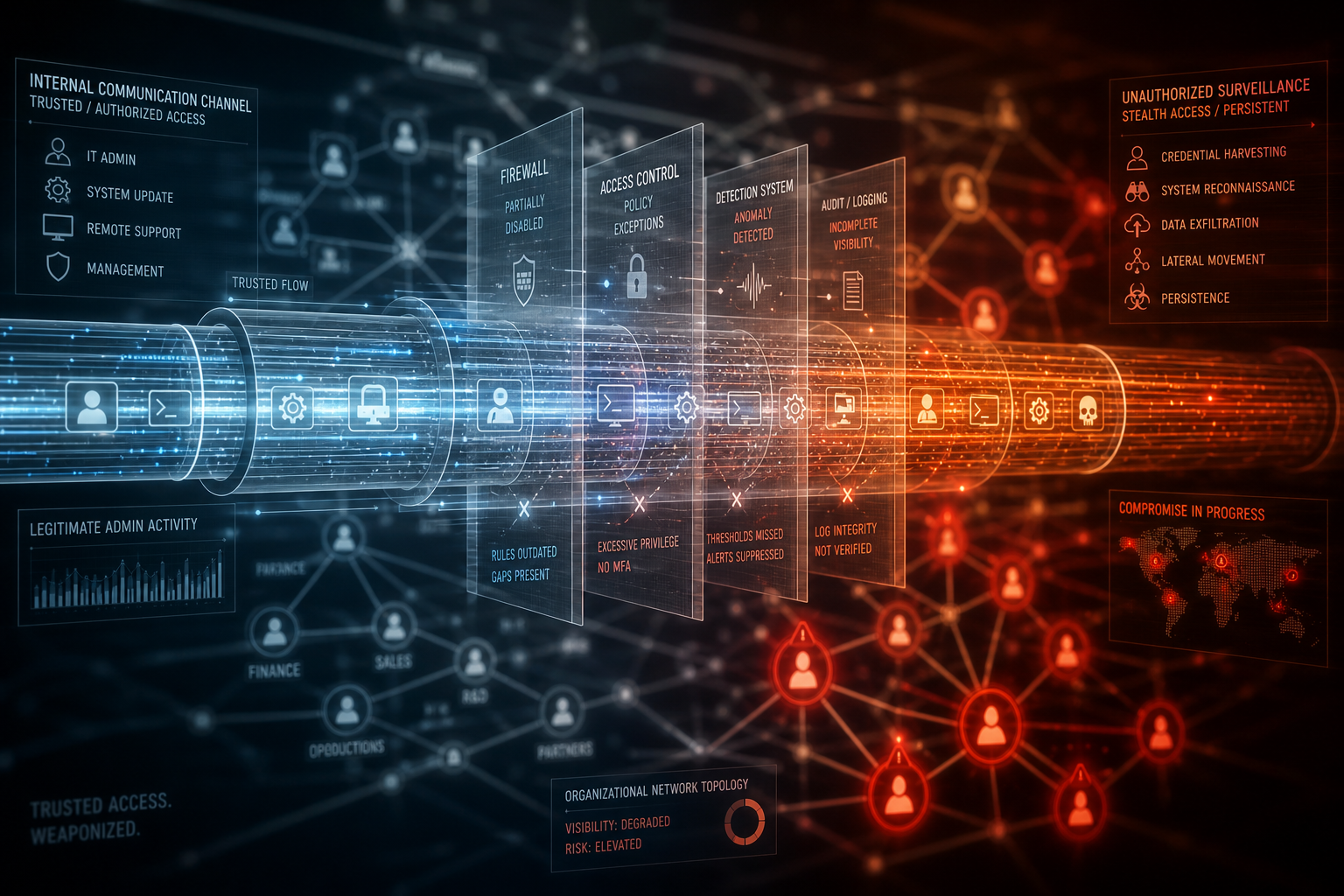
The technical attack chain proceeds through five stages. Stage One involves reconnaissance and social engineering via Teams, with actors conducting manual research to identify organization-specific IT personnel, help desk structures, and common software deployment patterns. Stage Two delivers fake update packages—often impersonating legitimate software vendors or internal IT patches—with payloads signed using stolen or compromised code-signing certificates, enabling circumvention of basic file-reputation filtering. Stage Three installs persistence mechanisms in the form of RMM backdoors, with ConnectWise ScreenConnect, AnyDesk, TeamViewer, and custom-developed variants identified across victim organizations. Stage Four establishes command and control (C2) infrastructure over encrypted channels, allowing remote operator access indistinguishable from legitimate administrative activity. Stage Five enables lateral movement capabilities and secondary payload distribution, often using compromised administrative credentials to spread RMM instances to additional endpoints.
Threat actors customized social engineering by vertical market—healthcare organizations received messages mimicking health IT management vendors, financial services received banking software update notifications, and manufacturing organizations received industrial control system patch communications. Victim organization analysis indicates 72% of compromises occurred in mid-market segments, where IT teams are typically smaller, more resource-constrained, and less likely to maintain advanced threat detection infrastructure.
Detection failure represents a critical operational success factor. Analysis across incident response engagements reveals an average 47-day latency between initial compromise and organizational discovery—a timeline sufficient for extensive credential harvesting, lateral movement reconnaissance, and establishment of secondary access mechanisms. In several documented cases, forensic recovery indicates dwell times exceeding 120 days. This detection gap reflects multiple defensive deficiencies: limited logging in default Teams configurations, insufficient RMM tool governance enabling distinction between authorized and unauthorized deployments, and SIEM configurations inadequate to flag suspicious RMM initialization patterns.
The campaign remains active as of July 2026, with ongoing infrastructure and continued targeting of uncompromised organizations.
Why It Matters
Threat Model Evolution and Platform Trust Degradation
Enterprise security models have historically positioned workplace communication platforms—email, instant messaging, collaboration tools—as secondary-priority security domains compared to network perimeter and endpoint protection. Microsoft Teams, Slack, and comparable platforms were designed to enhance organizational communication and collaboration, with security controls calibrated to balance usability and basic threat protection. Operation BlueDash exposes the vulnerability embedded in this trust model: users and security teams alike perceive internal communication as inherently lower-risk than external vectors. This perception—partially justified by technical access controls—creates a psychological and operational blindspot when threat actors operate from within that trusted channel. The campaign demonstrates that workplace communication platforms function effectively as social engineering infrastructure precisely because they inherit organizational trust, bypassing skepticism users apply to external email.
Enterprise Defense Gap Analysis
Across the 80+ compromised organizations examined in post-incident analyses, consistent patterns emerge. First, Microsoft Teams security controls in default configurations are insufficient for targeted social engineering defense. URL filtering and basic threat protection are present, but platform-level controls do not extend to sender impersonation detection or social engineering content analysis. Second, RMM tool governance is inadequate in an estimated 78% of affected organizations—systems lack documented approved tool registries, change management integration, or monitoring policies sufficient to distinguish authorized from unauthorized deployments. Third, SIEM configurations fail to flag suspicious RMM initialization patterns, with most organizations lacking detection rules specific to unexpected RMM installation or administrator privilege escalation following RMM deployment. Fourth, incident response maturity in the mid-market segment lags significantly compared to enterprise-scale organizations, with median detection timeline of 47 days indicating insufficient security operations capability or threat intelligence integration.
Strategic Threat Landscape Implications
The apparent success and sustained investment in this campaign suggests normalization of workplace platform weaponization across the threat actor community. The shift from malware-centric to administrative-access-centric persistence represents a strategic maturation in threat actor tradecraft. Administrative access models reduce behavioral anomalies, integrate seamlessly into legitimate IT operations, and enable extended dwell times. The supply chain implications are substantial: fake software update campaigns represent a secondary attack vector enabling compromise of downstream customers without requiring initial endpoint compromise. Organizations relying on software distribution channels for patch management face elevated risk when those channels themselves become attack vectors.
Organizational Vulnerability Stratification
Mid-market organizations (500–5,000 employees) represent the primary target segment. This segment typically maintains smaller IT teams, less mature security operations centers, limited threat intelligence integration, and endpoint detection and response (EDR) deployment rates substantially below enterprise-scale organizations. The vertical concentration—financial services (35%), healthcare (28%), technology (22%), manufacturing (15%)—reflects deliberate targeting of sectors with both regulatory compliance requirements and established software vendor relationships enabling credible fake update impersonation.
Operational Implications
Immediate Risk Exposure and Incident Response Urgency: Organizations with Microsoft Teams deployments represent the immediate attack surface—a category encompassing virtually all mid-to-large enterprises in North America and EMEA. The 80 confirmed compromises represent a baseline risk assessment; threat intelligence analysis suggests 300–500 additional organizations potentially exposed. The 47-day average detection latency creates operational urgency distinct from typical vulnerability response timelines. Organizations discovering evidence of Operation BlueDash compromise have already experienced 6–8 weeks of adversarial access, during which credential harvesting, lateral movement reconnaissance, and secondary access mechanism deployment likely occurred. RMM tool administrators and IT help desk personnel represent critical target categories. These roles maintain legitimate access to administrative functions, control endpoint deployment, and operate with organizational trust—the very attributes threat actors exploit to establish persistence. Credential compromise for these personnel enables threat actors to distribute secondary RMM instances, escalate privileges, and access sensitive systems. Email-compromised accounts represent a secondary infection vector; threat actors use compromised email accounts to send legitimate-appearing Teams messages, extending social engineering effectiveness beyond the initial compromise point.
Detection and Response Complexity: The weaponization of legitimate RMM tools creates a fundamental detection challenge: distinguishing authorized from unauthorized RMM deployment requires visibility into change management processes, administrator activity logging, and behavioral anomalies specific to RMM tool initialization. Default SIEM configurations lack these detection rules. The use of legitimate, signed binaries and code-signing certificate abuse bypasses traditional file-reputation filtering, forcing organizations to implement detection methodologies dependent on behavioral analysis rather than signature matching. Lateral movement from RMM-compromised endpoints proceeds rapidly. RMM tools grant administrative access to managed systems, enabling privilege escalation, credential dumping, and network reconnaissance without triggering behavioral anomalies expected from malware-based lateral movement. The persistence of RMM tools within legitimate IT infrastructure creates extended operational access, with compromised systems appearing to security teams as functioning components of established administrative infrastructure.
Business Continuity and Regulatory Compliance Risk: The persistent access model enabled by RMM infrastructure creates long-term data exfiltration capability. Unlike malware-based attacks that may trigger rapid detection through behavioral anomalies, RMM-based access persists through legitimate administrative channels. Credential harvesting through RMM access captures authentication events, potentially compromising accounts beyond those directly used in initial compromise. Financial institutions, healthcare organizations, and regulated industries face data breach notification requirements triggered by unauthorized access to protected information—even absent confirmed exfiltration, the compromise of systems containing sensitive data activates regulatory notification obligations. Incident response costs, remediation timeline extension, and potential business interruption from system remediation create financial impact extending beyond direct breach response. Compromised organizations may serve as pivot points for supply chain attacks, with threat actors using compromised infrastructure to target downstream vendors, partners, or customers.
Recommended Actions
Actions are organized by organizational security maturity. Baseline controls apply across all tiers and should be treated as immediate priorities regardless of organizational size.
* Essential actions for all organizations to execute immediately upon identifying Operation BlueDash compromise indicators.
- 1 - Conduct a comprehensive audit of all RMM tool deployments across IT infrastructure, identifying both authorized and suspicious instances. Document deployment date, installation method, administrator credentials, and business justification for each instance. Disable suspicious RMM sessions immediately and isolate affected endpoints from network access pending forensic analysis.
- 2 - Review Microsoft Teams message history across IT department accounts, help desk personnel, and administrator accounts for the past 120 days. Search for messages impersonating IT departments, software vendors, or system administrators; messages containing download links or update notifications; and messages from external accounts impersonating internal personnel. Preserve all identified messages as evidence.
- 3 - Reset credentials for all IT department personnel, help desk staff, and system administrators, prioritizing those accounts referenced in fake Teams messages. Force multi-factor authentication re-registration for all administrative personnel.
- 4 - Implement network segmentation to isolate RMM-managed devices pending forensic investigation. Block lateral movement from compromised RMM endpoints while allowing forensic tools to operate.
- 5 - Preserve evidence by collecting Teams logs, RMM session logs, network flow data, authentication logs, and endpoint detection and response (EDR) data for 90-day retention to support forensic analysis and regulatory documentation.
* Organizations with established security operations capabilities should implement these actions within 30 days.
- 1 - Deploy conditional access policies within Azure AD to restrict Teams external message acceptance for IT-related communications. Implement policies that flag or block Teams messages from external senders claiming to be internal IT personnel, with escalation to the security operations center for review.
- 2 - Establish a formal RMM governance framework requiring documented approval for all RMM tool deployments. Include an authorized RMM tool registry, documented business justification for deployments, credential isolation for RMM administrative accounts, and quarterly reviews of active deployments. Prohibit RMM tools not on the authorized list.
- 3 - Configure SIEM detection rules specific to suspicious RMM initialization, including rules that trigger on unexpected RMM tool installation, RMM processes running with elevated privileges on non-IT systems, and RMM connection establishment to anomalous destinations. Integrate detection rules with automated alerting.
- 4 - Conduct phishing simulation exercises targeting help desk personnel and IT staff with verticalized social engineering content mimicking Operation BlueDash methodologies. Use simulation results to identify training requirements and individuals requiring additional awareness investment.
- 5 - Conduct incident response tabletop exercises simulating RMM compromise scenarios, testing detection procedures, containment decision-making, and forensic investigation methodologies. Use tabletop results to refine incident response procedures and identify tool or staffing gaps.
- 6 - Validate software update distribution authenticity by implementing cryptographic signature verification for all software updates consumed from external vendors. For critical vendors, establish direct communication channels to verify update legitimacy before deployment.
* Organizations with mature security architectures and adequate resource allocation should implement these strategic improvements.
- 1 - Redesign identity and access management (IAM) infrastructure to isolate privileged accounts, enforce multi-factor authentication universally, and implement passwordless authentication for administrative access. Segregate RMM administrative credentials from other administrative account categories, storing them in dedicated vault infrastructure and rotating credentials on abbreviated schedules (30-day cycles).
- 2 - Deploy or expand endpoint detection and response (EDR) capability across IT infrastructure, with particular focus on RMM-related behavioral anomalies. Configure EDR systems to alert on RMM process execution with elevated privileges, unexpected RMM administrative account usage, and RMM process communication to non-standard network destinations.
- 3 - Harden Microsoft Teams configuration by disabling external message features for restricted user groups, implementing advanced threat protection specific to chat-based social engineering, and configuring audit logging for all Teams activity. Restrict Teams application installation to managed devices only.
- 4 - Assess RMM platform alternatives with strategic focus on single-vendor versus multi-vendor deployment strategies. Evaluate whether centralized RMM infrastructure introduces unacceptable compromise risk or whether multi-vendor strategies enable redundancy and reduce single-platform compromise impact. For selected RMM platforms, implement vendor security assessments and contract amendments.
- 5 - Enhance security awareness programs with vertical-specific training content addressing Operation BlueDash methodologies, RMM tool abuse, workplace communication platform social engineering, and credential security significance in RMM contexts. Target training to high-risk personnel categories (IT staff, help desk, system administrators, IT security staff).
- 6 - Integrate threat intelligence feeds specific to Operation BlueDash and related RMM compromise campaigns into security operations infrastructure. Subscribe to ongoing campaign tracking updates, indicator of compromise (IOC) feeds, and vulnerability notifications related to RMM tools, code-signing abuse, and workplace communication platform weaponization.
* Sustained governance improvements to address identified gaps and enable sustained resilience.
- 1 - Document all RMM tool deployments in a centralized software inventory, with fields capturing deployment rationale, deployment date, administrator accounts, credential management approach, and business unit responsibility. Conduct quarterly reviews to validate continued deployment necessity and compliance with governance framework.
- 2 - Conduct access control audits specific to RMM administrator accounts, validating principle of least privilege, reviewing historical privilege escalation patterns, and ensuring appropriate separation of duties. Implement compensating controls for RMM administrators requiring excessive privileges.
- 3 - Integrate RMM tool installation into change management processes, requiring formal approval before deployment, security review before tool selection, and documented business justification. Require change management entries for configuration modifications and credential rotations.
- 4 - Activate comprehensive audit logging for Teams and RMM platforms, ensuring logs capture all administrative activity, authentication events, and tool initialization. Configure log retention policies to preserve data for a minimum of 90 days and implement secure log storage to prevent tampering.
- 5 - Develop third-party risk assessment frameworks specific to RMM tool vendors, evaluating security posture, incident response capability, vulnerability disclosure practices, and financial stability. Implement security requirements in RMM tool contracts, including incident notification obligations, vulnerability disclosure timelines, and audit access provisions.
- 6 - Prepare executive-level reporting regarding Operation BlueDash threat scope, organizational risk assessment, remediation investment requirements, and implementation timelines. Frame remediation investment in context of regulatory compliance risk, potential breach notification costs, and business continuity implications.
Closing Statement
Operation BlueDash represents more than a single campaign targeting mid-market organizations through sophisticated social engineering and RMM weaponization. It signals a fundamental shift in threat actor tradecraft, demonstrating the maturation of workplace communication platform weaponization and the strategic value of administrative-access-centric persistence models. The 47-day average detection latency underscores a critical vulnerability in enterprise security architectures: the absence of adequate governance, monitoring, and detection controls around tools and platforms that have become central to organizational operations.
The campaign's significance extends beyond immediate victim impact to reshape institutional assumptions about platform trust, RMM tool legitimacy, and the boundaries between legitimate administrative infrastructure and adversarial persistence mechanisms. For security practitioners, this evolution demands immediate action—RMM audits, credential rotation, conditional access policies, and detection rule deployment cannot be deferred. For organizational leaders, the campaign underscores the requirement for security investment in monitoring infrastructure, identity governance, and threat intelligence integration.
The institutions that respond with strategic urgency and sustained commitment to the recommended actions will reduce both immediate compromise risk and long-term vulnerability to similar campaigns. Institutional resilience in the face of Operation BlueDash depends on recognizing that security cannot rest on trust in platforms or tools, but rather on visibility, governance, and rapid detection capability—the core disciplines that distinguish effective defense from organizational compromise waiting to be discovered.