
Severing the Attack Vector: Building Physical Isolation and Resilience into Critical Infrastructure Networks
Executive Summary
The U.S. Intelligence Community, Department of Homeland Security, and allied partners have released the CI-Fortify framework in response to escalating threat actor targeting of critical infrastructure operational technology (OT) systems. The framework mandates physical and logical isolation of vital control systems governing energy grids, water treatment facilities, transportation networks, and communications infrastructure.
Physical isolation without simultaneous operational redesign creates secondary failure modes that may be equivalent to the attacks it prevents. This article examines the CI-Fortify mandate, its implementation pathways, and the organizational constraints critical infrastructure operators face in balancing security isolation with operational continuity. Decision-makers should prioritize strategic assessment and cross-functional risk positioning before capital allocation and implementation planning begins.
Key Finding: Physical isolation of critical infrastructure control systems requires simultaneous architectural redesign of both network topology and operational workflow; government guidance now establishes that isolation without operational continuity planning creates secondary failure modes equivalent to the attacks it prevents.
What Happened
On July 28, 2026, the FBI's Internet Crime Complaint Center (IC3), in coordination with the Cybersecurity and Infrastructure Security Agency (CISA) and the Department of Homeland Security, released a Cyber Security Alert detailing escalating threat actor activity targeting critical infrastructure operational technology environments. The alert documented sophisticated, coordinated attacks exploiting the convergence of legacy industrial control systems with modern IT network architectures—a vulnerability pathway that has become the primary targeting vector for state-sponsored and criminal threat actors seeking to compromise supervisory control and data acquisition (SCADA) systems, distributed control systems (DCS), and programmable logic controllers (PLC) that govern critical national infrastructure.
The immediate catalyst for this escalation was a series of attempted intrusions into energy sector control systems coupled with demonstrated capability improvements in supply chain targeting. Threat actors have begun attempting to insert compromised hardware and firmware into industrial control system components before delivery to critical infrastructure operators. The IC3 alert characterized these campaigns as part of an evolving threat landscape in which adversaries have shifted tactics away from traditional network perimeter attacks toward hybrid approaches combining network-based initial access, vendor relationship exploitation, and insider threat vectors.
In response, CISA, the Australian Cyber Security Centre (ACSC), and partner agencies released the CI-Fortify framework—an integrated set of technical specifications, operational continuity requirements, and institutional guidance mandating physical isolation of critical OT systems from connected IT networks. The framework departs from earlier guidance by emphasizing that isolation architecture must be designed and implemented alongside operational workflow redesign, monitoring infrastructure deployment, and emergency access procedures.
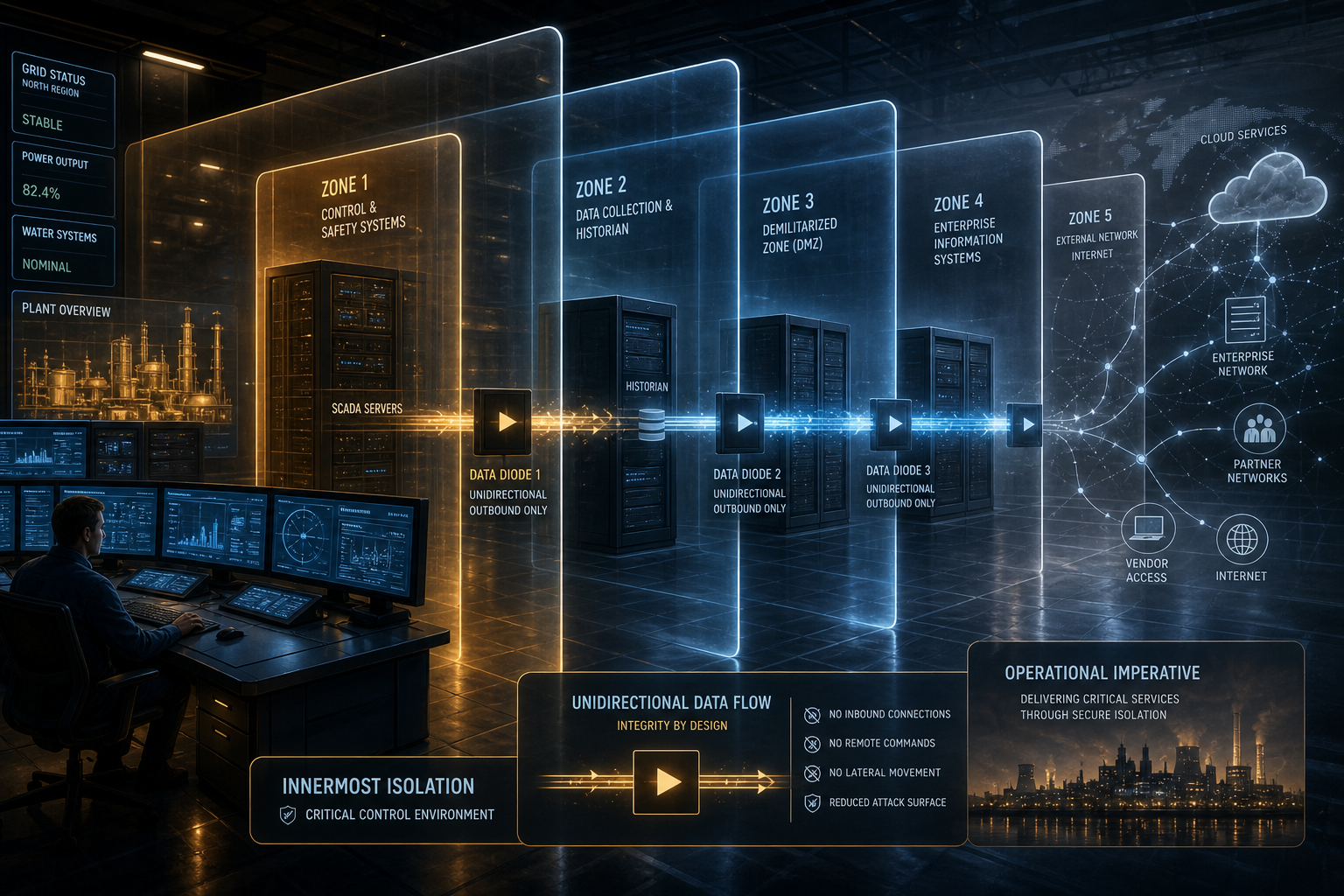
The CI-Fortify initiative identified specific platform categories requiring isolation: SCADA systems managing power generation and grid operations, water treatment control systems, transportation signaling and safety systems, and communications infrastructure controllers. The framework acknowledges that complete air-gapping is operationally infeasible for most critical infrastructure operators who must collect sensor data, receive software updates, permit vendor remote access, and integrate with external agency systems and information-sharing networks. Consequently, the framework specifies a range of isolation architectures—from complete air-gap with manual data transfer protocols to managed one-way data diode implementations to logically segmented networks with strict access controls—allowing operators to calibrate isolation depth against operational necessity.
Sector-specific regulatory bodies—the Federal Energy Regulatory Commission (FERC) for energy, the Environmental Protection Agency (EPA) for water, the Department of Transportation (DOT) for transportation, and the Federal Communications Commission (FCC) for communications—are expected to translate CI-Fortify principles into mandatory compliance frameworks within 90 to 180 days. This accelerated timeline significantly compresses the institutional decision-making and implementation window compared to historical infrastructure modernization cycles.
Why It Matters
Security Practitioners and Risk Leadership
Physical isolation of critical OT systems represents a fundamental shift in threat mitigation philosophy. Rather than detecting and responding to intrusions within a connected network, isolation prevents network-based compromise at the architectural level. This approach is particularly compelling for SCADA and DCS environments designed decades ago, which lack the logging, monitoring, and alerting capabilities modern IT environments possess. However, the risk reduction benefit of isolation depends on two conditions many organizations have not yet operationalized: (1) complete architectural redesign ensuring no unintended data pathways connect isolated systems to external networks, and (2) comprehensive operational continuity planning that prevents isolation requirements from creating availability failures. Organizations implementing isolation without addressing these factors may trade one class of failure mode—network-based attack—for another: operational inability to respond to legitimate requests, sensor data unavailability, and vendor maintenance delays.
Operational Leadership
The mandate creates direct tension between security isolation requirements and the service continuity obligations critical infrastructure operators bear toward the public. Extended power outages during grid isolation implementation could create cascading failures across water treatment, transportation, and communications sectors dependent on continuous electrical supply. Water treatment operators face similar challenges: isolation implementation timelines must be synchronized with maintenance windows and seasonal demand patterns to avoid service interruptions affecting public health. Transportation authorities managing air traffic control, rail switching, and highway signaling systems face regulatory obligations to maintain safety margins and service levels that may be compromised during isolation transition periods. These operational constraints mean isolation implementation cannot follow a uniform timeline; it must be customized to each organization's specific dependencies and operational constraints.
Capital Planning and Financial Decision-Making
Physical isolation of critical infrastructure typically requires substantial capital expenditure. Network redesign, data diode or managed transfer infrastructure deployment, isolated monitoring and logging systems, redundancy design to prevent single-point failures introduced by isolation itself, and hardware refresh cycles all create significant budget requirements. Organizations face uncertainty about the true scope and duration of required investment because supplementary regulatory sourcing and isolation standard specificity remain incomplete. Board-level risk committees must decide whether to front-load isolation investment—accepting budget concentration and higher near-term costs—or phase implementation across 3–5 years, extending exposure window and regulatory compliance risk. This decision directly affects competitive positioning: organizations that isolate faster may receive preferential insurance pricing and regulatory leniency, while those phasing implementation preserve near-term operational flexibility but face extended regulatory scrutiny.
Regulatory and Compliance Functions
The CI-Fortify framework acceleration creates a compressed compliance window. Organizations cannot await final sector-specific regulatory guidance; they must begin strategic assessment immediately based on preliminary IC3 and CISA guidance, understanding that regulatory bodies will likely codify or exceed CI-Fortify recommendations within 90 to 180 days. This creates a real-time compliance forecasting challenge: organizations must implement now based on incomplete information. The risk of over-investment—building isolation more extensive than regulatory requirements demand—and under-investment is correspondingly high.
Workforce and Organizational Capability
Physical isolation requires fundamental changes to how operators manage critical systems. Legacy OT environments were designed around human-in-the-loop operational models where staff directly access and adjust systems in near-real-time. Isolation often requires transition to monitored, centralized control models where operators interact with systems through mediated interfaces rather than direct network access. This shift creates training, certification, and workforce development requirements organizations have not fully scoped. Operator licensing and competency requirements may need to evolve to account for isolation-mediated operational models. Staff with isolation bypass privileges become high-value targets for insider threat or social engineering, requiring new personnel security and background checking practices.
Operational Implications
Network Architecture and Physical Isolation Design: Organizations must evaluate fundamental topology choices. Complete air-gapping provides maximal security but creates severe operational constraints: no real-time sensor data collection to central monitoring systems, no remote vendor access, no integration with grid operators or government agencies, and manual data transfer protocols creating bottlenecks in critical workflows. More feasible alternatives include data diode implementations—one-way fiber optical or hardware-enforced protocols allowing data flow from OT to IT systems but not in reverse—or logically segmented networks with strict access controls and monitoring. Each topology choice carries different capital costs, operational constraints, and residual security implications. The ACSC technical specifications provide baseline design principles, but organizations must adapt these to their specific operational environments. This requires collaborative effort between network architects, OT engineers, and security practitioners.
Monitoring and Visibility Across Isolation Boundaries: A primary operational concern is maintaining security instrumentation—intrusion detection, log aggregation, anomaly detection—that enables incident detection and response. Isolated OT systems generate security-relevant logs that would normally flow to a centralized security operations center, but isolation architectures may prevent or constrain this data flow. Organizations must design monitoring infrastructure that operates both within isolated environments and at isolation boundaries, detecting attacks and operational anomalies without compromising isolation integrity. This often requires deploying duplicate or shadow logging and alerting systems within isolated network segments, creating redundancy but also increasing maintenance burden and potential for configuration drift.
Third-Party Access and Supply Chain Integration: Many critical infrastructure environments depend on vendor support for maintenance, diagnostics, and system optimization. Isolation architectures make vendor remote access substantially more difficult: traditional VPN or secure shell connections across isolation boundaries may be impossible. Organizations must develop new vendor access models—potentially including physical on-site presence for routine maintenance, pre-staged software updates deployed in batch cycles, and emergency access procedures requiring multi-party authorization and audit trails. These changes increase operational cost and may create maintenance delays affecting system availability. Supply chain security becomes correspondingly more critical: hardware or software installed on isolated systems requires rigorous security validation, as security updates and patches may be difficult to deploy rapidly.
Emergency Access and Incident Response: Physical isolation creates secondary challenges for incident response. Traditional incident response playbooks assuming network-based forensics, remote access, and real-time data collection may be operationally impossible. Organizations must develop isolation-specific incident response procedures accounting for degraded visibility, manual data collection, and physical access constraints. Additionally, legitimate emergency operational needs—responding to equipment failures, natural disasters, emergency system reconfiguration—may require temporary isolation bypass. Organizations must design emergency access procedures maintaining isolation integrity through audit trails, multi-party approval, and time limits while enabling necessary operational flexibility. The tension between security isolation and operational necessity creates governance challenges most organizations have not yet resolved.
Operational Procedure Redesign: Isolation often requires fundamentally different operational procedures. In connected environments, operators initiate configuration changes remotely, receive real-time feedback, and adjust systems iteratively. In isolated environments, changes require batch processing, offline approval cycles, and delayed feedback loops. Staff must be retrained accordingly. The roles and responsibilities of different teams require redefinition: where IT security teams once had visibility into all network activity, isolation may exclude them from direct OT system observation. Conversely, OT engineering teams may need to develop new security monitoring and incident response capabilities traditionally held by IT security. These organizational and procedural changes are as critical as technical architecture decisions but are often underestimated in implementation planning.
Recommended Actions
Actions are organized by organizational security maturity. Baseline controls apply across all tiers and should be treated as immediate priorities regardless of organizational size.
* Limited OT security maturity; legacy system dominance.
- 1 - Begin with immediate strategic assessment: inventory all systems classified as critical under CI-Fortify guidance, identify current network connectivity for each system, and map dependencies to external systems. Completion within 30 days should explicitly identify which critical systems currently lack isolation and which have existing logical or physical segmentation.
- 2 - Initiate cross-functional stakeholder engagement by convening representatives from operations, engineering, security, capital planning, and regulatory affairs to establish a CI-Fortify steering committee with executive sponsorship.
- 3 - This committee should develop preliminary understanding of isolation requirements, operational constraints, and budget implications. Priority is establishing foundational governance: assigning ownership, setting decision-making authority, and creating a preliminary implementation roadmap.
- 4 - Technical implementation decisions should not proceed without this governance foundation. Baseline organizations should also prioritize engagement with sector-specific regulatory bodies or industry associations to understand preliminary regulatory timelines and expected compliance standards.
* Established OT security program; some network segmentation existing.
- 1 - Conduct detailed network architecture design reviews. Using ACSC technical specifications as baseline, evaluate which isolation topology is feasible for each critical system given operational dependencies.
- 2 - This design process should explicitly address: (1) operational continuity requirements, (2) monitoring and incident response infrastructure needed within isolated environments, and (3) emergency access procedures and governance for isolation bypass authorization. This phase should complete within 60–90 days.
- 3 - Initiate pilot implementation: select a non-critical system suitable for isolation, implement one isolation topology as proof-of-concept, validate that operational procedures function as designed, train staff on isolation-mediated operational models, and conduct simulated incident response exercises in isolation conditions.
- 4 - The pilot should explicitly test monitoring infrastructure, vendor access procedures, and emergency access protocols. Results should inform the broader implementation roadmap and identify operational constraints not apparent in initial design.
* Comprehensive OT security program; multi-site operations.
- 1 - Leverage existing security architecture maturity to accelerate compliance. Where possible, conduct parallel implementation across multiple sites, using early sites as validation for subsequent deployments.
- 2 - Prioritize integration of CI-Fortify isolation requirements into broader security architecture initiatives (zero-trust design principles, AI/ML-based anomaly detection, automated compliance monitoring).
- 3 - For multi-site operations, develop standardized isolation architectures and operational procedures deployable consistently across geographic regions, reducing training burden and improving operational consistency.
- 4 - Engage proactively with regulatory bodies and industry consortiums to help shape emerging regulatory guidance. Organizations demonstrating early CI-Fortify compliance are likely to receive favorable regulatory treatment and may influence ultimate regulatory requirements.
* All maturity levels.
- 1 - Establish regulatory timeline tracking: assign ownership for monitoring emerging guidance from sector-specific regulatory bodies. Develop a decision framework for responding to regulatory changes that may exceed or modify preliminary CI-Fortify guidance. Plan for regulatory updates within 90–180 days.
- 2 - Develop capital budgeting discipline: quantify isolation implementation costs at the system level (network redesign, hardware refresh, monitoring infrastructure, staff training), develop phased implementation budgets across 3–5 years, and establish decision criteria for front-loading versus phasing investment.
- 3 - Build vendor relationship management processes: develop new vendor onboarding procedures for isolated system environments. Work with key vendors to understand their capability to support isolated system maintenance, remote access limitations, and patch management procedures in isolation contexts.
- 4 - Create isolation-specific incident response procedures: develop playbooks for incident response in isolated environments, accounting for limited visibility, delayed data collection, and physical access constraints. Exercise these procedures regularly through tabletop or simulated incident exercises.
- 5 - Invest in workforce development: identify staff managing isolated systems, plan training and certification programs aligned with isolation-mediated operational models, and develop career progression paths recognizing isolation management as specialized capability.
- 6 - Monitor emerging threats to isolation infrastructure: work with CISA/IC3 to track threat actor adaptation to isolation architectures. Specifically monitor supply chain attacks targeting isolation infrastructure, insider threats targeting isolation management processes, and emerging attack techniques against physical isolation.
Closing Statement
The CI-Fortify framework represents an institutional inflection point for critical infrastructure operators. Physical isolation of operational technology systems is no longer a theoretical security debate; it is an emerging regulatory mandate reshaping how critical infrastructure organizations design networks, manage operations, and respond to incidents.
Organizations that approach isolation as a network architecture problem while neglecting simultaneous redesign of operational procedures, workforce training, monitoring infrastructure, and emergency response capabilities will likely create new failure modes rather than reduce risk. The most successful implementations will treat isolation as a cross-functional organizational transformation, not an IT security project.
Strategic assessment and cross-functional risk positioning must precede capital allocation. The resilience outcomes of CI-Fortify implementation will ultimately depend not on isolation architecture sophistication, but on how thoroughly organizations redesign their operations to function reliably within those architectures.