Inside the Security and AI Innovations Shaping 6G Networks
Executive Summary
The transition to 6G networks fundamentally redefines security from reactive rule-based enforcement to autonomous, AI-driven defense systems operating across distributed infrastructure at microsecond latencies. While AI enables real-time anomaly detection, adaptive network slicing, and privacy-preserving federated learning, it introduces novel attack surfaces—adversarial model manipulation, gradient leakage, inference attacks—that legacy security frameworks cannot address.
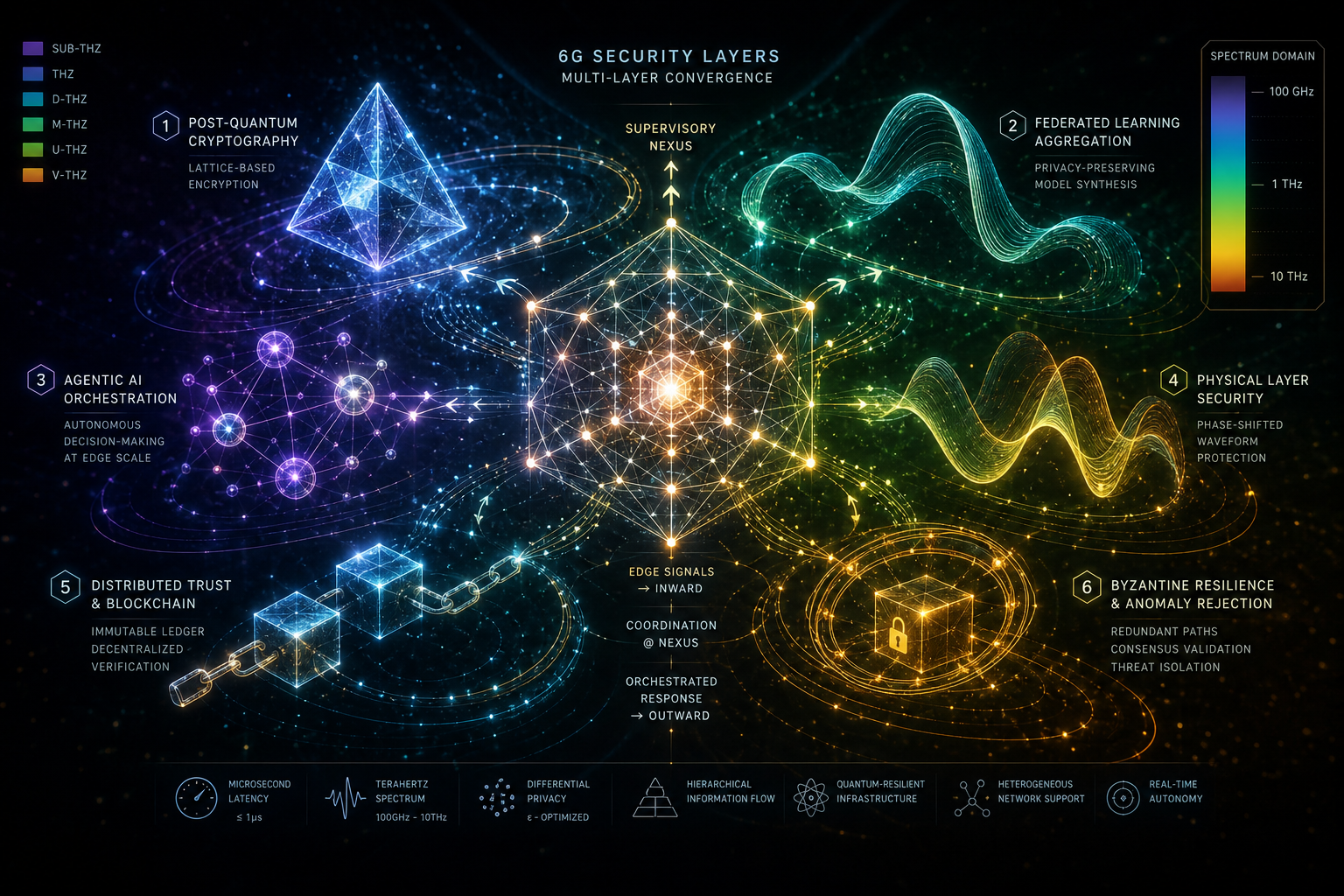
Six enabling technologies must operate in synchronized concert: distributed AI with federated learning, distributed ledger technology, physical layer security, quantum-resilient cryptography, terahertz and visible light communication, and agentic AI orchestration. No single technology delivers complete security in isolation. The critical challenge is calibrating computational, latency, and deployment trade-offs against specific threat models while addressing a significant skills gap in Byzantine-resilient aggregation, differential privacy, post-quantum cryptography, and autonomous incident response.
Immediate actionable guidance: Actionable takeaway: Initiate cryptographic transition planning immediately and establish federated learning pilots within 12 months; organizations delaying standards participation past Q4 2026 face interoperability failures and stranded infrastructure investments.
Key Finding: Six enabling technologies—Distributed AI with Federated Learning, Distributed Ledger Technology, Physical Layer Security, Quantum-Resilient Cryptography, Terahertz and Visible Light Communication, and Agentic AI Orchestration—must operate in synchronized, multi-layered concert to achieve 6G security and privacy objectives. However, no single technology delivers complete security in isolation, and each introduces computational, latency, and deployment trade-offs requiring careful calibration against specific use-case threat models and resource constraints.
What Happened
5G security architectures rely on three foundational principles: centralized identity management through Subscription Concealed Identifier (SUCI), network slicing isolation enforced via virtualized network functions (VNFs), and end-to-end encryption orchestrated through human-configured, rule-based policies. This model assumes relatively stable threat environments, modest data rates (10–20 Gbps), and sufficient latency tolerance (50–100 ms) to support centralized security orchestration.
The 6G inflection point—projected for standardization between 2026 and 2030—introduces operational constraints that render centralized, rule-based models functionally obsolete. Terabit-per-second data rates, one-millisecond latency requirements for Ultra-Reliable Low-Latency Communication (URLLC), autonomous network slicing across terrestrial and non-terrestrial domains (satellite, UAV, aerial platforms), and Integrated Sensing and Communication (ISAC) systems with continuous biometric and behavioral telemetry cannot be secured through human-in-the-loop incident response or static policy enforcement. Security must transition from a bolt-on, post-deployment layer to an embedded capability spanning data plane, control plane, and orchestration plane simultaneously.
Kumar, Dutta, and colleagues (IEEE Access, January 2026) document this transition through a three-tiered AI-driven security architecture: edge-based detection and anomaly identification, distributed threat intelligence aggregation via federated learning, and autonomous remediation through hierarchical multi-agent orchestration. Their analysis provides concrete performance benchmarks across seven major threat vectors: CNN-LSTM intrusion detection systems achieving 97–99% detection accuracy with 1–3% false positive rates; GAN-based anomaly detection achieving 90–98% accuracy on IoT datasets; reinforcement learning-based network slice isolation completing mitigation in less than 1 second.
AI systems that enable real-time threat detection simultaneously introduce novel attack surfaces absent from signature-based security models. Adversarial sample injection—carefully crafted input perturbations—can degrade machine learning classifier accuracy by 15–20% under Fast Gradient Sign Method (FGSM) attacks without defensive training. Model poisoning exploits federated learning's distributed nature: Byzantine threat actors controlling 30–40% of training updates can corrupt model parameters without triggering detection unless Byzantine-resilient aggregation algorithms (Krum, Trimmed Mean, geometric median) are explicitly deployed. Inference attacks can extract sensitive training data from model outputs, particularly in federated scenarios where models are deployed to edge nodes.
Prajwalasimha S N and colleagues (International Conference on Cognitive Robotics and Intelligent Systems, July 2025) present a federated learning framework integrating differential privacy that achieves 20% improved detection accuracy and 35% reduced false positives compared to centralized intrusion detection systems. Their research establishes that privacy-preserving machine learning is foundational to security, not merely complementary. However, naive federated aggregation (standard FedAvg) permits gradient leakage under membership inference attacks, requiring explicit differential privacy mechanisms with privacy budgets (ε) calibrated to 1–3 for financial and critical infrastructure use cases, accepting 5–10% accuracy degradation.
Di Tommaso, Davoli, Spadaccino, and Cerroni (IEEE NetSoft 2026 Workshop, June 2026) present Edgent, an agentic AI framework for eBPF-based service deployment and edge orchestration. Their work validates autonomous agents with planning capabilities orchestrating complex, multi-step security responses across heterogeneous infrastructure without centralized control. Testing across 85-node topologies demonstrated 100% task completion reliability even with quantized 4-billion-parameter small language models (SLMs) constrained to 4GB memory and less than 500 ms planning latency.
Wai Yie Leong (ECTI-CON International Conference, June 2026) maps the emerging threat landscape for 6G-driven metaverse environments across six functional layers: biometric and behavioral data streams, extended reality (XR) avatar identity systems, network slicing and resource allocation, blockchain-based trust anchors, sensor integration and ISAC systems, and cross-domain orchestration. Risk analysis quantifies specific threats: avatar spoofing exploits identity verification weaknesses in XR systems; biometric inference attacks extract demographic and behavioral information from motion capture and eye-tracking data; network slicing breaches enable lateral movement across isolated slices; blockchain consensus attacks undermine distributed trust infrastructure.
Bolgouras, Farao, and Xenakis (IEEE CAMAD Workshop, November 2024) synthesize a threat mitigation roadmap linking quantum-safe cryptography, AI/ML defense mechanisms, and privacy-preservation frameworks to standardization timelines across ETSI (European Telecommunications Standards Institute), ITU-T (International Telecommunication Union), and 3GPP (Third Generation Partnership Project). Their analysis identifies a critical window: ITU-T SG13 and SG17 will finalize 6G security specifications by Q4 2026; 3GPP Release-20 will integrate AI-driven orchestration requirements by 2027; NIST Post-Quantum Cryptography standards (FIPS 203, 204, 205) reach finalization in Q3 2024, with transition timelines spanning 2025–2030.
Why It Matters
Security Operations and CISO Leadership
Legacy security models—centralized SOCs, signature-based intrusion detection, human-in-the-loop incident response—are fundamentally misaligned with 6G operational requirements. Centralized threat detection cannot process microsecond-latency decisions at terabit-per-second throughput without computational bottlenecks. Signature-based systems cannot adapt to adversarial perturbations in real-time. Rule-based policies cannot preserve privacy while aggregating telemetry from billions of IoT and XR endpoints without explicit differential privacy mechanisms. Organizations relying on legacy 5G assumptions face three compounding risks: latency compliance risk (6G URLLC applications require security decisions within 1–5 milliseconds, but current incident response processes assume 50–100 ms decision windows); data sovereignty risk (federated learning and edge-deployed AI systems require new data residency policies, yet most organizations lack governance frameworks to ensure federated learning implementations actually preserve data residency); algorithmic accountability risk (black-box AI decisions in critical infrastructure demand explainable AI frameworks that most organizations have not yet implemented).
Technical Workforce Development
Current security workforce expertise concentrates in areas incompatible with 6G architectures. Network administrators trained on firewall rule configuration, intrusion detection system tuning, and VPN endpoint management possess minimal exposure to the mathematical and algorithmic foundations required for 6G security: Byzantine-resilient aggregation, differential privacy budgets, post-quantum cryptography, and agentic AI reasoning. Defenders must understand that standard federated learning aggregation (FedAvg) permits Byzantine threat actors controlling 30–40% of training participants to corrupt model parameters. Mitigation requires algorithms like Krum (selecting the update geometrically closest to the median), Trimmed Mean, or geometric median-based aggregation. Privacy protection in federated learning is quantified as ε-δ privacy loss, requiring organizations to calibrate privacy-utility trade-offs against threat models. NIST has standardized lattice-based key encapsulation mechanisms (Kyber), lattice-based signatures (Dilithium), and hash-based signatures (SPHINCS+), which are not backward-compatible with RSA or ECDSA and require different key sizes, computational profiles, and certificate infrastructure. Autonomous threat response requires both high-level reasoning (multi-agent orchestration, planning algorithms) and low-level system manipulation (eBPF kernel programs), and few security teams include personnel fluent in both domains.
Policy and Institutional Planning
The 2026–2030 period represents a critical standardization window. ITU-T SG13 (Future Networks) and SG17 (Security) are finalizing 6G security architectures; 3GPP is integrating AI-driven network management requirements; ETSI is developing Zero-Touch Service Management (ZSM) frameworks; NIST is completing post-quantum cryptography standardization. These specifications will drive procurement requirements and regulatory compliance mandates for the next decade. Organizations that do not participate in standards development by Q4 2026 face significant consequences: interoperability failures (6G networks will interoperate across multiple vendors, geographic regions, and regulatory jurisdictions; organizations whose security architectures do not align with ETSI/ITU/3GPP specifications will not integrate with competitor systems or public infrastructure); regulatory non-compliance (emerging regulations mandate specific security and privacy controls, forcing expensive, incomplete compliance retrofitting); stranded investments (cryptographic infrastructure built around RSA and ECDSA will not be quantum-resilient; intrusion detection systems based on signature matching will not detect adversarial perturbations; incident response processes optimized for 100 ms latency cannot support 1 ms URLLC requirements; infrastructure investments in 2026–2027 without quantum-resilience and AI-native design will become obsolete by 2032–2035).
Operational Implications
2026–2027: Foundation Layer: Deploy post-quantum cryptography based on NIST-standardized algorithms (Kyber for key encapsulation, Dilithium for signatures, SPHINCS+ for hash-based signatures). Begin hybrid cryptographic operations: issue dual certificates (RSA + Kyber) for all new identities; disable weak algorithms (RSA <2048 bit, ECDSA <256 bit) in new deployments. Establish quantum key distribution (QKD) pilots in high-security domains (banking, critical infrastructure). Implement federated learning frameworks with differential privacy; conduct pilots on non-sensitive operational telemetry (network flow statistics, application latency data). Certify 50% of security operations personnel in post-quantum cryptography fundamentals; establish federated learning training programs.
2027–2029: Intelligence Layer: Integrate Agentic AI orchestration into security operations: deploy hierarchical multi-agent systems with explicit planning and reasoning capabilities. Implement eBPF-based in-kernel threat detection: develop kernel programs executing mitigation actions (DDoS filtering, slice isolation) without context-switching. Establish XAI governance: mandate SHAP or LIME-based interpretability for security-relevant ML decisions; create audit trails justifying autonomous actions. Deploy testbeds: 32–85 node topologies with quantized small language models validating orchestration reliability and latency under production conditions. Train security architects on Agentic AI reasoning, eBPF programming, and XAI frameworks; establish incident response procedures for autonomous system failures.
2029–2031: Autonomous Operation Layer: Transition to zero-touch network and service management (ETSI ZSM): fully autonomous threat response without operator escalation except for policy decisions. Enable closed-loop reinforcement learning for network slicing orchestration and adaptive threat response. Validate quantum-resilient cryptography against emerging quantum computing threats. Achieve cross-domain interoperability: security architecture functions seamlessly across terrestrial networks, satellite constellations, aerial platforms, and metaverse environments.
Ongoing: Privacy-Utility Trade-off Calibration: Federated learning with differential privacy introduces a fundamental trade-off: stronger privacy protection degrades model accuracy, and higher accuracy requires relaxing privacy guarantees. Organizations must calibrate this trade-off against specific threat models and operational requirements. High-security finance/critical infrastructure deployments mandate aggressive privacy protection (differential privacy budget ε = 0.5–1.0; accept 5–10% detection accuracy degradation; federated learning with no centralized raw data; quantum key distribution for all encryption). Latency-sensitive XR/metaverse applications balance privacy and latency (differential privacy budget ε = 3–5; accept 2–3% accuracy degradation; edge-only federated learning). Resource-constrained IoT/edge sensors relax privacy for efficiency (differential privacy budget ε = 5–10; accept 3–5% accuracy degradation; quantized federated learning models).
Recommended Actions
Actions are organized by organizational security maturity. Baseline controls apply across all tiers and should be treated as immediate priorities regardless of organizational size.
* Organizations with standard security tooling and general-purpose endpoint protection.
- 1 - Conduct cryptographic algorithm inventory across all systems: document RSA modulus lengths, ECDSA curve parameters, symmetric key sizes, key exchange mechanisms. Develop hybrid cryptography transition roadmap with timeline for introducing post-quantum algorithms (Kyber, Dilithium) while maintaining RSA/ECDSA backward compatibility.
- 2 - Evaluate federated learning frameworks against specific threat models and network topology. Define differential privacy requirements by use case, establishing ε budgets balancing privacy protection and accuracy. Design secure aggregation protocols using homomorphic encryption, secret sharing, or alternative cryptographic mechanisms.
- 3 - Establish policy mandate: all AI-driven security decisions accompanied by XAI outputs (SHAP values, LIME explanations, attention visualizations). Select and integrate XAI tooling; design audit trail system logging all autonomous threat response actions with justifications.
- 4 - Launch federated learning-based anomaly detection on non-critical network segments (test, development, staging). Validate Byzantine-resilient aggregation (Krum algorithm) against gradient poisoning; measure privacy-accuracy trade-offs empirically with ε values (0.5, 1.0, 2.0, 5.0).
- 5 - Deploy Agentic AI framework (Edgent or equivalent) on 10–15 node test topology; validate autonomous error recovery. Implement tool validation middleware preventing hallucinated API calls; design fallback planning strategies.
- 6 - Certify 50% of security personnel in NIST PQC standards (Kyber, Dilithium, SPHINCS+). Conduct hands-on labs: deploy test PKI with post-quantum algorithms; issue certificates; validate interoperability with legacy RSA systems.
- 7 - Train 25% of data science and ML personnel on differential privacy (ε-δ privacy loss, privacy budget tracking) and Byzantine-resilient aggregation algorithms (Krum, Trimmed Mean, geometric median).
* Organizations with mature security operations and advanced threat intelligence capabilities.
- 1 - Adopt hierarchical multi-agent orchestration architecture: Supervisor agents in regional data centers (planning, correlation, policy updates); Worker agents at edge and access points (local detection, immediate mitigation). Design eBPF-based in-kernel threat detection: identify which security functions execute in kernel space (DDoS filtering via XDP, rate limiting via TC, packet inspection) versus user space.
- 2 - Deploy federated learning coordinator: organize model training across distributed edge nodes, aggregate updates with Byzantine-resilient algorithm, apply differential privacy. Establish ML operations (MLOps) infrastructure: versioning for models, datasets, training configurations; automated pipelines for continuous model retraining and validation.
- 3 - Develop XDP programs for DDoS mitigation targeting <100 microsecond per-packet latency. Implement TC (Traffic Control) qdisc programs for rate limiting and traffic shaping. Deploy in-kernel network telemetry using eBPF to collect flow statistics, latency histograms, anomalous packet patterns.
- 4 - Evaluate physical layer security solutions for THz/VLC: OFDM subcarrier masking, artificial noise injection, beamforming-based secrecy capacity enhancement. Design authentication at PHY layer ensuring 6G devices validate signal source.
- 5 - Deploy 10–25 node pilot testbed topology combining edge nodes, regional supervisors, and cloud coordination with mixed compute platforms (x86, ARM, FPGA). Test hierarchical orchestration, federated learning integration, and quantum-safe cryptography inter-node communication.
- 6 - Deploy small-scale network segments using post-quantum cryptography for control plane: network slicing isolation mechanisms use Kyber; inter-node communication uses post-quantum algorithms. Validate cross-slice attack mitigation through red team exercises.
* Organizations with enterprise-scale threat detection and autonomous response capabilities.
- 1 - Implement full hierarchical multi-agent orchestration with Supervisor agents performing slow, complex planning (global threat correlations, long-term policy updates) and Worker agents executing fast, local mitigation (DDoS filtering, slice isolation, anomaly flagging). Achieve 5–15 ms end-to-end latency and 100% orchestration reliability on 85+ node topologies.
- 2 - Establish continuous federated learning pipeline with monthly or quarterly retraining incorporating Byzantine-robust aggregation and differential privacy. Implement model degradation response procedures, retraining process validation, and deployment governance. Deploy production-grade inference latency validation with quantized small language models on target hardware.
- 3 - Develop eBPF-based in-kernel anomaly detection with real-time packet filtering at network ingress (<100 microsecond per-packet latency), traffic shaping and rate limiting, and encrypted aggregation of distributed telemetry. Establish code review procedures for in-kernel programs ensuring auditability and security.
- 4 - Integrate quantum-safe key exchange into 6G network slice isolation mechanisms: encryption keys for slice access control use Kyber or equivalent. Validate cross-slice attack mitigation; develop emergency key rotation and re-encryption procedures for archived data. Establish quantum-safe key rotation policies with maximum lifetime 2–5 years.
- 5 - Monitor ITU-T SG13/SG17, 3GPP, and ETSI working groups; participate in standards development influencing specifications. Create internal standards mapping documenting which systems must be updated for 6G compliance; develop procurement criteria mandating 6G-compliance.
- 6 - Transition to zero-touch network and service management (ETSI ZSM) with fully autonomous threat response without operator escalation except for policy decisions. Enable closed-loop reinforcement learning for network slicing orchestration. Validate quantum-resilient cryptography against emerging quantum computing threats.
- 7 - Design and deploy Supervisor-Worker hierarchical architecture with Supervisor infrastructure in Q1 2027, Worker agents in field trials Q3 2027, production orchestration transition Q2 2028. Establish cross-domain interoperability: security architecture functions seamlessly across terrestrial networks, satellite constellations, aerial platforms, and metaverse environments.
Closing Statement
The transition to 6G security is not a technology adoption challenge; it is an architectural and organizational transformation that must begin in 2026 to avoid disruption by 2030. The technologies required—federated learning, differential privacy, Byzantine-resilient aggregation, post-quantum cryptography, Agentic AI, eBPF orchestration, and physical layer security—are individually mature but operationally untested at scale. No single capability delivers security in isolation; all six must operate in synchronized concert.
The stakes are existential for organizations with critical infrastructure responsibilities. Latency requirements render centralized security decision-making functionally obsolete. Regulatory mandates for privacy-by-design and explainability cannot be met with legacy signature-based and rule-based systems. Quantum computing timelines for cryptanalysis may exceed current projections, but the cost of cryptographic transitions makes delays economically irrational.
The window for standards participation and influence closes at Q4 2026. Organizations not engaged in this window will navigate specifications they did not shape and face procurement cycles that lock in non-optimal designs for a decade. Workforce development must begin immediately: Byzantine-resilient aggregation, differential privacy budgets, and post-quantum cryptography are not typical security domains, and the skills gap is severe.
Begin cryptographic transition planning immediately. Establish federated learning pilots within 12 months. Participate in standards development before Q4 2026. The alternatives—stranded infrastructure investments, interoperability failures, and regulatory non-compliance—are far more costly than the disciplined, systematic advancement toward 6G-native security.