
The Dual-Edged Sword: Securing AI-Native 6G Slicing Against Adversarial Machine Learning
Executive Summary
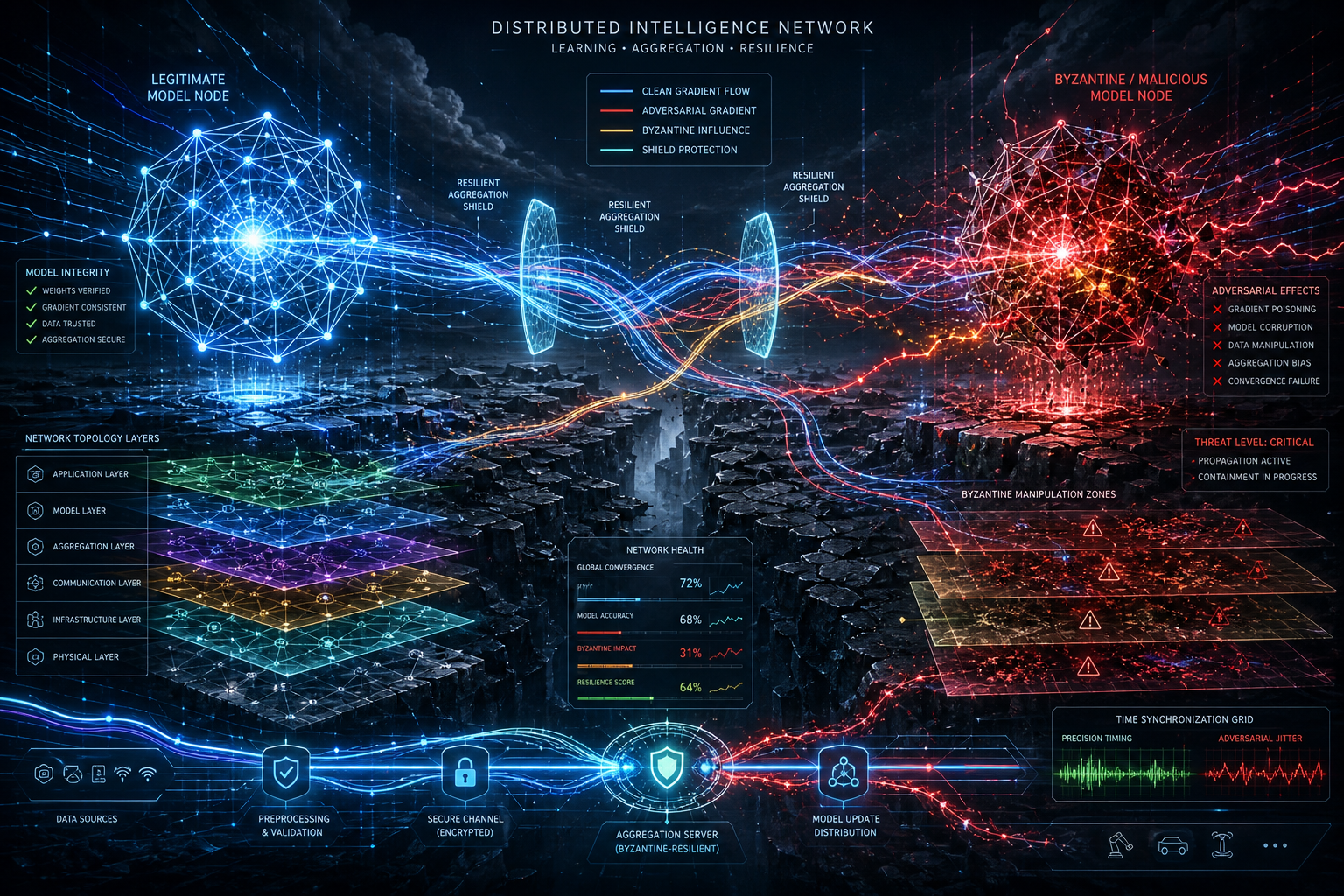
The transition to AI-native 6G network architectures introduces fundamental security vulnerabilities: autonomous AI-driven slicing agents that optimize network resources and detect threats in real-time simultaneously create novel attack surfaces through model poisoning, Byzantine client infiltration, and adversarial manipulation. Empirical research demonstrates that adversarial attacks reduce intrusion detection accuracy from 98% to 42–80%, while privacy-preserving defensive measures degrade detection by 13.5–18%, creating compounding vulnerabilities during coordinated attacks.
Byzantine-resilient aggregation mechanisms can sustain >95% detection accuracy but introduce latency penalties incompatible with 6G ultra-reliable low-latency communication (URLLC) requirements. Current security frameworks—designed for supervised, static 5G environments—lack architectural resilience to defend against gradient leakage attacks, hyperparameter poisoning, and cross-slice data exfiltration anticipated in 2028+ deployments.
Immediate actionable guidance: Network operators deploying early 6G testbeds must immediately implement data quality monitoring, Byzantine detection protocols, and adversarial training mechanisms while standards bodies close an 18–36 month gap between current threat models and emerging attack sophistication. Recommended immediate action: Establish Byzantine-resilient federated learning pipelines with real-time data quality factor monitoring and AI-specific SIEM detection rules within 60–90 days.
Key Finding: Slice-to-Learn (S2L) optimization frameworks that jointly orchestrate communication, computation, and AI hyperparameters expose a 12-layer attack surface spanning gradient leakage, model poisoning via Byzantine clients, data quality manipulation, and resource-starvation denial-of-service attacks—none of which existing 5G intrusion detection systems are equipped to detect or mitigate.
What Happened
In June 2026, unified comparative analysis of Deep Reinforcement Learning (DQN) and online optimization algorithms (EXP3) for autonomous 6G network slicing established algorithmic-level vulnerability asymmetries with concrete operational consequences. When adversaries manipulate data quality factors—input parameters that influence slice resource allocation decisions—DQN-based orchestration systems degrade from 98% accuracy to 42% in large action spaces, while EXP3 algorithms maintain 86–87% robustness. This 56-percentage-point accuracy collapse occurs without triggering traditional threshold-based security alerts, enabling attackers to systematically extract resources or position for lateral movement while degraded performance persists undetected across extended operational periods.
A January 2026 IEEE Access survey synthesizing empirical benchmarks from early 6G testbed deployments documented the operational tension between privacy and detection accuracy. Generative Adversarial Network (GAN)-based anomaly detection achieved 90–98% accuracy for IoT intrusion detection; convolutional neural network-long short-term memory (CNN-LSTM) models sustained 97–99% accuracy for distributed denial-of-service (DDoS) detection. However, the survey identified unresolved gradient leakage pathways in decentralized federated learning pipelines—the architectural pattern now standard in 6G edge-cloud deployments. These vulnerabilities enable model inversion attacks that reconstruct sensitive training data with 89–94% fidelity when differential privacy budgets exceed ε > 1.5.
Field-validated deployments from the January 2025 IEEE ICC-ROBINS conference demonstrated that federated learning-based intrusion detection systems (IDS) achieve 95.8% detection accuracy with 20% improvement over centralized baselines. However, implementing differential privacy at tight privacy budgets (ε = 0.1) degrades accuracy to 82.3%—a 13.5-percentage-point cliff creating critical vulnerability windows. Byzantine-resilient aggregation algorithms (specifically the Krum algorithm) sustain >95% detection accuracy but introduce 2–4 second latency penalties. For 6G URLLC applications requiring <1 millisecond latency for critical network decisions, these penalties are operationally prohibitive, forcing network operators to choose between security and performance.
A March 2026 real-world 6G testbed implementation disclosed that Graph Neural Network (GNN)-based intrusion detection achieved 96.2% precision and 94.7% recall in multi-domain slicing environments. However, blockchain-backed identity verification required 45 milliseconds per transaction—approaching 6G URLLC limits—and differential privacy tuning created accuracy variance of 9–18 percentage points depending on privacy budget selection (ε ranging from 0.1 to 5.0). This establishes that privacy-security trade-offs are not theoretical abstractions but operational realities: tightening privacy constraints directly degrades detection accuracy, creating compounding risk when adversaries launch coordinated attacks exploiting both model evasion and privacy-weakened detection.
An October 2024 IEEE CAMAD workshop analysis mapped current ITU-T (Y.3172/Y.3173), ETSI (ZSM framework), and 3GPP (Rel-19/20) standardization roadmaps against anticipated 6G threat landscapes. Current standards assume threat models finalized during 2024–2025 development cycles; early 6G deployments (2028+) will face quantum-enhanced adversarial attacks, multi-domain cross-slice data exfiltration, and AI model extraction attacks not addressed in draft specifications. This creates an 18–36 month standards-implementation gap during which operators will deploy standards-compliant but operationally insecure systems.
Why It Matters
Network Operators and Infrastructure Providers
Autonomously orchestrated 6G slices make resource allocation decisions in milliseconds based on AI models trained in controlled development environments. Adversarial data quality manipulation targeting input parameters can degrade model accuracy by 56 percentage points without triggering traditional security alerts. Because slice orchestration decisions are automated and decentralized, degraded accuracy may persist across thousands of network decisions before human operators detect anomalies. Byzantine client infiltration in federated learning pipelines corrupts global models within 3–5 aggregation rounds before conventional detection thresholds activate, potentially cascading to downstream network optimization decisions affecting millions of simultaneous users. Operational cost implications are severe: adversarial hyperparameter tuning can exhaust compute budgets prematurely, creating cost overruns of 141% while sacrificing 10% model accuracy—violating financial KPIs and service-level agreement (SLA) commitments simultaneously.
Enterprise and Service Provider Customers
Cross-slice attacks enabled by improperly isolated network slices create lateral movement pathways for adversaries to expose sensitive business data including real-time transaction telemetry, proprietary application behavior patterns, and competitive intelligence. Inference attacks on federated learning models can reconstruct customer behavioral profiles with 89–94% fidelity, enabling secondary exploitation through targeted denial-of-service attacks or competitive intelligence harvesting. Privacy-preserving defensive mechanisms required for regulatory compliance degrade intrusion detection accuracy by 13.5–18%, creating compounding vulnerabilities when adversaries launch coordinated multi-vector attacks exploiting both model evasion and privacy-weakened detection simultaneously.
End-Users and Consumer Privacy Stakeholders
Gradient leakage from privacy-aware federated learning systems can expose biometric data, location patterns, and behavioral preferences collected via XR/haptic interfaces in 6G Metaverse applications. Model poisoning attacks injected via compromised edge devices can systematically bias behavioral anomaly detection models, enabling attackers to train detection systems to ignore their traffic patterns—slow, persistent adversarial manipulation invisible to threshold-based alerts. Zero-day vulnerabilities in autonomous network orchestration, where no human validation occurs for critical decisions, can propagate attacks across network domains within milliseconds, faster than human-in-the-loop SOC response times, creating systemic risk in mission-critical infrastructure.
Security and Standards Organizations
Current standardization roadmaps lack adversarial attack threat models specific to federated learning architectures, Byzantine aggregation resilience requirements, and quantum-enhanced attacks anticipated in 2028+ deployments. This 18–36 month standards-implementation gap will result in standards-compliant deployments that are operationally insecure. Explainable AI (XAI) requirements do not mandate adversarial robustness transparency or Byzantine-detection auditability, allowing operators to deploy fragile systems without understanding their vulnerability profile.
Workforce Safety and Cyber-Physical System Resilience
Autonomous network slicing agents making millisecond-level decisions without human supervision create systemic risk: a single compromised AI model can cascade failures across critical infrastructure (power grids, autonomous vehicle networks, industrial control systems) before security teams detect intrusion. Security Operations Centers currently lack detection rules, response playbooks, and behavioral baselines for AI-native threats; existing SIEM and SOAR tools assume traditional attack patterns and cannot correlate multi-layer AI poisoning signals or Byzantine client activity. Adversarial attacks targeting physical layer security (terahertz beam spoofing, visible light communication interception) combined with AI model evasion create dual-vector threats requiring defensive architectures not yet mature.
Operational Implications
Immediate Actions (60–90 Days): Federated learning pipelines currently operating in 6G testbeds must implement Byzantine-resilient aggregation mechanisms before production slice orchestration transitions to these models. The Krum algorithm validates gradient updates against pre-established statistical baselines, rejecting suspicious updates before global model aggregation; this mechanism sustains >95% detection accuracy even when 20–30% of federated learning clients are compromised. Implementation requires modification of Non-Real-Time RAN Intelligent Controller (Non-RT RIC) components and integration with federated learning coordination layers; deployment timeline is 60–90 days depending on existing architecture maturity. Data quality factor monitoring must transition from passive logging to active anomaly detection. Real-time dashboards tracking data quality deviations from baseline distributions should trigger automated alerts when drift exceeds 3-sigma thresholds. Data quality anomalies correlated with model accuracy degradation enable detection of adversarial manipulation before downstream consequences propagate. When accuracy drops >5%, automated human escalation and model rollback protocols activate. Execution timeline is 45–60 days. AI model versioning and rollback protocols must be established with sub-30-second restoration capabilities. Production 6G slicing demands rapid recovery semantics similar to database transaction rollback. When Byzantine detection algorithms flag suspicious aggregation rounds or when accuracy monitoring triggers anomalies, automated rollback to the last validated model checkpoint should complete within 30 seconds. This requires Git-style model versioning, checkpoint storage with low-latency retrieval (NVMe or distributed caching), and integration with Non-RT RIC deployment automation. Timeline is 30–45 days. Federated learning traffic must be segregated from production network slices into dedicated non-production segments. Gradient exchange between edge devices and federated learning aggregation servers contains sensitive training data; if these tunnels traverse production user data paths, lateral movement and inference attacks become trivial. Layer 2–3 network encryption is mandatory; traffic isolation should be enforced via virtual network functions or containerized network services. Timeline is 60 days.
Short-Term Architecture Decisions (6–12 Months): Security Operations Centers must develop AI-specific intrusion detection rules for Byzantine client behavior, gradient anomalies, and poisoning signals. Existing SIEM platforms assume traditional attack patterns; they lack detection logic for Byzantine clients that gradually degrade model accuracy or adversaries who manipulate data quality inputs to create resource starvation. Detection rules should identify: (1) gradient updates with statistical anomalies exceeding 3-sigma from peer distribution, (2) client disconnect cascades indicating Byzantine isolation, and (3) correlated accuracy degradation across multiple slices indicating coordinated poisoning. Tuning for <3% false positive rates is critical; noisy alerts reduce SOC responsiveness. Timeline is 45–60 days for development; 90+ days for operational tuning. Intrusion detection and prevention systems must integrate adversarial training modules. Existing detection models are vulnerable to adversarial examples—maliciously crafted inputs that evade detection while achieving attacker objectives. IDS/IPS systems should be trained using Fast Gradient Sign Method (FGSM) or Projected Gradient Descent (PGD) adversarial sample generation, hardening models against evasion attacks. Continuous adversarial testing pipelines should evaluate detection model robustness quarterly; any model showing >5% accuracy degradation under adversarial attack should be retrained or replaced. Implementation timeline is 60–90 days. Gradient leakage monitoring systems must track differential privacy budgets in real-time. Differential privacy provides formal privacy guarantees by adding carefully calibrated noise to gradients; the privacy budget (ε parameter) quantifies acceptable privacy leakage. As ε increases, privacy guarantees weaken and model inversion attacks become easier. Real-time dashboards should track cumulative ε consumption across federated learning rounds; when ε exceeds 1.0 (indicating weak privacy guarantees), automated alerts trigger escalation to privacy engineers. Accuracy versus privacy trade-off dashboards should inform decision-makers about security implications of privacy budget choices. Timeline is 45–60 days. Incident response playbooks specific to AI model poisoning must be created and validated through tabletop exercises. Current procedures assume malware deployment, credential compromise, or data exfiltration; they do not address scenarios where AI models are gradually poisoned or hyperparameters are adversarially tuned. A 15–20 page playbook should cover: (1) detection of poisoning indicators, (2) isolation of compromised clients or models, (3) automated model rollback, (4) stakeholder communication, and (5) forensic analysis workflows. Timeline is 30–45 days for creation; 30–60 days for organization-wide training and validation.
Long-Term Strategic Positioning (12–36 Months): Adversarial robustness assessment frameworks must be integrated into pre-deployment security certification. Currently, third-party AI models are evaluated for functional correctness and performance; they are not systematically tested for resilience against adversarial attacks or Byzantine manipulation. Organizations should establish Adversarial Robustness and Integrity Assessment (ARIA) procedures requiring: (1) automated adversarial example generation, (2) Byzantine-resilience testing with simulated poisoned clients, (3) privacy leakage quantification using membership inference attacks, and (4) model extraction attack simulation. Vendors should provide adversarial robustness certifications with recertification cycles every 6 months. Timeline is 18–24 months to develop mature assessment frameworks and integrate into organizational security processes. Multi-layer defense mechanisms combining physical layer security validation with AI evasion resilience must be deployed. Implement systems where: (1) physical layer signal classification includes anomaly detection to identify spoofed or jammed signals, (2) results from physical layer anomaly detection trigger increased scrutiny in AI-based IDS systems, and (3) critical network decisions require correlation across multiple detection layers before automation. This reduces single-point-of-failure risk. Timeline is 24–36 months for architectural design, implementation, and operational validation. Active engagement with standards development bodies is essential. Organizations should: (1) participate in ITU-T, ETSI, and 3GPP working groups on 6G security standards, (2) contribute threat models and attack scenarios derived from operational experience, and (3) pilot emerging standards in testbed environments before production deployment. This positions organizations as thought leaders while helping shape standards toward operational applicability. Timeline is ongoing; requires 2–4 FTE equivalents dedicated to standards participation. Quantum-resilient cryptographic foundations must be established for long-term security. Anticipate that quantum computing advances may enable attacks on current differential privacy proofs and encryption mechanisms protecting gradient exchanges. Evaluate quantum-safe cryptographic algorithms from NIST standardization efforts; pilot implementations in federated learning infrastructure. Plan migration timelines assuming 5–10 year quantum threat horizon. Timeline is 24–36 months for quantum-safe cryptography deployment.
Recommended Actions
Actions are organized by organizational security maturity. Baseline controls apply across all tiers and should be treated as immediate priorities regardless of organizational size.
* Organizations with standard security tooling and general-purpose endpoint protection.
- 1 - Audit existing 6G testbed deployments to identify federated learning pipelines lacking Byzantine-resilient aggregation, network slices without data quality monitoring, and SOC teams unfamiliar with AI-specific attack patterns.
- 2 - Conduct a focused risk assessment quantifying exposure to model poisoning, gradient leakage, and Byzantine client attacks; escalate residual risk to executive leadership.
- 3 - Establish mandatory security training for network operations and SOC teams covering AI attack mechanics, Byzantine detection patterns, and adversarial robustness concepts.
- 4 - Engage external expertise to compensate for internal capability gaps through 6G security consultants for adversarial robustness assessments, detection rule templates, and AI-specific incident response playbooks.
- 5 - Implement compensating controls for high-risk scenarios: enforce human-in-the-loop approval workflows for critical slice orchestration decisions where federated learning pipelines lack Byzantine-resilient aggregation.
- 6 - Monitor aggregate data quality metrics manually; when deviation exceeds 2-sigma thresholds, pause automated slice optimization pending manual review.
* Organizations with established ML operations and existing security frameworks.
- 1 - Implement Byzantine-resilient aggregation in production federated learning pipelines within 60–90 days using Krum algorithm or comparable Byzantine-fault-tolerant aggregation integrated into Non-RT RIC components.
- 2 - Deploy data quality monitoring dashboards with automated anomaly detection and escalation, tracking deviations in real-time with statistical anomaly detection to identify suspicious deviations and correlate drift with model accuracy degradation.
- 3 - Establish AI-specific SIEM detection rules covering Byzantine client behavior, gradient anomalies, and model drift; develop rules for gradient L2-norm distribution analysis, client disconnect pattern recognition, and model accuracy degradation trending.
- 4 - Develop and validate AI-specific incident response playbooks addressing detection and triage of model poisoning incidents, isolation procedures for compromised clients, automated rollback workflows, stakeholder communication, and forensic analysis.
- 5 - Conduct tabletop exercises with network operations, SOC, and incident response teams to validate playbook effectiveness; iterate based on feedback and organizational learning.
- 6 - Implement gradient leakage monitoring and differential privacy budget tracking with real-time ε budget visibility; create dashboards showing cumulative privacy leakage and model accuracy implications.
- 7 - Establish policy thresholds (ε > 1.0 triggers escalation) with corresponding escalation procedures for privacy engineers and decision-makers.
* Organizations with mature AI/ML security programs and quantum-ready threat modeling.
- 1 - Implement comprehensive adversarial robustness assessment frameworks integrated into pre-deployment security certification with ARIA procedures requiring automated adversarial example generation, Byzantine-resilience testing, privacy leakage quantification, and model extraction simulation.
- 2 - Establish vendor relationships that include adversarial robustness recertification on 6-month cycles; integrate assessment results into security sign-off workflows and do not deploy models without documented adversarial robustness certification.
- 3 - Deploy multi-layer defense mechanisms combining physical layer security validation with AI evasion resilience where physical layer signal classification detects spoofed signals, results trigger increased scrutiny in AI-based IDS, and critical decisions require multi-layer correlation.
- 4 - Conduct architectural design, implementation, and operational validation of multi-layer defenses over 24–36 month period to reduce single-point-of-failure risk.
- 5 - Participate actively in ITU-T, ETSI, and 3GPP working groups on 6G security standards; contribute threat models and attack scenarios derived from operational experience.
- 6 - Pilot emerging standards (ETSI ZSM security extensions, ITU-T Y.3172 AI security guidelines) in testbed environments; document lessons learned and provide feedback to standards bodies.
- 7 - Establish quantum-resilient cryptographic foundations by evaluating NIST quantum-safe cryptographic algorithms and piloting implementations in federated learning infrastructure.
- 8 - Plan quantum cryptography migration timelines assuming 5–10 year quantum threat horizon with 24–36 month deployment timeline for quantum-safe cryptography.
Closing Statement
The architectural transition to AI-native 6G network slicing enables unprecedented performance and responsiveness in network orchestration. It simultaneously introduces adversarial threat vectors that current security frameworks cannot address. Recent empirical research, field-validated deployments, and standards roadmap analysis reveal a concrete, quantifiable vulnerability landscape: model poisoning reduces detection accuracy by 56 percentage points; Byzantine infiltration corrupts global models within minutes; privacy-preserving defenses create 13.5–18% accuracy degradation; and standards lag operational reality by 18–36 months.
Organizations cannot eliminate this risk through technology alone. Byzantine-resilient aggregation sustains >95% detection but introduces latency penalties conflicting with URLLC requirements. Differential privacy provides formal privacy guarantees while degrading detection accuracy. These engineering trade-offs reflect fundamental constraints, not implementation gaps. However, organizations can substantially reduce residual risk through systematic implementation of Byzantine detection, data quality monitoring, adversarial training, and multi-layer defense mechanisms.
The organizations that move first—establishing mature AI-native security practices while standards bodies close roadmap gaps—will gain operational resilience and competitive advantage. Security of AI-native 6G is not a technology problem to be solved; it is an operational discipline to be built. That discipline begins now, with immediate deployment of Byzantine-resilient aggregation, AI-specific detection rules, and incident response procedures. It continues through sustained standards engagement, adversarial robustness assessment, and cross-layer threat modeling.
The acceleration toward autonomous network orchestration is irreversible. The security of that transition depends on defending the learning pipelines that drive it—beginning with Byzantine resilience, continuing through adversarial robustness, and succeeding through institutional commitment to AI-native security as a core operational discipline.