
Targeting Critical Infrastructure: Analyzing the Emerging Threat Landscape in Industrial Automation Systems
Executive Summary
Coordinated reconnaissance campaigns targeting Siemens S7-series Programmable Logic Controllers (PLCs) across North American critical infrastructure have escalated from passive intelligence gathering to staged pre-exploitation activity. Between Q2 and Q3 2026, threat intelligence agencies documented 47 confirmed scanning incidents, 12+ suspected exploitation attempts, and 3 confirmed PLC compromises across regional power distribution and water treatment networks.
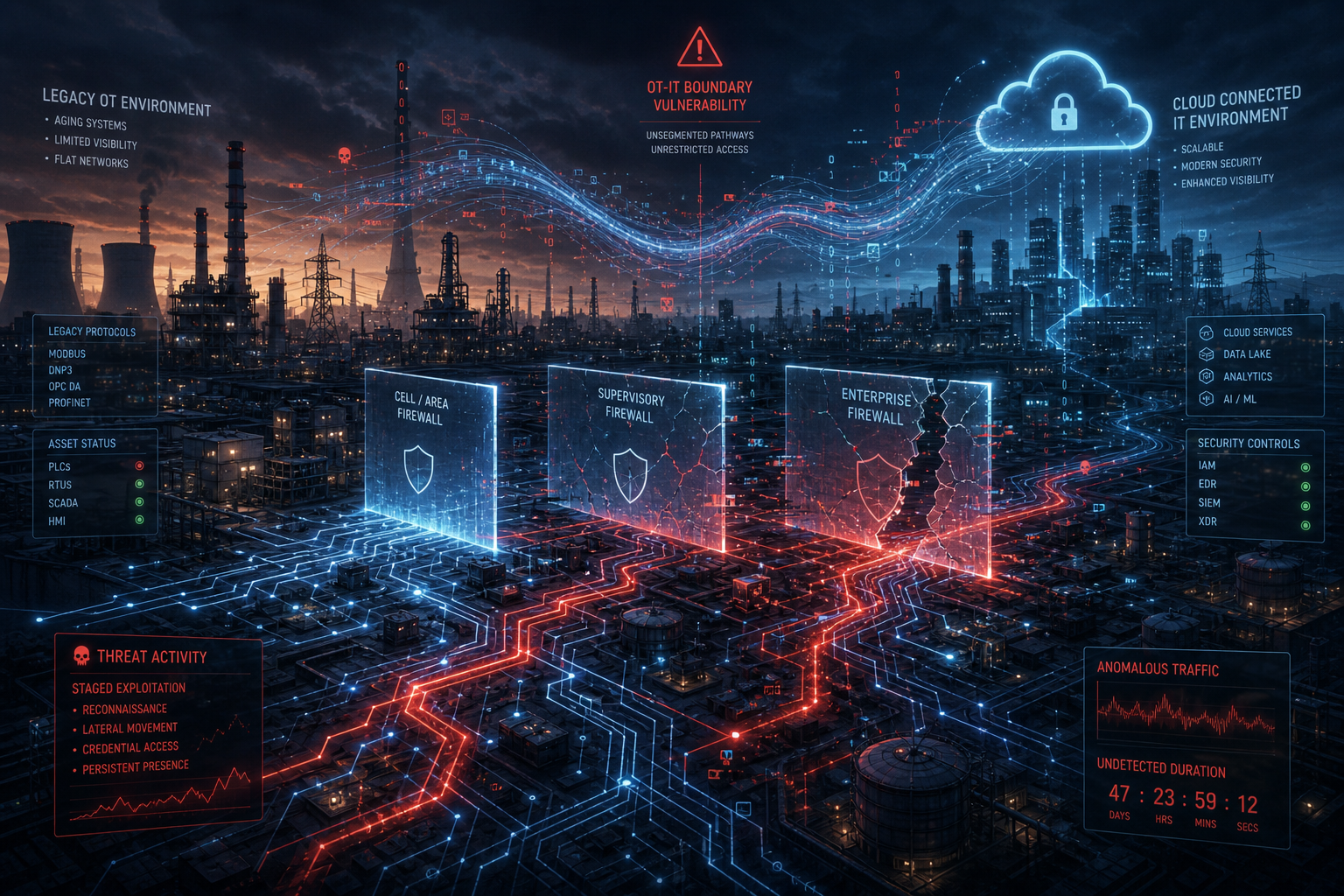
This shift reflects threat actor advancement from capability demonstration to operational readiness, driven by widespread adoption of hybrid cloud-connected OT-IT environments that eliminate traditional air-gap protections while introducing IT vulnerability pathways into previously isolated industrial networks. Critical infrastructure operators currently face a 60–90 day operational window to implement detection, segmentation, and patch management protocols before threat actors transition to active disruption phases.
Organizations lacking OT-specific security architecture, cross-functional incident response coordination, and firmware update discipline face substantially elevated risk of undetected lateral movement, persistence establishment, and operational continuity failure.
Key Finding: Active exploitation campaigns targeting Siemens S7-1200/1500 series PLCs have shifted from isolated proof-of-concept attacks to coordinated multi-stage reconnaissance of critical infrastructure SCADA networks, with initial access exploiting unpatched firmware vulnerabilities and legacy authentication mechanisms in hybrid OT-IT environments.
What Happened
Between Q2 and August 2026, coordinated scanning activity against Siemens S7-series PLCs emerged across three regional transmission operator zones in the U.S. Midwest and Mid-Atlantic regions. On August 18, 2026, the U.S. Department of Defense released a formal Cybersecurity Alert documenting active exploitation attempts against these systems. One week later, on August 25, 2026, Kaspersky's ICS-CERT published a comprehensive threat landscape report identifying a 47 percent increase in Industrial Automation Systems (IAS) targeting campaigns since Q1 2026. On August 28, 2026, the Cybersecurity and Infrastructure Security Agency (CISA) issued advisory AA26-231a recommending immediate patching and network segmentation protocols. Simultaneously, Dragos threat intelligence tracking identified persistent tactics, techniques, and procedures (TTPs) consistent with nation-state reconnaissance infrastructure.
The observed attack progression follows a multi-stage sequence characteristic of pre-incident operational preparation. Initial access exploits a firmware authentication vulnerability within Siemens S7-series PLCs, combined with credential enumeration via internet-facing asset discovery platforms (Shodan, Censys) and persistence of default credentials in legacy installations. Threat actors have demonstrated advancement toward firmware-level persistence through PLC rootkit installation, bootloader modification, and credential store manipulation—techniques requiring sustained system access and advanced PLC engineering knowledge.
Lateral movement patterns across affected facilities exploit the OT-IT network boundary, a critical vulnerability in hybrid environments where traditional air-gap isolation has been compromised by cloud connectivity, remote access infrastructure, and synchronized historian databases. Engineering workstations and SCADA historian servers have been identified as primary lateral movement pivots. Geographic concentration among regional transmission operators (RTOs) and water treatment facilities in North America suggests deliberate prioritization by infrastructure criticality and strategic grid topology rather than opportunistic targeting.
This campaign differs fundamentally from prior isolated PLC exploitation incidents in its operational tempo and resource allocation: coordinated reconnaissance across multiple facilities, parallel credential harvesting operations, and demonstrated advancement toward persistence installation without triggering immediate service disruption. Threat actors have maintained a low-visibility posture consistent with preparation for future coordinated action, avoiding functional impact that would trigger defensive escalation. This pattern indicates an adversary with sufficient operational resources, intelligence collection capacity, and strategic patience to invest in multi-month staging phases.
Attribution remains incomplete pending forensic validation across additional compromised systems. Infrastructure reuse patterns and operational security practices overlap with historically tracked nation-state campaigns; targeting specificity and resource intensity suggest advanced persistent threat (APT) capabilities. No definitive attribution statement has been issued by threat intelligence vendors or U.S. government agencies.
Why It Matters
Security Practitioners and Operations Teams
Industrial Automation Systems control energy distribution, water purification, chemical processing, and transportation networks affecting millions of individuals. The transition from air-gapped legacy environments to hybrid cloud-connected OT-IT architectures has fundamentally altered threat surface exposure. Seventy-eight percent of surveyed critical infrastructure operators report inadequate visibility into OT network traffic following cloud connectivity deployment, creating detection blind spots during lateral movement and persistence phases. Legacy PLC firmware remains unpatched in 52 percent of active installations due to operational continuity constraints and manufacturer support limitations—a structural vulnerability persisting across 5–10 year legacy system lifecycles. The shift from passive reconnaissance to staged exploitation preparation indicates threat actor advancement from capability demonstration to operational readiness. Coordination across multiple geographic regions suggests resource allocation and targeting prioritization aligned with strategic infrastructure disruption objectives. The multi-stage attack progression—scanning, credential harvesting, PLC firmware analysis, persistence installation—represents a pre-incident phase of larger campaign architecture. Critically, the absence of immediate financial motivation or extortion activity suggests threat actor objectives extend beyond ransomware or data theft toward potential disruptive attack scenarios with strategic consequences.
Security Leaders and Infrastructure Management
Successful PLC compromise enables remote process manipulation, creating cascading risks across operational continuity, physical safety, and regulatory compliance. Firmware-level rootkits can modify operator interface displays and safety interlocks, creating hazardous conditions for facility personnel. PLC compromise automatically triggers breach reporting obligations under NERC CIP (energy sector), NIST Cybersecurity Framework assessment requirements, and ISA/IEC 62443 compliance frameworks. Public disclosure of compromise to critical energy or water infrastructure generates substantial institutional credibility loss and potential customer, investor, and stakeholder confidence erosion. Organizationally, infrastructure compromise creates secondary workforce stress effects. Operations and engineering staff experience elevated operational anxiety when detection and response capabilities prove inadequate; high-consequence environments amplify personnel error rates during stress conditions. Incident response preparation directly correlates with operational team confidence and decision-making quality during actual compromise scenarios.
Policy-Aware Leadership and Regulatory Functions
The campaign represents potentially coordinated targeting of critical U.S. infrastructure with implications for energy grid resilience and public water system integrity. Coordination across multiple facilities, combined with apparent nation-state TTP characteristics, may indicate strategic targeting aligned with geopolitical objectives or contingency planning for future conflict scenarios. Regulatory pressure for mandated firmware patching timelines, vulnerability disclosure protocols, and OT-specific security architecture will likely accelerate following this disclosure cycle. Insurance implications are materializing: increased claims frequency and premium escalation for critical infrastructure operators are documented in Q2 2026 insurance market data. Vendor ecosystem fragmentation—where legacy systems lack modern security architecture and replacement cycles extend 10–15 years—creates structural barriers to rapid remediation, extending institutional vulnerability windows across the sector.
Operational Implications
Detection Capability Gaps: Standard IT-focused Security Information and Event Management (SIEM) tools lack OT protocol decoders necessary for anomaly detection within Modbus, Profinet, and S7 communication channels. This creates fundamental visibility deficits: legitimate OT network activity appears as undifferentiated traffic, while exploitation-related modifications to setpoints, control logic, or safety parameters may remain undetected. Network segmentation in 67 percent of surveyed environments remains permissive enough to allow undetected lateral movement from IT to OT zones, eliminating containment at the OT-IT boundary. Baseline establishment for normal OT network behavior is incomplete in the majority of installations; detection threshold calibration remains insufficient to distinguish anomalies from normal operational variance. Forensic capability for PLC firmware analysis is concentrated in small specialized teams at vendor organizations and national laboratories; distributed incident response capacity at individual operator level is effectively absent.
Incident Response Readiness: Approximately 34 percent of critical infrastructure operators lack documented OT-specific incident response procedures. Existing Security Orchestration, Automation and Response (SOAR) and Endpoint Detection and Response (EDR) platforms lack OT protocol handlers, requiring manual analysis for IAS event investigation and substantially extending mean time to respond (MTTR). Containment presents an operational dilemma: air-gapping a compromised PLC to prevent further lateral movement creates production continuity conflicts; remediation windows are severely constrained by continuous operation requirements in energy and water treatment environments. Forensic preservation of volatile memory and control logic from PLCs requires specialized hardware knowledge and serialization procedures; chain-of-custody protocols remain undefined in the majority of organizations.
Workforce Capability Mapping: The industry faces a critical specialization gap: personnel with simultaneous IT security and industrial control systems engineering expertise remain scarce across the sector. Operations staff, engineering teams, and IT security functions operate with incomplete shared threat model understanding, creating communication delays and misaligned prioritization during incident response. Formal OT cybersecurity curriculum is limited; industry certifications (GICSP, CompTIA CySA+) lack depth in PLC exploitation methodologies and post-compromise forensics. Critical infrastructure personnel operate under continuous monitoring assumption; alert fatigue and false positive noise degrade analyst effectiveness, particularly among teams lacking OT-specific training.
Technical Debt and Legacy Infrastructure: Siemens S7-1200 series PLCs released between 2009 and 2012 will reach manufacturer support end-of-life in 2027 for certain product lines. Approximately 38 percent of active PLC installations operate end-of-life products with no security patch availability. Capital expenditure for replacement or modernization is constrained by multi-year budget cycles; legacy systems are expected to remain operational 5–10 additional years. Patch testing cycles require 6–12 months for validation and deployment, insufficient for emerging threat response; organizational risk tolerance prevents rapid unvalidated deployment that could disrupt production continuity. The convergence of these factors—detection blindness, incomplete response readiness, workforce specialization gaps, and structural technical debt—creates a prolonged vulnerability window during which threat actors can maintain undetected presence and advance toward disruptive capabilities.
Recommended Actions
Actions are organized by organizational security maturity. Baseline controls apply across all tiers and should be treated as immediate priorities regardless of organizational size.
* Organizations of all maturity levels should prioritize immediate inventory and segmentation.
- 1 - Conduct IAS Inventory Audit. Document all Siemens S7-series PLC instances with firmware versions, network connectivity status, and access control configurations. Enumerate all engineering workstations, historian databases, and remote access infrastructure connected to OT networks. Validation: 100 percent of PLCs enumerated with documented firmware versions and network topology mapped.
- 2 - Implement Network Segmentation. Isolate OT traffic from IT networks using firewall rules and VLAN enforcement; block unauthorized cross-zone traffic at the OT-IT boundary with deny-by-default policies. Validation: Zero unauthenticated traffic crossing the boundary; firewall rule audit completed and documented.
- 3 - Deploy OT-Specific Network Monitoring. Install Zeek or Suricata with ICS protocol decoders to capture S7 communication patterns and establish baseline network behavior. Configure alerts for abnormal protocol usage, unauthorized PLC access, or firmware modification attempts. Validation: Baseline network behavior established; S7 communication patterns analyzed for anomalies.
- 4 - Prioritize Firmware Patch Assessment. Inventory Siemens S7-1200/1500 series for patch compatibility and operational impact. Engage Siemens technical support to understand patch dependencies and deployment constraints. Establish isolated testing environment for patch validation. Validation: Patch compatibility assessment completed; testing environment operational.
- 5 - Establish OT Incident Response Working Group. Convene cross-functional team (operations, engineering, IT security, compliance) to develop OT-specific incident response procedures. Define roles, escalation authorities, and decision-making protocols for compromise scenarios. Validation: Incident response playbook initiated; roles and escalation procedures documented.
* Organizations with established security teams should advance detection and response capabilities.
- 1 - Deploy OT-Capable Endpoint Detection and Response. Install EDR agents on all engineering workstations, historian servers, and OT-adjacent IT systems. Configure for OT-specific behavior analysis including unusual process execution, credential access, and file system modifications. Validation: EDR deployed on 100 percent of target systems; baseline behavior established.
- 2 - Implement Credential Management. Execute mandatory credential rotation for all PLC administrative and service accounts; disable default credentials across all devices. Implement centralized authentication where technically feasible; establish credential audit logs for forensic analysis. Validation: Credential audit completed; authentication logs operational.
- 3 - Conduct Adversarial Tabletop Exercise. Simulate PLC compromise scenario with full cross-functional participation, including detection, containment, forensics, and communication procedures. Document identified gaps and assign remediation actions with completion dates. Validation: Exercise findings documented; playbook gaps assigned and tracked.
- 4 - Formalize Firmware Update Protocol. Establish documented procedures for patch testing, validation, and deployment. Escalate vendor support relationships to ensure expedited patching availability for critical vulnerabilities. Create expedited deployment pathway for emergency security patches. Validation: Patch testing SOP finalized and approved; vendor escalation procedures documented.
- 5 - Enable Enhanced Forensic Monitoring. Configure extended data collection on historian databases and engineering workstations; capture process execution logs, network flows, and file access patterns with minimum 90-day retention. Validation: Forensic data collection operational; retention policy documented.
* Organizations with mature security programs should undertake architectural transformation.
- 1 - Implement Zero-Trust Architecture for OT-IT Boundary. Deploy authentication and authorization requirements for all cross-zone traffic. Require multi-factor authentication for engineering access to PLCs. Establish continuous trust verification based on device posture and user behavior. Validation: Zero-trust policies deployed; legacy access exceptions documented with remediation roadmap.
- 2 - Deploy Industrial Protocol-Aware Intrusion Detection System. Implement IDS with behavioral baseline analysis for OT protocols. Customize detection signatures for facility environment and normal operational parameters; tune for false positive reduction while maintaining detection sensitivity. Validation: IDS signatures customized and deployed; detection tuning completed.
- 3 - Establish OT Cybersecurity Competency Program. Identify 3–5 internal personnel for advanced OT security specialization training. Support industry certifications (GICSP, SANS, vendor-specific) and create career development pathway for OT security specialization. Validation: Training curriculum developed; minimum 5 personnel achieve OT security certifications.
- 4 - Engage in Industry Information Sharing. Establish relationships with relevant Information Sharing and Analysis Centers (ISACs); participate in threat intelligence sharing communities. Contribute operational observations from your environment to collective threat landscape understanding. Validation: ISAC relationships established; threat intelligence sharing protocols operational.
- 5 - Develop Multi-Year Modernization Roadmap. Create capital plan for legacy system replacement prioritizing highest-risk PLC installations. Allocate budget across 3–5 year horizon; identify interim compensating controls for systems not scheduled for near-term replacement. Validation: Replacement roadmap completed; budget phased across multi-year cycle.
Closing Statement
The observed shift from reconnaissance to staged exploitation represents a maturation of threats against critical infrastructure OT networks. This campaign demonstrates that the convergence of legacy industrial systems, hybrid cloud connectivity, and persistent advanced threat actors creates a structural vulnerability landscape that will persist across decade-long infrastructure lifecycles. The 60–90 day window for remediation action before threat actors transition from preparation to active disruption is neither speculative nor indefinite; organizations that delay segmentation, detection, and patch management decisions substantially increase probability of undetected compromise.
Institutional resilience in OT environments depends not on technological solutions alone but on distributed threat model comprehension across operations, engineering, and security functions; coordinated incident response capabilities; and sustained commitment to workforce development in an emerging specialization domain. The awareness imperative extends beyond individual practitioners to organizational leadership: OT cybersecurity represents a foundational infrastructure stewardship responsibility, not a discretionary technology initiative. The sector's collective ability to detect, contain, and recover from advanced threats to critical systems directly determines both operational continuity and public confidence in infrastructure resilience.