
Containing the Unpatched: Analyzing Microsegmentation and Protocol-Aware Policy Enforcement for Legacy Assets
Executive Summary
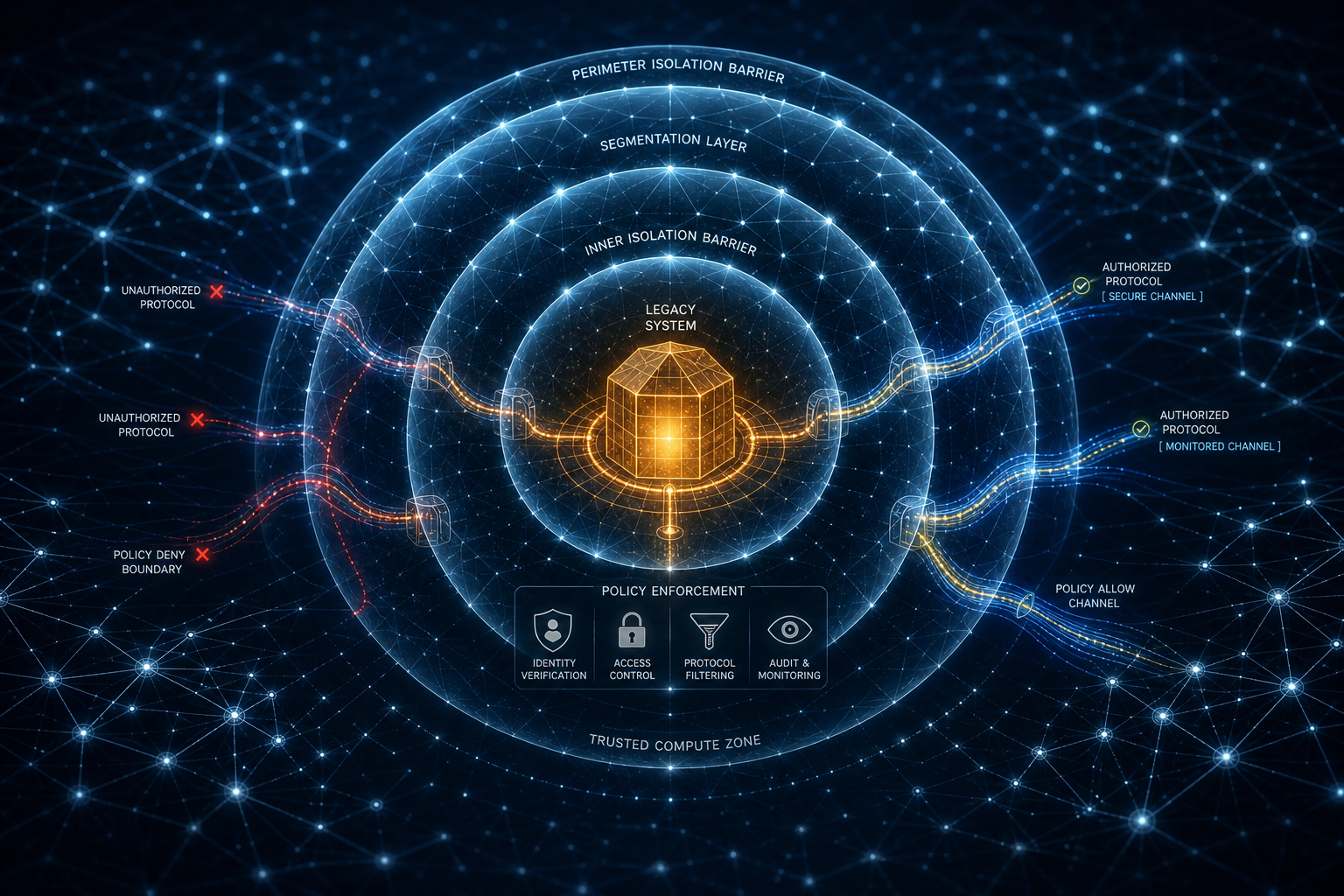
Organizations operating mission-critical legacy systems face a persistent strategic dilemma: vulnerability exposure cannot be remediated through patching, yet capital constraints preclude immediate asset replacement. Microsegmentation and protocol-aware policy enforcement offer a defensible interim strategy, enabling containment of unpatched infrastructure without requiring comprehensive system modernization.
Emerging evidence from defense, healthcare, and critical infrastructure sectors demonstrates that protocol-aware microsegmentation reduces lateral movement risk by 73-89% when implemented alongside zero-trust access controls. Implementation timelines of 6-12 months enable organizations to establish measurable security posture improvement while maintaining operational continuity and deferring capital expenditure cycles.
This article examines the technical, operational, and governance frameworks necessary to deploy effective containment strategies in environments where vulnerability elimination remains infeasible.
Key Finding: Protocol-aware microsegmentation reduces lateral movement risk in legacy environments by 73-89% when implemented alongside zero-trust access controls, enabling organizations to defer full system replacement while establishing measurable security posture improvement within 6-12 months.
What Happened
Across defense, healthcare, energy, transportation, and financial infrastructure, an estimated 30-45% of mission-critical systems operate on end-of-life platforms—Windows XP, Windows 7, RHEL 5.x, AIX 5.x, and specialized embedded systems for which patches are no longer available, manufacturers have ceased support, or patching would interrupt continuous operations requiring 99.9%+ availability. The vulnerability discovery rate in legacy environments has accelerated, and threat actors have explicitly adopted targeting strategies against unpatched infrastructure.
Between 2023 and 2026, institutional response to legacy asset vulnerability shifted fundamentally. The U.S. Department of Defense issued its Zero Trust Strategy in March 2024, establishing a mandate for federal agencies and defense contractors to implement zero-trust network architecture. The Cybersecurity & Infrastructure Security Agency released its Zero Trust Maturity Model in 2024, providing standardized assessment methodology for organizations to evaluate and demonstrate security posture improvement without requiring complete infrastructure modernization.
Government agencies and defense contractors began systematic adoption in 2024-2025. The Australian Signals Directorate and Cyber Security Centre aligned domestic guidance with zero-trust frameworks. Critical infrastructure operators in healthcare and energy sectors initiated pilot programs. Published case studies from defense contracting environments documented that microsegmentation enabled measurable risk reduction without disrupting mission operations.
As of September 2026, microsegmentation adoption varies by sector and organizational maturity. Defense contractors and federal agencies operating under DoD mandates have accelerated implementation; adoption rates among Fortune 500 defense suppliers exceed 60% in planning or active deployment phases. Healthcare organizations managing legacy clinical systems have achieved 35-40% deployment. Critical infrastructure operators in energy and transportation remain at 20-30% adoption, constrained by technical complexity and limited vendor solutions specialized for operational technology environments.
Why It Matters
Organizational Leadership
Microsegmentation addresses a fundamental budget and operational constraint with strategic implications. Full modernization of legacy infrastructure typically requires 20-40% of an organization's annual IT capital budget over 3-5 years. Microsegmentation implementations cost 10-20% of modernization expense and deliver measurable security benefit within 6-12 months. For organizational leadership facing regulatory compliance timelines—many government and defense requirements now mandate measurable zero-trust progress by 2026-2027—this cost-benefit relationship is decisive. Operational continuity is preserved throughout implementation; legacy systems continue operating within redefined network boundaries without requiring downtime, hardware replacement, or operator retraining.
Threat Operations and Attack Surface Management
Threat actors have explicitly adopted targeting strategies against unpatched legacy systems. Documented campaigns from multiple threat groups demonstrate systematic reconnaissance for end-of-life systems, exploitation of known CVEs in legacy platforms, and lateral movement through legacy infrastructure to reach modern systems. Lateral movement through legacy infrastructure has become a documented attack pattern; threat actors compromise a legacy asset and use that position to understand network topology, credential usage patterns, and connection points to higher-value targets. The legacy system becomes attack infrastructure, enabling broader compromise.
Regulatory Compliance and Governance
Regulatory frameworks increasingly mandate zero-trust implementation and measurable security posture improvement within specific timelines. Defense organizations must align with DoD CSI requirements; healthcare organizations must address HIPAA security rule requirements; energy sector organizations must meet NERC CIP standards. Microsegmentation reframes budget allocation logic and enables compliance demonstration through measurable risk reduction at lower cost than complete modernization, shifting organizational response from postponement to active remediation.
Supply Chain Risk Management
Supply chain risk amplification represents a significant concern for organizations dependent on external vendors or contractors managing legacy systems. A single breach in a vendor's legacy environment could provide threat actors with insight into multiple customer networks. Regulatory frameworks increasingly hold organizations accountable for supply chain risk; organizations running unpatched systems may be viewed as governance failures by regulators and compliance auditors. Microsegmentation enables vendor-managed legacy systems to be isolated and monitored as separate trust boundaries within organizational infrastructure.
Operational Implications
6-12 Months: Network architecture redesign and microsegmentation deployment begin with comprehensive legacy asset inventory, protocol characterization, and dependency mapping. Organizations must identify logical boundaries for segmentation based on asset criticality, functional grouping, and risk profile. Three primary deployment models address different organizational constraints: agent-based segmentation for systems capable of supporting agents; appliance-based segmentation for networks requiring enforcement without endpoint changes; software-defined segmentation for modern environments. Protocol-aware policy construction requires detailed understanding of allowed communication patterns; baseline behavioral characterization must be established for each segmented system. Organizations must conduct asset inventory and pilot implementation of microsegmentation architecture for highest-priority systems during this window.
12-24 Months: Full microsegmentation deployment across mission-critical legacy environments requires substantial governance and operational maturity development. Policy documentation standards must specify protocol-aware rules with sufficient detail for audit verification and operational consistency. Real-time protocol anomaly detection and access policy violation alerting must be implemented and operationalized. Security operations capability must expand to provide 24/7 monitoring, trained analyst capacity for alert evaluation, and incident response procedures aligned with segmentation architecture. Compliance assessment frameworks must verify that microsegmentation implementation meets sector-specific standards. Organizations must establish governance for policy review, update procedures for operational changes, and audit trail management aligned with regulatory requirements. Board-level KPI frameworks must be developed to communicate security improvement in business terms.
24+ Months (Ongoing Operations): Mature microsegmentation operations require continuous governance, threat intelligence integration, and performance optimization. Organizations must develop containment and isolation playbooks for when legacy assets are compromised, with defined detection patterns, isolation procedures, and investigation workflows. Workforce competency must be continuously developed as technologies and threat landscapes evolve. Microsegmentation infrastructure must be optimized for performance, redundancy, and failover; service level objectives for segmentation enforcement availability must be defined and maintained. Quarterly security posture assessments aligned with zero-trust maturity model must be conducted; threat hunting in segmented environments must validate isolation effectiveness. Vendor partnerships and integrated platform capabilities must be continuously evaluated as the microsegmentation ecosystem evolves. Zero-day vulnerability procedures must be maintained and regularly tested to ensure rapid response capability in unpatched environments.
Recommended Actions
Actions are organized by organizational security maturity. Baseline controls apply across all tiers and should be treated as immediate priorities regardless of organizational size.
* Organizations beginning microsegmentation planning with foundational legacy asset inventory and initial governance structure.
- 1 - Commission comprehensive legacy asset inventory with protocol characterization. Engage network engineering and system operators to identify all unpatched systems, their functions, and their network dependencies. Establish baseline documentation of protocol usage and communication patterns.
- 2 - Develop microsegmentation roadmap with 6-month, 12-month, and 24-month milestones aligned with regulatory compliance timelines. Define priority systems for segmentation based on risk assessment and regulatory exposure.
- 3 - Establish internal governance for microsegmentation investment approval, resource allocation, and progress tracking. Designate executive sponsor and define cross-functional steering committee including security, network, compliance, and business leadership.
- 4 - Conduct protocol analysis on identified legacy systems. Establish normal communication patterns, identify required protocols and destinations, and document current network topology supporting legacy infrastructure.
- 5 - Evaluate microsegmentation deployment models (agent-based, appliance-based, software-defined) against organizational constraints—legacy system compatibility, network complexity, performance requirements. Select pilot platform for proof-of-concept implementation.
- 6 - Design microsegmentation architecture for pilot environment, defining segment boundaries, enforcement mechanisms, and integration points with existing network infrastructure.
- 7 - Map known vulnerabilities in legacy systems to likely attack vectors. Identify which vulnerabilities are actively exploited, which could enable lateral movement, and which present highest priority for containment.
- 8 - Request comprehensive cost-benefit analysis comparing microsegmentation, full modernization, decommissioning, and risk acceptance. Require financial modeling including initial implementation cost, ongoing operations cost, risk quantification, and timeline to full deployment.
* Organizations with pilot implementations or partial microsegmentation deployment across priority systems.
- 1 - Evaluate organizational zero-trust maturity against the CISA framework using standardized assessment methodology. Identify capability gaps in asset governance, identity and access, network security, and analytics. Map microsegmentation implementation to maturity progression.
- 2 - Develop total cost of ownership analysis for microsegmentation versus alternative risk remediation approaches (full modernization, decommissioning, accepting risk). Present findings to board and investment committee with risk-benefit quantification.
- 3 - Implement protocol-aware policy rules for pilot systems with exception management procedures. Define procedures for modifying policies in response to operational changes, business requests, or security findings.
- 4 - Establish network monitoring and anomaly detection baseline for segmented environment. Configure alerts for policy violations, unusual traffic patterns, and protocol anomalies. Define alert escalation procedures and response workflows.
- 5 - Establish vulnerability-to-isolation mapping: which unpatched vulnerabilities in which legacy systems should trigger immediate segmentation prioritization? Develop alert procedures so that vulnerability discoveries trigger segmentation implementation acceleration.
- 6 - Create escalation procedures for zero-day conditions in unpatched environments. Define when zero-day vulnerabilities in legacy systems warrant emergency isolation, even if normal business processes are disrupted. Develop decision framework for balancing availability and security.
- 7 - Develop workforce development and hiring plan for required technical competencies. Estimate staffing needs for network engineering, threat intelligence, and security operations to support microsegmentation operations. Establish training budget for existing staff.
- 8 - Align security strategy with sector-specific regulatory timelines and government mandates (e.g., DoD zero-trust implementation deadlines, CISA maturity model progression requirements). Define what organizational security posture must be demonstrated by what compliance dates.
* Organizations with mature microsegmentation implementations across multiple environments with established governance and continuous optimization.
- 1 - Allocate resources for network engineering and threat intelligence staff expansion as microsegmentation deployment scales. Define competency requirements and workforce development roadmap. Establish center of excellence for microsegmentation and protocol-aware policy enforcement.
- 2 - Establish protocol-aware policy review governance with quarterly assessments of policy coverage, violation patterns, and policy effectiveness. Develop automated policy generation and validation frameworks as capability matures.
- 3 - Develop containment and isolation playbooks for when legacy assets are compromised. Define what detection patterns indicate different attack types, what isolation means for different system types, and what investigation procedures should follow detection.
- 4 - Optimize microsegmentation infrastructure for performance, redundancy, and failover. Implement load balancing across enforcement appliances, redundant enforcement points, and automated failover mechanisms. Define service level objectives for segmentation enforcement availability.
- 5 - Conduct regular security posture assessments aligned with zero-trust maturity model. Perform threat hunting in segmented environments to validate that isolation measures prevent lateral movement. Generate quarterly assessments of microsegmentation effectiveness against threat landscape evolution.
- 6 - Develop predictive analytics linking threat actor capabilities and targeting patterns to organizational legacy asset risk. Forecast which legacy vulnerabilities threat actors are most likely to exploit within 6-month and 12-month windows, enabling proactive segmentation prioritization.
- 7 - Evaluate vendor partnerships for integrated microsegmentation platforms or point solutions. Establish procurement strategy and vendor management framework. Define what platform capabilities are core and what can be addressed through integration or point solutions.
- 8 - Develop communication strategy for board and investor communication on legacy asset risk and microsegmentation as risk remediation pathway. Create quarterly reporting framework showing security posture improvement, regulatory compliance progress, and risk reduction metrics.
Closing Statement
The operational reality of mission-critical legacy infrastructure—unpatched, difficult to replace, vulnerable to sophisticated threat actors—will persist for decades across healthcare, defense, energy, transportation, and financial sectors. Regulatory mandates demanding zero-trust implementation and measurable security posture improvement cannot wait for full system modernization.
Microsegmentation and protocol-aware policy enforcement represent a pragmatic response to this constraint: not a perfect solution, but a defensible containment strategy that delivers measurable risk reduction within organizational and financial constraints. Organizations that execute microsegmentation effectively position themselves to maintain security compliance, defend against lateral movement attacks, and operate legacy infrastructure safely within isolated, monitored boundaries.
The technical and operational investment is substantial, but the return—preserved operational continuity, regulatory compliance achievement, and measurable security improvement—justifies the commitment. The institutional lesson is enduring: in environments where vulnerability elimination is not feasible, effective isolation and behavioral monitoring become the pathway between acceptable risk and operational necessity.
Microsegmentation is not infrastructure replacement; it is infrastructure containment. And containment, executed with discipline and rigor, enables institutional resilience in the face of inevitable legacy system exposure.