
Patching at the Perimeter: Analyzing Deep Packet Inspection and Protocol Sanitation in Gateway Security
Executive Summary
Organizations unable to deploy security patches within operational windows—due to system criticality, vendor delays, or supply chain constraints—increasingly rely on gateway-level controls to reduce exploitable exposure. Virtual patching, implemented through deep packet inspection (DPI) and protocol-level sanitation at network gateways, offers measurable risk mitigation during patch cycles but functions as a temporary compensating control, not a permanent solution.
This article examines the technical architecture, institutional deployment models, and governance requirements for effective gateway-based protection in enterprise and industrial control system environments. The central strategic requirement is clear: organizations must integrate virtual patching into documented remediation roadmaps with explicit patch timelines, establish maximum duration policies (typically 90 days), and recognize that gateway controls alone cannot substitute for comprehensive vulnerability management.
Key Finding: Virtual patching and gateway-based protocol sanitation provide measurable risk reduction during patch windows but function as temporary compensating controls rather than permanent security solutions; their effectiveness depends on precise protocol specification, continuous rule maintenance, and explicit integration within comprehensive vulnerability management strategies—rendering them insufficient as standalone defenses in environments where patch deployment can be deferred indefinitely.
What Happened
Virtual patching has emerged as widespread institutional practice over the past decade, driven by operational constraints that make timely patch deployment infeasible. The adoption reflects a fundamental tension in modern security operations: the accelerating speed of vulnerability disclosure and exploit availability conflicts with the operational realities of system maintenance windows, vendor release cycles, and critical infrastructure uptime requirements.
Three primary adoption patterns characterize current deployment. First, organizations managing legacy systems past vendor end-of-life rely on gateway controls because security patches are no longer available. Second, critical infrastructure operators—particularly in industrial control systems—face rigid uptime requirements and deterministic network environments where patch installation can trigger unplanned downtime lasting days or weeks. Third, enterprises managing geographically distributed or supply-chain-dependent systems encounter vendor-imposed patch delays or compatibility constraints that prevent timely deployment.
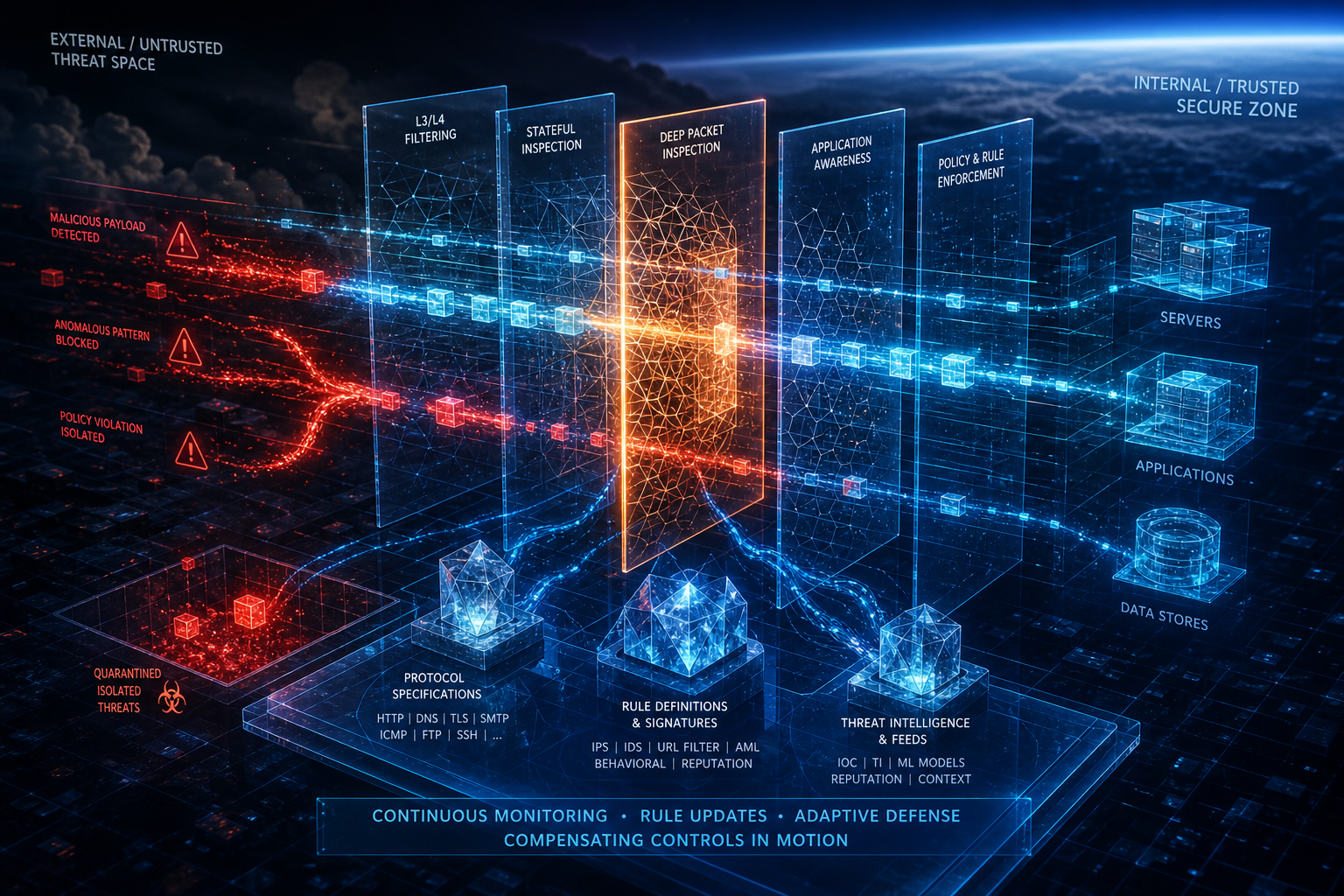
The technical foundation for gateway-level virtual patching rests on deep packet inspection (DPI), a network analysis technique that examines packet payloads and protocol state information beyond Layer 3-4 routing decisions. DPI enables systems to identify specific vulnerability patterns, validate protocol compliance, reject malformed traffic, and apply application-layer filtering rules. Modern implementations examine network traffic at Layers 4 through 7 (transport through application), enabling detection of exploitable patterns embedded in legitimate-appearing network flows.
Current deployment mechanisms span several appliance categories. Next-generation firewalls (NGFWs) integrate DPI with traditional firewall functions, offering Layer 4-7 inspection of enterprise protocols including SMB, RDP, HTTP, and email systems. Intrusion prevention systems (IPS) specialize in signature-based detection and packet modification, providing broad protocol coverage with varying degrees of encrypted traffic handling. Industrial-purpose gateways, designed specifically for environments running Modbus, Profibus, OPC-UA, or DNP3 protocols, enforce protocol-state validation and command sequence rules with deterministic latency profiles suitable for real-time control systems.
Virtual patching rules operate through vulnerability-specific signatures that detect and block (or modify) network traffic patterns matching known exploit methodologies. For example, remote code execution vulnerabilities in SMB exploitable through malformed packet sequences can be addressed by gateway rules rejecting packets violating SMB protocol state machines. SQL injection vulnerabilities accessible through HTTP query parameters can be constrained by rules validating HTTP request structure.
The technical architecture differs significantly between enterprise and industrial control system environments. Enterprise deployments typically operate in encrypted network contexts where SSL/TLS traffic predominates. This reality fundamentally limits gateway inspection capability: encrypted payloads cannot be analyzed for vulnerability patterns unless the gateway performs SSL/TLS decryption. Enterprise gateways therefore often employ flow-level analysis examining connection metadata rather than payload content, or operate in selective decryption modes targeting high-risk protocols.
Industrial control system deployments, by contrast, typically operate in deterministic, lower-encryption environments where payload inspection remains feasible. ICS protocols often transmit commands and data in plaintext or with application-level encryption rather than transport-layer protection. This permits direct inspection of protocol semantics: validating that register addresses fall within acceptable ranges, rejecting malformed command sequences, or enforcing timing constraints required for safe equipment operation.
Both deployment contexts share a common operational requirement: continuous rule maintenance and effectiveness monitoring. Vulnerability disclosures trigger rule development or vendor-provided updates. Protocol variants and system-specific implementations require rule tuning to prevent false positives (legitimate traffic blocked) or false negatives (exploitable traffic permitted). Organizations must establish processes for rule versioning, testing in non-production environments, monitoring rule-trigger rates in production, and retiring rules once permanent patches are deployed.
Why It Matters
Security Operations Practitioners
Virtual patching enables risk reduction during periods when permanent remediation is impossible. Without gateway controls, organizations managing patch windows exceeding several weeks face unmitigated exposure to actively exploited vulnerabilities. The ability to deploy rules within hours—rather than awaiting vendor releases, change control windows, or maintenance scheduling—provides tactical risk management aligned with operational reality. However, this capability creates organizational risk if treated as a permanent solution. Practitioners must communicate clearly to management that virtual patching is temporary, establish escalation procedures when rules expire, and integrate virtual patch status into vulnerability dashboards and reporting.
Industrial Control System Operators
The significance is particularly acute. ICS environments often operate with rigid availability requirements: power grids, water treatment systems, and manufacturing facilities cannot tolerate frequent patches or associated downtime. Many legacy ICS systems run decades-old software with limited patch availability. Virtual patching at the network gateway—between external networks and internal control zones—provides defense-in-depth protection without modifying the legacy systems themselves. This aligns with security architecture standards including ISA/IEC 62443, which mandates layered defense and explicitly recognizes compensating controls when system modification is operationally infeasible.
Enterprise Risk and Compliance Officers
Virtual patching creates documented compensating controls that demonstrate reasonable security measures to internal risk committees, external auditors, and regulatory authorities. When a vulnerability cannot be patched within agreed SLAs, a documented gateway rule blocking exploitable traffic provides evidence of active risk mitigation. This is particularly relevant in regulated environments (financial services, healthcare, utilities) where vulnerability management and patch compliance are auditable controls. The compensating control must be documented with explicit risk acceptance and a remediation timeline, but it provides institutional protection against claims of security negligence.
Enterprise Architecture and Security Leadership
Virtual patching informs strategic decisions around network design, encrypted traffic handling, and vulnerability management investment. Organizations deploying extensive encrypted traffic—prevalent in modern enterprises—may find gateway-level virtual patching increasingly ineffective without SSL/TLS decryption, which introduces performance and privacy costs. This reality drives architectural conversations about network segmentation, internal encryption policies, and trade-offs between detection depth and operational friction. Virtual patching also influences remediation SLA setting: organizations with mature gateway control capabilities can justify longer patch windows for non-critical systems, while those lacking gateway infrastructure may need to enforce tighter patch SLAs to maintain acceptable risk levels.
All Stakeholders
Institutional Limitations and Risk: The significance of virtual patching must be understood within explicit constraints. Virtual patching cannot address vulnerabilities in encrypted traffic without decryption infrastructure. It is ineffective against zero-day exploits (vulnerabilities without known signatures or patterns). Protocol mutations and evasion techniques can bypass rules designed for standard protocol implementations. Most critically, virtual patching creates organizational risk if permitted to persist indefinitely: systems should never remain unpatched for extended periods merely because a gateway rule exists. Rule failure, misconfiguration, or evolution of the exploit beyond the rule's scope could leave systems unexpectedly exposed. A second-order consequence is institutional complacency. Organizations successful with gateway-based virtual patching may defer patch deployment indefinitely, creating technical debt and increasing risk when the compensating control eventually fails.
Operational Implications
Technical Prerequisites and Immediate Deployment: Organizations must possess deep understanding of target protocol specifications. A virtual patching rule for an SMB vulnerability requires knowledge of SMB state machine behavior, message sequencing, and legitimate traffic patterns. Industrial protocol rules require understanding of command sequences, register ranges, and timing constraints specific to each protocol and often to specific equipment models. This expertise gap is significant: many enterprise security teams lack deep protocol knowledge and must either hire specialized expertise, engage vendors for rule development, or operate with less-effective generic rules. Gateway placement within network architecture determines both effectiveness and latency impact. Centralized inspection at organizational perimeter boundaries protects all ingress/egress traffic but introduces latency affecting all north-south traffic flows. Distributed inspection at zone boundaries or internal network segments reduces latency exposure but requires coordination across multiple gateway instances and introduces complexity in rule consistency and maintenance.
Performance and Operational Considerations: Performance and latency considerations are frequently underestimated. Deep packet inspection introduces measurable processing overhead: a gateway performing full DPI on encrypted traffic (via decryption) may introduce 5-50 milliseconds of additional latency depending on appliance class, traffic volume, and rule complexity. Enterprise environments with millisecond-sensitive applications may experience unacceptable performance degradation. Industrial control systems with microsecond or sub-millisecond timing requirements may find DPI-based gateways unable to meet determinism constraints. Organizations must conduct performance baseline testing before and after rule deployment to validate that latency introduction remains acceptable.
Ongoing Operational Skill Requirements: Effective virtual patching requires skills often absent in standard security operations teams. Protocol analysis expertise enables evaluation of whether a vulnerability is suitable for gateway-level remediation or requires architectural changes (network segmentation, system isolation). Signature development or tuning capability is necessary when vendor-provided rules require modification for specific network environments. Continuous monitoring and triage responsibilities demand dedicated staff: false positive rates exceeding 5-10% typically render gateway controls operationally unmanageable as legitimate traffic begins to be blocked at unacceptable rates. Organizations often underestimate staffing requirements, leading to rule deployment followed by inadequate ongoing maintenance.
Medium-Term Integration and Governance: Virtual patching must integrate into formal vulnerability management workflow rather than existing as isolated gateway rules. Each virtual patch requires documentation linking it to specific CVEs or vulnerability classes, the expected patch completion date, and responsible parties for escalation if the date is exceeded. Vulnerability dashboards and reporting must distinguish between vulnerabilities addressed through permanent patches versus those mitigated only through gateway rules. This creates dual-tracking burden: vulnerability management systems track the vulnerability, while gateway management systems track the rule, and these must remain synchronized. Each virtual patch creates compliance and audit documentation requirements. The compensating control must be recorded in risk management systems with explicit risk acceptance by appropriate authority. The expected remediation date must be tracked and escalated if exceeded. Audit evidence must be maintained: gateway logs, rule change records, monitoring dashboards. Organizations often underestimate this burden, leading to inadequate documentation that fails to satisfy compliance requirements or creates audit findings.
Industrial Control System Specific Medium to Long-Term Implications: ICS deployments face additional constraints. Many legacy control systems communicate over proprietary or customized protocol implementations not well-documented in public specifications. Reverse-engineering protocol behavior for rule development can require extensive lab testing. State-based analysis—tracking protocol state across multiple messages—is often essential for ICS protocols but requires sophisticated gateway capabilities. Real-time constraints mean that rule failures or latency-induced delays can have physical consequences (equipment malfunction, safety risks), imposing higher testing and validation requirements before production deployment. The small scale of many ICS networks means that testing environments must closely replicate production architecture, increasing test costs. The prevalence of SSL/TLS encryption in modern networks fundamentally constrains gateway-level virtual patching. Organizations with encrypted internal traffic must choose between: (1) accepting that gateway inspection is ineffective for encrypted payloads; (2) deploying SSL/TLS decryption infrastructure (introducing performance costs, certificate management complexity, and privacy implications); or (3) segmenting networks to permit inspection of specific high-risk traffic flows. None are ideal solutions.
Recommended Actions
Actions are organized by organizational security maturity. Baseline controls apply across all tiers and should be treated as immediate priorities regardless of organizational size.
* Organizations with standard security tooling and general-purpose endpoint protection.
- 1 - Inventory vulnerabilities that cannot be patched within acceptable risk timelines and document the specific constraint preventing patching: operational system criticality, vendor delay, end-of-life status, or supply chain dependency.
- 2 - Evaluate whether existing network gateways (NGFW, IPS) already provide DPI capability and prioritize sourcing vendor-provided rule sets from appliance manufacturers rather than developing custom signatures.
- 3 - Establish a 90-day maximum duration policy: any virtual patch exceeding 90 days without permanent remediation triggers escalation to security leadership and affected system owners.
- 4 - Document compensating controls in risk management systems with clear risk acceptance by appropriate authority (CISO or risk committee).
* Organizations with dedicated security operations team and established vulnerability management processes.
- 1 - Conduct a protocol audit of critical systems to determine which are suitable for gateway inspection and map network architecture to determine feasible gateway placement locations.
- 2 - Establish a rule development process: source vendor-provided rules where available; engage protocol subject matter experts for custom rule development; test rules in non-production lab environments before production deployment.
- 3 - Implement continuous monitoring of rule effectiveness: track false positive rates, rule-trigger frequencies, and correlation between rule deployment and incident detection.
- 4 - Integrate virtual patch status into vulnerability dashboards, clearly labeling status as 'Mitigated by Gateway Control—Expires [Date]' rather than 'Patched'.
- 5 - Establish quarterly reviews of all active virtual patches to assess whether permanent patches have become available or rules should be retired.
* Organizations with mature security operations, enterprise architecture discipline, and ICS-specific capabilities.
- 1 - Develop architecture-level decisions about virtual patching integration into defense-in-depth strategy and determine whether encrypted traffic inspection (via SSL/TLS decryption or selective routing) is justified.
- 2 - Establish service-level agreements between security and operations explicitly defining patch timelines for different system criticality levels.
- 3 - For industrial control system environments: implement ISA/IEC 62443-compliant zone architecture with gateway controls at zone boundaries and integrate virtual patching into formal security zone documentation.
- 4 - Develop incident response procedures for virtual patch failures and treat rule failures as security incidents requiring investigation.
- 5 - Maintain forward-looking vulnerability management: integrate threat intelligence about emerging exploits for unpatched systems to anticipate rule requirements.
* Essential practices regardless of organizational maturity.
- 1 - Establish escalation procedures for vulnerabilities not suitable for virtual patching and document limitations explicitly.
- 2 - Communicate realistic expectations to organizational leadership that virtual patching is a temporary risk reduction tool, not a permanent solution.
- 3 - Conduct periodic red team or penetration testing specifically targeting virtual patch rules to determine evasion possibilities.
- 4 - Ensure virtual patching does not substitute for genuine patch management investment or delay patch infrastructure modernization.
Closing Statement
Virtual patching represents an important evolution in institutional risk management, enabling organizations to reduce exploitable exposure during periods when permanent remediation is impossible. However, its significance lies not in replacing patch management but in extending it—providing tactical time and credible risk mitigation when organizational constraints make timely patching infeasible.
The critical strategic requirement is clarity: organizations must distinguish between temporary mitigation and permanent remediation, enforce explicit patch timelines even when gateway controls exist, and integrate virtual patching into formal governance frameworks rather than allowing it to drift into indefinite practice.
Gateway-level protocol sanitation, when implemented within disciplined compensating control frameworks and integrated with comprehensive vulnerability management, provides measurable security value during the inherently vulnerable transition periods that characterize modern security operations. When deployed without such discipline—when virtual patches persist beyond intended durations or substitute for genuine remediation investment—they create institutional risk rather than reducing it.
The measure of effective virtual patching is not its prevalence but its integration into explicit, documented, time-bounded decision frameworks that distinguish professional security operations from operational drift. Digital resilience requires seeing these controls for what they are: essential bridges across inevitable patch windows, not destinations.