
Severing the Lifeline: Analyzing Unauthenticated Command Injection in Cobham SATCOM VSAT7090 Maritime Terminals (CVE-2026-83772)
Executive Summary
A critical unauthenticated command injection vulnerability (CVE-2026-83772) discovered in Cobham's VSAT7090 maritime satellite communication terminal enables remote attackers to achieve arbitrary code execution without authentication, credentials, or user interaction. The VSAT7090 is globally deployed across commercial shipping, naval operations, and offshore energy infrastructure, integrated into vessel bridge systems and maritime logistics coordination networks.
Immediate actionable guidance: The vulnerability creates pathways for compromise of vessel positioning systems, navigation networks, and command channels aboard vessels operating in international waters, with particular exposure in contested maritime zones and remote operational environments. Organizations operating VSAT7090 terminals should immediately inventory affected hardware, deploy network-layer access controls, and establish heightened monitoring of terminal behavior. Firmware patches are anticipated within 90 days; interim compensating controls are essential given the severity and authentication-free exploitation requirement.
Key Finding: Unauthenticated adversaries can execute arbitrary commands on VSAT7090 terminals without credentials, enabling remote compromise of vessel positioning, navigation systems, and integrated maritime operational networks through standard network access alone.
What Happened
CVE-2026-83772 was announced in September 2026 following coordinated disclosure between security researchers and Cobham SATCOM. The vulnerability represents a critical flaw in the VSAT7090, a widely deployed maritime satellite communication terminal. Initial assessment indicates that reconnaissance activity and exploitation attempts may have preceded formal disclosure, suggesting independent discovery or operational telemetry detection prior to public announcement. The VSAT7090 terminal exists across multiple hardware revisions and firmware versions, affecting systems globally.
The vulnerability roots in improper neutralization of special elements in command processing (CWE-77, CWE-74). Attack mechanics operate at the network layer: adversaries craft specially formed command packets that traverse the VSAT7090's input validation routines without sanitization or escaping of injected command syntax. Malicious packets reach the terminal's command processing engine, where unsanitized input is interpreted as executable commands rather than data, enabling arbitrary code execution at terminal privilege level. Exploitation requires no authentication credentials, prior system access, or social engineering.
The VSAT7090 is Cobham SATCOM's primary maritime satellite communication terminal, providing bidirectional satellite communication for vessel-to-shore command links, fleet management coordination, weather routing, emergency distress signaling, and integrated bridge system automation. Global deployment data indicates tens of thousands of terminals with concentration in major shipping corridors (Northern Europe, Southeast Asia, Middle East, US Gulf Coast, East Asia), contested maritime zones (South China Sea, Eastern Mediterranean, Arctic passages), and offshore energy development regions (Gulf of Mexico, North Sea, Southeast Asia, West Africa).
The global VSAT7090 installed base creates expansive attack surface. Deployed terminals exist aboard commercial vessels in international waters, naval vessels in contested zones, offshore energy platforms in remote locations, and land-based infrastructure in isolated regions. Maritime industry practices indicate that significant terminal populations maintain continuous satellite connectivity during voyages, creating persistent network exposure windows. Some vessels operate with internet-routable satellite communication (fully exposed to internet-based reconnaissance and attack), while others operate on private maritime networks (reducing but not eliminating exposure to insider threats or compromised infrastructure).
Why It Matters
Maritime Operators & Shipping Companies
Modern vessel operations depend critically on satellite communication for command-and-control integration between bridge systems, shore-based operations centers, and other vessels. The VSAT7090 terminal is not peripheral communications equipment; it represents a foundational integration point within vessel architecture. Bridge navigation systems rely on satellite communication for weather routing and course corrections. Engine room command systems depend on bridge communication for propulsion control and emergency shutdown signals. Compromise of the VSAT7090 creates potential pathways for manipulation of dependent systems, including false navigation commands into Integrated Navigation Systems, manipulation of positioning data broadcast through AIS, interception or forging of communications between bridge and engine room, or disruption of emergency signaling during distress scenarios.
Naval & Military Operations
For naval operations, the VSAT7090 vulnerability creates command-and-control security risks. Naval vessels depend on satellite communication for fleet coordination, command authority transmission, and operational intelligence sharing. Compromise of naval vessel VSAT7090 terminals could enable attackers to intercept command communications, forge orders, disrupt vessel coordination, or degrade situational awareness, representing direct threats to naval operational effectiveness and force projection capabilities. In contested maritime zones, the vulnerability creates asymmetric threat vectors where state-sponsored operators with network-level surveillance and attack capabilities can target military vessels during sensitive operations.
Offshore Energy & Infrastructure Operators
Offshore energy infrastructure—floating production units, platform supply vessels, drilling rigs—depends on VSAT7090 communication for supply chain coordination, personnel safety management, and environmental monitoring. PSVs operating between platforms rely on satellite communication for navigation and supply coordination. Compromise of offshore communication infrastructure creates both operational and safety risks. Strategic chokepoint vulnerability represents an additional concern, as significant global maritime traffic transits through chokepoints where vessel density is extremely high and coordination requirements are critical.
Regulatory Authorities & Compliance Officers
The International Maritime Organization (IMO) established cybersecurity guidance requiring baseline cybersecurity practices for maritime systems. The VSAT7090 vulnerability creates direct compliance questions regarding classification of critical systems and required security measures. Organizations must demonstrate implementation of adequate detection and response capabilities or risk non-compliance findings. SOLAS (Safety of Life at Sea) compliance obligations require vessels maintain communication systems adequate for distress response. If VSAT7090 terminals can be compromised in ways degrading emergency communication, operators may be non-compliant with SOLAS requirements absent mitigation measures.
Insurance & Risk Management
Marine insurance policies typically include clauses regarding vessel safety and maritime regulation compliance. If a vessel operates with a known-vulnerable VSAT7090 terminal and experiences an incident where communication compromise contributes to damage, loss, or injury, operators may face insurance coverage challenges or liability exposure. Insurers may require proof of vulnerability remediation as continued coverage conditions. Insurance and liability frameworks may shift accordingly as the extent of VSAT7090 exposure becomes apparent across the maritime industry.
Operational Implications
Immediate (0-72 Hours): Organizations operating VSAT7090 terminals face an immediate tactical vulnerability window measured in hours to days from disclosure. Vulnerability details are now public, exploit techniques are well-documented, and adaptation of existing command injection tools to the VSAT7090 requires modest technical effort. Automated vulnerability scanning can likely identify VSAT7090 terminals on accessible networks within 24–48 hours of disclosure. Attack execution timelines are short—an attacker with network access to a VSAT7090 terminal can achieve code execution within seconds to minutes of reconnaissance. Business continuity impact during exploitation could be severe: if an attacker maintains code execution on a VSAT7090 terminal aboard a vessel in international waters, the vessel loses reliable satellite communication until the terminal is restored, creating cascading failures across vessel operations.
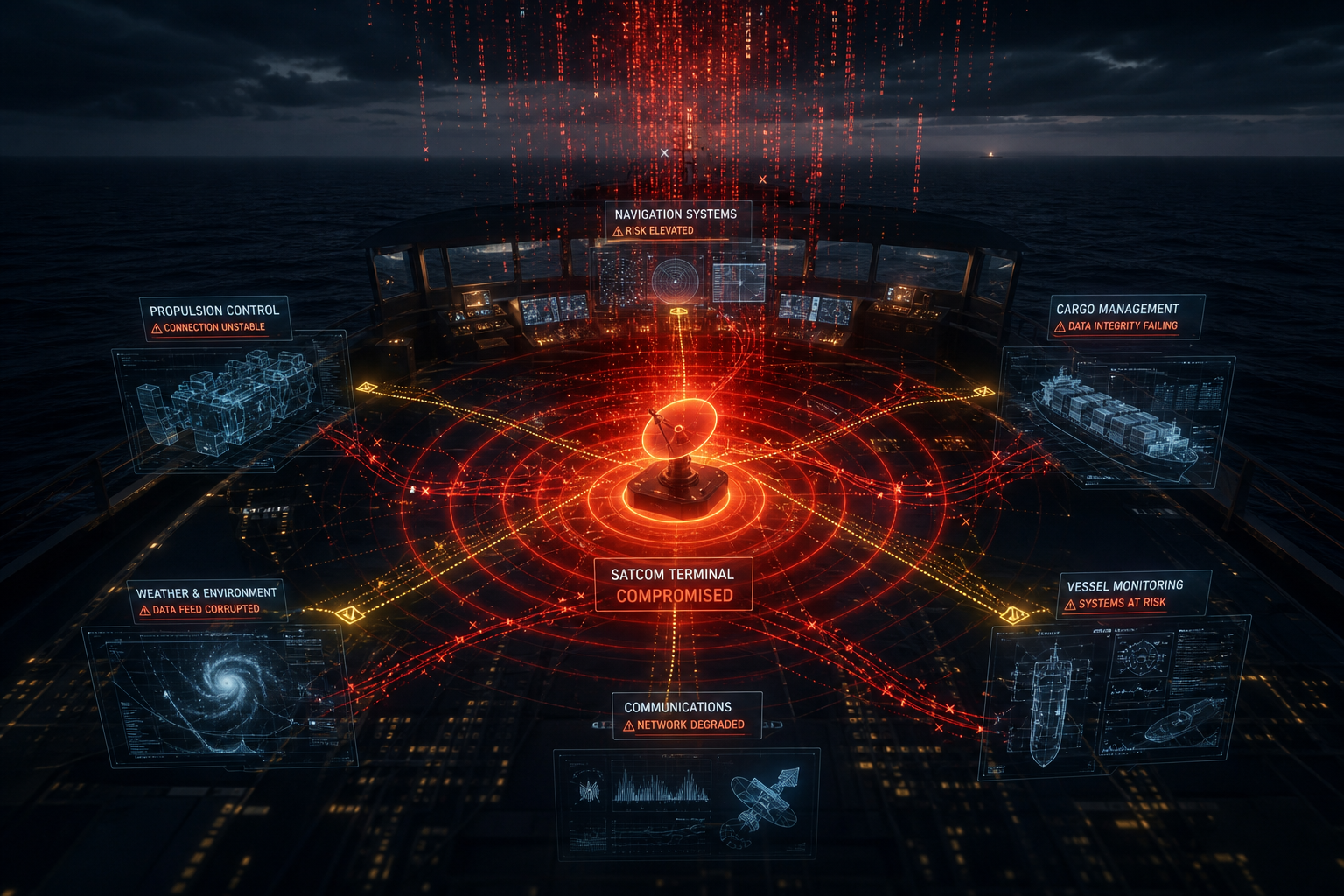
Short-Term (1-30 Days): The VSAT7090 terminal is not isolated; it integrates into vessel networks, creating vulnerability propagation pathways. Once attackers achieve code execution on the VSAT7090, vulnerability can propagate to dependent systems including Integrated Navigation Systems, bridge automation, propulsion control, and cargo management systems. Modern vessels increasingly implement centralized network architectures where bridge systems connect through shared network segments, enabling potential lateral movement from the VSAT7090 into other vessel systems. Vessel Management Systems represent secondary targets, as compromise could enable access to shore-based systems and fleet-wide operational data. Remote monitoring infrastructure creates additional propagation vectors if these systems are accessed through VSAT7090 connections.
Medium-Term (30-90 Days): Threat actor operational capability assessments suggest that VSAT7090 vulnerability accessibility means even opportunistic cybercriminals and maritime-focused threat actors can likely exploit this vulnerability within days of disclosure. Automated scanning and targeting capability is probable, enabling large-scale campaigns against multiple vessels simultaneously. State-sponsored operators possess additional capabilities and motivations, with military and intelligence services leveraging network-level access to maritime communications infrastructure as part of broader intelligence collection and asymmetric competition. Attribution complexity is significant due to remote exploitation capability and routing obfuscation possibilities. The remediation window during this period requires coordinated firmware update deployment, testing protocols, and operational scheduling around vessel positions and crew availability.
Long-Term (90+ Days): Strategic architectural redesign of maritime communication systems becomes necessary beyond vulnerability patching. Maritime communication systems were historically designed for operational reliability in isolated ocean environments, not for security in adversarial cyberspace. Organizations must develop comprehensive maritime cybersecurity architecture incorporating segmentation, zero-trust principles, and alternative communication redundancy. Institutional resilience requires moving beyond vulnerability-by-vulnerability patch management toward multi-year transformation programs. This redesign must balance operational safety, communications reliability, regulatory compliance, and cyber threat resilience. Long-term mitigation includes evaluation of alternative satellite communication providers with modern security architectures, establishment of dedicated Maritime Cybersecurity Operations Centers, and development of maritime-specific cybersecurity training and incident response capabilities.
Recommended Actions
Actions are organized by organizational security maturity. Baseline controls apply across all tiers and should be treated as immediate priorities regardless of organizational size.
* Organizations with standard security tooling and general-purpose endpoint protection.
- 1 - Complete a full inventory of VSAT7090 terminals across your fleet, identifying vessel name, terminal serial number, firmware version, and current network connectivity status. Contact Cobham SATCOM or your maritime IT vendor for asset discovery support if current inventory is incomplete.
- 2 - Issue immediate communication to all vessels operating VSAT7090 terminals, alerting bridge and IT personnel to heightened security awareness. Provide guidance on anomalous terminal behavior indicators including unexpected reboots, communication interruptions, and unexpected network traffic patterns.
- 3 - Establish escalation procedures where anomalies are reported to shore-based IT security teams rather than treated as standard technical issues. Activate backup communication procedures and verify all vessels understand manual communication protocols should VSAT7090 communication be disrupted.
- 4 - Verify communications redundancy and backup procedures. Ensure vessels have alternative communication pathways available if VSAT7090 communication is lost or compromised: backup satellite systems, high-frequency radio, or coastal cellular capability.
- 5 - Test backup communication systems weekly to ensure functionality and crew familiarity with activation procedures. Document all backup communication procedures in vessel security and emergency response plans.
- 6 - Contact Cobham SATCOM to obtain available firmware patches or advisories. Monitor CVE databases and vendor security bulletins for VSAT7090-specific remediation guidance. Develop a firmware update plan prioritizing vessels in contested maritime zones and high-risk shipping corridors.
- 7 - Establish a testing protocol where firmware updates are first deployed on a limited set of vessels to verify that updates do not cause operational disruptions before broad fleet deployment.
- 8 - If Cobham has not released patches within 30 days, implement compensating controls to reduce exploitation risk. Deploy input validation and command neutralization at the network edge, filtering command packets containing injection-prone syntax before they reach VSAT7090 terminals.
- 9 - Apply packet filtering signatures or intrusion prevention system rules specifically designed to block VSAT7090 exploitation attempts to all network access points adjacent to VSAT7090 terminals.
- 10 - Enable all available logging on VSAT7090 terminals, including command history, authentication attempts, network access patterns, and error logs. Configure centralized log collection so that terminal logs are collected to shore-based systems for archival and forensic analysis.
- 11 - Notify your marine insurance carriers immediately regarding VSAT7090 vulnerability exposure and your remediation plan. Determine whether insurance policies provide coverage for cybersecurity incidents affecting maritime communication systems.
- 12 - Contact your flag state maritime administration proactively, notifying them of VSAT7090 vulnerability exposure, your fleet's affected terminals, and your remediation timeline. Provide documentation of mitigation and remediation plans.
* Organizations with mature security operations and integrated threat monitoring capabilities.
- 1 - In addition to baseline inventory, implement network-layer access controls immediately. Deploy firewall rules or network access control lists restricting VSAT7090 terminal access to authorized networks only. If VSAT7090 terminals are internet-facing, implement segmentation immediately.
- 2 - Create a demilitarized zone network where VSAT7090 terminals reside, accessible only to authorized systems and services. This segmentation significantly reduces attack surface by limiting which systems can communicate with the terminal.
- 3 - Deploy network-based monitoring and anomaly detection specifically configured for VSAT7090 terminals. Configure logging at the network level to capture all traffic to and from VSAT7090 terminals.
- 4 - Establish baseline behavioral profiles for each terminal (expected traffic patterns, communication frequency, data volume) and configure alerts for baseline deviations.
- 5 - Ensure VSAT7090 monitoring is explicitly included in security operations center alert tuning and incident escalation procedures.
- 6 - If Cobham-provided patches are available, establish a controlled deployment schedule. Coordinate firmware update deployment with fleet operations scheduling, vessel positions, and crew availability.
- 7 - Establish out-of-band verification procedures to confirm firmware updates have been successfully applied. Use cryptographic signature verification to confirm all firmware updates originate from legitimate Cobham SATCOM sources.
- 8 - Implement secondary authentication mechanisms if available. Evaluate whether your terminals support out-of-band authentication or multi-factor authentication enhancements and implement these if available.
- 9 - Design and implement terminal network segmentation as a strategic architectural change. VSAT7090 terminals should not share network segments with bridge navigation systems, propulsion control, or cargo management systems.
- 10 - Create dedicated network zones where VSAT7090 terminals reside, with restricted communication channels to dependent systems. Use VLANs, physical network separation, or application-level gateways to enforce segmentation.
- 11 - Conduct comprehensive vulnerability assessments of your maritime communication infrastructure. Engage qualified maritime cybersecurity assessors to evaluate your entire communication network.
- 12 - Assess network architecture, identify dependencies, evaluate compensating controls, and recommend prioritized improvements.
- 13 - Communicate with customers regarding VSAT7090 vulnerability, your remediation plan, and timeline for deploying patches and compensating controls.
- 14 - Notify all vendors, logistics partners, and service providers depending on your vessel communication systems regarding VSAT7090 vulnerability. Coordinate remediation timelines to minimize supply chain disruption.
* Organizations with comprehensive security architecture, dedicated maritime cybersecurity capability, and strategic threat intelligence integration.
- 1 - In addition to intermediate controls, implement zero-trust maritime communication network architecture. Assume VSAT7090 terminals may be compromised and design systems as if no component can be trusted without explicit authentication and authorization.
- 2 - Implement gateway systems between VSAT7090 networks and operational systems, with policy-based access control enforcing that only explicitly authorized commands from terminals reach dependent systems.
- 3 - Use cryptographic authentication and integrity verification for all commands transiting between terminal and dependent systems.
- 4 - Evaluate alternative satellite communication providers and technologies as part of long-term risk mitigation. Assess newer satellite communication systems with modern security architectures, built-in encryption, authentication mechanisms, and vendor track records for security patch responsiveness.
- 5 - Develop a multi-year transition plan toward more secure communication platforms, beginning with new vessel acquisitions or scheduled VSAT7090 replacement cycles.
- 6 - Establish dedicated Maritime Cybersecurity Operations Centers for real-time threat monitoring and incident response. Develop expertise in maritime threat detection, incident response procedures optimized for maritime operations, and relationships with maritime authorities.
- 7 - Implement regular penetration testing and red team exercises specifically designed for maritime communication systems. Engage qualified maritime security assessment teams to conduct simulated attacks against your communication infrastructure.
- 8 - Include not only technical exploitation but also social engineering, physical security assessment, and operational procedure validation in red team exercises.
- 9 - Develop maritime cybersecurity training and awareness programs tailored to maritime operations. Develop training modules specific to maritime threat scenarios, communication system compromise, vessel network architecture, and incident response procedures.
- 10 - Ensure bridge officers, IT personnel, fleet operations teams, and shore-based leadership complete maritime-specific cybersecurity training.
- 11 - Establish relationships with maritime cybersecurity authorities, flag state maritime administrations, and incident response resources. Develop relationships and coordination procedures before incidents occur.
- 12 - Document regulatory reporting obligations, incident notification timelines, and points of contact for maritime security incidents.
- 13 - Escalate VSAT7090 vulnerability and remediation requirements to board-level risk management discussions. Ensure board-level awareness of operational and financial implications of inadequate remediation.
- 14 - Prepare comprehensive documentation of your VSAT7090 vulnerability assessment, mitigation measures, remediation plan, and deployment timeline for regulatory compliance verification and insurance claim substantiation.
Closing Statement
The VSAT7090 vulnerability represents a foundational exposure across global maritime infrastructure, exploitable through network access alone without authentication barriers. The criticality of the vulnerability, combined with distributed global VSAT7090 deployment, creates an immediate remediation imperative across maritime operations.
Organizations should understand this vulnerability not as a discrete technical issue but as an indicator of broader maritime cybersecurity architecture gaps. Maritime communication systems were historically designed for operational reliability in isolated ocean environments, not for security in adversarial cyberspace. Modern maritime operations increasingly integrate connectivity, digitalization, and network dependencies that expose vessels to cyber threats previously confined to land-based infrastructure.
Institutional resilience in maritime operations requires moving beyond vulnerability-by-vulnerability patch management toward comprehensive maritime cybersecurity architecture redesign. This redesign must balance operational safety, communications reliability, regulatory compliance, and cyber threat resilience. It requires cross-functional coordination between maritime operations, IT security, regulatory authorities, and risk management. It requires investment in capability development, training, and architectural transformation extending across multiple years and affecting every vessel in operation.
The 72-hour window for foundational mitigation, the 30-day window for substantive remediation, and the 180-day window for strategic architectural redesign represent distinct phases through which organizations must navigate. Each phase requires specific actions, resource commitments, and decision-making at different organizational levels. The VSAT7090 vulnerability, while technically discrete, demands institutional response integrating technical remediation, operational adaptation, regulatory compliance, and strategic planning.