Automating the Weak Link: Analyzing AI-Driven Security and Resilience Risks in Modern Supply Chains
Executive Summary
Global enterprises are deploying AI-driven automation across supply chain operations—demand forecasting, inventory optimization, logistics routing, and supplier assessment—at accelerating velocity. Over 60% of major enterprises now operate AI-driven supply chain systems, with deployment velocity increasing 35% year-over-year. However, security assessment and incident response capabilities lag by 12–18 months.
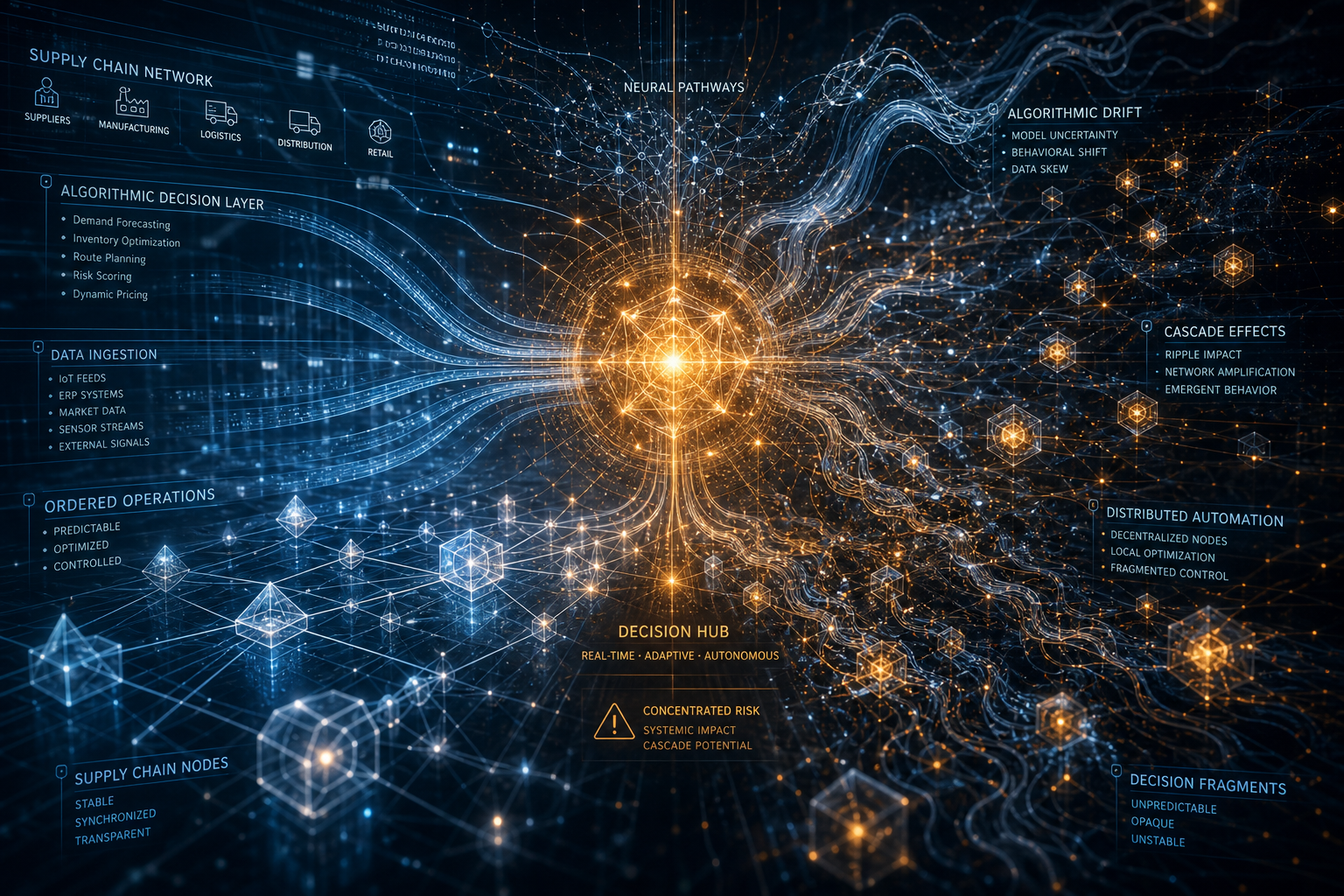
The central institutional risk lies not in algorithmic failure itself, but in the concentration of decision-making authority within opaque systems whose adversarial susceptibilities, failure modes, and cascade risks remain unmapped by enterprise frameworks designed for human-centric operations. This article establishes a decision-support framework for institutional resilience planning, distinguishing between point-of-failure risk reduction (achieved through distributed automation) and systemic cascade risk concentration (created simultaneously).
Immediate actionable guidance: Enterprises should immediately inventory all supply chain AI systems, establish real-time model monitoring and input validation controls, and recalibrate incident response procedures for autonomous decision scenarios within the next 90 days.
Key Finding: AI-driven supply chain automation exhibits fundamentally asymmetric security characteristics: while these systems reduce point-of-failure risks through distributed decision-making, they simultaneously concentrate institutional risk through algorithmic opacity, limited adversarial testing, and incident response architectures designed for human-initiated workflows rather than autonomous, cascading failures.
What Happened
The adoption of AI-driven automation in supply chain operations represents one of the fastest technology transitions in enterprise infrastructure. According to Gartner's Supply Chain Top 25 research (June 2026), over 60% of enterprise supply chain operations now incorporate AI-driven automation, with deployment velocity accelerating at 35% year-over-year between 2025 and 2026. This adoption spans North America and Western Europe (leading markets) with rapid acceleration across Asia-Pacific regions.
The technology stack comprises integrated ERP-AI modules, real-time predictive systems, and autonomous decision-making workflows deployed across hybrid cloud-on-premises architectures. The vendor ecosystem spans both legacy supply chain software providers enhanced with AI capabilities and specialized AI-native platforms. Critically, organizations are deploying these AI systems faster than their capacity to conduct comprehensive security and compliance assessments—a temporal misalignment that creates structural vulnerability across the enterprise landscape.
Operational transformation evidence is substantial. McKinsey's analysis of reverse logistics with AI integration documents efficiency gains of 25–40% in cost reduction, with real-time autonomous routing replacing human-managed exception handling. Organizations have shifted from reactive to predictive operational postures, with decisions now executing at algorithmic speed. This transformation has simultaneously reshaped workforce composition, concentrating strategic supply chain roles while reducing intermediate-level management positions historically responsible for exception handling and decision validation.
Institutional readiness, however, has demonstrably lagged deployment velocity. Both Gartner research and ongoing NIST AI security studies document security assessment capabilities trailing deployment by 12–18 months. Incident response procedures remain engineered for deterministic, human-initiated failures rather than algorithmic cascade scenarios. Vendor security validation remains insufficient, with limited third-party auditing of AI decision-making systems. This gap between deployment capability and security/compliance capability represents a structural condition embedded in current enterprise risk frameworks, not a temporary operational lag.
Why It Matters
Enterprise Supply Chain Leadership
Traditional supply chain risk frameworks were constructed around discrete point-of-failure modeling: supplier disruption, logistics failure, quality breakdown at specific nodes. These frameworks assume human decision-making with audit trails, deterministic failure modes, and rollback capability. AI-driven automation introduces a fundamentally different risk class: continuous, algorithmic decision-making whose failure modes are probabilistic, emergent, and context-dependent. A single compromised AI model can propagate decisions across multi-tier supply networks without human intervention checkpoints, creating cascade risks previously impossible in human-centric supply chains.
Compliance and Risk Functions
Algorithmic opacity concentrates institutional risk. Enterprise personnel operating AI supply chain systems lack meaningful interpretability of decision logic. Organizations cannot reliably detect behavioral drift, bias acceleration, or anomalous response to adversarial inputs. Compliance and audit frameworks are fundamentally misaligned with autonomous decision processes—organizations cannot verify whether algorithmic decisions align with policy or regulatory requirements. NIST AI Research Security and Resilience frameworks document this interpretability gap as a foundational institutional challenge.
Cybersecurity and IT Security Teams
Current vendor security practices focus on traditional cybersecurity domains—data breach prevention, access control, network segmentation. Insufficient attention addresses adversarial input scenarios, model poisoning attacks, or cascade failure propagation. No industry-standard methodology for AI supply chain penetration testing exists. This means critical vulnerabilities potentially remain undetected until operational activation, at which point propagation across dependent systems may have already occurred.
Incident Response Functions
Existing supply chain incident response procedures assume human-initiated decisions with manual rollback capability. AI systems may execute thousands of autonomous decisions before human detection of anomalies. A cascading failure—where algorithmic malfunction propagates across dependent AI systems and integrated human workflows—can advance far beyond detection and containment windows designed for discrete point failures.
Executive and Board Leadership
AI-driven supply chains introduce vulnerability classes with no precedent in traditional supply chain security, creating emergent attack surface categories including model poisoning, real-time inference manipulation, and supply chain dependency risks. WEF research identifies a counterintuitive institutional condition: AI-driven supply chains reduce point-of-failure risk through distributed automation while simultaneously increasing systemic cascade risk through algorithmic correlation and dependency concentration. The locus of single-point-of-failure risk has shifted from discrete suppliers or logistics nodes to shared algorithmic infrastructure.
Operational Implications
Immediate (0–4 Weeks): Organizations currently operate AI supply chain systems with insufficient monitoring and anomaly detection infrastructure. Model drift—unplanned performance degradation—can remain undetected for 2–4 weeks even with monitoring protocols in place, or 8+ weeks without detection systems. Demand forecast errors, suboptimal supplier selection, and inventory miscalibration propagate during these detection lag periods, creating operational costs and supply disruption. Adversarial input injection targeting logistics routing, inventory allocation, or procurement decisions can manifest operational impact within 24 hours, yet detection may lag 2–4 weeks.
Short-term (1–3 Months): Cascade failures originating in a single model can propagate across dependent forecasting and optimization systems within one hour, while root cause identification requires 24–48 hours. Supply chain operations teams currently lack interpretability training for AI platform behavior; IT security frameworks do not include AI model monitoring procedures; incident response playbooks omit AI-specific decision trees; third-party vendor assessment processes do not validate AI model security rigor; board oversight operates without AI risk-specific metrics. This represents a comprehensive governance gap across organizational layers—from operational teams to executive oversight.
Medium-term (3–12 Months): Consider demand forecast model degradation causing 25% systematic demand overestimation cascading into inventory overstock and supplier payment obligations. Current manual audit processes require 3–4 weeks for detection; remediation requires another 1–2 weeks. Alternatively, logistics routing model compromise via adversarial input causes systematic transportation cost sub-optimization, potentially providing attackers operational visibility or supplier influence. Current detection occurs only via supplier complaint; no proactive anomaly detection mechanism exists. These scenarios illustrate capability misalignment requiring real-time model performance monitoring, automated anomaly detection, and rapid decision override mechanisms—capabilities absent from most enterprise environments.
Strategic (12+ Months): A strategic paradox exists at the operations level. AI automation increases operational resilience through redundancy and distributed decision-making; simultaneously, it increases systemic fragility through algorithmic concentration and cascade risk. Enterprises have traded point-of-failure resilience (understood, distributed, human-managed) for systemic cascade risk (opaque, concentrated, autonomous). Institutional resilience profiles have shifted fundamentally without explicit strategic recalibration or governance adjustment. AI systems execute thousands of decisions before human awareness of failure conditions. Detection lag, decision scope expansion, and cascade propagation all accelerate beyond human intervention windows. Organizations currently lack decision containment procedures appropriate to autonomous systems, creating operational vulnerability windows measured in hours or days rather than the weeks traditional incident response assumes.
Recommended Actions
Actions are organized by organizational security maturity. Baseline controls apply across all tiers and should be treated as immediate priorities regardless of organizational size.
* Organizations must establish foundational risk visibility and assessment capabilities for all AI-driven supply chain systems.
- 1 - Catalog all AI models in production supply chain operations, documenting data lineage, decision scope, autonomy level, and business criticality; classify each model by external data dependency, vendor origin, and testing documentation. Complete 100% inventory within 45 days.
- 2 - Evaluate each AI model against decision autonomy level, business criticality, external data dependency, vendor security validation history, and testing rigor documentation. Produce risk assessment matrix identifying high-risk systems requiring immediate control implementation within 60 days.
- 3 - Request from all AI vendors: model testing documentation, third-party security assessment results, incident history, and adversarial testing results. Establish baseline vendor security posture and identify compliance gaps within 60 days.
- 4 - Map current incident response procedures against AI-specific failure scenarios (model drift, adversarial input injection, cascade failures). Develop AI-specific IR decision trees and amend procedures within 90 days.
- 5 - Evaluate supply chain team AI literacy, model interpretability understanding, and anomaly detection capability. Design and schedule training program within 90 days.
* Organizations must deploy monitoring, validation, and response infrastructure designed specifically for autonomous AI decision systems.
- 1 - Implement model performance dashboards tracking decision quality, prediction accuracy, and behavioral deviation from established baselines. Establish automated alerting for anomalies with <4-hour detection latency for all critical systems.
- 2 - Deploy data validation pipelines and rule-based input screening at model entry points. Implement statistical anomaly detection to identify potentially adversarial inputs with <1-hour response protocols.
- 3 - Enhance logging infrastructure for all autonomous decisions; implement model explainability tools (SHAP, LIME, or equivalent); establish comprehensive decision audit trails enabling 100% decision traceability.
- 4 - Establish third-party AI security validation standards; require annual model security testing; amend vendor security SLAs to include AI-specific requirements with 100% vendor compliance within 180 days.
- 5 - Develop and validate AI-specific IR playbooks; establish decision override protocols; implement automated model isolation capabilities. Train IR teams and validate procedures through simulation within 180 days.
* Organizations must establish redundancy, validation, and governance architectures that reduce single-model failure impact and systemic cascade risk.
- 1 - Implement multi-model decision validation using ensemble approaches; establish automated failover mechanisms for critical decisions. Reduce single-model failure impact by 60%+ through validation redundancy; maintain operational functionality when any single model fails.
- 2 - Build historical decision quality baselines across operational scenarios; establish alert sensitivity thresholds calibrated to organizational risk tolerance. Achieve <5% false positive rate with <24-hour detection latency for anomalies.
- 3 - Calibrate autonomous decision scope by criticality: high-criticality decisions require human review; medium-criticality trigger review on anomaly; low-criticality decisions execute with full autonomy. Implement clear approval procedures and override mechanisms reducing cascade risk by 50%+.
- 4 - Reduce dependency on single AI platform vendors; implement integration abstraction layer enabling vendor flexibility; conduct competitive vendor assessment. Achieve multi-vendor architecture supporting critical functions with <30% single-vendor failure impact.
- 5 - Establish structured training in AI literacy, anomaly detection, and model interpretability. Develop internal AI expertise; establish cross-functional AI governance council with representation from supply chain operations, IT security, risk, and compliance.
* Organizations must integrate AI governance into enterprise risk frameworks and establish industry-level standards and oversight.
- 1 - Develop AI-specific risk taxonomy integrated with NIST SP 800-161 Rev. 1 requirements; embed into enterprise supply chain risk framework; establish board-level risk metrics and reporting with standardized AI supply chain risk language.
- 2 - Establish vendor AI security validation standard based on NIST AI Risk Management Framework; implement continuous monitoring requirements; integrate into procurement SLAs and vendor renewal processes with industry adoption achieved.
- 3 - Develop AI-specific risk dashboards; establish model performance and failure metrics; implement quarterly executive reporting on AI supply chain risk posture and incident activity. Enable executive decision-making incorporating AI risk visibility.
- 4 - Engage regulatory bodies on AI supply chain risk guidance; participate in industry working groups; contribute to emerging regulatory frameworks. Shape policy environment and anticipate compliance requirements.
- 5 - Conduct multi-stakeholder AI supply chain risk simulation exercises; establish industry resilience benchmarks; develop collaborative risk mitigation strategies. Achieve industry-wide resilience visibility and initiate collaborative risk reduction.
Closing Statement
AI-driven supply chain automation represents genuine operational advancement—efficiency gains, predictive capability, and decision velocity improvements are substantial and strategically valuable. Yet this article's central insight persists: institutional risk has shifted rather than diminished. Enterprises have exchanged comprehensible, distributed, human-centric supply chain risk for opaque, concentrated, autonomous algorithmic risk. Neither is inherently superior; both demand different institutional competencies and governance approaches.
The gap between current enterprise capability and the demands of algorithmic supply chain governance represents the true strategic vulnerability. Organizations that systematically address this gap through risk visibility, control architecture development, and workforce capability building will not eliminate AI supply chain risk—they will manage it with institutional intention. Those that treat AI automation as a 'plug and play' operational improvement will discover that opaque systems, when they fail, do so at algorithmic scale and across interconnected dependencies.
The question facing supply chain leadership is not whether to deploy AI—competitive velocity and operational necessity have largely answered that question—but rather how to govern autonomous decision-making with the same rigor enterprises have historically applied to human operational authority. Bridging this capability gap over the next 18 months will determine whether AI-driven supply chains become sources of institutional resilience or concentration risk.